The best B2B paid media agencies share one discipline that separates them from a generalist marketing agency: they tie every dollar of paid media to qualified pipeline, not lead volume. For SaaS and technology companies with long, complex sales cycles, the wrong marketing agency fills a dashboard with cheap leads that never close, while the right paid media agency delivers demos, qualified pipeline, and revenue the sales team can actually work. This guide profiles 11 B2B paid media agencies, with the channels each one runs, the pipeline they can prove, the pricing model they use, and the type of technology company each is built for.
We wrote this for founders, demand generation leads, and marketing teams at B2B technology companies who already know that a paid media agency is a growth engine, not a line item. Whether you need Google Ads and LinkedIn Ads managed, an account based marketing program built, or a full demand generation motion across paid search and paid social, the B2B marketing agencies below cover what technology companies actually hire for in 2026.
At a glance: the best B2B paid media agencies
| Marketing agency | Best for | Core channels | B2B strength | Certifications |
|---|---|---|---|---|
| MarketinGO | Pipeline-focused B2B paid media | Google Ads, LinkedIn, Microsoft, Meta | Lower cost per lead, real pipeline | Google Partner, Meta Business Partner |
| HawkSEM | Paid search specialists for SaaS | Google Ads, Microsoft, paid social | PPC depth and demos | Google Premier Partner |
| KlientBoost | Paid media plus landing pages | Google, LinkedIn, Microsoft, Meta | PPC and conversion rate | Google Partner |
| Directive | Full-funnel B2B customer generation | Paid media, LinkedIn, SEO, content | Pipeline attribution | LinkedIn certified |
| Gripped | B2B SaaS demand generation (UK) | Google Ads, LinkedIn, paid social | Post-PMF SaaS scaling | Google Partner |
| Refine Labs | Demand generation strategy | Paid social, LinkedIn, YouTube | Demand creation | Strategy-led |
| Single Grain | Content and paid blended | SEO, content, Google, LinkedIn | Integrated growth | Google Partner |
| New North | Full-service for smaller tech teams | Google, LinkedIn, content, ABM | SMB tech breadth | None listed |
| Ironpaper | ABM and demand generation | LinkedIn, content, HubSpot | Account based marketing | HubSpot Diamond |
| Walker Sands | PR-led integrated marketing | PR, paid media, content, SEO | Brand and pipeline | Google, Microsoft |
| Siege Media | Content and SEO (organic counterweight) | Content, SEO, digital PR | Organic growth | Content specialist |
Use the table to scan, then read the profiles below, because a grid cannot capture how each marketing agency actually works and where it stops.
How we selected these B2B marketing agencies
Any list of the best B2B paid media agencies is only as trustworthy as its criteria, so here is exactly how we built this one.
Verified pipeline results. Every marketing agency here has at least one named B2B client result published on its own site or a reputable third party. B2B marketing is full of vanity metrics, so where a figure could not be independently confirmed, it is attributed to the agency rather than stated as fact. The strongest case studies show pipeline contribution and revenue outcomes, not lead volume.
Specialization depth. Paid media for technology companies rewards focus. We weighted paid media agencies that run Google Ads, LinkedIn Ads, and Microsoft Ads for B2B every day over a full service marketing agency that treats paid media as one line item beside web development and PR. A paid media agency that lives inside the ad accounts of SaaS companies will usually outperform a digital marketing agency that dabbles.
Certifications you can check. Google Partner and Premier Partner status is verifiable in Google's public directory, and we note who holds it and who could not be confirmed. Platform certifications matter for B2B marketing agencies because they signal spend under management and a track record on the channels that drive demand generation for technology companies.
Honest limitations. Each profile states who the marketing agency is not built for. A high enterprise minimum is a strength for one technology company and a dealbreaker for another. The best B2B marketing agencies for an enterprise with a $50k deal size are rarely the best fit for an early-stage SaaS company.
Fit to the buyer. The right paid media agency depends on your stage, deal size, and sales cycles. The decision framework near the end maps common situations to specific names, so you can compare B2B marketing agencies against your own reality.
What B2B paid media agencies actually do
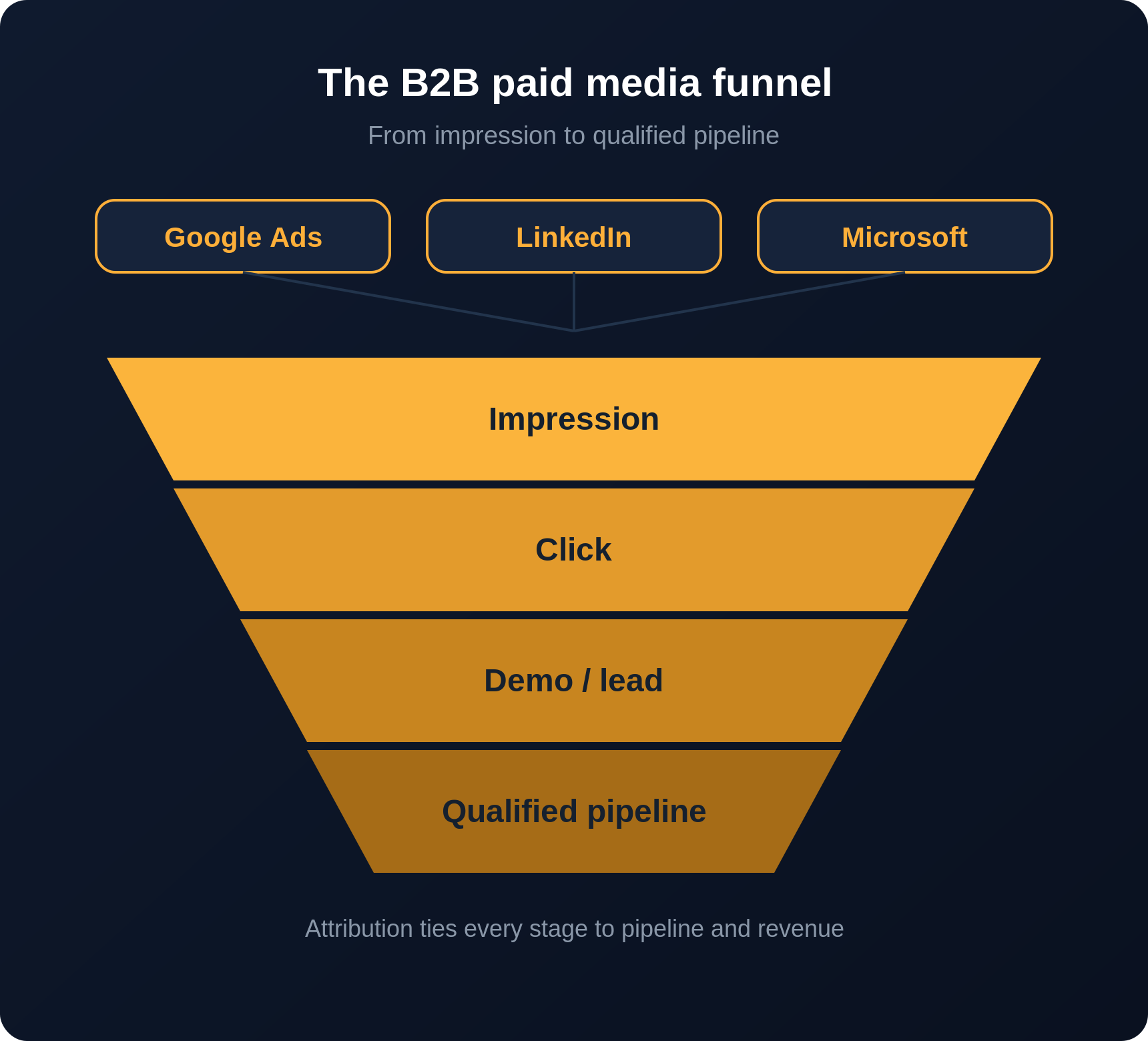
Before comparing names, it helps to be precise about the service, because B2B paid media is a different craft from consumer advertising. A B2B paid media agency plans and runs paid advertising for technology companies with the goal of qualified pipeline, and the good ones treat the whole journey, from first impression through multi stakeholder sales cycles, as their responsibility. In practice that usually means Google Ads for high-intent capture and LinkedIn Ads for reaching named roles and accounts, run as one system rather than two disconnected channels.
Channel strategy and campaign architecture. A strong paid media agency starts with account structure: separating branded from non-branded paid search, mapping campaigns to buying stages, and choosing the two or three channels that fit your motion. For most technology companies that means Google Ads for capture, LinkedIn Ads for precise targeting of decision makers, and Microsoft Ads for cheaper incremental demand. Getting this architecture right is where a good marketing agency earns its fee.
Demand generation, not just lead capture. The best B2B marketing agencies balance demand generation with demand capture. Demand generation creates awareness and future pipeline through paid social and content promotion, while paid search captures the intent that demand gen creates. A paid media agency that only runs bottom-of-funnel paid search will plateau, because it harvests demand without creating any.
Account based marketing. For enterprise deals, account based marketing focuses paid media on a defined list of high-value accounts. A capable marketing agency runs account based marketing across LinkedIn Ads and programmatic, coordinating ads with the sales team so the same accounts see consistent messaging. ABM is where B2B paid media and the sales process meet.
Attribution and pipeline reporting. B2B marketing must connect activity to revenue outcomes across long sales cycles and multiple stakeholders. A serious paid media agency sets up clean tracking and reports on qualified pipeline and pipeline contribution, not lead volume. This is the single biggest difference between a paid media agency that renews and one that gets fired: the ability to show revenue, not clicks.
Landing pages and conversion rate. Finally, the strongest paid media agencies treat landing pages and conversion rate as part of the media buy. Great ad accounts sending traffic to weak pages waste budget, so the best B2B marketing agencies either optimize your landing pages or build new ones tied to each campaign.
The 2026 B2B paid media market
Three shifts are reshaping how technology companies buy paid media this year, and each one changes what a good marketing agency looks like.
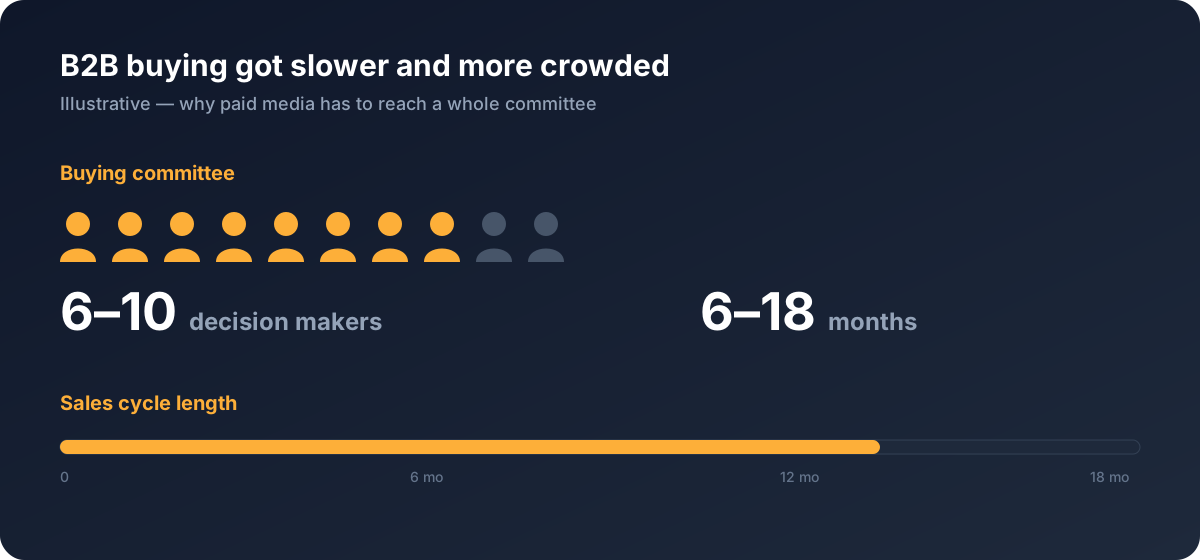
Buying committees keep growing, and sales cycles keep stretching. B2B buyers now take 6 to 18 months to decide, and a typical purchase involves six to ten decision makers. That means paid media cannot chase a single lead; it has to reach and influence a whole committee across long sales cycles. The best B2B marketing agencies design for multi stakeholder sales cycles rather than a single conversion.
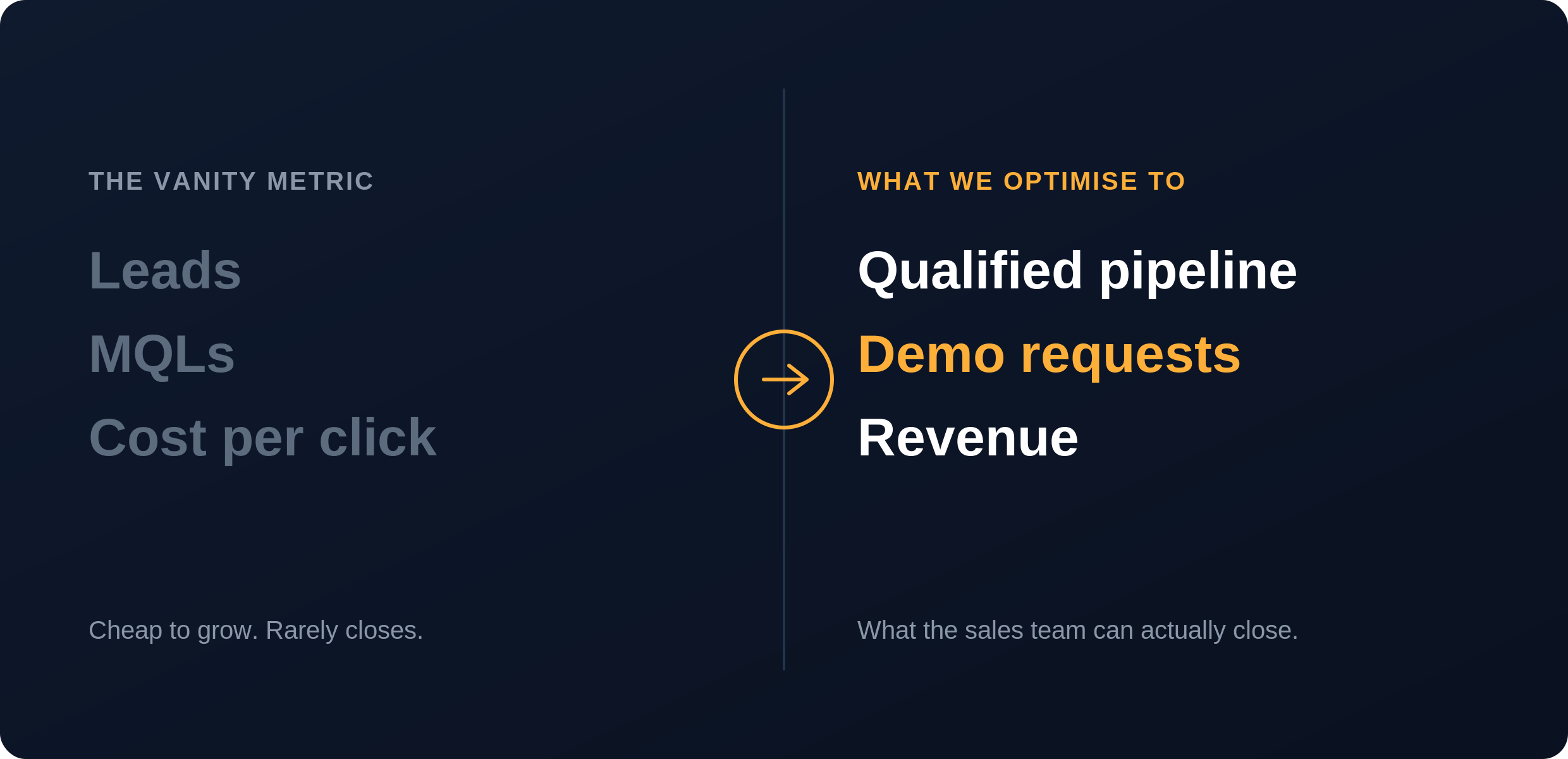
Pipeline is replacing lead volume as the metric. Technology companies have learned that MQLs are a poor proxy for revenue, so the market is moving toward pipeline contribution and revenue outcomes. A modern paid media agency reports on qualified pipeline and revenue, and a marketing agency still selling on lead volume is behind. This shift rewards paid media agencies that can connect marketing activity to closed revenue.
Demand generation and AI search are converging. Technology companies increasingly win by combining paid demand generation with strong organic and content marketing, and buyers now research inside AI search as well as Google. The strongest B2B marketing agencies coordinate paid media with content marketing and generative engine optimization, so a technology company shows up whether the buyer uses paid search, organic search, or an AI assistant. Paid media is the fast engine; content marketing and organic growth compound alongside it.
With the craft and the market defined, here are the eleven B2B marketing agencies, starting with our pick for pipeline-focused paid media.
MarketinGO 1. MarketinGO: best for pipeline-focused B2B paid media
Founded: 2020 · HQ: remote, serving the US and Europe · Team: ~10 specialists · Website: marketingo.com
MarketinGO is a B2B paid media agency for US and European technology companies that want qualified pipeline, not a bigger lead count. Where a full service marketing agency spreads attention across web development, PR, and content, MarketinGO stays focused on paid media, runs the two or three highest-impact channels together, and is known for going live fast, often within about a week of kickoff.
What they do. Paid search, paid social, LinkedIn Ads, and Microsoft Ads for B2B lead generation, backed by conversion tracking and landing page work that ties spend to pipeline. MarketinGO runs Google Ads, LinkedIn, Meta, and Microsoft as one system with shared audiences and unified attribution, so demand generation and demand capture reinforce each other. Because the team is paid media only, every account sits with senior operators rather than being spread thin across a dozen service lines.
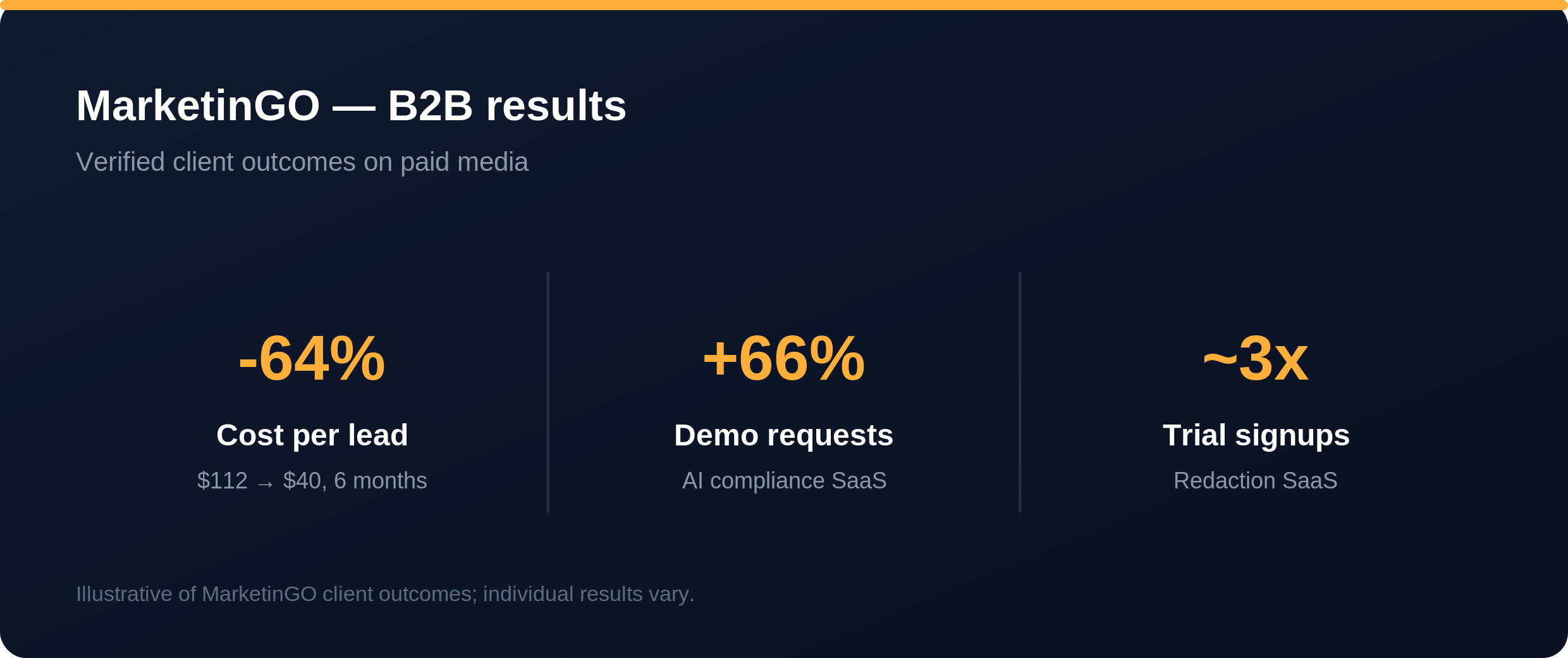
Verifiable results. For a regulatory-compliance company, MarketinGO cut cost per lead 64%, from $112 to $40.25, adding 557 high-value leads and 27% more traffic while spending $4,000 less over six months. For an AI compliance SaaS company, a lean Google Ads and LinkedIn Ads launch grew demo requests 66%, reaching 10 qualified demos per month with no increase in budget. For a document-redaction SaaS company, the team roughly tripled trial signups and cut cost per trial about 58%, then added Microsoft Ads as a second high-intent channel. And for a digital forensics firm, MarketinGO grew traffic 73% and leads 43% while trimming $500,000 in wasted ad spend.
Ideal fit. SaaS and technology companies, high-ticket B2B services, and multi-location service businesses that want a paid media agency optimizing to qualified pipeline, fast execution, and fluency with the US market. Clients praise the responsiveness: one founder describes generating leads at $35 to $45 each at 1,000 to 1,200 leads per month, and being live within a week. Because the same team also runs DTC ecommerce, technology companies with a self-serve motion alongside sales-led deals can keep both under one roof.
Where it stops. MarketinGO is paid media only. Technology companies that want SEO, content marketing, PR, or web development handled in-house should pair MarketinGO with a specialist for those. It is a paid media agency, not a full service marketing agency, and that focus is the point.
Certifications: Google Partner and Meta Business Partner. Pricing. A managed monthly engagement, shared transparently on a discovery call, matched to your pipeline goals.
HawkSEM 2. HawkSEM: best for paid search specialists serving SaaS
Founded: 2006 · HQ: Los Angeles, CA · Team: ~80 · Website: hawksem.com
HawkSEM is a true paid media specialist that started as a paid search shop and still leads with Google Ads. For technology companies that want deep PPC expertise and clean demo generation, it is one of the strongest options on this list.
What they do. Paid search and PPC across Google Ads and Microsoft Ads, paid social, remarketing, and conversion rate work, with SEO as a secondary add-on. HawkSEM runs paid media for both B2B and B2C, and its proprietary reporting keeps campaigns tied to conversions.
Verifiable results. For B2B SaaS company Zephyr, HawkSEM doubled lead volume and cut cost per acquisition roughly 80%, from $300 to $50. For Datadog, it grew sales demos 75% and reduced cost per acquisition 40%.
Ideal fit. SaaS and technology companies that want a paid search specialist with verifiable B2B results and top-tier Google credentials.
Where it stops. Very early-stage or tiny budgets, complex multi-touch account based marketing programs, and buyers wanting a content or PR-led marketing agency. HawkSEM serves both B2B and ecommerce, so it is not a B2B-only shop.
Certifications: Google Premier Partner (top 3%), Microsoft Advertising Partner, and Meta Business Partner. Pricing. Quote-based; third-party estimates put management around $5,000 to $15,000 per month.
KlientBoost 3. KlientBoost: best for paid media paired with landing pages
Founded: 2015 · HQ: Costa Mesa, CA · Team: ~100 · Website: klientboost.com
KlientBoost is a performance marketing agency that bundles paid media with in-house landing page design and conversion rate work, so campaigns and their destinations are built together.
What they do. PPC across Google Ads, Microsoft Ads, Meta, and LinkedIn Ads, plus landing page design and CRO. The practice serves B2B and SaaS as well as ecommerce, and its signature is fast creative and landing page iteration tied to paid media performance.
Verifiable results. KlientBoost publishes more than 300 case studies and 400-plus Clutch reviews. Reported B2B results include cost per acquisition reductions and pipeline growth for SaaS clients, though some figures sit on third-party pages rather than named case studies.
Ideal fit. Technology companies that want paid media and landing pages from one marketing agency and value rapid testing across both.
Where it stops. Very small budgets, and buyers wanting brand strategy, PR, or demand-creation. KlientBoost is a generalist performance shop across ecommerce, SaaS, and lead generation rather than a B2B-only agency.
Certifications: Google Partner, Microsoft Advertising Partner, and Meta Business Partner. Pricing. Publicly states a $10,000 per month minimum marketing spend; fees quote-based.
Directive 4. Directive: best for full-funnel B2B customer generation
Founded: 2014 · HQ: Irvine, CA · Team: ~200 · Website: directiveconsulting.com
Directive is a full-funnel B2B marketing agency built around what it calls customer generation, blending paid media with SEO, content, and RevOps. It is paid-media-capable, but sells an integrated methodology rather than pure PPC.
What they do. Paid media, LinkedIn Ads, programmatic, and performance creative, combined with content marketing, SEO, and revenue operations, all aimed at pipeline attribution for SaaS and technology companies.
Verifiable results. For SentinelOne, Directive drove a 251% increase in digital leads and a 159% increase in organic traffic across a multi-channel program. For dbt, its first paid campaign reportedly exceeded growth goals by nearly 2x.
Ideal fit. Mid-market to enterprise B2B SaaS and tech firms that want paid media inside a broader, attribution-led demand generation program.
Where it stops. Early-stage SMBs and sub-$10,000 budgets, and buyers wanting a lean single-channel paid search shop. Directive is a full-funnel marketing agency, so a technology company that only needs Google Ads managed will pay for capability it will not use.
Certifications: LinkedIn Ads certified agency; Google Premier tier not independently confirmed. Pricing. No public rate card; third-party estimates around $10,000 to $25,000 per month with multi-month minimums.
Gripped 5. Gripped: best for B2B SaaS demand generation in the UK
Founded: 2017 · HQ: London, UK · Team: ~30 · Website: gripped.io
Gripped is a B2B SaaS and technology demand generation agency with genuine paid media depth, aimed at post-product-market-fit companies that want to scale pipeline.
What they do. Paid search, paid social, and LinkedIn Ads, plus demand generation, account based marketing, SEO, and generative engine optimization. Gripped manages Google Ads, LinkedIn Ads, Reddit, display, and retargeting for SaaS and tech firms.
Verifiable results. For Blackdot Solutions, Gripped generated £2.1M in pipeline from demand generation in a year, growing from 3 to more than 50 leads per month. It also reports a £1.3M quarterly pipeline for Crownpeak from paid search and paid social.
Ideal fit. Post-PMF B2B SaaS companies, roughly £2M to £50M ARR, that want full-funnel demand generation with real paid media depth, especially in the UK and Europe.
Where it stops. Pre-seed or pre-product-market-fit companies, which Gripped explicitly excludes, and buyers wanting a Microsoft Ads specialist. Pricing is in GBP and the practice is a full-funnel demand generation agency rather than a pure paid media shop.
Certifications: Google Partner and HubSpot Partner. Pricing. Published tiers from £3,500 per month, with performance engagements from £7,500 and full demand generation from £15,000.
Refine Labs 6. Refine Labs: best for demand generation strategy
Founded: 2019 · HQ: Boston, MA · Team: ~50 · Website: refinelabs.com
Refine Labs is a demand generation strategy agency known for demand creation and a paid social-heavy approach. It is a strategy-led marketing agency more than a paid search specialist.
What they do. Demand strategy consulting, content and creative, and paid media management across LinkedIn, Google, YouTube, Meta, and Reddit, deliberately weighting budget toward demand creation over demand capture.
Verifiable results. Across a cohort of 20 B2B SaaS clients, Refine Labs reported a median 76% increase in its proprietary pipeline metric over six months. Note that it reports in that custom metric rather than standard cost per lead or SQLs.
Ideal fit. Mid-market and enterprise B2B SaaS companies that want a demand generation philosophy and are ready to invest in demand creation, not just lead capture.
Where it stops. SMBs and small budgets, buyers wanting classic PPC and cost per lead performance, and technology companies that need clean last-click attribution, which the Refine Labs thesis deliberately downplays.
Certifications: Not positioned as a certified-partner shop. Pricing. No public numbers; third-party estimates around $15,000 to $40,000 per month with longer commitments.
Single Grain 7. Single Grain: best for content and paid media blended
Founded: 2014 · HQ: Los Angeles, CA · Team: ~45 · Website: singlegrain.com
Single Grain is a content and SEO-led digital marketing agency with a genuine paid arm, best known for combining organic growth with paid media and AI-search optimization.
What they do. SEO and content marketing, conversion rate work, and paid media across Google Ads, Meta, LinkedIn Ads, and YouTube. Its center of gravity is content and search, with paid media as a complementary channel.
Verifiable results. For Nextiva, Single Grain reduced cost per lead 41% year over year on Google Ads. Its content and SEO work has driven large organic traffic gains and AI-search visibility for other clients.
Ideal fit. Technology companies that want integrated content marketing, SEO, and paid media from one digital marketing agency rather than a paid-media specialist.
Where it stops. Buyers wanting deep, dedicated B2B paid media specialization, and B2B-only focus, since Single Grain also serves ecommerce and other sectors.
Certifications: Reported Google Partner; Premier tier not confirmed on Google's directory. Pricing. No rate card; intake spans small to enterprise budgets, with third-party estimates around a $10,000 minimum.
New North 8. New North: best for full-service marketing for smaller tech teams
Founded: 2008 · HQ: Frederick, MD · Team: ~30 · Website: newnorth.com
New North is a full-service B2B technology marketing agency built for small, in-house tech teams that want an outsourced marketing function rather than a paid-media specialist.
What they do. Branding, content marketing, account based marketing, marketing operations, and sales enablement, plus paid media across Google Ads, Meta, and LinkedIn. It does not offer Microsoft Ads or a dedicated paid search sub-practice.
Verifiable results. For fintech client Swipesum, New North reports saving $5,400 from fraudulent clicks in three months, increasing conversions 500%, and cutting ad spend 17%, focusing on efficiency rather than pipeline volume.
Ideal fit. Lean SMB technology companies that want a full-service marketing agency to run the whole function, on US Eastern time.
Where it stops. Buyers wanting a dedicated search ads or LinkedIn Ads performance shop, Microsoft Ads coverage, or enterprise-scale programs. New North is a generalist marketing agency, not a paid media specialist.
Certifications: None listed; do not assume partner status. Pricing. Publicly stated at $6,000 to $15,000 per month.
Ironpaper 9. Ironpaper: best for account based marketing and demand generation
Founded: 2003 · HQ: New York, NY · Team: ~70 · Website: ironpaper.com
Ironpaper is a B2B demand generation and account based marketing agency built around content and HubSpot. Paid media is a minor, mostly LinkedIn, part of the mix.
What they do. Demand generation, account based marketing, inbound and content marketing, B2B SEO, website and CRO, and marketing automation. The only meaningful paid channel is LinkedIn paid social for content distribution.
Verifiable results. For insurtech client Solartis, Ironpaper increased MQLs 86% over six months and generated 10 SQLs in a single month, alongside large organic search-ranking gains.
Ideal fit. Complex, long-cycle B2B technology companies that want account based marketing, content, and a HubSpot-centric demand generation program.
Where it stops. Buyers wanting a paid media or search campaigns performance specialist, and transactional or very early-stage companies. Ironpaper is a content and ABM marketing agency, not a paid media shop.
Certifications: HubSpot Diamond Partner and Databox Premier Partner; self-stated Google Partner not independently confirmed. Pricing. No public list; third-party estimates around $10,000 per month.
Walker Sands 10. Walker Sands: best for PR-led integrated marketing
Founded: 2001 · HQ: Chicago, IL · Team: ~200 · Website: walkersands.com
Walker Sands is a PR-led, full-service B2B marketing agency with a real paid media practice sitting inside a broader public relations, brand, and demand bundle.
What they do. Strategic communications and PR as the flagship, plus creative, content marketing, SEO, and a digital marketing practice covering search ads, paid social, programmatic, and content syndication. It targets enterprise and global B2B technology companies.
Verifiable results. For Sendbird, Walker Sands ran a paid program that drove 4,028 MQLs, influenced 342 opportunities worth $6.4M in pipeline, and sourced 250 opportunities worth $2.5M, alongside a 54% lift in organic traffic.
Ideal fit. Enterprise technology companies that want PR, brand, and category creation with paid media coordinated alongside it.
Where it stops. Buyers wanting a dedicated paid media performance shop, and early-stage SaaS or SMBs, since Walker Sands is enterprise-priced and PR-heavy.
Certifications: Google and Microsoft platform partners; specific tier not stated. Pricing. No public list; third-party estimates from under $10,000 per month for light engagements up to $30,000 or more for full programs.
Siege Media 11. Siege Media: best for content and SEO as the organic counterweight
Founded: 2012 · HQ: Austin, TX · Team: ~110 · Website: siegemedia.com
Siege Media is a content, SEO, and digital PR agency, included here as the organic counterweight to paid media. It runs no paid search, paid social, or account based marketing at all.
What they do. Content strategy and creation, SEO, generative engine optimization, digital PR, and link building. Siege Media is the option for technology companies that want to build organic growth alongside whatever paid media agency they hire.
Verifiable results. For Zapier, Siege Media reports adding $7.2M in blog traffic value and growing organic traffic 290% over two years. For Zendesk, it reports growing organic blog traffic 657%.
Ideal fit. Technology companies that want a dedicated content marketing and SEO partner to compound organic growth while a separate paid media agency drives immediate pipeline.
Where it stops. Any paid media need, since Siege Media offers none. Results are a long-game organic play, not cost per lead, demos, or qualified pipeline on a paid timeline.
Certifications: Content and SEO specialist; no paid-media partner status, and none expected. Pricing. Clutch minimum project around $5,000; content and digital PR programs scale from there.
How to choose the right B2B paid media agency
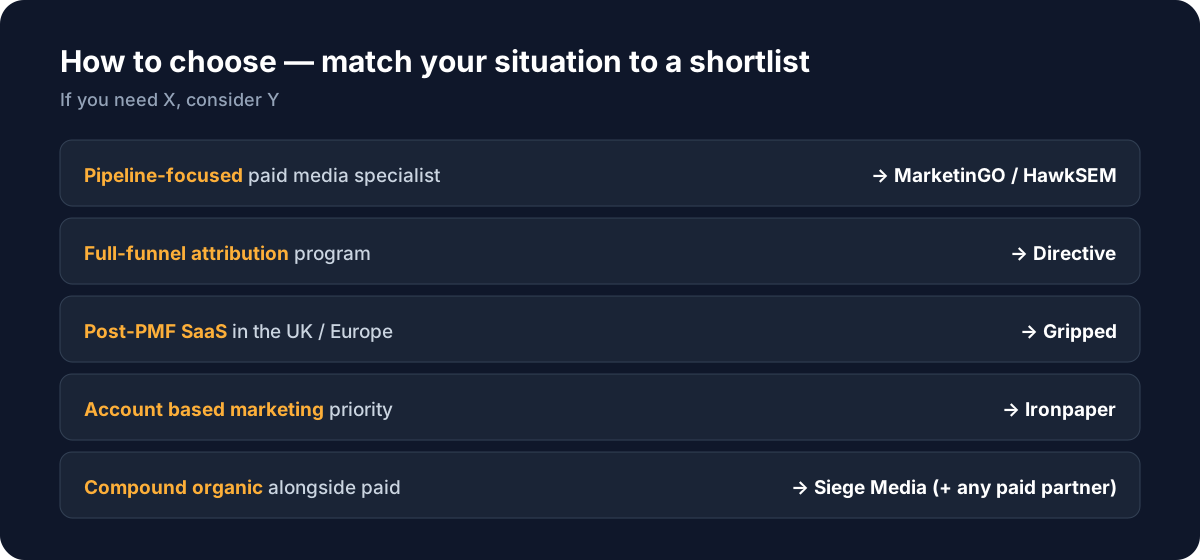
Every marketing agency above is credible; the question is fit. Use these conditional recommendations to match your situation to a name, then compare B2B marketing agencies on a call rather than a sales deck.
If you want a pipeline-focused paid media specialist, start with MarketinGO or HawkSEM, both of which optimize to qualified pipeline and demos rather than lead volume.
If your landing pages are the bottleneck, KlientBoost builds paid media and conversion pages together.
If you want paid media inside a full-funnel attribution program, Directive is built for it.
If you are a post-PMF SaaS company in the UK or Europe, Gripped combines demand generation with real paid media depth.
If you believe in demand creation over lead capture, Refine Labs leads with that philosophy.
If you want content marketing and paid media blended, Single Grain covers both.
If you are a small tech team wanting an outsourced marketing function, New North runs the whole thing.
If account based marketing is your priority, Ironpaper is a content and ABM specialist.
If you need PR and brand alongside paid media, Walker Sands leads with communications.
If you want to compound organic growth beside your paid media, pair any paid media agency with Siege Media for content and SEO.
What B2B paid media agencies charge
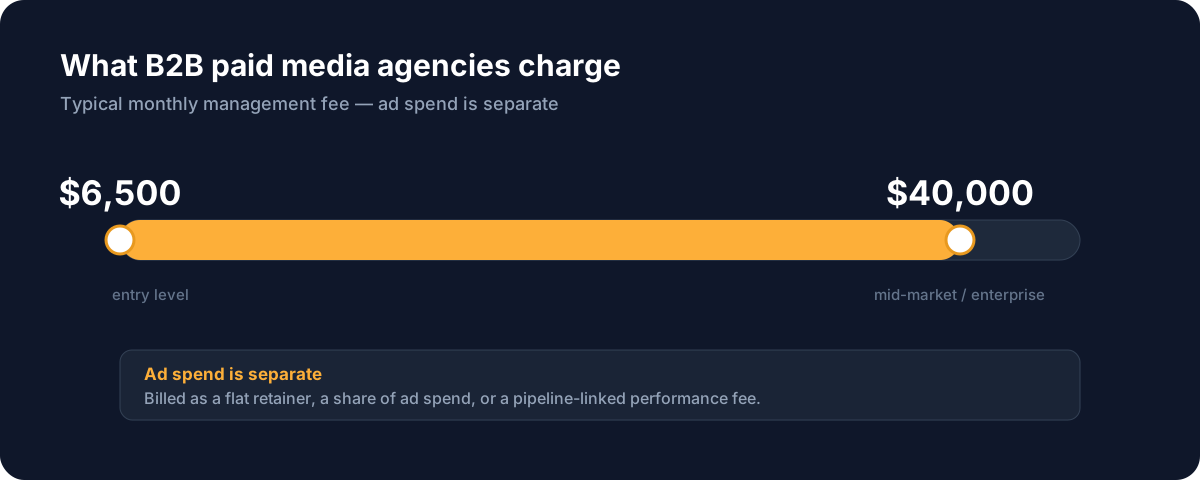
Pricing for B2B marketing agencies is opaque, so here is the shape of the market. Most B2B agencies charge between $6,500 and $10,000 per month at the entry level, with mid-market and enterprise paid channels programs running $15,000 to $40,000 per month or more. Marketing agencies bill in one of three ways: a flat monthly retainer, a percentage of ad spend, or a performance-based fee tied to pipeline. Ad spend is separate from the management fee.
Two points matter when you compare B2B marketing agencies. First, a percentage-of-spend model can misalign incentives, since the marketing agency earns more when you spend more, whether or not the extra spend drives qualified pipeline. A flat fee or a pipeline-linked model avoids that. Before you judge any quote, it is worth knowing what a retainer has to return to pay for itself: our lead generation ROI calculator works that out from your own close rate and deal size. Second, the cheapest paid media agency is rarely the best value for a technology company with long sales cycles; senior attention, clean attribution, and pipeline-focused reporting matter more than a low retainer. Judge the marketing agency on the pipeline it can defensibly move, not the invoice alone.
B2B media buying versus demand generation versus content marketing
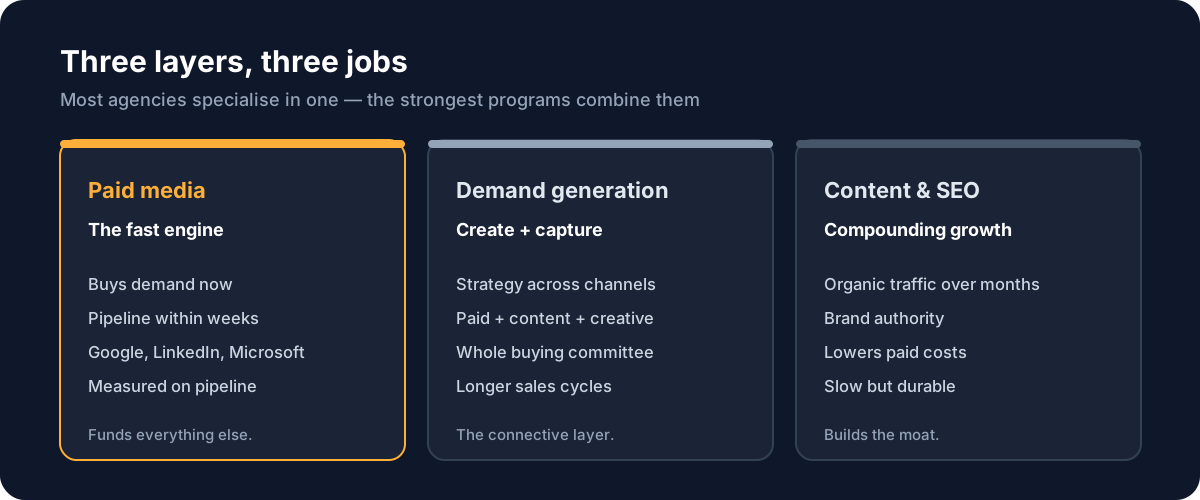
Buyers often blur these three, so it helps to separate them. Paid advertising is the fast engine: a paid media agency buys demand through search ads and paid social and can move qualified pipeline within weeks. Demand generation is broader, a strategy that combines paid campaigns, content, and creative to create and capture demand across long sales cycles. Content marketing and SEO are the compounding layer, building organic growth, brand authority, and website traffic over months.
The reason this matters when you choose a marketing agency is that many B2B marketing agencies specialize in one of the three and imply they cover all. A content marketing agency like Siege Media builds organic growth but runs no media buying. A demand generation agency like Refine Labs leads with strategy and demand creation. A pure paid programs agency like MarketinGO or HawkSEM drives pipeline through paid channels and stays in that lane. The strongest B2B programs usually combine a focused paid advertising agency for immediate pipeline with a content marketing or SEO partner for compounding organic growth, and a technology company gets the best result when each layer is run by a team that actually specializes in it rather than a generalist marketing agency that dabbles in all three.
For most technology companies, the practical sequence is to get paid channels right first, because it produces measurable qualified pipeline quickly and funds everything else, then layer in content marketing and demand generation so the whole program compounds. A paid media agency that reports honestly on pipeline contribution, and that tells you where it stops, is worth more than a full service marketing agency that promises the entire funnel and specializes in none of it.
Questions to ask before you sign
A short, sharp set of questions reveals more than any pitch. Ask a prospective paid media agency: who specifically will manage my account, and how senior are they? How do you structure Google Ads and LinkedIn Ads for a technology company like mine? How do you set up attribution and report on pipeline, not lead counts? How do you handle landing pages and conversion rate? Can I see two B2B case studies in my category with verifiable pipeline numbers, and speak to those clients? Clear, specific answers signal a marketing agency that will treat your budget like its own and measure the right outcome.
B2B paid media agencies versus full-service marketing agencies
One of the first choices a technology company faces is whether to hire a focused paid media agency or a broad full service marketing agency. Both models appear on this list, and the right answer depends on where your gap is.
A full service marketing agency bundles paid advertising with digital marketing, content strategy, marketing automation, sales enablement, and often PR, so a technology company gets one vendor across multiple channels. Advertising agencies of this type suit companies that lack an internal marketing team and want an outsourced function. The trade-off is depth: when a marketing agency spreads across web development, content strategy, and marketing automation, its paid channels bench is often thinner than a specialist's.
A specialist paid media agency does the opposite. It goes deep on Google Ads, LinkedIn Ads, and Microsoft Ads, and leaves content strategy, technical SEO, and marketing automation to partners who specialize in those. For a technology company whose main constraint is pipeline from paid channels, this focus usually pays off, because the senior people stay inside the ad accounts rather than juggling a full digital marketing strategy.
The B2B marketing agencies in the middle, the full-funnel demand generation shops, try to combine both, pairing media buying with content, SEO, and marketing automation under one roof. That works well for SaaS companies that want a single partner for demand generation, provided the paid programs practice is genuinely strong and not just a line item beside sales enablement and content strategy. When you compare B2B marketing agencies, press on this point: is paid activity a core competency, or one of a dozen services?
Where B2B paid advertising fits in a wider digital marketing strategy
Paid channels rarely works alone, so it helps to see where a paid media agency sits inside a full digital marketing strategy for a technology company. Media buying buys immediate, measurable pipeline, while the rest of your digital marketing builds the durable assets that make that pipeline cheaper over time.
A complete B2B marketing strategy usually blends paid and organic. A paid programs agency drives pipeline now through search campaigns and paid social, while content marketing and content strategy grow organic traffic and brand authority over months, technical SEO improves discoverability, and marketing automation nurtures leads across long sales cycles. Some technology companies buy all of this from one full service marketing agency; others assemble a bench, using a focused paid activity agency for demand capture and separate partners for content strategy, technical SEO, social media marketing, and marketing automation.
For most technology companies, the practical version is simple. Your paid advertising agency owns search ads, paid social, and account based marketing, and reports on pipeline. A content marketing or SEO partner grows organic growth and website traffic, handling content strategy and technical SEO. Marketing automation and sales enablement connect the two, so a lead generated by paid channels is nurtured and passed cleanly to the sales team. The point of the wider digital marketing strategy is that every layer feeds the others: strong content strategy and organic growth lower paid campaigns costs, while media buying data sharpens the whole plan.
This is also where social media marketing and demand generation meet. Organic social media marketing builds audience and brand authority, while social ads within your demand generation program turns that audience into pipeline. A technology company gets the best result when a paid programs agency runs the paid side and a content or social team runs the organic side, rather than one generalist marketing agency doing both at half depth.
Performance marketing and demand gen for SaaS and tech firms
The phrase performance marketing gets used loosely, so it is worth defining for B2B. Performance marketing means paid activity held accountable to a measurable outcome, in B2B that outcome is real pipeline, not clicks. A performance marketing agency for SaaS companies structures every campaign around pipeline and revenue, and a marketing agency that cannot tie performance marketing to pipeline is really selling traffic.
Demand gen is the broader discipline that performance marketing lives inside. Demand gen combines paid advertising, content, and creative across multiple channels to create and capture demand, and for technology companies with long sales cycles, demand gen produces higher quality pipeline than chasing cheap qualified leads. The best B2B marketing agencies run demand gen as a system: social ads campaigns and content create demand, SEM campaigns captures it, and marketing automation nurtures the qualified leads that are not yet ready to buy.
For SaaS companies specifically, demand gen and performance marketing have to account for two motions at once, a self-serve trial motion and a sales-led motion, often selling to the same buyer. A capable paid media agency runs performance marketing across multiple channels for both, sending trial intent to a fast signup path and enterprise intent to a demo request, then measuring each on the right outcome. Technology companies in professional services, fintech, and cybersecurity all share this pattern of complex, multi-stakeholder buying, which is why demand gen for these companies rewards a marketing agency that understands the sales process, not just the ad platforms.
The takeaway for technology companies is to treat performance marketing and demand gen as one connected motion across multiple channels, run by a paid media agency that reports on pipeline. Professional services firms and SaaS companies alike waste budget when they buy isolated qualified leads instead of a demand gen program that produces pipeline the sales team can actually close.
Red flags when comparing B2B marketing agencies
A few patterns should give a technology company pause. Be wary of a marketing agency that leads with MQLs, clicks, or lead counts rather than closed pipeline, since those numbers rise without helping revenue. Be cautious of a full service marketing agency that cannot tell you who runs your media buying day to day, or that shows content strategy and PR case studies when you asked about search campaigns and demand gen. And treat a percentage-of-spend-only model with care, because it rewards the marketing agency for spending more whether or not the spend drives pipeline. The best B2B paid programs agencies talk about your deal size and sales cycles before they quote a plan.
A B2B digital marketing strategy checklist
When a technology company reviews a proposal, it helps to check that the digital marketing strategy on offer actually covers what B2B growth needs, because thin scopes hide gaps. A complete digital marketing strategy for a technology company sets out how paid activity, content, and data work together, not just which ads will run.
Start with the digital strategy itself. A strong digital strategy names the two or three channels that fit your motion, the buyer and buying committee you are targeting, and the pipeline goal, before any budget is spent. A marketing agency that cannot articulate a clear digital strategy in plain language, and instead lists every service it sells, is not offering a digital marketing strategy so much as a menu.
Next, confirm how the digital marketing strategy handles measurement. Good digital marketing ties spend to pipeline, so ask how attribution is set up and how results are reported across long sales cycles. This is the part of digital marketing that separates a real growth program from activity, and it is where many B2B marketing agencies are weakest.
Then check the supporting layers. A durable digital marketing strategy pairs paid advertising with content, technical SEO, and marketing automation, so the leads paid channels generates are nurtured rather than lost. You do not need one marketing agency to run all of it, but the digital strategy should say who owns each layer and how they connect. For most technology companies, a focused paid media agency plus a content or SEO partner is a cleaner digital marketing strategy than a single generalist trying to do everything.
Finally, make sure the digital strategy is honest about time. Media buying produces pipeline quickly, while the content and organic parts of a digital marketing strategy compound over months. A marketing agency that promises overnight organic results is overselling, and a digital marketing strategy that expects paid programs to carry the entire load forever is fragile. The strongest digital marketing strategy funds fast pipeline with paid activity while the slower layers build.
Paid advertising for professional services and other B2B verticals
Not every buyer of B2B paid channels is a software company, and the craft shifts by vertical. Professional services firms, in consulting, accounting, law, and staffing, run high-ticket, relationship-led sales, so paid campaigns for professional services is about generating a small number of high-value conversations rather than a flood of cheap leads. A marketing agency serving professional services has to respect long, trust-based sales cycles and a buying committee that behaves differently from a SaaS trial user.
For professional services firms, LinkedIn Ads and search tend to carry the load, because the goal is reaching a specific decision maker at a specific type of firm. A paid media agency that understands professional services will build tight targeting, lead with credibility and expertise rather than discounts, and measure success by qualified conversations and pipeline, not raw lead numbers. The same discipline applies to other high-consideration B2B verticals such as fintech, cybersecurity, and industrial technology, where the deal is large and the sales cycle is long.
This is why fit to vertical matters when a technology company or professional services firm compares B2B marketing agencies. An agency that has run paid programs for professional services and complex B2B buyers will recognize the pattern faster than a generalist. When you shortlist, ask the marketing agency for case studies in your vertical, whether that is SaaS, professional services, or another high-ticket B2B category, and confirm the pipeline results are real. Paid activity rewards specialists who know the buyer, and both technology companies and professional services firms get more pipeline from a paid advertising agency that has done the work in their world before.
How B2B marketing agencies package their services
It helps to understand how B2B marketing agencies structure what they sell, because the packaging tells you where their strength really is. Most agencies fall into one of three shapes, and reading the shape saves you from a mismatch.
The first shape is the specialist. These advertising agencies sell a narrow set of marketing services, usually paid media and conversion work, and go deep. An agency focused this way will describe its marketing services in terms of channels and pipeline, not a sprawling menu, and that focus is a signal of depth.
The second shape is the full-funnel demand generation agency. These B2B marketing agencies package paid media, content, and data into integrated demand generation programs, selling marketing services as one connected motion across multiple channels and multiple stakeholders. When the paid advertising inside that package is genuinely strong, integrated demand generation is powerful, because a single team coordinates the buying committee's whole experience. The risk is that some agencies label a thin paid practice as integrated demand generation to win a bigger retainer.
The third shape is the generalist or content marketing agency. Here the marketing services span branding, content, PR, and web, with paid channels as a minor line. A content marketing agency is the right call when your gap is organic growth and brand authority, but it is the wrong call when you need pipeline from paid channels fast. Most agencies of this type are honest about the split if you ask directly.
When you compare B2B marketing agencies, name the shape you actually need. A technology company whose constraint is pipeline should favor a specialist or a demand generation agency with real paid depth over a content marketing agency. The marketing programs that produce pipeline reliably are the ones run by teams whose marketing services are built around media buying, with content and brand as partners rather than afterthoughts.
Making your shortlist
You do not need to interview all eleven B2B marketing agencies. Use the decision framework to pick two or three whose strengths match your stage, deal size, and sales cycles, then run the same short set of questions past each and ask for verifiable pipeline case studies in your category. The right marketing agency will talk about your buying committee and revenue before your budget, explain how it structures Google Ads and LinkedIn Ads for a technology company like yours, and be candid about what it does not do. That combination of senior attention, pipeline focus, and honesty is what separates a paid media hire that funds itself from marketing programs that quietly drain budget.
If pipeline-focused, fast-moving B2B paid advertising across Google, LinkedIn, Microsoft, and Meta is what your technology company needs, MarketinGO is built for exactly that, and a short discovery call will tell you quickly whether it is the right fit.
The bottom line
For a technology company, the choice of a B2B paid media agency comes down to a simple test: does the agency measure itself by pipeline and revenue, or by leads and clicks? The eleven agencies here span true paid media specialists, full-funnel pipeline generation shops, and content and PR-led marketing agencies, and the best fit depends on your stage, deal size, and sales cycles. Shortlist the two or three whose strengths match your situation, ask each for verifiable pipeline results in your category, and choose the team that treats your budget like its own. Paid media is the fastest, most measurable growth lever a B2B technology company has, and in the right hands it funds everything else.

B2B pipeline metrics, briefly
Because B2B buyers judge agencies on the wrong numbers so often, here is a quick glossary of the metrics that actually matter. Cost per lead is the price of a single captured contact, useful as an input but a weak measure of success on its own. Cost per opportunity, or cost per SQL, is the price of a sales-qualified opportunity, a far better signal because it reflects lead quality. Pipeline contribution is the total value of opportunities that a channel influenced or sourced, and it is the number a strong agency reports on. MQL, the marketing-qualified lead, is falling out of fashion precisely because it counts interest rather than intent. Buying committee size explains why B2B is hard: with six to ten people involved, no single click closes a deal. And revenue, finally, is the only metric that pays the bills, which is why the best agencies work backward from it. Ask any prospective partner which of these it reports on, and you will learn quickly whether it thinks like an operator or a vendor.