The best Google Shopping agencies for ecommerce win on the parts of the channel most buyers never see: a clean product feed, a Merchant Center that stays approved, and Performance Max campaigns structured to bid harder on the products that actually make money. Google Shopping puts your products in front of high-intent shoppers at the moment they are comparing options, but the platform rewards the store whose data is best organized, which is why the agency managing your feed and bidding decides whether Shopping ads return 3x or 8x on the same catalog. This guide profiles 11 Google Shopping agencies, with the feed and Performance Max approach each runs, the results it can prove, the pricing model it uses, and the type of ecommerce brand each is built for.
We wrote it for founders and marketing leads at online stores who are choosing a Google Shopping ads agency for the first time, or already spending on Shopping campaigns and unsure their current agency is doing the feed work that separates a profitable account from an expensive one. Whether you want a pure Google Shopping specialist, a paid media team that runs Shopping alongside search and Meta, or a full-service partner that can rebuild the storefront too, the agencies below cover what ecommerce companies actually hire for in 2026.
At a glance: the best Google Shopping agencies for ecommerce
| Agency | Best for | Core channels | Shopping strength | Certifications |
|---|---|---|---|---|
| MarketinGO | Profitable Shopping scaling | Google, Meta, Microsoft, LinkedIn | Feed discipline, profit focus | Google Partner, Meta Business Partner |
| Bidnamic | Technology-led Shopping | Google Shopping, PMax | SKU-level bidding | Google Partner |
| ZATO Marketing | Senior specialist-run Shopping | Google Shopping, PMax, Microsoft | Merchant Center depth | Google Partner |
| Inflow | Mid-market with senior strategists | Google Shopping, Amazon, paid social | Shopping specialization | Premier Partner |
| OuterBox | Shopping plus a storefront rebuild | Google Shopping, Amazon, web | Feed management and web | Premier Partner |
| Tinuiti | Enterprise commerce media | Google, Amazon, CTV | Scale and measurement | Google Premier Partner |
| Disruptive Advertising | Shopping paired with CRO | Google, Microsoft, Meta | Conversion testing | Google Partner |
| KlientBoost | Shopping with landing pages | Google, Meta, Microsoft | Creative and CRO | Google Premier Partner |
| Elumynt | Profit-first ecommerce scaling | Google, Meta, Shopping | Margin-based bidding | Google Partner |
| Common Thread Collective | DTC scaling across Meta and Google | Meta, Google | Forecasting and creative | Meta partner |
| Thrive | Full-service with marketplace reach | Google, Amazon, Walmart | Breadth over depth | Google Partner |
Use the table to scan, then read the profiles, because a grid cannot show how each agency actually manages a Google Shopping account and where it stops.
How we selected these Google Shopping agencies
Any list of the best Google Shopping agencies is only as good as its criteria, so here is how this one was built.
Verified results. Every agency here has at least one named client result published on its own site or a reputable source. Shopping ads marketing is full of round-number claims, so where a figure could not be independently confirmed, it is attributed to the agency rather than stated as fact, and short-window or older numbers are flagged.
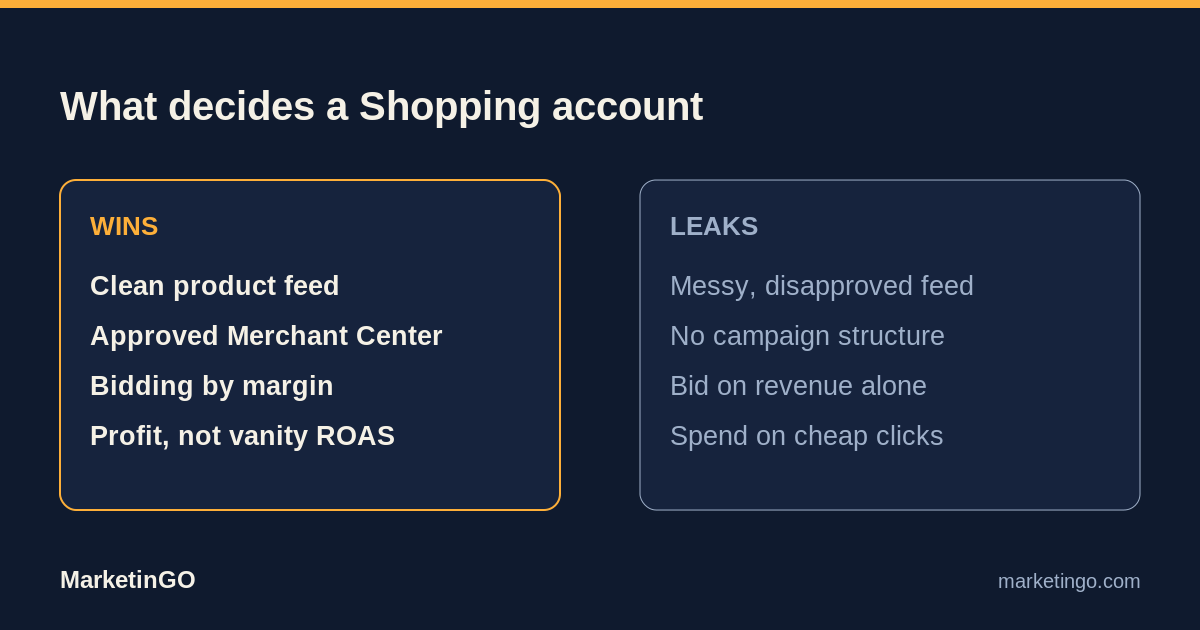
Feed and Merchant Center depth, not just bidding. Google Shopping success starts in the product data, so agencies that treat feed management and Merchant Center health as core work were weighted above shops that only touch bids. A specialist who fixes product titles, resolves disapprovals, and structures the feed for margin will beat a generalist who leaves the data alone.
Performance Max discipline. Most Shopping spend now runs through Performance Max, which hides placement and search-term detail by default. The agencies that stand out impose structure on PMax with asset groups, custom labels, and standard Shopping where it belongs, rather than handing the budget to the algorithm and hoping.
Profit, not vanity ROAS. A high return on ad spend on a discounted bestseller can still lose money once margin and returns are counted. The stronger agencies report on profitability and new-customer revenue, and each profile notes which think that way.
Fit to the store. A single-product DTC brand and a 40,000-SKU catalog need different partners. The decision framework near the end maps common situations to names.
What a Google Shopping agency actually does
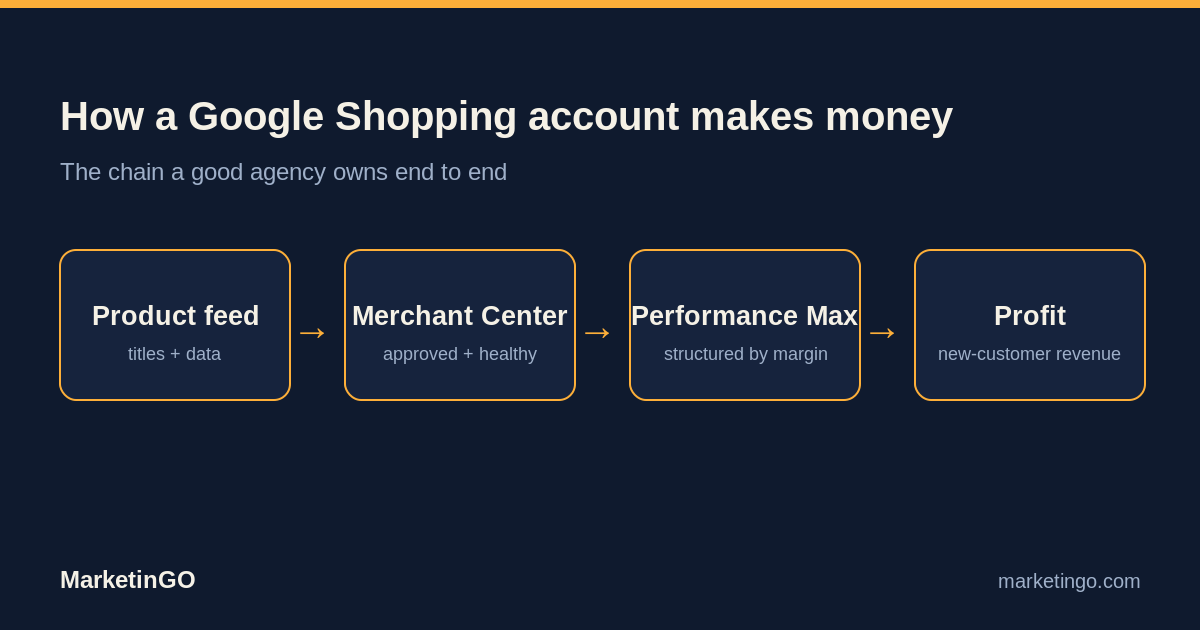
Before comparing names, it helps to be precise about the work, because Google Shopping is a distinct craft with more moving parts than a text search campaign. A Google Shopping agency plans and runs your Shopping ads and Performance Max campaigns with the goal of profitable revenue, and the good ones own the whole chain, from the product data in your store to the bid on each SKU.
Product feed and Merchant Center. Google Shopping ads are built from your product feed, not keywords, so the feed is where an agency earns its fee. A strong team optimizes product titles and descriptions, fixes attributes and product data, keeps the Google Merchant Center account approved, and resolves disapprovals fast, because a disapproved feed means the ads simply stop. This shopping feed management runs from the initial Merchant Center setup through ongoing title and description optimization, since a product feed is never truly finished. Feed optimization is the single highest-impact task in the channel, and the agencies that skip it leave revenue on the table.
Campaign structure and Performance Max. Once the data feed is clean, the agency decides how to run it. That means structuring Performance Max asset groups, deciding which products belong in a standard Shopping campaign for control, and using custom labels to separate high-margin winners from low-margin filler. Loose structure is where most Shopping budgets leak, since the algorithm will happily spend on cheap clicks that never convert to profit.
Bidding and budget by margin. Smart bidding optimizes to the target you give it, so an agency that feeds it revenue alone will scale unprofitable products. The better approach ties bids and budget to margin and new-customer value through custom labels and conversion values, so the account pushes spend toward the SKUs that actually make money.
Conversion tracking and measurement. Accurate conversion tracking, offline conversion imports, and clean product data let bidding optimize to real outcomes rather than form fills or inflated last-click revenue. With signal loss tightening across every channel, this measurement work is now core to the job, and it is what lets an agency report on profit rather than platform ROAS.
Reporting and the wider account. Reaching shoppers is only half the work. The best agencies report on profitability, new-customer revenue, and cost of Google Shopping per order, and many run Shopping alongside search ads, Microsoft Ads, and Meta so the channels reinforce each other rather than compete for the same buyer.
The 2026 Google Shopping market
Three shifts are reshaping how ecommerce companies buy Google Shopping this year, and each changes what a good agency looks like.
Performance Max is now the default, and structure is the edge. Most Shopping spend runs through Performance Max, and Tinuiti's 2025 benchmark data shows PMax and standard Shopping now perform within a few points of each other for the median advertiser, with sales per click for PMax about 5% higher but cost per click roughly 7% higher, leaving ROAS close to even. The takeaway is that PMax is no longer a free lift, so the agencies that win are the ones imposing structure on it rather than trusting the black box. Feed-based product ads account for the majority of PMax spend in a well-run ecommerce account, which is exactly why feed work matters more, not less, under Performance Max.
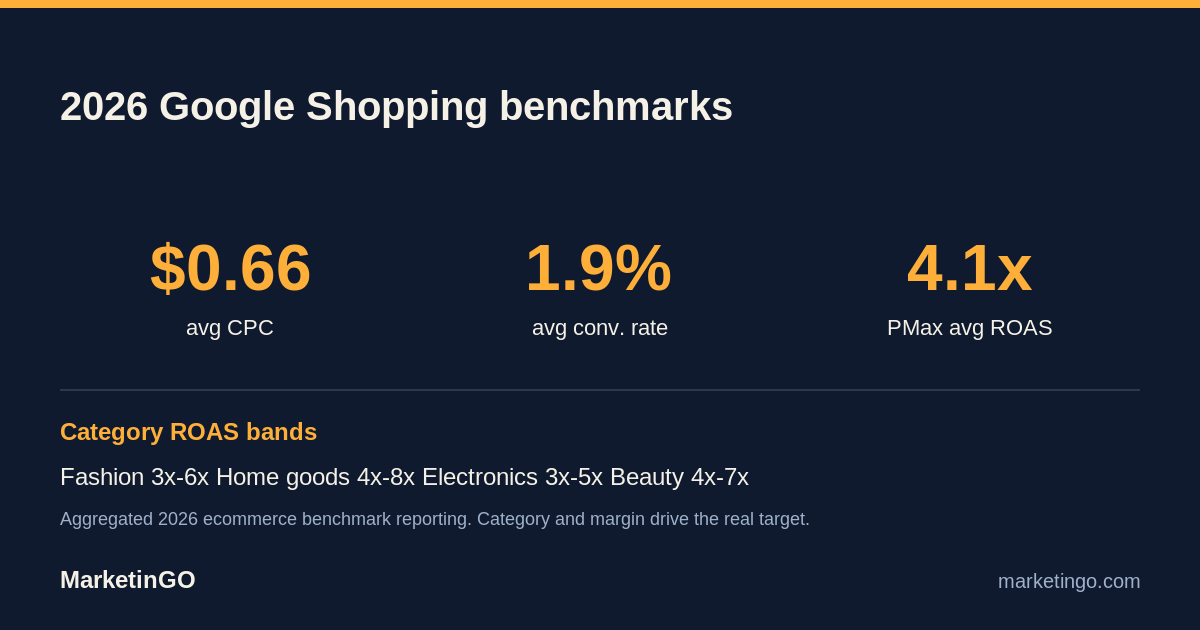
Benchmarks are tight, so waste is expensive. Google Shopping in 2026 runs an average cost per click near $0.66 and an average conversion rate around 1.9%, with Performance Max averaging roughly a 2.4% conversion rate and a 4.1x ROAS across ecommerce, according to aggregated benchmark reporting. Category matters more than any single number: fashion and apparel commonly see 3x to 6x ROAS, home goods 4x to 8x, and electronics a tighter 3x to 5x. Accounts with fewer than 30 to 50 conversions a month rarely give smart bidding enough signal to optimize, so at low volume the feed and structure carry even more of the load.
Feed quality and Comparison Shopping Services move the numbers. Feed optimization produces a measurable lift in Shopping ROAS within the first month for most catalogs, because better product titles and attributes win more relevant impressions at a lower cost per click. In the UK and Europe, running through a Comparison Shopping Service, or CSS, can also cut the effective cost of Google Shopping clicks, which is one more lever a specialist agency uses and a generalist often ignores. The stores that treat their product data as a growth asset, not a one-time upload, compound the advantage while competitors keep bidding on a messy feed.
With the craft and the market defined, here are the eleven agencies, starting with the pick for profitable Shopping scaling.
MarketinGO 1. MarketinGO: best for profitable Google Shopping scaling across Google and Meta
Founded: 2020 · HQ: remote, serving the US and Europe · Team: ~10 specialists · Website: marketingo.com
MarketinGO is a paid media agency for US and European ecommerce brands that want revenue growth without watching margin disappear. Where many Google Shopping agencies chase a headline ROAS to renew a contract, MarketinGO optimizes to profit, and the team is known for going live fast, often within about a week, with senior operators on the account who treat the product feed as the first place to find money.
What they do. Google Shopping and Performance Max management, paid search, and paid social across Google Ads, Microsoft Ads, and Meta, backed by feed optimization, conversion tracking, and landing page work that ties ad spend to revenue. MarketinGO cleans and structures the product feed in Google Merchant Center, uses custom labels to bid by margin, and decides which SKUs belong in Performance Max versus standard Shopping campaigns so the account pushes budget toward profitable products. Because the team is paid media only, every Shopping account sits with an experienced buyer rather than a rotating junior.
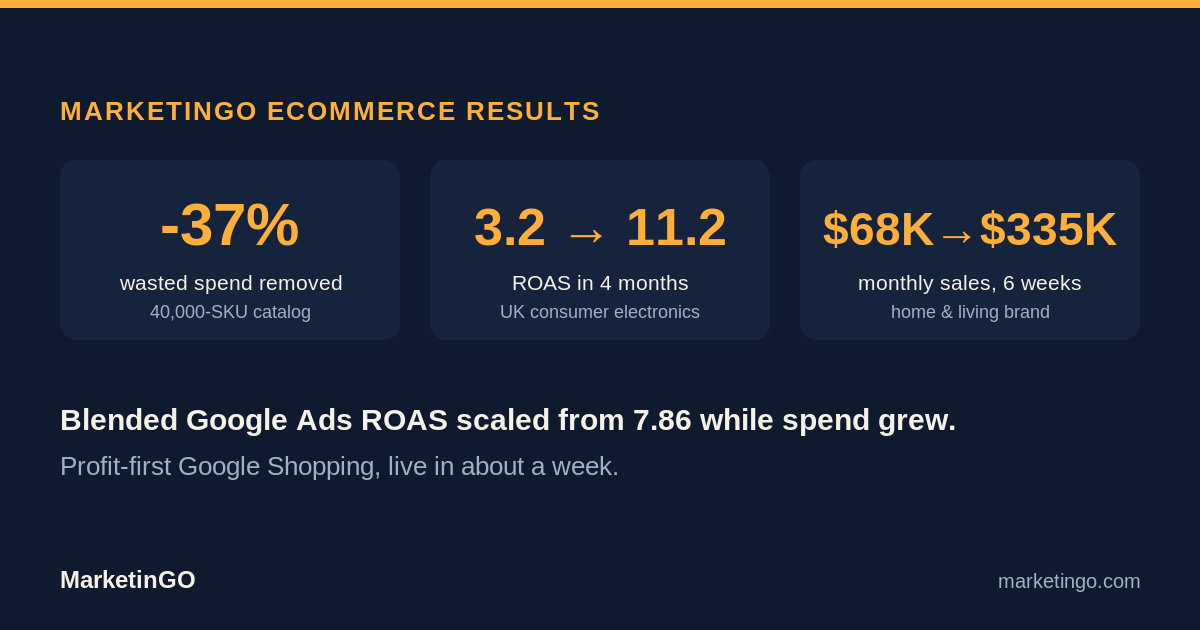
Verifiable results. On a 40,000-SKU dental supplies store on BigCommerce, MarketinGO cut the 37% of budget being wasted on zero-revenue products, lifted blended Google Ads ROAS from a starting 7.86 while scaling spend, and then expanded profitably into Meta with catalog and remarketing campaigns. A ceramics brand in the home and living space grew from $68K to $335K in monthly sales within six weeks. For a UK consumer electronics brand, the team lifted ROAS from 3.2 to 11.2 and reached profitable scale in four months, and an outdoor fashion brand saw ROAS rise from 3.1 to 7.3 with purchases doubling in 90 days, even in the off-season.
Ideal fit. DTC and online stores doing meaningful revenue that want a hands-on Google Shopping ads agency optimizing to profit, fast execution, and fluency with the US market. MarketinGO is especially strong for fashion, consumer electronics, home and living, and large-catalog stores where feed discipline and campaign structure decide the outcome. Because the same team also runs high-ticket B2B lead generation, brands with both a DTC line and a B2B arm can keep everything under one roof. You can start with a free ad audit at /free-ad-audit and pressure-test the numbers with the ecommerce ROAS calculator.
Where it stops. MarketinGO is paid media only. Brands that want SEO, content marketing, email and lifecycle, influencer programs, or web development handled in-house should pair MarketinGO with a specialist for those, and the team will point you to good ones. It is a paid media partner that runs Google Shopping as part of a profitable funnel, not a full-service marketing agency, and that focus is the point.
Certifications: Google Partner and Meta Business Partner. Pricing. A managed monthly engagement, shared transparently on a short discovery call, with scope matched to your revenue and goals.
Bidnamic 2. Bidnamic: best for a technology-led Google Shopping specialist
Founded: 2018 · HQ: Leeds, UK · Team: ~50 · Website: bidnamic.com
Bidnamic is a Google Shopping specialist built around its own bidding technology, founded by Liam Patterson and backed by venture funding to serve retailers that live and die by Shopping. Its pitch is SKU-level bidding driven by purchase-intent data, which suits catalogs large enough that manual bidding cannot keep up.
What they do. Google Shopping management and Performance Max, powered by a proprietary platform that sets bids at the individual product level using search-term and purchase-intent signals, alongside feed work and account structure. The single-channel focus means the team knows Merchant Center, product data, and the Shopping auction deeply, and the technology is aimed at squeezing more revenue from the same ad spend.
Verifiable results. For fashion brand Oh Polly, Bidnamic reports revenue growth of 661% with 457% more clicks and a 24% higher conversion rate, after which the client grew ad spend 801% year over year. For Spongellé, it reports a 3x ROAS by the second month and roughly 70% visibility of its category on Google Shopping. Bidnamic also reports that The Union Project increased revenue 62% using the same machine-learning approach.
Ideal fit. Mid-market and larger ecommerce companies with sizeable catalogs that want a pure Google Shopping specialist combining feed work with algorithmic SKU-level bidding, and that have the volume for the technology to learn.
Where it stops. Small stores with thin catalogs or low conversion volume, and brands wanting one partner to also run Meta, Amazon, or a broad program, since Bidnamic concentrates on Google Shopping. It is a channel and technology specialist, not a full-funnel paid media team.
Certifications: Google Partner. Pricing. Typically a percentage-of-spend or technology-plus-management model; effective minimums suit established Shopping budgets.
ZATO Marketing 3. ZATO Marketing: best for senior, specialist-run Shopping and Performance Max
Founded: 2011 · HQ: Billings, MT (remote) · Team: ~5 senior specialists · Website: zatomarketing.com
ZATO is a senior-only ecommerce PPC agency founded by Kirk Williams, one of the more recognized names in paid search, and it treats Google Shopping and Performance Max as its core craft rather than a line item. Every client is run by a specialist with roughly a decade of experience, with no junior hires or account managers between you and the person in the account.
What they do. Google Shopping, Performance Max, and Merchant Center management, plus Google Search, YouTube and Demand Gen, and Microsoft Ads, for DTC and ecommerce brands spending roughly $25K to $1M or more per month. ZATO positions the specialist as the head engineer directing PMax, updating the feed as the catalog changes, watching bid performance daily, and making the margin calls an algorithm cannot.
Verifiable results. ZATO's published client reviews report the strongest SEM and Shopping audits they had received from any outside firm, with recommendations implemented within months that produced significant improvements. Public testimonials and its DesignRush and Credo profiles cite senior-level Shopping and Performance Max work for ecommerce brands, though ZATO publishes fewer single-number case studies than the technology-led shops.
Ideal fit. DTC and ecommerce brands that want a genuine Google Shopping specialist and direct access to a senior operator, and that value daily hands-on management of Performance Max and Merchant Center over a large agency bench.
Where it stops. Brands wanting paid social as the primary channel, a large multi-market team, or full-service marketing including SEO and web. ZATO is a focused senior paid search and Shopping shop, and it stays in that lane by design.
Certifications: Google Partner; Microsoft Advertising Partner. Pricing. Not public; senior-specialist retainers that suit established ecommerce budgets.
Inflow 4. Inflow: best for mid-market ecommerce wanting senior Shopping strategists
Founded: 2007 · HQ: Denver, CO · Team: ~25 · Website: goinflow.com
Inflow is an ecommerce specialist known for putting senior, hands-on strategists on the account rather than junior teams, with particular depth in Google Shopping. Mid-market brands tired of being handed to a rotating cast of juniors come to Inflow for experienced operators who know the feed and the auction.
What they do. Paid search for ecommerce across Google Search and Google Shopping, YouTube, Amazon Ads, and paid social, plus SEO and conversion optimization. Shopping campaigns are a named specialization, and the agency's conversion tracking and analytics work is a strength that shows up in the reliability of its reporting.
Verifiable results. For KEH Camera, Inflow reports growing ad revenue 413% year over year, lifting paid search ROAS 65%, averaging 29x ROAS on paid social, and adding $865K in conversion-driven revenue, a well-rounded result across paid media and post-click work.
Ideal fit. Mid-market DTC brands that want experienced operators and strong Shopping management without a giant agency wrapped around them, and that value senior attention over sheer headcount.
Where it stops. Very small budgets and brands wanting a large multi-market bench or full brand and web-development services. Inflow is a focused ecommerce advertising agency, not a sprawling full-service marketing agency.
Certifications: Premier Partner; Microsoft Ads Partner and Meta Business Partner. Pricing. Project minimums around $1,000; typical annual engagements roughly $24K to $80K.
OuterBox 5. OuterBox: best for Google Shopping paired with a storefront rebuild
Founded: 2004 · HQ: Akron, OH · Team: ~120 · Website: outerboxdesign.com
OuterBox is an ecommerce specialist that pairs Google Shopping with web design and development, which helps when the storefront itself needs work alongside the ads. It is one of the few Google Shopping agencies that can rebuild your site and run your Shopping campaigns under one roof.
What they do. Google Ads and Google Shopping with feed management, Amazon PPC, and paid social, plus ecommerce web design and development on Shopify, BigCommerce, and Magento, and SEO. The team reports more than $105M in Google Ads spend managed, and its feed and Shopping work is a genuine strength for catalog-heavy retailers.
Verifiable results. For apparel brand johnnie-O, OuterBox reports growing holiday revenue 21% year over year, Cyber Week revenue 66%, and ROAS 14.9%. For a confidential skincare brand, it reports cost per order falling 46% while ROAS rose 83% across two quarters.
Ideal fit. Retailers that want Google Shopping and paid search run by the same team that can rebuild or optimize the storefront and its product pages, removing the usual finger-pointing between an agency and a separate web shop.
Where it stops. Very small or budget-constrained businesses. OuterBox skews toward larger retail and B2B industrial accounts, with quote-based pricing and longer contracts, so it is a poor match for a lean starter budget.
Certifications: Premier Partner; Microsoft Advertising Select Partner. Pricing. Quote-based; third-party estimates suggest a few thousand dollars per month with multi-month terms.
Tinuiti 6. Tinuiti: best for enterprise, multi-channel commerce media
Founded: 2004 · HQ: New York, NY · Team: ~1,200 · Website: tinuiti.com
Tinuiti is the largest independent performance marketing agency in the US, and its center of gravity is scale. DTC brands running Google Shopping alongside Amazon and streaming at once come to Tinuiti for measurement and reach that smaller shops cannot match, and its benchmark research is a reference point for the whole industry.
What they do. Paid search and Google Shopping, Amazon and commerce media, paid social, and connected TV, unified by a proprietary measurement platform called Bliss Point. The breadth suits brands that treat retail media and Shopping as one system, and Tinuiti has the headcount to staff complex feeds and catalogs deeply.
Verifiable results. For Parts Town, Tinuiti reports helping grow revenue 170% and improve ROAS 27% across a long-running partnership, the kind of compounding result a multi-year relationship with a large agency can produce.
Ideal fit. Enterprise and upper mid-market retailers that need many channels measured together and have the ad spend to justify a large team. If you manage eight-figure budgets across Shopping, Amazon, and CTV, Tinuiti belongs on your shortlist.
Where it stops. Small and early-stage stores. High minimums and enterprise scope make Tinuiti over-built for a single-channel or tight-budget Shopping account, and a smaller store will often get more attention from a boutique specialist.
Certifications: Google Premier Partner and a past Premier Partner of the Year for international growth; Amazon Ads Advanced Partner. Pricing. Retainer plus a share of ad spend, with project minimums around $10,000.
Disruptive Advertising 7. Disruptive Advertising: best for Shopping paired with conversion testing
Founded: 2012 · HQ: Lindon, UT · Team: ~150 · Website: disruptiveadvertising.com
Disruptive Advertising pairs paid search and Google Shopping with serious conversion rate work, so the traffic that lands on the site has a better chance of converting. For online retailers whose Shopping ads perform but whose product pages let them down, this combination is the draw.
What they do. Google Shopping and paid search, paid social, and conversion testing across Google, Microsoft Ads, Meta, and Amazon, for both ecommerce and lead generation clients. The agency treats landing pages and site experience as part of the paid media job rather than a separate project, which matters when a Shopping click lands on a weak product page.
Verifiable results. Disruptive reports a 1,300% sales lift in 60 days for cooler brand HÜKR, alongside gains in click-through rate and ROAS on the same account.
Ideal fit. Brands that suspect their product pages, not just their Shopping campaigns, are the bottleneck, and want ads and conversion optimization handled by one team.
Where it stops. Very small budgets and month-to-month seekers. This is a performance-first agency with typical minimums and multi-month commitments, so it fits established stores better than brand-new ones.
Certifications: Google Partner. Pricing. Third-party reviews cite a starting point around $5,000 per month with multi-month terms.
KlientBoost 8. KlientBoost: best for Google Shopping with landing pages built in
Founded: 2015 · HQ: Costa Mesa, CA · Team: ~100 · Website: klientboost.com
KlientBoost is a performance marketing agency that bundles paid media with landing page design, so Shopping campaigns and their destinations are built together rather than handed off between teams. On a channel where product-page speed and clarity decide the conversion rate, that pairing pays off.
What they do. Google Shopping and paid search across Google Ads, Meta, and Microsoft Ads, plus landing page design, conversion optimization, and some SEO and content. The practice serves ecommerce alongside B2B and SaaS, with Amazon work for online stores, and its signature is fast creative and landing page iteration tied to paid search performance.
Verifiable results. For UBTECH Robotics on Amazon, KlientBoost reports growing revenue 53% and new-customer orders 483%, a result driven by tighter targeting and better product presentation working together.
Ideal fit. Brands that want Shopping management and landing pages from a single agency and value rapid testing across both. If your creative and product-page throughput is the constraint, KlientBoost is built for that.
Where it stops. Very small budgets. Some third-party reviews note account-manager turnover and reduced responsiveness after onboarding, so ask who will run your account day to day and request a reference call.
Certifications: Google Premier Partner; Meta and Microsoft partner. Pricing. Not public; third-party estimates put management in the low thousands per month or a share of ad spend.
Elumynt 9. Elumynt: best for profit-first ecommerce scaling
Founded: 2013 · HQ: Stillwater, MN · Team: boutique · Website: elumynt.com
Elumynt is a performance agency for ecommerce that optimizes to profit and EBITDA rather than platform ROAS, an approach that resonates with founders watching the bottom line instead of a dashboard. Its Google Shopping work is tied to margin from the start rather than bolted on later.
What they do. Google Shopping, paid search, paid social, and programmatic across Google Ads, Meta, and Snapchat, with ecommerce growth consulting. Notably, Amazon, email and SMS, and conversion optimization are referred out rather than run in-house, which keeps this agency focused on the paid media it does best.
Verifiable results. For Oros Apparel, Elumynt reports cutting cost per acquisition 52%, lifting ROAS 122%, and growing revenue 136% within two weeks of taking over the account, a fast turnaround that reflects how much structure and bidding discipline can change.
Ideal fit. Online stores that want Shopping bidding tied to profit, not just account-level ROAS, and prefer a boutique senior team over a large agency.
Where it stops. Non-ecommerce businesses, brands wanting Amazon or email handled in-house, and sub-$5,000 budgets. Elumynt is a specialist, and it stays in its lane.
Certifications: Displays a Premier Google Partner badge on its own site; treat as self-reported pending a directory check. Pricing. Project minimums around $5,000.
Common Thread Collective 10. Common Thread Collective: best for DTC brands scaling across Meta and Google
Founded: 2012 · HQ: Costa Mesa, CA · Team: ~100 · Website: commonthreadco.com
Common Thread Collective, or CTC, is a DTC growth shop with deep Meta and creative muscle that runs Google Shopping as part of a forecasting-led model. Its framework, the Prophit Engine, is built around forecasting and incrementality for online stores, and its content on ecommerce growth has made it one of the better-known DTC agencies.
What they do. Meta and Google ad buying, including Shopping and Performance Max, retention through email and SMS, and high-volume ad creative, aimed at DTC brands roughly in the $5M to $100M range. CTC leans harder into paid social and creative testing than most Shopping specialists, treating the ad creative itself as a primary lever.
Verifiable results. For Igloo Coolers, CTC reports a 796% year-over-year sales increase in April 2020, 4.6x year-to-date growth, and 37,000 new customers, with top Meta creatives running at 3.61 to 4.74 ROAS.
Ideal fit. DTC brands whose growth lives on paid social and who want Google Shopping run alongside it inside a forecasting-led program, with a partner fluent in the economics of ecommerce.
Where it stops. Stores that want a Google Shopping specialist first, since CTC's center of gravity is Meta and creative rather than feed and Merchant Center depth. Small or early-stage stores and pure single-channel Shopping mandates are a weaker fit.
Certifications: Recognized as a top Meta partner in third-party sources; Google Premier status not confirmed. Pricing. Project minimums around $5,000, with client ad spend commonly $15K to $350K per month.
Thrive 11. Thrive: best for a full-service generalist with marketplace reach
Founded: 2005 · HQ: Arlington, TX · Team: ~200 · Website: thriveagency.com
Thrive is a long-established full-service agency whose Google Shopping work sits alongside deep marketplace advertising across Amazon, Walmart, and Target Plus. For brands that want many services in one place, it is a convenient single vendor.
What they do. Google Ads, Microsoft Ads, paid social, and Google Shopping, plus marketplace advertising, SEO, web design and development, social media marketing, and content. This is breadth over depth, which suits brands that value one roof over a specialist bench.
Verifiable results. For a high-end juicer retailer, Thrive reports doubling PPC sales year over year, growing Google Ads revenue 87.4%, and lifting Shopping conversions 72%.
Ideal fit. Brands selling across multiple marketplaces that want Shopping, SEO, and storefront services from a single generalist partner, and that prioritize convenience.
Where it stops. Advertisers scaling past roughly $10K per month or running large multi-marketplace catalogs, where reviews note optimization gaps. Thrive is a generalist rather than a dedicated Google Shopping specialist, so brands whose growth hinges on squeezing every point of ROAS from the feed may outgrow it.
Certifications: Top-tier Google Partner, verified in Google's directory. Pricing. Proposal-based, with service tiers commonly starting around $2,500 per month.
How to choose the right Google Shopping agency
Every agency above is credible; the question is fit. Use these conditional recommendations to match your situation to a name, then compare agencies on a call rather than a sales page.
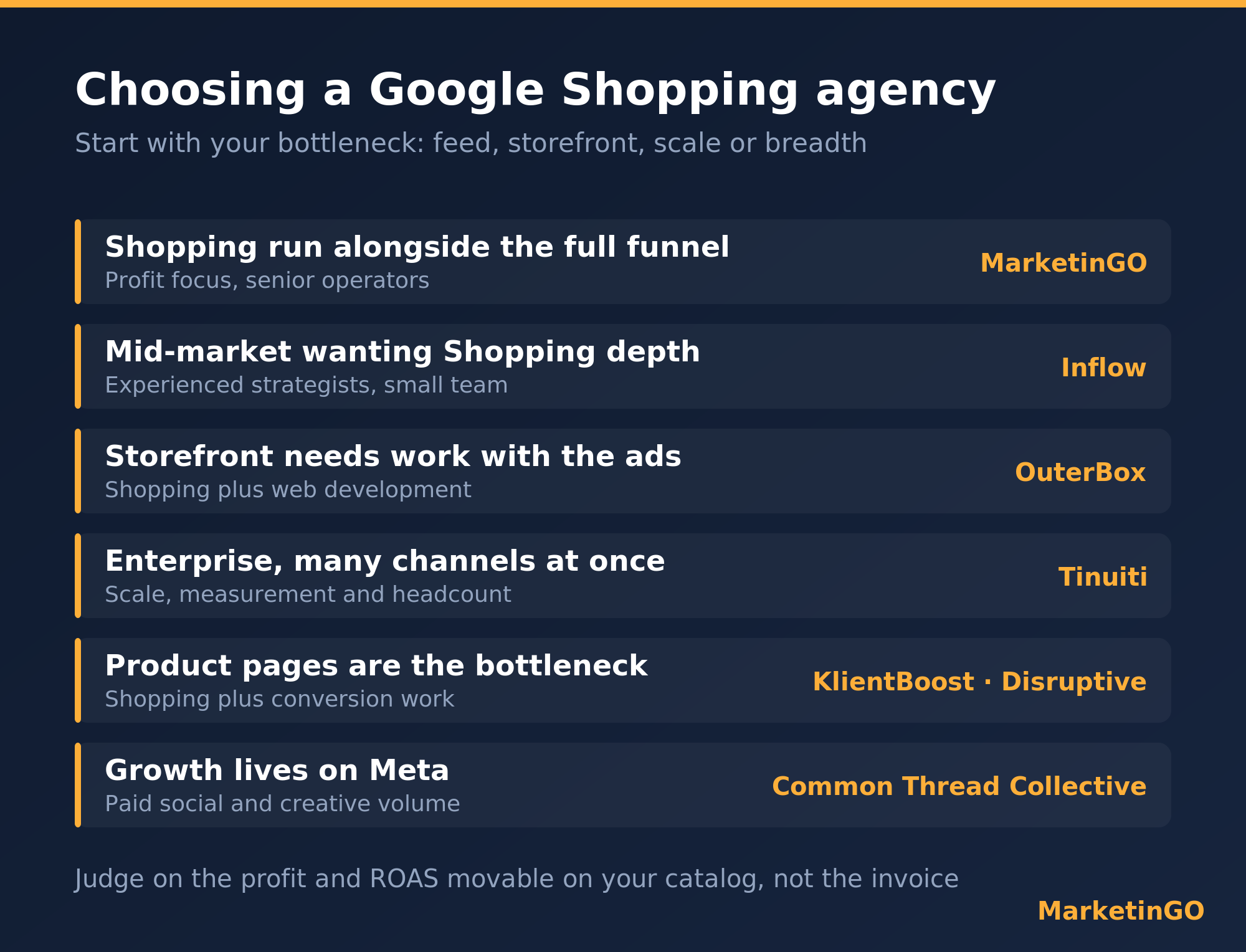
If you want profitable scaling without losing margin, start with MarketinGO or Elumynt, since both optimize to profit rather than platform ROAS and will talk in terms of contribution margin.
If you run a large catalog and want algorithmic bidding, Bidnamic sets bids at the SKU level with its own technology and purchase-intent data.
If you want a senior specialist in the account every day, ZATO gives you direct access to an experienced operator running Shopping and Performance Max.
If you are mid-market and want senior operators with Shopping depth, Inflow gives you experienced strategists without a giant agency around them.
If your storefront needs work alongside the ads, OuterBox pairs Shopping and feed management with web development so one team owns the path from click to checkout.
If you are enterprise and run many channels at once, Tinuiti has the scale, measurement, and headcount to match a complex account.
If your product pages are the bottleneck, KlientBoost and Disruptive Advertising build Shopping campaigns and conversion work together.
If your growth lives on Meta and you want Shopping run alongside it, Common Thread Collective is built for paid social and creative volume.
If you want advertising, SEO, and marketplaces from one generalist, Thrive offers breadth and convenience over specialist depth.
What Google Shopping agencies charge
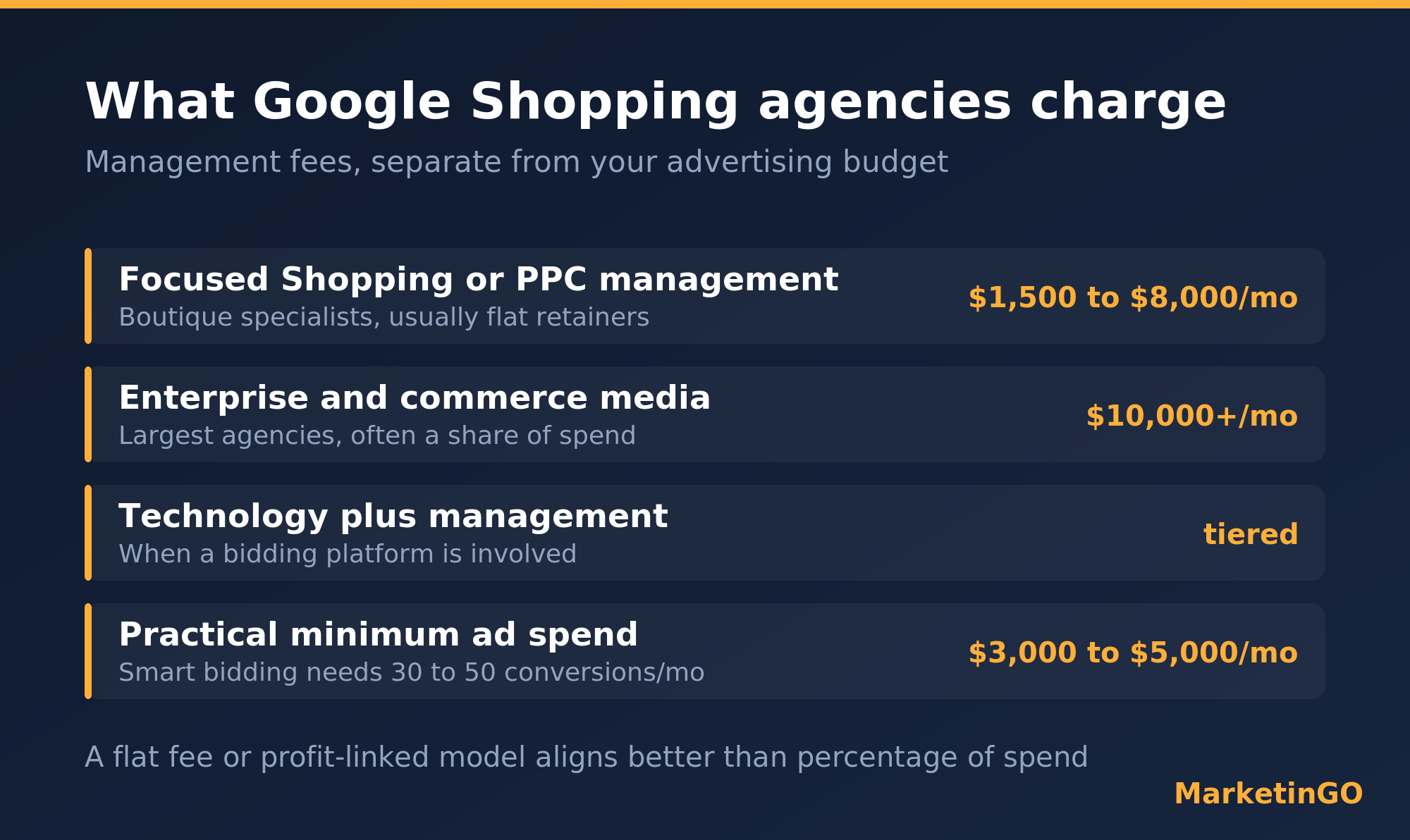
Pricing for Google Shopping agencies is often opaque, so here is the shape of the market. Management fees commonly run from about $1,500 to $8,000 per month for focused Shopping or PPC management, with enterprise and full-service commerce-media models reaching $10,000 or more, all separate from your advertising budget. Agencies bill as a flat retainer, a percentage of spend, or a technology-plus-management fee when a bidding platform is involved. Boutique specialists tend to charge flat retainers, while the largest agencies lean on a share of spend.
Two points matter when you compare. First, Google Shopping carries a practical minimum budget to work, so most agencies expect ad spend starting around $3,000 to $5,000 per month before management makes sense; below that, the account rarely gathers the 30 to 50 conversions a month that smart bidding needs. Second, a percentage-of-spend model can misalign incentives, since the agency earns more as you spend more, whether or not the extra budget is profitable, so a flat fee or a profit-linked model is cleaner. Judge the agency on the profit and ROAS it can defensibly move on your catalog, not the invoice alone.
Questions to ask before you sign
A short, sharp set of questions reveals more than any pitch. Ask a prospective Google Shopping agency: who specifically manages my account, and how senior are they? What is your Merchant Center disapproval playbook, and how fast do you resolve a feed that goes down? How do you use custom labels to bid by margin rather than revenue alone? Do you run standard Shopping alongside Performance Max, and how do you decide which SKUs go where? How do you optimize product titles and product data, and how often do you refresh the feed? Can I see two ecommerce case studies in my category with verifiable ROAS and profit numbers, and speak to those clients? Clear answers separate an agency that manages the feed from one that only touches the bids. Short paid account audits before a full engagement are another good test of how Google Shopping specialists think versus a generalist filling a slot.
Whichever way you go, the honest first step is finding out where your feed and campaign structure leak margin, before you pay anyone to scale them. A free ad audit covers exactly that, and the ecommerce ROAS calculator will tell you what ROAS your catalog actually needs to clear on margin rather than on revenue. Our Google Ads management page covers how we run Shopping for DTC and ecommerce brands, and the ecommerce Google Ads case study shows what cutting 37% of wasted budget did to blended ROAS while spend scaled.