The setup
This client sells custom basketball and volleyball uniforms to teams, schools and organisations across the United States. In this niche, performance depends on qualified team-level enquiries from coaches, athletic directors and team managers — not high-volume consumer traffic. When MarketinGO took over in October 2025, the priority was to rebuild the measurement foundation, stabilise the core lead-gen engine, and turn an underperforming volleyball angle into a working acquisition channel.
Challenge
Google conversion tracking was based on a generic Google Analytics form-submit event, so there was no proof that a reported conversion was a genuine quote or contact request.
The volleyball angle had spent $933 on Search with zero verified conversions to show for it.
Google remarketing was not running at all. Neither was Meta remarketing.
Meta attribution was mixed across broader lead events and contact-form submissions, so Google and Meta could not be compared on the same definition of a lead.
UTM tagging was inconsistent across live campaigns — flagged during our audit.
What we did
Measurement foundation & UTM audit
We audited Google Ads, Meta Ads, Google Analytics and UTM tagging across every live campaign. The core issue was that legacy reporting relied on generic form-submit events, which could include non-sales form interactions. We moved the primary measurement focus to the specific contact submission that represents a genuine lead request.
Google Ads Search restructure
We removed and consolidated irrelevant legacy activity, reviewed keywords and search terms, added negative keywords, and kept the structure focused on high-intent search traffic. The core basketball-angle campaign moved into a Target CPA test to establish a controlled cost-per-lead baseline.
Remarketing funnel activation
Neither Google nor Meta remarketing was active at handoff. We launched Google Display Remarketing and a Meta basketball-angle remarketing layer to re-engage visitors who had already interacted with the business but had not yet submitted a verified contact request.
Meta Ads rebuild
We rebuilt Meta around cleaner conversion tracking, stronger audience logic and more useful retargeting. We created creative analysis and testing guidelines, then used CRM contact lists to support custom audience development.
Volleyball-angle channel launch & seasonal budget planning
The volleyball campaign had spent money without generating a single verified lead. We rebuilt the keyword strategy, restructured the campaign, used CRM-based audience inputs, and built a seasonality-based budget plan for the May-August peak. That turned the angle from an unproven spend line into a working acquisition path.
Key wins
A volleyball angle that had spent $933 for nothing became a live acquisition channel, with a seasonal plan for the May-August peak
Reporting moved from generic form-submit events to specific contact-form submissions, giving a clean qualified-lead pipeline
Google Display Remarketing and Meta basketball-angle remarketing added, where neither existed before
Google Ads
Oct 2024 - Sep 2025 vs. Oct 2025 - Apr 2026
| Metric | Oct 2024 - Sep 2025 | Oct 2025 - Apr 2026 |
|---|---|---|
| Core-angle spend | $11,851.70 | $12,173.68 |
| Core-angle leads | 360 (generic form-interaction event) | 240 (verified contact-form submissions) |
| Core-angle cost per lead | $32.88 | $50.72 |
| Remarketing layer | Not running | Active — $421.46 spend |
| Primary conversion tracking | Generic form-submit event | Specific contact-form submission |
Why the "before" cost per lead looks better
It is the single most important thing to understand about this account, so we will not bury it: the reported cost per lead went up, from $32.88 to $50.72 on Google and from roughly $18.45 to $62.60 on Meta.
That is not a performance drop. It is what happens when you stop counting the wrong thing. The old numbers were built on a generic form-interaction event and, on Meta, on a mix of broader lead events — both of which counted interactions that were never quote requests. The new numbers count only verified contact-form submissions.
The two figures are measuring different things, so they are not comparable. What the client gained is a lead count they can actually trust, and the honest baseline every subsequent optimisation is now measured against. The volleyball angle is the cleanest illustration: under the old tracking it looked like nothing at all, because it genuinely produced zero verified leads. Under the new tracking, the rebuilt campaign produced 13.
Meta Ads
Oct 2024 - Sep 2025 vs. Oct 2025 - Jun 2026
| Metric | Oct 2024 - Sep 2025 | Oct 2025 - Jun 2026 |
|---|---|---|
| Campaign structure | Prospecting only | Prospecting plus a new remarketing layer |
| Total spend | $12,953.07 | $8,889.52 |
| Reported leads | ~702 (mixed attribution) | 142 (contact form only) |
| Average cost per lead | ~$18.45 (mixed attribution) | $62.60 |
| Remarketing layer | None | Active |
| Conversion attribution | Mixed broader lead events + contact-form events | Contact-form submissions only |
After the rebuild, reporting was narrowed to contact-form-only leads, which gave the client a cleaner view of true quote demand — on 31% less spend.
Combined channel trajectory
Most recent full months of blended lead generation
| Month | Google leads | Meta leads | Combined leads | Blended CPL |
|---|---|---|---|---|
| March 2026 | 64 | 49 | 113 | $65.93 |
| April 2026 | 50 | 33 | 83 | $59.57 |
Instead of optimising toward inflated legacy conversion volume, the account now works from clean qualified-lead tracking, active remarketing on both platforms, and a clear path toward the client's $50 cost-per-lead target.
Inside the accounts
What the old tracking was counting
The core basketball campaign before we took over. The generic Google Analytics form-submit event reported 152 conversions against 136.5 actual quote-request submissions — the gap is form interactions that were never a lead.
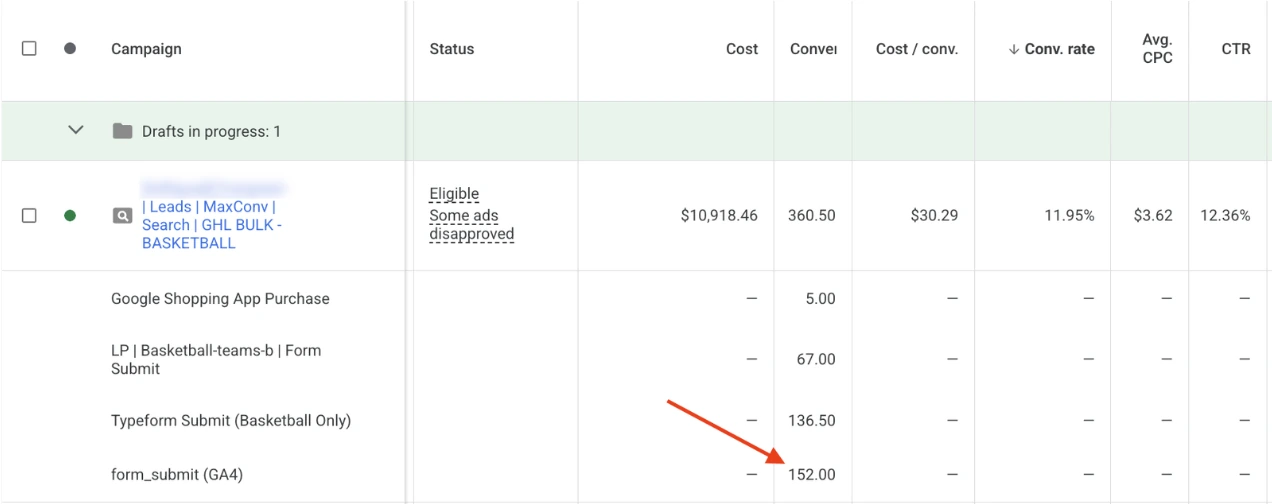
Google Ads — core campaign before the tracking rebuild
(click to enlarge)
Before and after, both platforms
The client's own comparison: account opening through to handover, against our first seven months. Reported cost per lead rises because the second panel counts only verified contact requests.
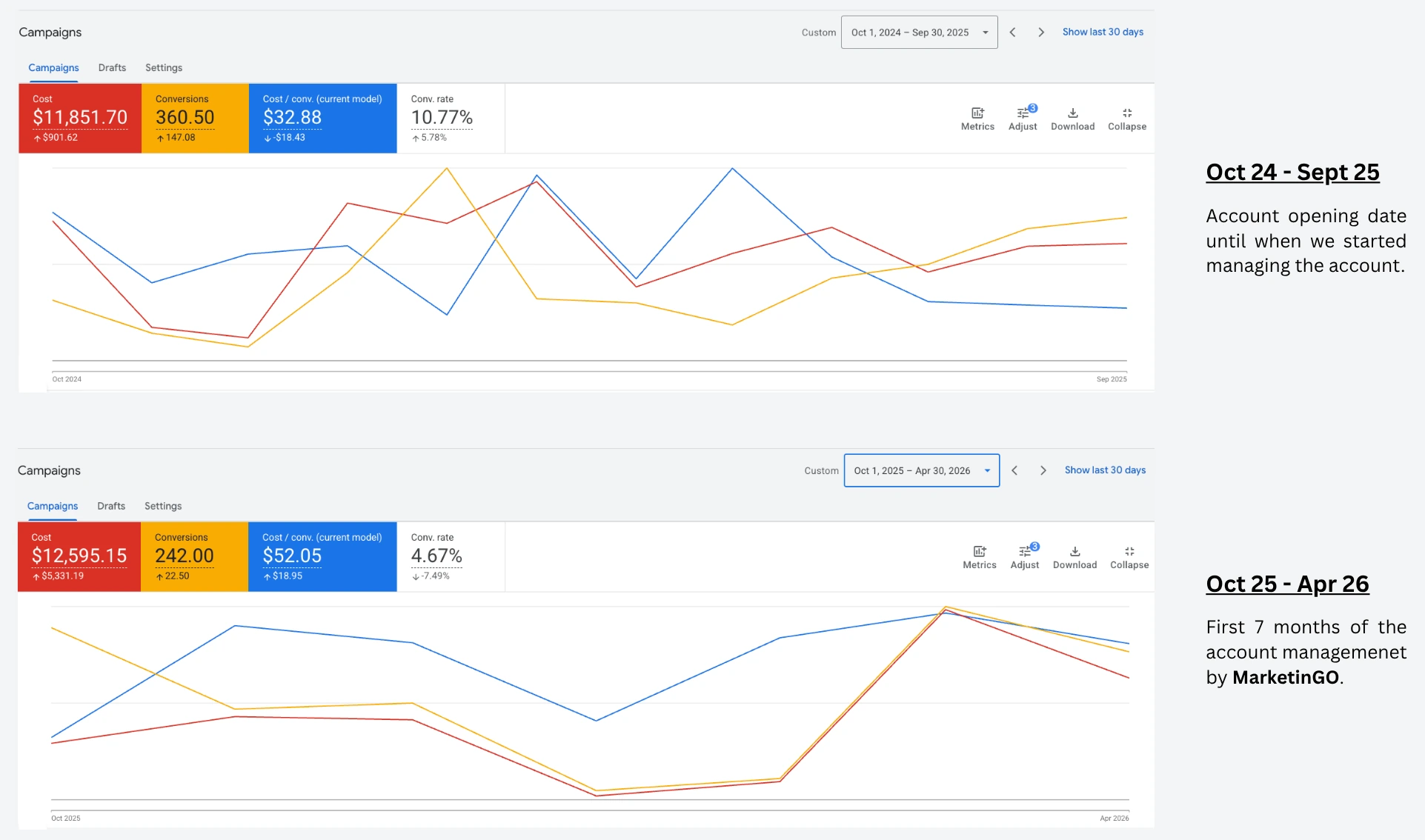
Google Ads — Oct 2024-Sep 2025 vs. Oct 2025-Apr 2026
(click to enlarge)
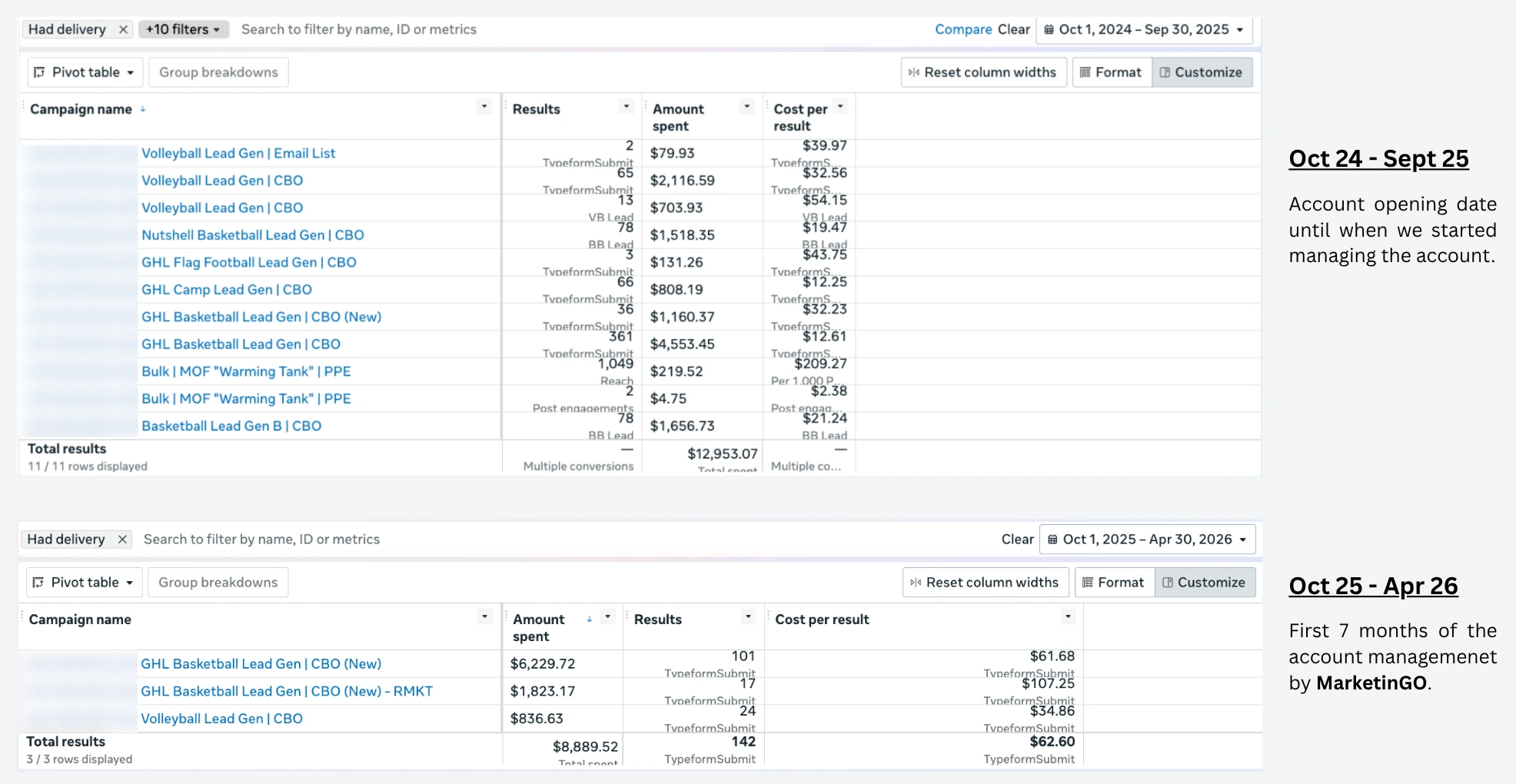
Meta Ads — eleven campaigns down to three that work
(click to enlarge)
The volleyball angle, from zero
The rebuilt volleyball campaign: $1,012.89 spent for 13 verified contact requests, where the previous structure had spent $933 for none.
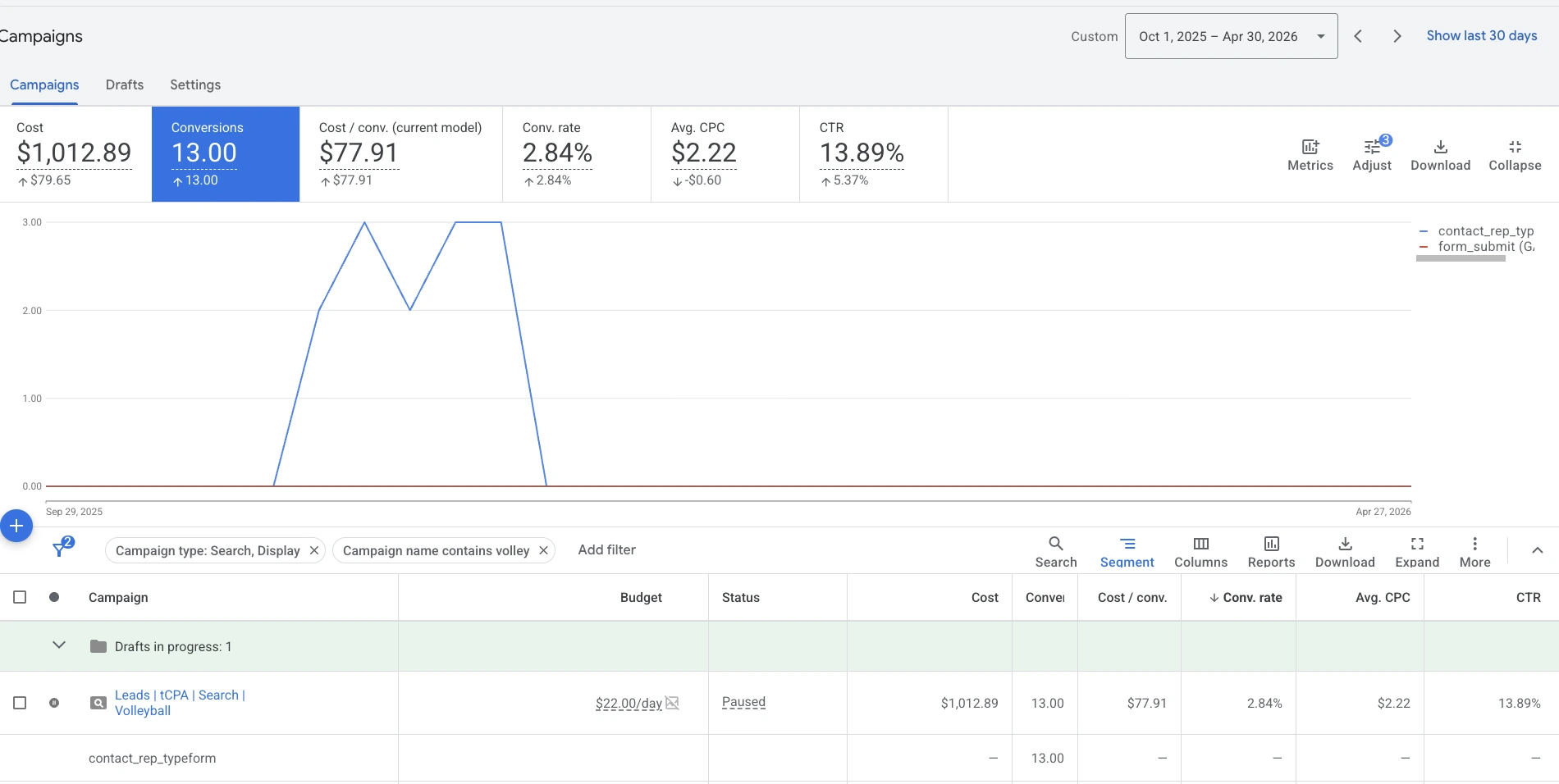
Google Ads — volleyball campaign, Oct 2025 - Apr 2026
(click to enlarge)
What's next
Our partnership with this client is ongoing. We continue to optimise, test and scale their campaigns, building on what is working and adapting as the market evolves. Growth in paid media is never a one-time event; it is a compounding process, and we are in it for the long run.