The setup
Compliance and legal-tech buyers rarely convert on a single visit. Enterprise prospects need trust signals and a real sales conversation; self-serve users just want to try the product. Blending both journeys into one optimisation goal is the most common mistake we see in this vertical — and it was exactly the trap this document-redaction and compliance SaaS platform was stuck in when we took over its Google Ads and Microsoft Ads accounts on 1 January 2026.
Challenge
The previous agency ran both platforms on one blended "all conversions" goal, so the algorithm chased the cheapest action — mostly trial signups — instead of plan purchases and enterprise demo bookings.
All traffic, demo-seekers and trial-seekers alike, landed on a single homepage. There was no dedicated demo page.
Ad copy and Ad Strength / Quality scores were weak across both platforms.
The client had previously spent $30K-$50K/month on a different channel mix with no reliable conversion tracking. The account we inherited was already scaled back to roughly $11K/month combined and still underperforming on cost per conversion.
Monthly targets at kickoff: 300 trial signups, 5 plan purchases, 15 single-doc purchases and 5 demo bookings — at the lowest cost per conversion the reduced budget allowed.
Strategy
Split Search into two parallel funnels — Enterprise/Demo and Self-serve/Trial — each with its own conversion goal, so the algorithm optimised for what mattered instead of blended "all conversions".
Built and launched a dedicated demo landing page with a single CTA, replacing the shared homepage funnel.
Rewrote ad copy and creative across both platforms to lift Ad Strength and message match.
Launched RLSA and Display remarketing on Google, plus Microsoft remarketing and audience bid adjustments, to re-engage past visitors instead of paying full price for cold traffic every time.
Tightened Performance Max targeting and paused Demand Gen prospecting, which was pulling in irrelevant, low-intent traffic.
Added Microsoft LinkedIn-profile bid adjustments to bid up on enterprise-relevant industries — Legal, Government, Healthcare, Banking & Financial Services — inside Search.
Rebuilt Brand and Competitor Search as always-on, high-intent capture layers on both platforms.
Results
14 → 32 demo bookings across both platforms
$38.73 → $34.40 blended cost per conversion
1,728 → 1,998 on 2.7% more spend
Google Ads
Jul 1 - Dec 31, 2025 vs. Jan 1 - Jun 30, 2026
| Metric | Before | After | Change |
|---|---|---|---|
| Spend | $61,597.39 | $56,165.49 | -8.8% |
| Impressions | 3,647,616 | 516,674 | -86% |
| Clicks | 12,345 | 11,777 | -4.6% |
| CTR | 0.34% | 2.28% | 6.7x |
| Cost per conversion (blended) | $37.39 | $32.69 | -12.6% |
| Trial signups | 1,442 | 1,512 | +4.2% |
| Demo bookings | 11 | 20 | +81% |
| Plan purchases | 55 | 73 | +23.6% |
| Single-doc purchases | 139 | 131 | -8.6% |
We cut spend and impressions sharply while conversion volume across all four goals grew. CTR moved 6.7x because we stopped buying broad, low-intent reach and started buying qualified searchers. Demo bookings — the client's top priority — grew 81%, and cost per demo nearly halved. Plan purchases grew 23.6% at a 26.2% lower cost each. Single-doc purchase volume dipped slightly, but cost per purchase held essentially flat.
Microsoft Ads
Jul 1 - Dec 31, 2025 vs. Jan 1 - Jun 30, 2026
| Metric | Before | After | Change |
|---|---|---|---|
| Spend | $5,305.92 | $12,570.04 | +137% |
| Clicks | 979 | 4,381 | 4.5x |
| CTR | 5.69% | 4.06% | -1.63pp |
| CPC | $5.42 | $2.87 | -47% |
| Cost per conversion (blended) | $66.32 | $44.89 | -32.3% |
| Trial signups | 57 | 242 | +323% |
| Demo bookings | 3 | 12 | +300% |
| Plan purchases | 8 | 13 | +62.5% |
| Single-doc purchases | 12 | 30 | +150% |
We treated Microsoft as an underused channel and grew it deliberately. Spend rose 137%, but blended cost per conversion still dropped 32.3% and CPC fell by nearly half. Every one of the client's four priority goals grew — trial signups more than quadrupled and demo bookings quadrupled, with plan and single-doc purchases both up double digits.
Performance screenshots
Google Ads — account performance
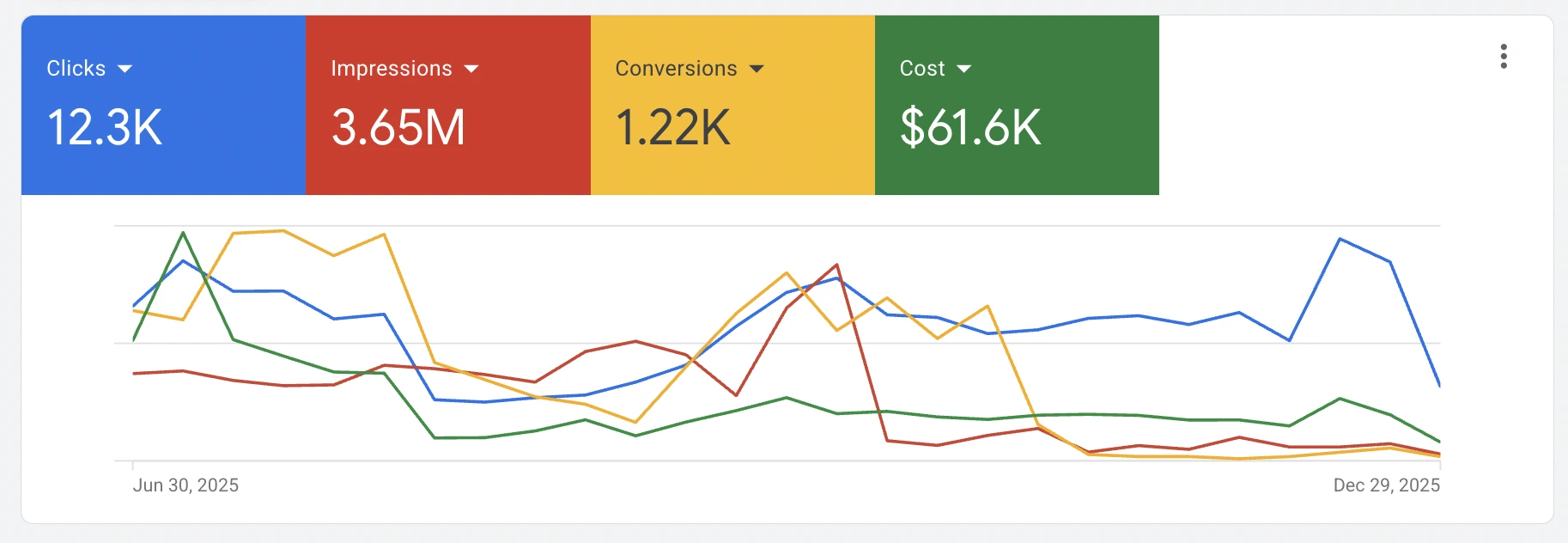
Before: Jul-Dec 2025
(click to enlarge)
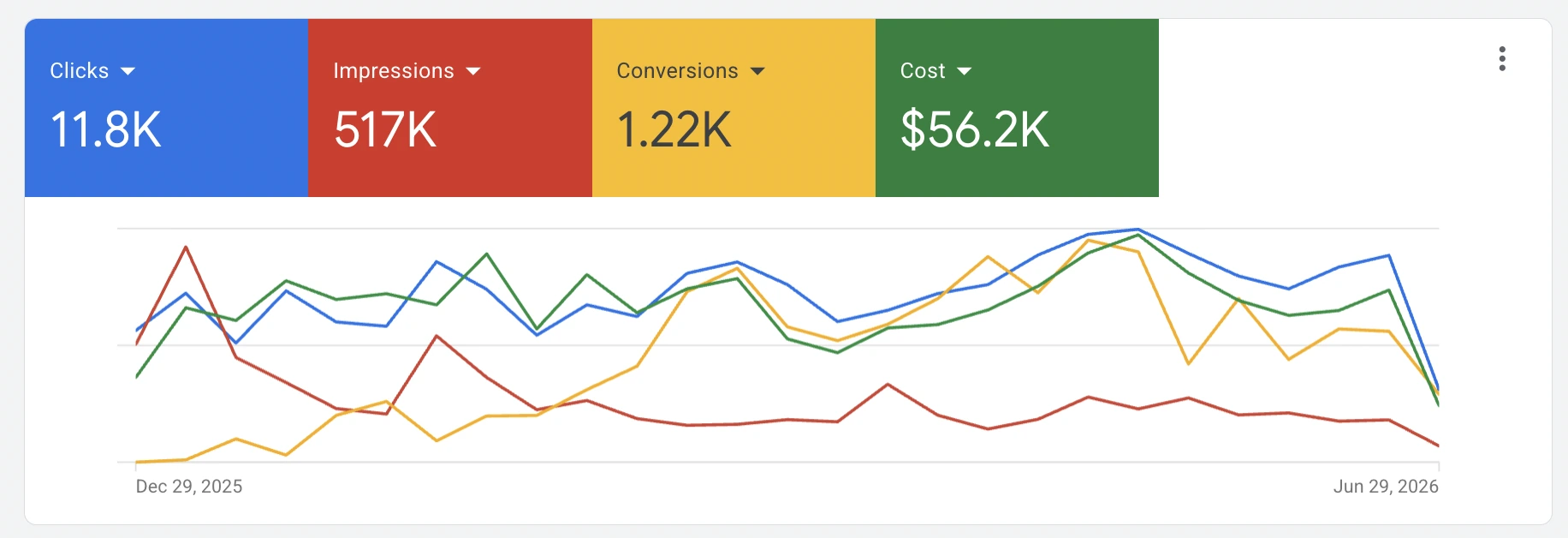
After: Jan-Jun 2026
(click to enlarge)
Google Ads — conversions by goal
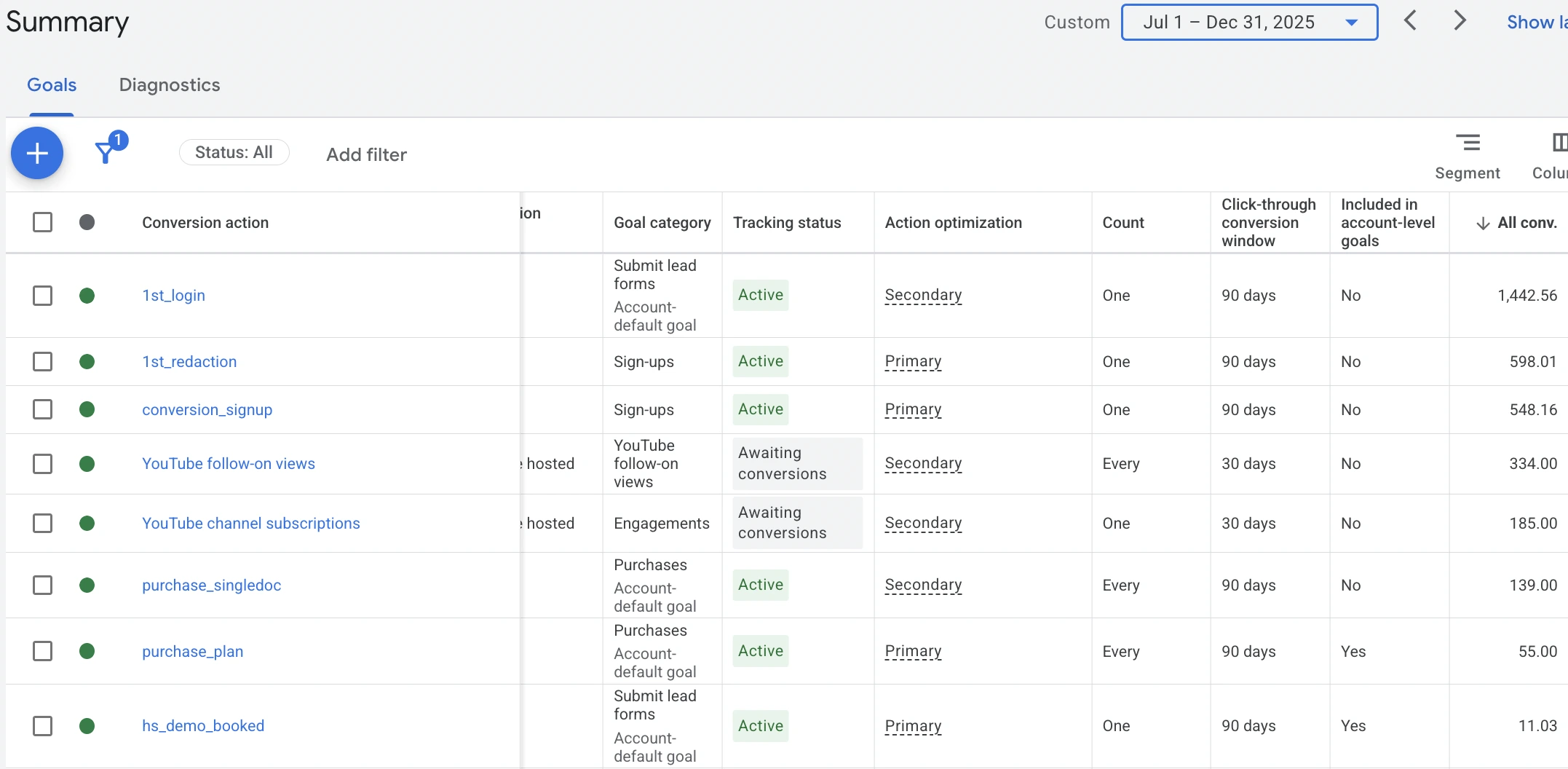
Before: Jul 1 - Dec 31, 2025
(click to enlarge)
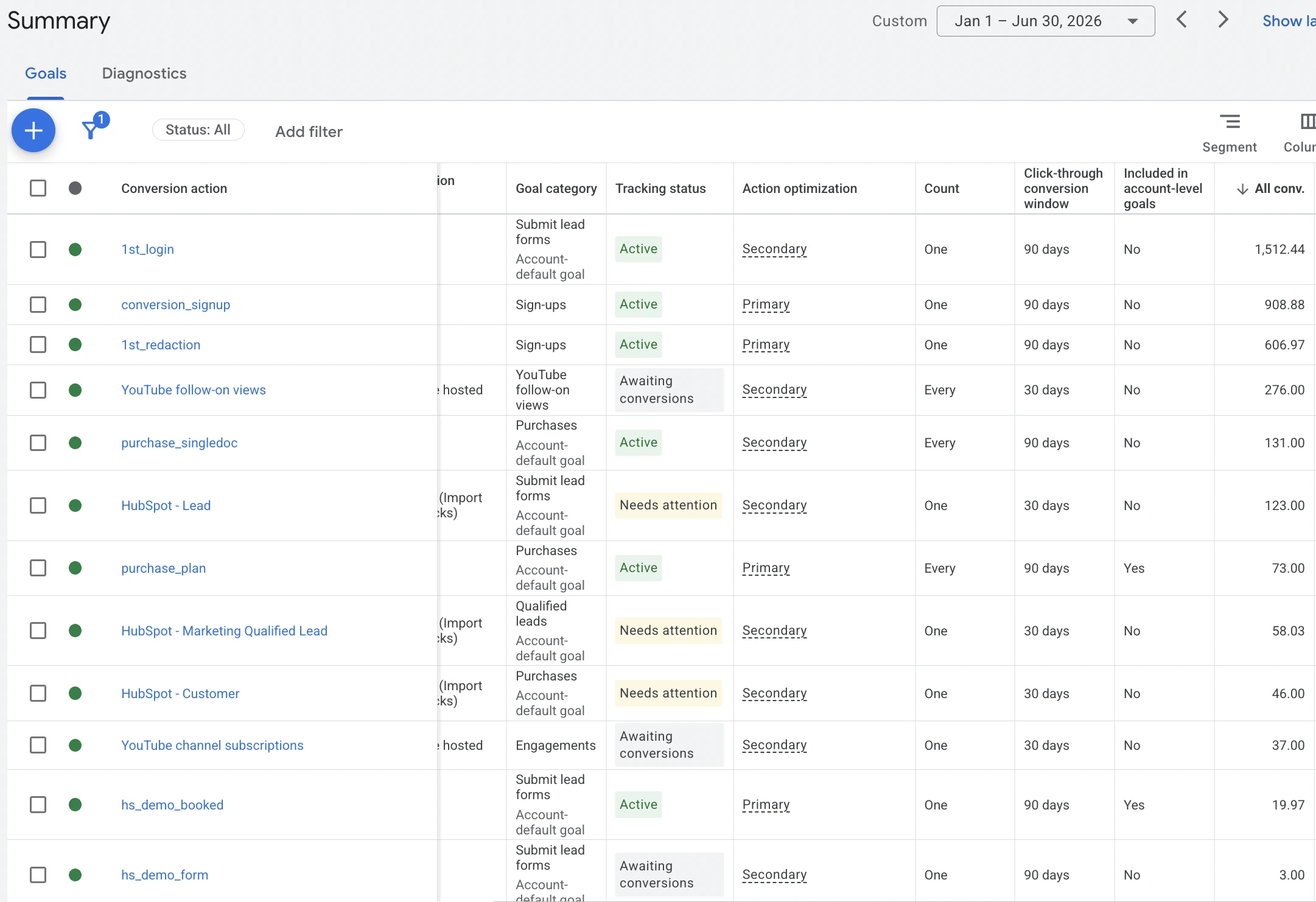
After: Jan 1 - Jun 30, 2026
(click to enlarge)
Microsoft Ads — conversions by goal
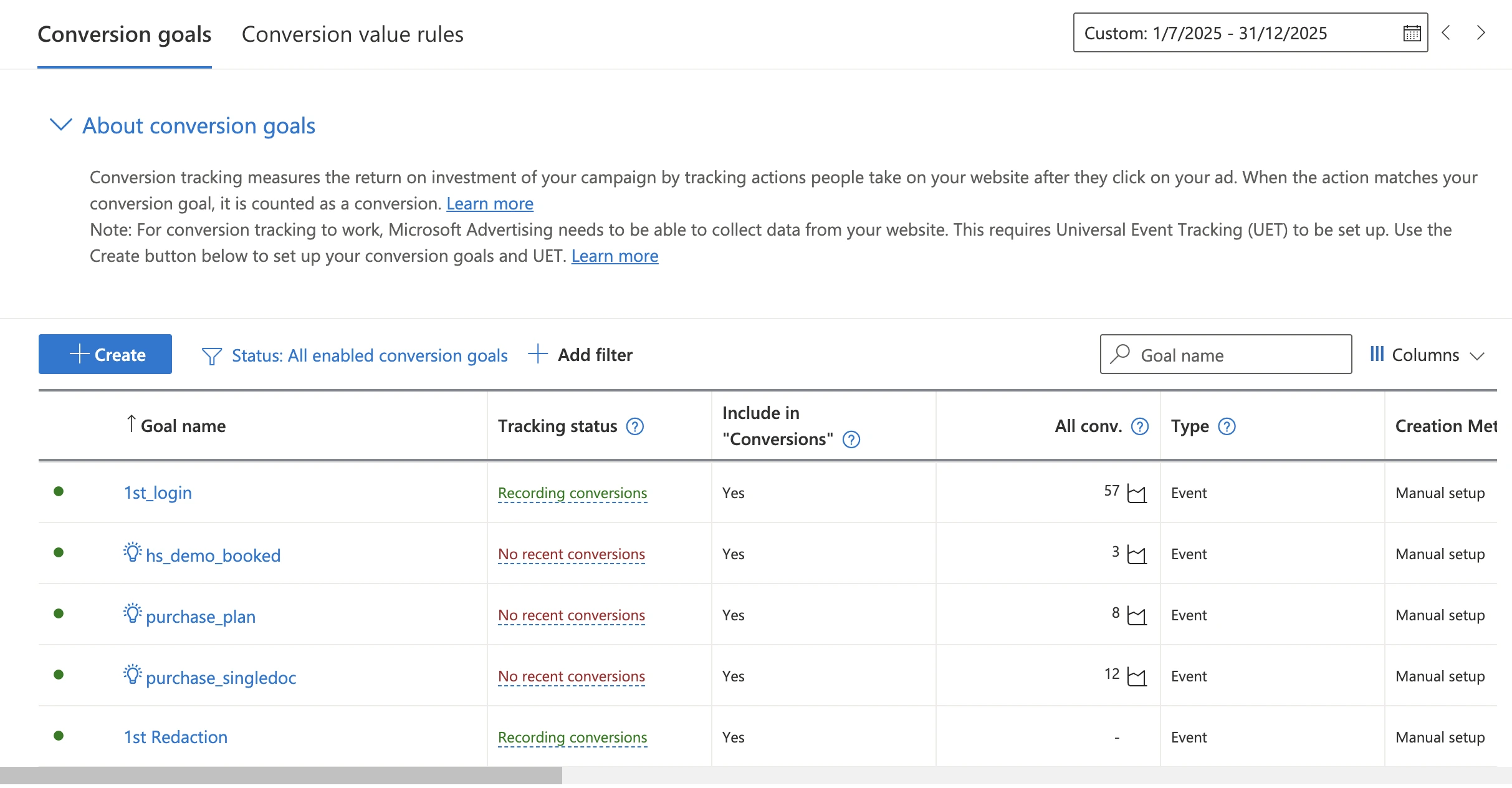
Before: Jul 1 - Dec 31, 2025
(click to enlarge)
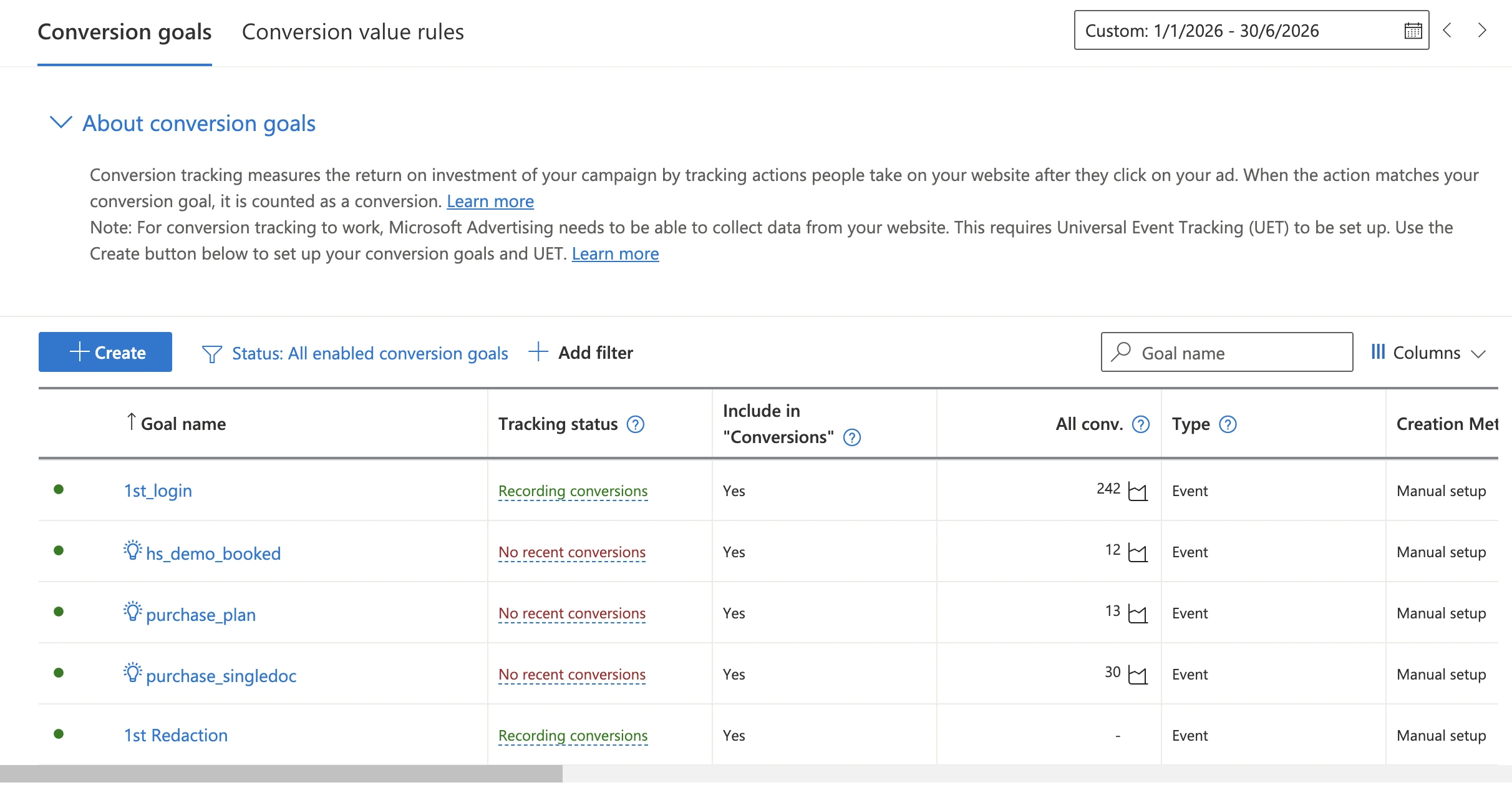
After: Jan 1 - Jun 30, 2026
(click to enlarge)
Against the client's monthly targets
97% of a 300/mo goal
106% of a 5/mo goal
270% of a 5/mo goal
157% of a 15/mo goal
The account is at or above target on all four goals, trending upward month over month.
Secondary result: the client's ad accounts are connected to HubSpot, and after reviewing the data internally the client reported a marked improvement in the quality of enterprise demo leads since the funnel split. This is a qualitative, client-reported observation rather than a tracked metric in the account data above.
The method: separate funnels by buyer journey, not just by product
When a B2B SaaS product serves two buyer types — self-serve trial users and enterprise demo-seekers — a single blended conversion goal will always get outbid by the cheaper action. Splitting Search into two funnels with two distinct conversion goals, then reinforcing each with its own remarketing and landing page, lets the algorithm optimise for what the client actually cares about instead of defaulting to volume.