The setup
E-commerce businesses with large product catalogues face a hard paid-media question: how do you scale ad spend without letting Google Ads waste budget on products that never convert?
This client is a Canadian e-commerce company operating primarily in the United States, selling dental supplies to both dental offices and individual consumers from a BigCommerce store with nearly 40,000 SKUs. Because the business serves B2B and B2C buyers in the same market, the account mixed professional procurement intent and individual consumer intent inside one Google Ads structure.
The real challenge was not generating sales — the account was already profitable. It was scaling revenue while keeping total marketing costs, ad spend and management fees combined, under 15% of revenue.
Challenge
Google Ads
37% of ad spend was going toward products with zero revenue.
Out of nearly 40,000 SKUs, around 35,000 products were receiving no traffic at all.
Performance Max campaigns were mixing B2B and B2C messaging, creating unclear signals.
The client was often priced higher than key competitors.
Any scaling had to keep total marketing costs under 15% of revenue.
Meta Ads
Catalog campaigns had never been launched.
Audiences were too narrow and creative variety was limited.
Messaging leaned almost entirely on clearance products and an "overpaying with other suppliers" angle.
The channel had spent only CA$1,460.56 at a 1.72 ROAS — the client needed a 7.00 minimum purchase ROAS before scaling spend.
What we did on Google Ads
Campaign restructure & product segmentation
We separated stronger-performing products from weaker ones so budget allocation became controllable. The lowest-performing products were excluded from the main campaigns, redirecting budget toward products with real revenue potential.
Zero-revenue product exclusions
With 37% of spend going to products generating no revenue, we identified and excluded those SKUs from the main campaign structure — stopping Google from pushing traffic toward products that were never going to contribute to profitable growth.
A dedicated campaign for a high-potential category
Keyword and product-level research surfaced one product category with a strong revenue opportunity. Instead of leaving it inside a broader structure, we isolated it into its own campaign with focused budget, bidding and optimisation.
B2B and B2C messaging split
We separated messaging so each audience received relevant copy: dental-office supply needs, bulk purchasing, professional use and reliable availability for B2B; convenience and direct online ordering for B2C. We also audited ad asset performance, removing weak headlines and descriptions and replacing them with variations built on angles that were already working.
Controlled product discovery
With around 35,000 products receiving no visibility, we launched campaigns aimed specifically at zero-traffic and underexposed SKUs. That gave Google room to discover hidden high performers without disrupting the efficiency of the core campaigns.
Results
CA$396K → CA$764K on Google Ads in seven months
2,515 → 5,277, at a 15.5% lower cost each
Up from 1.72 on a channel that was barely running
Google Ads: before vs. after
Mar - Sep 2025 (before) vs. Oct 2025 - Apr 2026 (after)
| Metric | Mar - Sep 2025 | Oct 2025 - Apr 2026 | Change |
|---|---|---|---|
| Total spend | CA$57,636.49 | CA$102,202.99 | +77% |
| Purchases | 2,514.86 | 5,277.28 | +110% |
| ROAS | 7.86 | 8.48 | +8% |
| Cost per purchase | CA$22.92 | CA$19.37 | -15.5% |
| Revenue | CA$453,156.78 | CA$866,616.54 | +91% |
| Profit | CA$395,520.29 | CA$764,413.55 | +CA$368,893 |
This is the core of the project: the account did not simply spend more. It generated more purchases, improved ROAS, reduced cost per purchase, and significantly increased revenue and profit — all while staying inside the client's profitability requirement.
What we did on Meta Ads
Launched catalog campaigns
We launched catalog campaigns supporting both dynamic prospecting and dynamic remarketing. Prospecting was seeded with the best-performing products identified in Google Ads, so Meta promoted products with proven conversion potential from day one. Several remarketing audiences targeted users at different funnel stages who had not yet purchased.
Tested static ads across three core audiences
Dentists, a 3% lookalike built on purchasers, and a broad US audience. The Dentists audience performed best, so budget shifted toward that ad set. The strongest creative angle was a general message about refilling dental supplies smarter, built around the client's core selling points.
Optimised toward what was working
The first months were learning months, starting around a 3.77 ROAS. Once the strongest audiences, ads and messaging angles were clear, we narrowed the structure toward them — lifting performance to a 9.95 ROAS while holding monthly spend stable for three months.
Launched new campaigns on proven signals
We built a new campaign around the dentists audience and its best-performing creative angles, generating additional revenue at an 8.19 ROAS. Reporting also showed four states delivering significantly higher ROAS than the rest, so we launched a dedicated campaign for those states — adding further revenue at an 8.34 ROAS.
Meta Ads: before vs. after
Mar - Sep 2025 (before) vs. Oct 2025 - Apr 2026 (after)
| Metric | Mar - Sep 2025 | Oct 2025 - Apr 2026 | Change |
|---|---|---|---|
| Total spend | CA$1,460.56 | CA$8,316.36 | +469% |
| Purchases | 23 | 433 | +1,783% |
| ROAS | 1.72 | 9.53 | 5.5x |
| Cost per purchase | CA$63.50 | CA$19.21 | -69.7% |
| Revenue | CA$2,508.55 | CA$79,261.16 | +31.6x |
| Profit | CA$1,047.99 | CA$70,944.80 | +CA$69,897 |
Meta stopped being a small, underused line item. After the restructure it became a profitable supporting revenue channel that could scale through catalog campaigns, remarketing, stronger audience testing and better-performing creative angles.
Inside the accounts
The client's name, account IDs and login details are hidden throughout. The Google Ads before and after covers exactly the two periods in the table above; the campaign-structure and Meta screenshots were captured in March 2026, so their windows close two months earlier.
Google Ads — campaign structure
The same account before and after the restructure. Ahead of the rebuild almost every campaign sat at zero; afterwards the catalogue is segmented across twelve working campaigns.
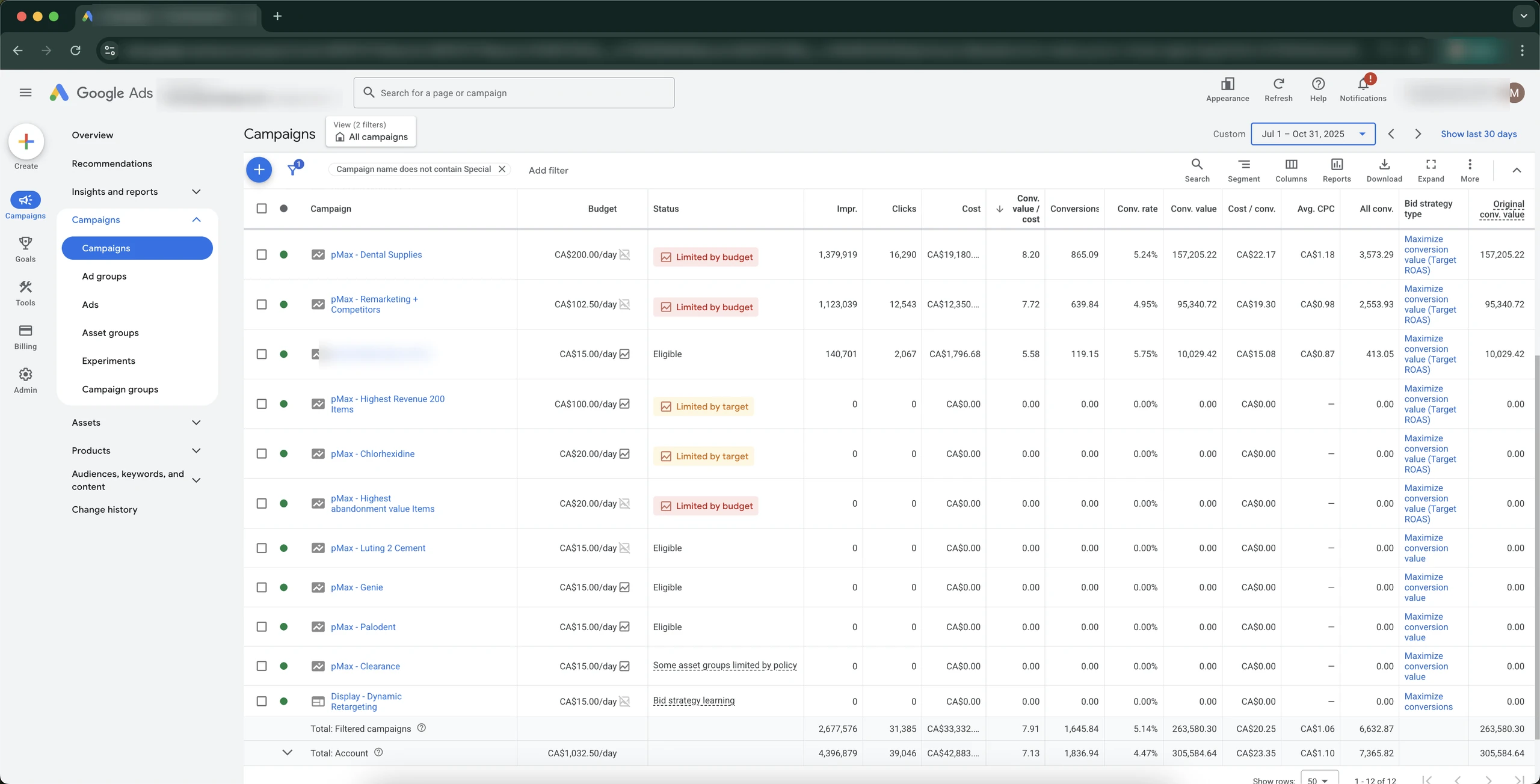
Before: Jul 1 - Oct 31, 2025
(click to enlarge)
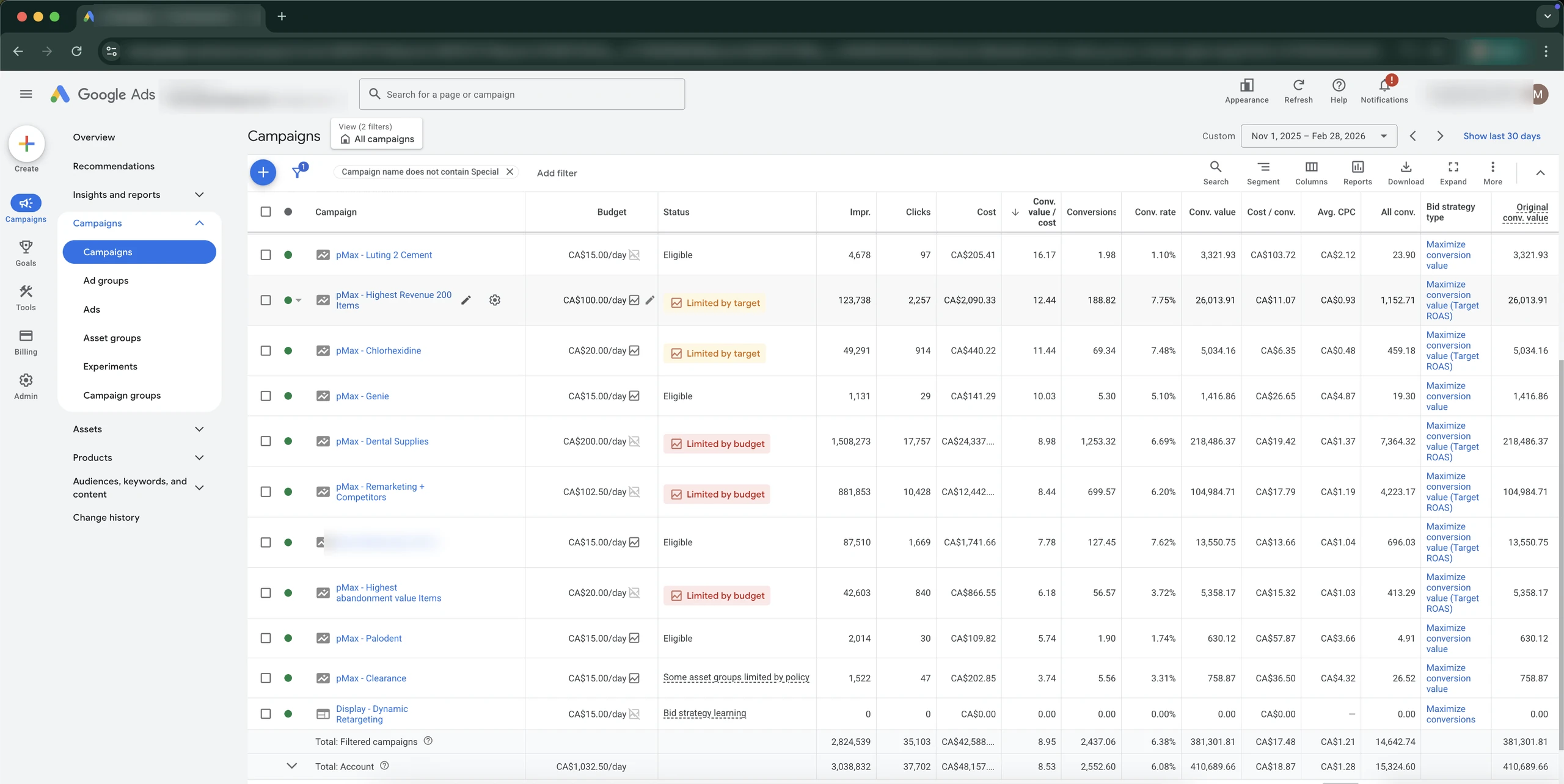
After: Nov 1, 2025 - Feb 28, 2026
(click to enlarge)
Google Ads — before and after
The account over the two periods the table above reports: the seven months before we took over, and our first seven months. Same campaigns, same currency, same conversion action on both sides.
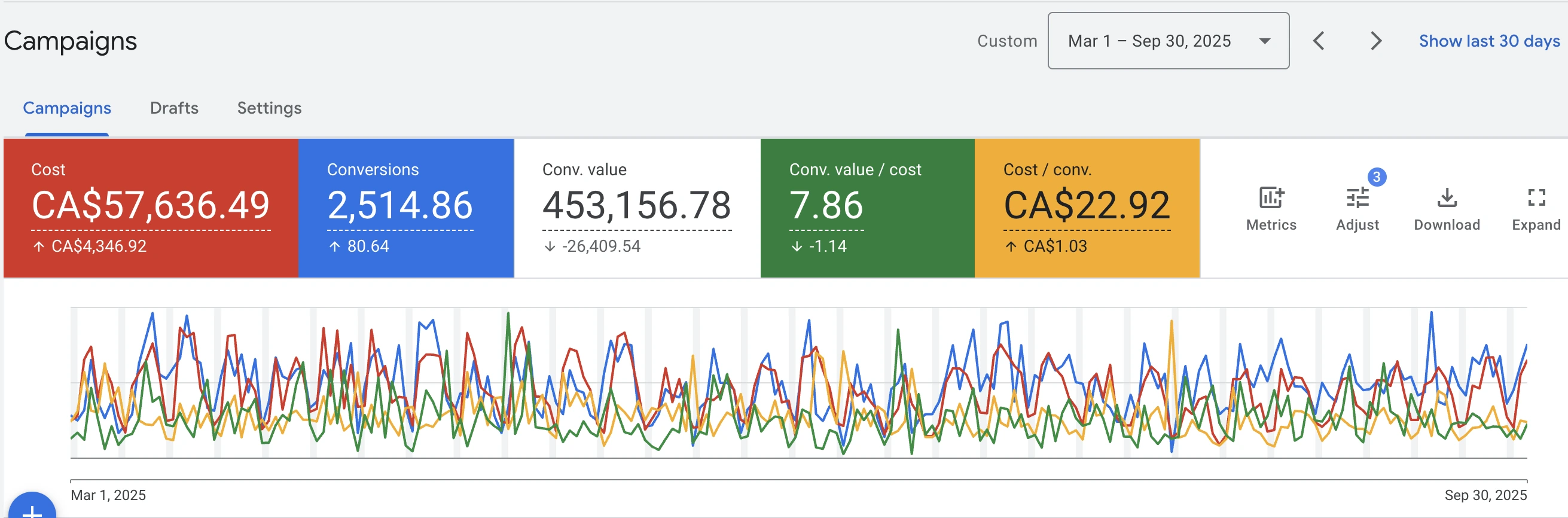
Before: Mar 1 - Sep 30, 2025 — 7.86 ROAS
(click to enlarge)
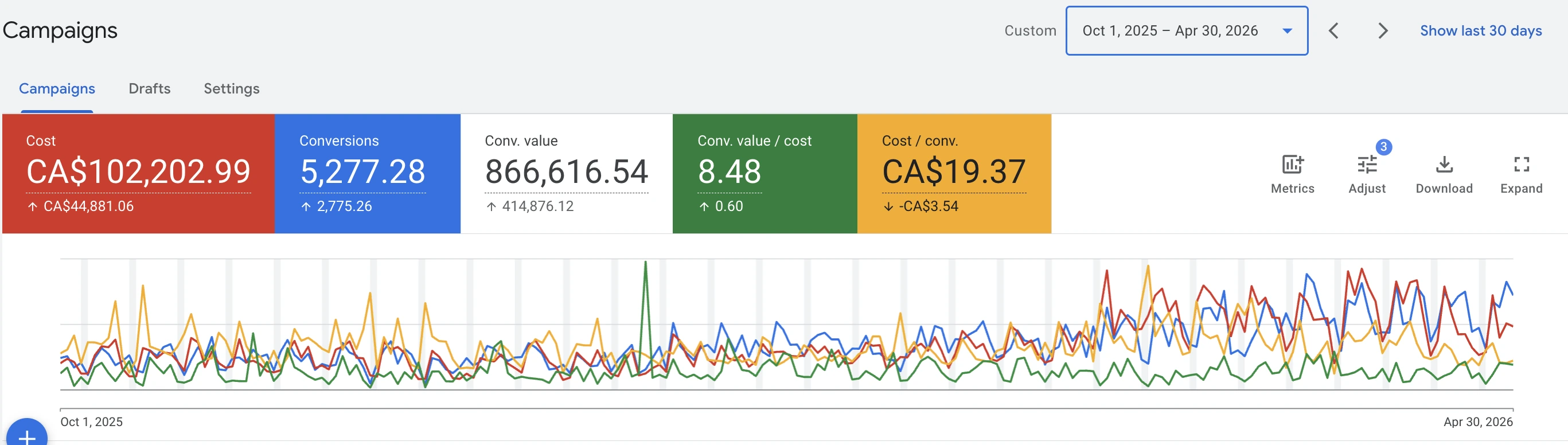
After: Oct 1, 2025 - Apr 30, 2026 — 8.48 ROAS
(click to enlarge)
Meta Ads — return climbing as the structure matured
The same account read over three progressively shorter windows. The more recent the window, the higher the average purchase ROAS — which is what improvement over time looks like in a Meta account.
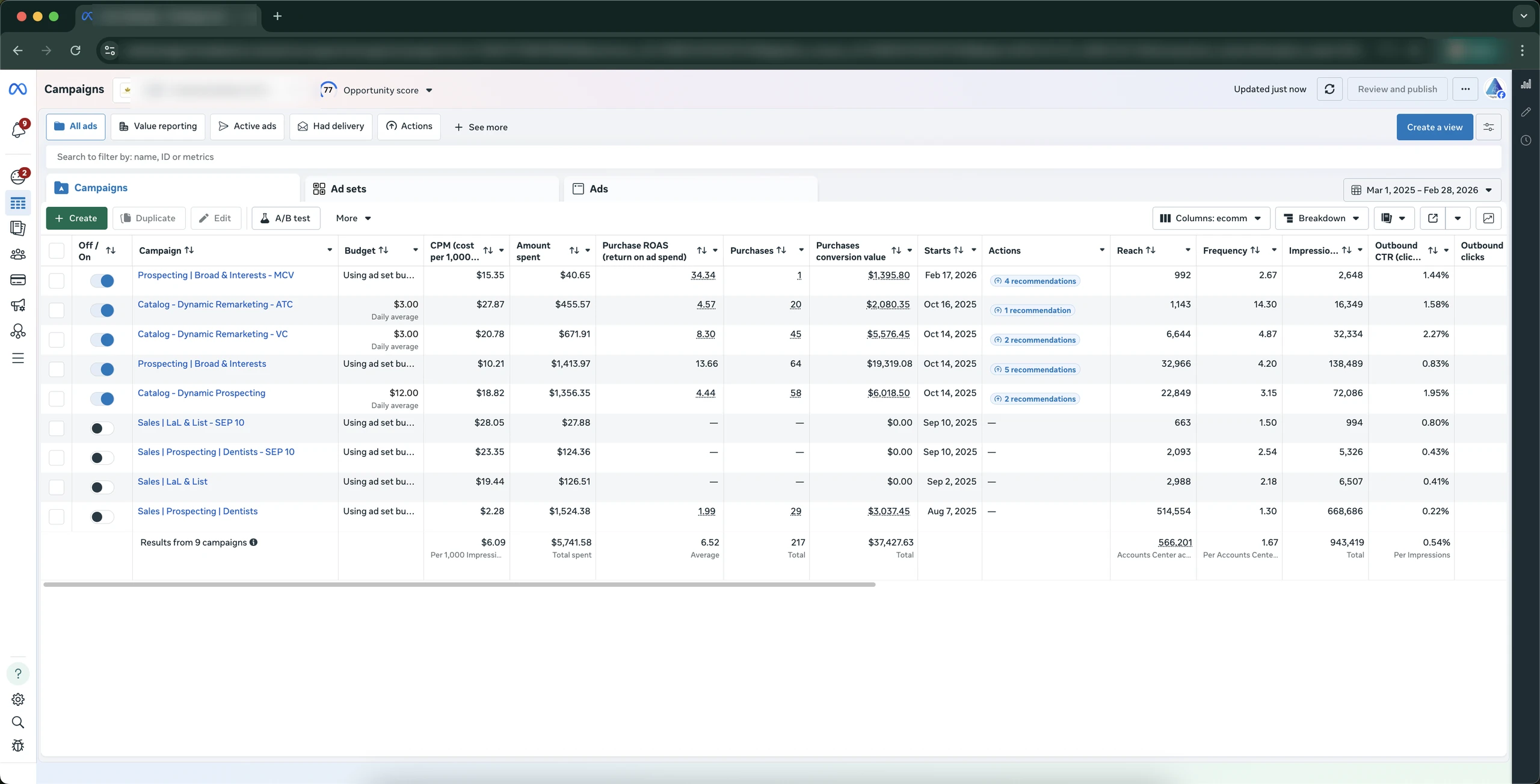
Twelve months: Mar 1, 2025 - Feb 28, 2026 — 6.52 average ROAS
(click to enlarge)
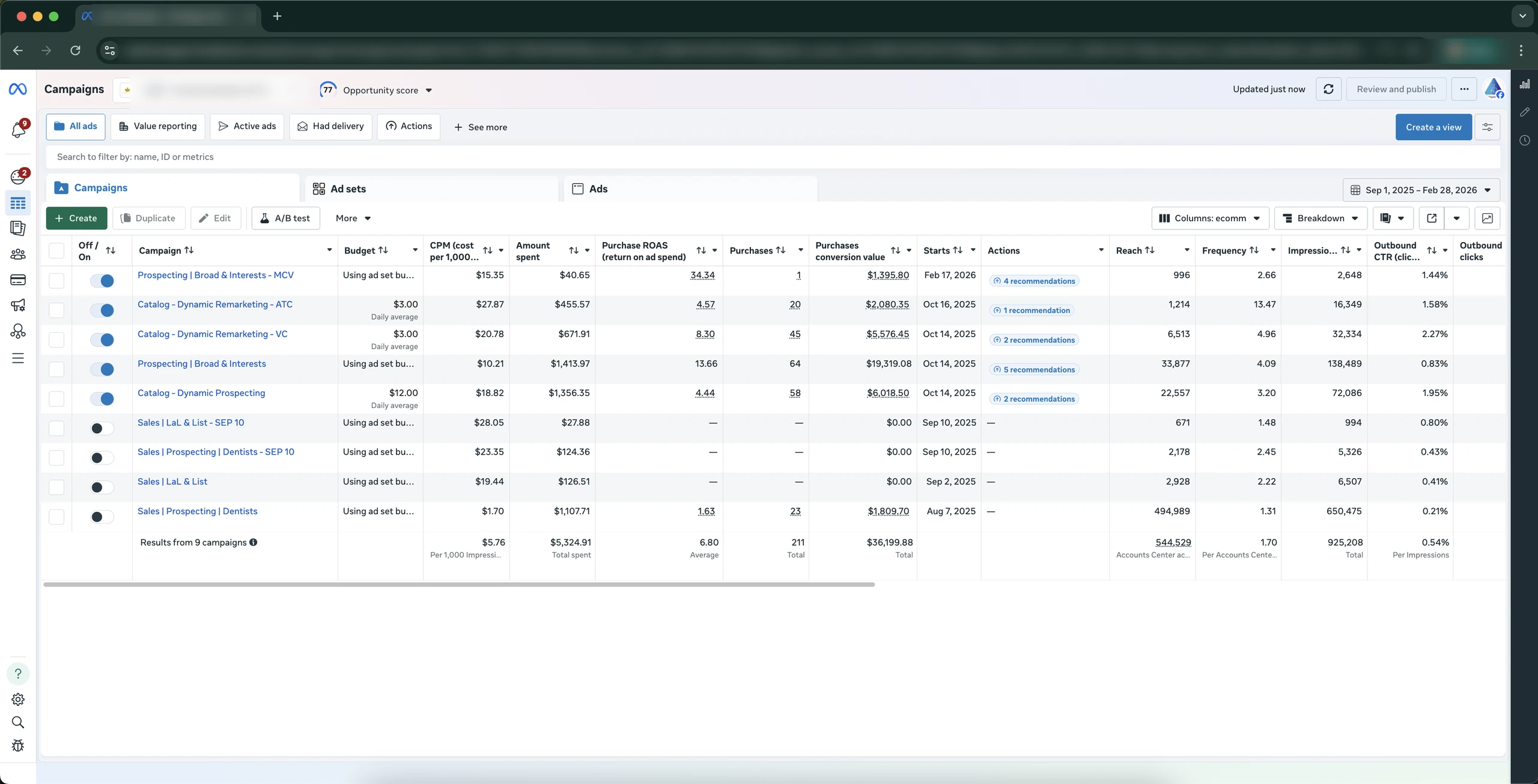
Six months: Sep 1, 2025 - Feb 28, 2026 — 6.80 average ROAS
(click to enlarge)
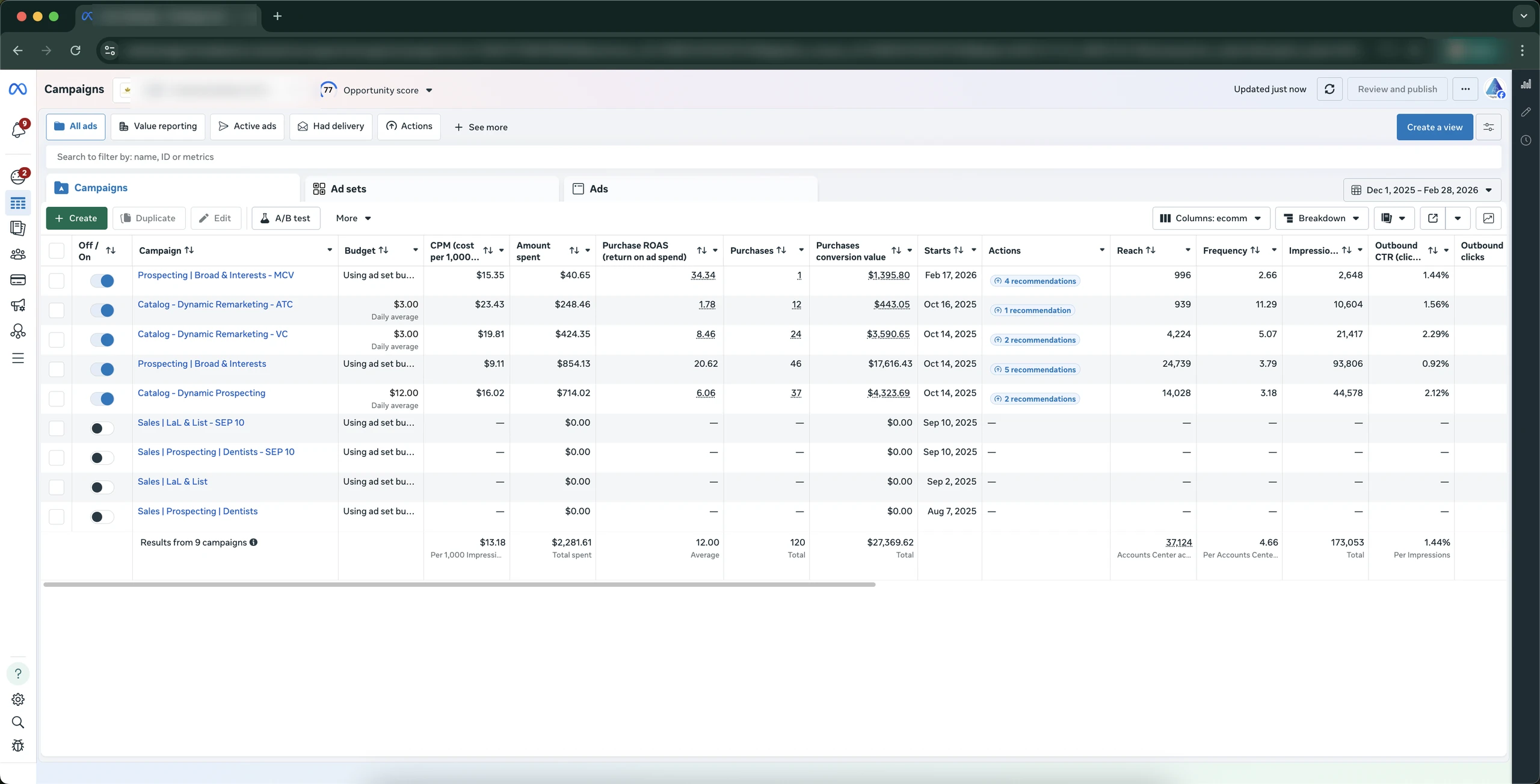
Three months: Dec 1, 2025 - Feb 28, 2026 — 12.00 average ROAS
(click to enlarge)
What's next
Our partnership with this client is ongoing. We continue to optimise, test and scale their campaigns, building on what is working and adapting as the market evolves. Growth in paid media is never a one-time event; it is a compounding process, and we are in it for the long run.