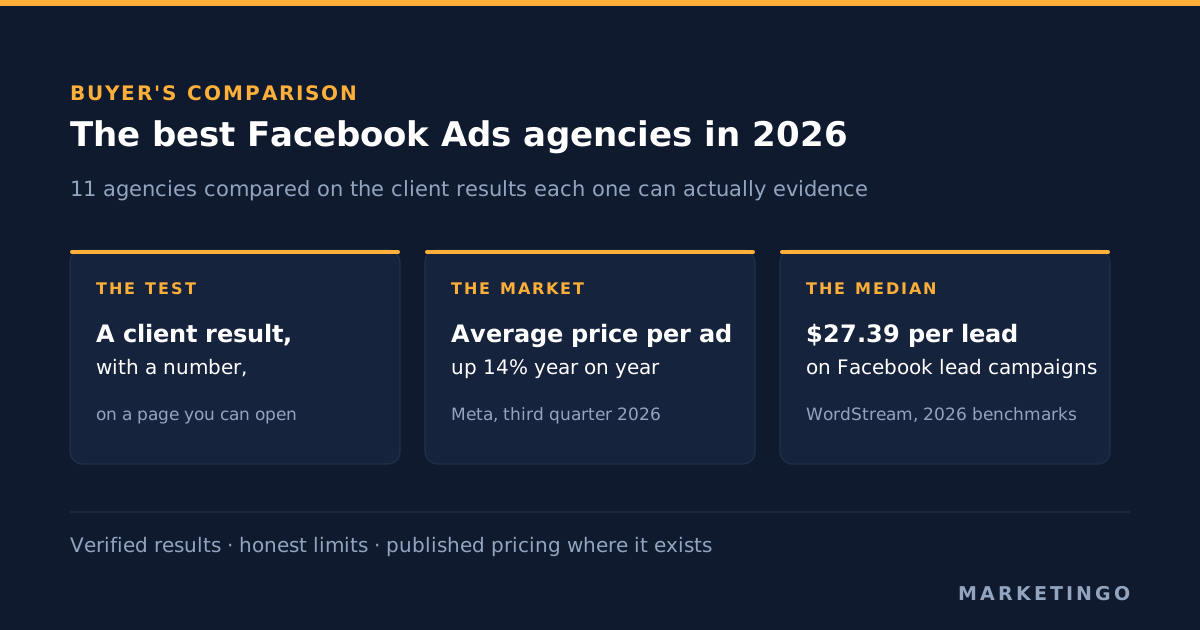
Picking a Facebook Ads agency in 2026 comes down to one test that most shortlists skip: can the agency show you a client result, with a number, on a page you can open yourself. This guide profiles 11 Facebook Ads agencies against exactly that test, with what each one runs, the evidence behind its claims, the agency pricing it will admit to in public, and the advertiser it is actually built for. Some are paid social specialists, some are a full-service digital marketing agency with a strong Meta practice, and the difference decides which one suits you.
The test matters because the price of Facebook inventory keeps moving. Meta's average price per ad rose 14% year over year in the third quarter of 2026 while impressions grew 10%, as Meta reported on 21 October 2026. Facebook remains the largest social network available to advertisers, with Meta reporting 3.64 billion daily active people across its apps in September 2026, so the inventory is not the problem. The price of reaching it is. An ad agency that was keeping you level last year is losing you ground this year unless it is earning that difference back in creative, targeting and measurement.
Two housekeeping notes. If you sell direct to consumer and Meta is your main acquisition engine, the companion list of Meta Ads agencies for ecommerce goes deeper on catalogue, creative volume and contribution margin, and it is the better page for you. If you want the broader paid search and paid social field rather than Facebook specifically, the general PPC agency comparison covers that ground. This page is for the buyer whose question is narrower: who should run my Facebook and Instagram advertising.
At a glance: the 11 best Facebook Ads agencies
| Agency | Best for | Core channels | Strongest evidence | Certifications |
|---|---|---|---|---|
| 1. MarketinGO | Facebook run on one profit number alongside Google and Microsoft | Meta, Google, LinkedIn, Microsoft | 3.2 to 11.2 return on ad spend, consumer electronics | Google Partner, Meta Business Partner |
| 2. KlientBoost | Facebook paired with landing pages and conversion testing | Meta, Google, LinkedIn, SEO, CRO | gorjana: Facebook revenue up 77% | Google, Microsoft, Meta partner listings |
| 3. The Social Shepherd | Consumer brands that need creative volume | Meta, TikTok, Pinterest, organic social | SNKR Supplies: 50 to 2,500 orders a month | Awards, no partner badge |
| 4. Single Grain | Meta demand creation that feeds branded search | Meta, Google, SEO, content | Schumacher Homes: cost per lead $125 to $72 | Google Premier Partner |
| 5. SmartSites | Meta inside a Google, Microsoft and email mix | Meta, Google, Microsoft, email, SEO, web | Club Furniture: Meta revenue up 158% | Meta Business Partner, Google Partner |
| 6. Sociallyin | Paid social inside a full social programme | Meta, TikTok, Reddit, influencer, organic | Bearpaw: 5.72x return on $35,977 spend | Meta, Google, TikTok, Reddit partners |
| 7. NoGood | Venture-funded brands scaling past easy audiences | Meta, TikTok, Google, lifecycle, creative | Cameo: Meta revenue up 113% to $4.9M | None claimed |
| 8. Disruptive Advertising | Facebook paired with conversion rate work | Meta, Google, Amazon, email, CRO | Nani Swimwear: revenue up 510% | Google Premier Partner, Meta Business Partner |
| 9. WebFX | Published pricing and predictable management | Meta, Google, Microsoft, Amazon, SEO | Kent County: cost per lead improved 82% | Meta partner, Google Premier Partner |
| 10. Ignite Visibility | Franchise and multi-location Meta | Meta, Google, SEO, web, email | Franchise lead growth 72.7%, client unnamed | Google Premier Partner, Meta partner |
| 11. LYFE Marketing | Small local budgets under $2,500 a month | Meta, Google, Microsoft, email, SEO | Lady Ease: $2.52 cost per lead | Meta Business Partner, Google Partner |
How we selected these Facebook Ads agencies
Evidence you can open. Every agency here publishes at least one client result with a figure attached, and every figure quoted below links to the page that states it. Where an agency's best Facebook number belongs to an unnamed client, or where the platform is not named on the page, that is said plainly rather than smoothed over. Three of the eleven have weaker published proof than their size suggests, and the profiles say which three.
Facebook and Instagram as a real practice, not a checkbox. Several large agencies sell Meta as one line on a menu of thirty services. That is not disqualifying, because plenty of advertisers want one supplier for search and social. It does change who the agency suits, so each profile states how central paid social actually is to the business.
Certifications that can be checked. Meta Business Partner and Google Partner status are directory facts, not adjectives. Where an agency states a tier on its own site, the profile repeats it with that caveat. Where an agency claims two different Meta tiers on two of its own pages, which one here does, the profile says so.
Honest limits. Every profile carries a section on what the agency does not do and who should not hire it. An agency that is wrong for your budget, your model or your market is wrong no matter how good its case studies are.
Relevance to a Facebook buyer. The shortlist leans towards agencies whose Facebook work is documented and current, and it deliberately mixes consumer specialists with agencies that serve B2B companies, because the two buy Facebook for different reasons. Two well-known paid social shops were left out for the opposite reason: their recent published work has moved into other channels, which is a fine business decision and a poor reason to hand them your Meta account today.
What a Facebook Ads agency actually does in 2026
The job has changed shape. Manual interest stacking and audience building used to be most of it; Meta's own automation now does the bulk of the targeting, and Advantage+ campaigns hand the machine the budget allocation too. What is left for the agency is the part the automation cannot do for you.
Creative supply. Automated delivery needs something to choose between. An agency running a serious Facebook account is producing and retiring ad creative on a schedule, because creative fatigue is now the main reason a profitable account stops being profitable. Agencies that cannot produce video and static at volume, in-house or through a partner studio, hit a ceiling quickly.
Measurement that survives the browser. Pixel-only attribution under-reports. Server-side tracking through Meta's Conversions API, offline conversion uploads and a blended view of spend against actual revenue are what separate an agency that reports platform numbers from one that reports your numbers. Ask any shortlisted agency how it reconciles Meta's reported conversions with the orders or leads in your own system.
Offer and landing experience. A Facebook click lands somewhere. Agencies that treat the destination as the client's problem leave most of the available gain untouched, which is why two of the agencies below sell landing page and conversion rate work as part of the same engagement.
Spend discipline. Facebook users are not infinite and neither is your advertising budget, but Meta will spend whatever you give it. The agency's value shows in the decisions about when to scale, when to hold and when to accept that an audience is exhausted, measured against a profit figure rather than in-platform return on ad spend.
What a Facebook Ads agency should deliver every month
Scope conversations go better when both sides know what the month actually contains. A Facebook ads management engagement that is working produces most of the following, and an agency that cannot say which of them it owns is selling you access rather than campaign management.
New creative, on a schedule. A named number of new static and video ads each month, written and produced rather than recycled from your website. Ad copy is tested against the creative rather than bolted to it, and losing concepts are retired instead of being left running at a trickle. For a catalogue business that includes dynamic product ads built from a clean feed, not just hand-made single-image posts.
A targeting and exclusion plan you can read. Meta's automation chooses most of the delivery, which makes the remaining choices more consequential, not less: which signals define your target audience, which customer lists are excluded, where the broad campaigns end and the retargeting begins. Ask to see it written down.
A measurement layer that reconciles. Server-side events, deduplication against the browser pixel, and a monthly view that puts Meta's reported conversions next to the orders or leads in your own system. The gap between those two numbers is the single most useful line in the report, and most agencies never show it.
One named account manager and one monthly conversation. Not a shared inbox. The monthly conversation should start from your business goals and the advertising budget they justify, then work backwards to ad performance, rather than opening on impressions and brand awareness and hoping nobody asks about revenue.
A written view on what to stop. The best signal of a serious media strategy is an agency that proposes cutting something: a saturated audience, a campaign that only converts people who were going to buy anyway, a channel that your return on investment no longer supports.
Agencies that sell marketing services across many channels will bundle some of this into a wider retainer; paid social specialists usually itemise it. Either is fine, as long as the deliverables are named in the contract and not left as an atmosphere.
What Facebook advertising costs before anyone manages it
Benchmarks are a sanity check, not a target. WordStream's 2026 Facebook Ads Benchmarks, reported by PPC Land on 14 September 2026, put the median cost per lead for lead campaigns at $27.39, roughly flat year on year, with a median cost per click of $1.80 and a median click-through rate of 2.70%. Traffic campaigns ran at a median $0.60 per click.
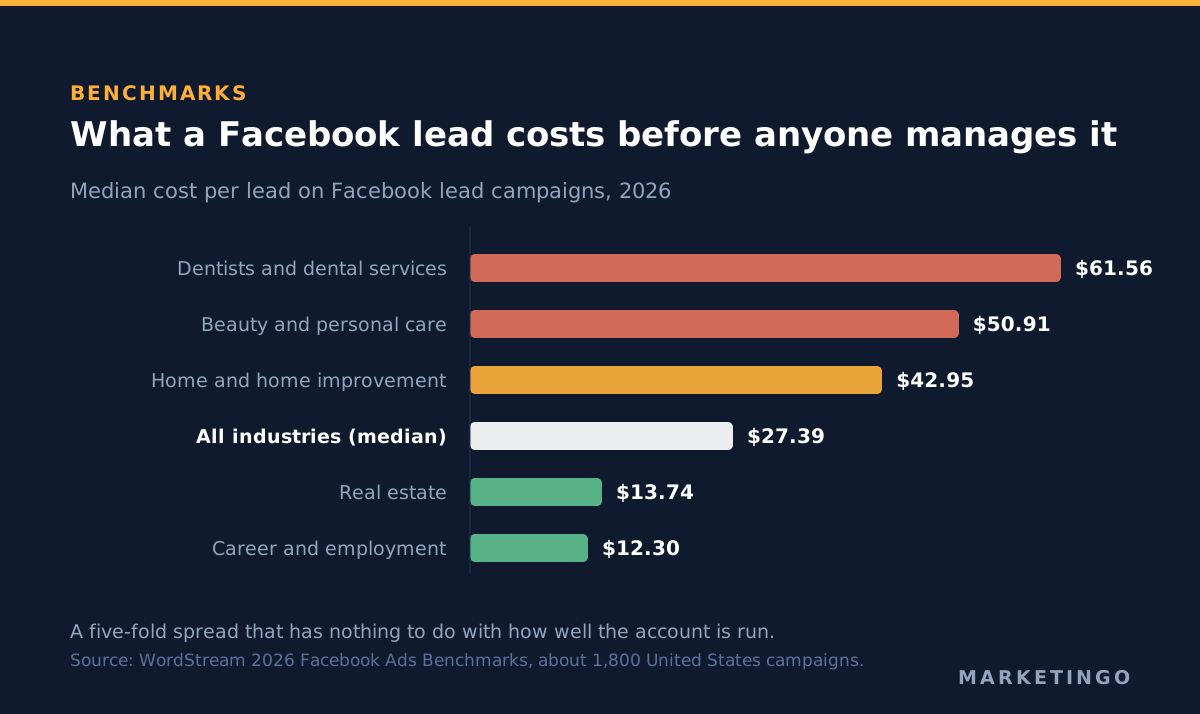
The spread by category is the part worth reading. The same benchmark set puts dentists and dental services at $61.56 per lead and career and employment at $12.30, a five-fold difference that has nothing to do with how well either account is run. Any agency that quotes you a flat cost per lead target without asking what you sell is guessing.
Read those figures as medians across roughly 1,800 campaigns, which is a small sample once it is cut by industry. PPC Land notes that some category lines rest on as few as four campaigns. They tell you whether you are in the right postcode, not whether you are in the right house.
Agency ad accounts: the question behind half these searches
A large share of people searching for a Facebook ads agency are not looking for an agency at all. They are looking for an agency ad account: a Meta ad account held by a reseller and rented out, usually marketed as having higher spending limits or surviving bans.
Here is the honest position. Meta documents only one legitimate arrangement for agency access, and it is partner permissions inside Business Manager: you own the ad account, the Page and the dataset, and you grant the agency access to them. Any agency that insists on running your spend through an account you do not own, or that sells access to a "whitelisted" account as its main value, is offering you something other than media buying. You cannot take the account with you when the relationship ends, your spending history and learnings do not belong to you, and if that account is restricted your campaigns stop.
Ask any Facebook Ads agency a single question before you sign: will my business own the ad account, the Page and the pixel or dataset. If the answer is anything other than yes, the rest of the conversation does not matter.
MarketinGO 1. MarketinGO: best for Facebook run on one profit number alongside Google and Microsoft
Founded: 2019 · HQ: Chisinau, Moldova, serving the United States and Europe · Team: ~5 senior operators · Website: marketingo.com
Most Facebook problems are not Facebook problems. An account looks like it is failing on Meta when the real issue is that Meta is being judged on its own reported return while Google takes credit for the same purchase, or that the offer converts badly for everyone and only paid social is being blamed. MarketinGO runs Facebook and Instagram inside the same plan as search, on one shared view of what a customer actually costs.
What they do. Paid media across Meta, Google, LinkedIn and Microsoft, with the conversion tracking, server-side measurement and landing page work that hold the measurement together. A typical engagement starts with two or three channels rather than all four, picked on where the demand already is, and senior operators stay on the account instead of handing it to a junior after onboarding. Facebook ad campaigns are planned against the same target and the same reporting as search, so nobody has to argue about which channel optimised itself at the other's expense. Clients describe going live in about a week rather than a quarter.
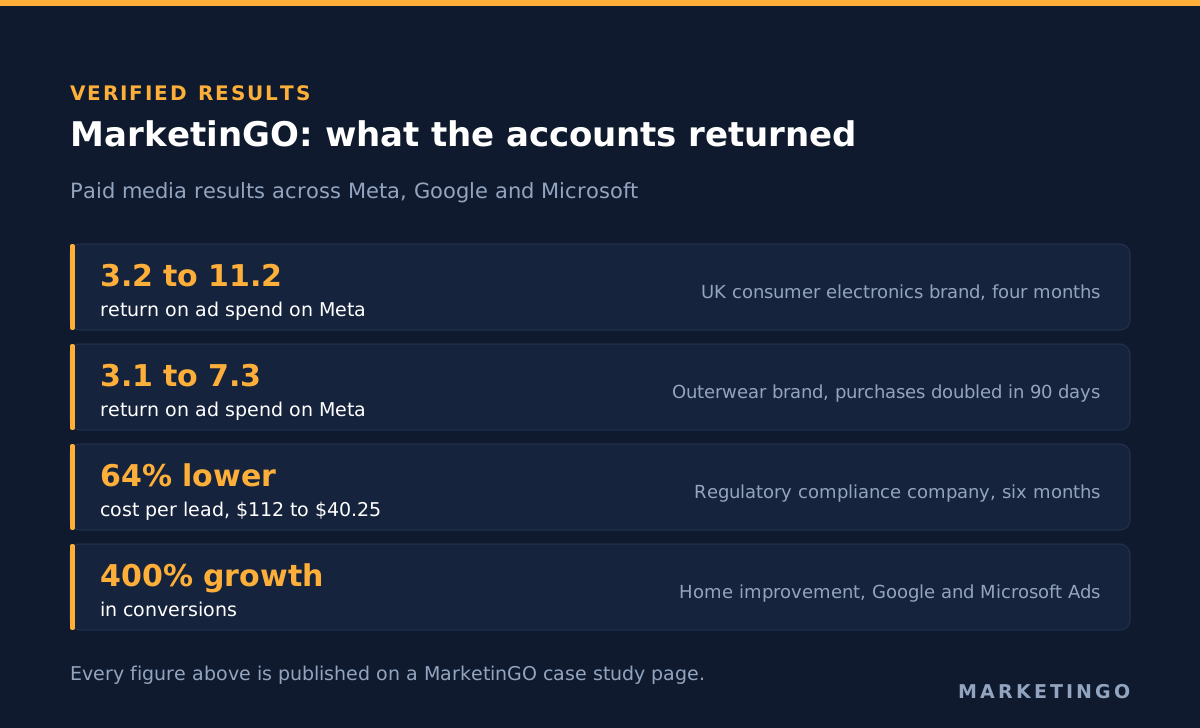
Verifiable results. For a UK consumer electronics brand, MarketinGO took return on ad spend from 3.2 to 11.2 on Meta, going from a standing start to profitable scale in four months. For a fashion brand selling waterproof outerwear, Meta return on ad spend moved from 3.1 to 7.3 with purchases doubling in 90 days, and that was achieved in the brand's off-season rather than its peak. On the lead generation side, a regulatory compliance company saw cost per lead fall 64%, from $112 to $40.25, with 557 additional high-value leads on $4,000 less spend over six months.
Ideal fit. Two kinds of advertiser. Direct to consumer brands where Facebook and Instagram carry demand creation and the question is whether scaling it still makes money after cost of goods. And high-ticket business to business companies using Meta for demand creation above a search campaign that is already capturing everything available, where the metric is cost per qualified lead rather than in-platform return. Both get the same thing: a team that will tell you to stop spending on a channel when that is the right answer.
Where it stops. Paid media only. No search engine optimisation retainers, no content marketing, no email or lifecycle programme, no organic social management, no outbound sales. A brand that wants one supplier for everything should hire a full-service shop from further down this list and accept the trade in depth. MarketinGO is also not a brand studio: it produces performance creative for the channels it runs, not brand identity work.
Certifications: Google Partner and Meta Business Partner. Pricing. A managed monthly engagement scoped to the channels and spend involved, quoted after an account review rather than from a rate card.
KlientBoost 2. KlientBoost: best for Facebook paired with landing pages and conversion testing
Founded: 2015 · HQ: Santa Monica, California, with offices in Raleigh and London · Team: ~80 specialists · Website: klientboost.com
KlientBoost built its reputation on a specific argument: the ad is only half the test, and the page behind it is where most of the lost money sits. That argument shapes the engagement, which usually bundles paid social with landing page design and conversion rate testing rather than treating them as separate projects.
What they do. Facebook and Instagram advertising, Google Ads, LinkedIn Ads, landing page design and conversion rate optimisation, search engine optimisation and content, email marketing, performance creative, plus their own in-house tracking software. Their Meta advertising work is sold alongside the page it sends traffic to rather than as a standalone channel. Paid media is the centre of the business. They do not sell web development or organic social management.
Verifiable results. For gorjana, the jewellery brand, KlientBoost reports Facebook revenue up 77% and Facebook return on ad spend up 48%, alongside Google revenue up 88%. The case study library is large and published as downloadable documents, which is more evidence than most agencies of this size make public, though a good share of those documents date from 2021.
Ideal fit. Advertisers who suspect their Facebook problem is partly a landing page problem, and who want one team holding both. It also suits companies running Facebook and Google together where the same conversion rate work benefits both channels. Lead generation businesses are well served here.
Where it stops. No published minimum retainer, so budget qualification happens on a sales call rather than before it. The headline figures on their own site are self-reported quarterly goal-hit rates rather than named client outcomes, and the named client evidence skews older than the marketing implies. No web development, no organic social, no Amazon.
Certifications: Google, Microsoft Advertising and Meta Business Partner directory listings, with no tier stated on the page. Pricing. Not published; three unnamed engagement options with figures given on request.
The Social Shepherd 3. The Social Shepherd: best for consumer brands that need creative volume
Founded: 2018 · HQ: Bath, England, with hubs in London, New York and Miami · Team: ~74 people · Website: thesocialshepherd.com
Of the agencies on this list, The Social Shepherd is the one whose business is most weighted towards Meta. Paid social and video production dominate its service mix, and the creative is made in-house rather than briefed out, which is the difference that shows when an account needs forty new assets a month rather than four.
What they do. Facebook and Instagram advertising, paid search, feed optimisation and shopping, organic social strategy and community management, social video, motion design, influencer and user-generated content campaigns, and TikTok Shop. The client base is consumer: ecommerce, retail and hospitality, and content creation is a larger share of the engagement than at any other agency here.
Verifiable results. For SNKR Supplies, the agency reports Facebook and Instagram advertising taking the business from 50 orders a month to 2,500, a 25-fold increase in monthly sales, with campaigns reaching more than 10 million people. They also publish an anonymised ecommerce case where Facebook return on ad spend moved from 2.45 to 5.4 with sales up 118% on the same spend and £1,601,205 attributed to the Facebook campaigns.
Ideal fit. Consumer brands with a visual product and a real creative appetite, particularly in the United Kingdom and Europe, that want paid and organic social run by the same team. If your Facebook account has plateaued because you are recycling the same three creatives, this is the shape of agency that fixes it.
Where it stops. No business to business, no software as a service, no lead generation: this is a consumer shop. Several of their named case study pages carry a results heading with the results block left empty, which is a real gap in the published proof and worth raising directly in a sales conversation. They claim no Meta or Google partner badge, leading with awards instead. Little Google-side depth, no email or lifecycle, no search engine optimisation.
Certifications: None claimed. Awards include UK Social Media Agency of the Year 2025. Pricing. Not published; the agency declines to give figures publicly.
Single Grain 4. Single Grain: best for Meta demand creation that feeds branded search
Founded: 2009, acquired by Eric Siu in 2014 · HQ: remote-first, Los Angeles registered · Team: ~20 people · Website: singlegrain.com
Single Grain's most useful Facebook work is the kind that does not look like direct response at all. They run top-of-funnel Meta video with the explicit goal of lifting branded search volume, then measure the search side to see whether the social spend worked. That is an unfashionable way to buy Facebook and a sensible one for considered purchases.
What they do. Search engine optimisation is the largest line of the business, followed by paid search and paid social, conversion rate work, content marketing, Reddit and podcast advertising, and a growing practice around visibility inside AI assistants. They also publish their own software products.
Verifiable results. For Schumacher Homes, a Meta top-of-funnel video campaign cut cost per lead 42%, from $125 to $72 month on month, added 35 qualified leads a month and lifted branded searches 25%, from 80,000 to 100,000. For Klassy Network, a Meta email collection campaign before a sale produced 656 new email addresses at $1.70 each and more than $48,000 in revenue from $1,115.20 of ad spend. That second figure is worth reading carefully: it is a real result on a very small budget, and the page's own return on ad spend arithmetic does not quite reconcile.
Ideal fit. Considered-purchase businesses where the buying cycle is long enough that Facebook's job is to create demand that search later captures. Home services, construction, financial services and higher-ticket business to business all fit that shape.
Where it stops. The smallest team on this list against one of the highest stated minimums, which means a thin bench if your account is demanding. The agency is currently repositioning towards AI and answer-engine visibility, so its newest published work is not paid social. No in-house creative studio at the volume a consumer brand would need, and no Meta partner status claimed.
Certifications: Google Premier Partner. No Meta Business Partner claim found. Pricing. Not published; third-party directories list a minimum engagement around $10,000.
SmartSites 5. SmartSites: best for Meta inside a Google, Microsoft and email mix
Founded: 2011 · HQ: Paramus, New Jersey, with a largely remote team · Team: ~370 worldwide · Website: smartsites.com
SmartSites publishes more Meta-specific client outcomes on one page than anybody else here, which is unusual for an agency whose centre of gravity is search and web. If your Facebook account is one channel in a wider mix that already includes Google, Microsoft and email, this is the shape of supplier that handles all of it without a handover between teams.
What they do. Paid media across Meta, Google, Microsoft, TikTok, Reddit, Amazon and connected television; organic search; email and text message marketing; social media marketing; and web design. Search and web are the largest parts of the business, with Meta a well-documented line within paid media.
Verifiable results. For Club Furniture, SmartSites reports Meta Ads revenue up 158%, conversions up 140% and click-through rate up 105%, with account-level return on ad spend up 465%. Their Meta Ads management page lists further named clients, including Recon Recovery at 982% more conversions and Cristallini at 235% higher return on ad spend.
Ideal fit. Small and mid-sized businesses that want paid social, paid search and email under one roof with a single point of contact, and ecommerce brands running Klaviyo alongside Meta who benefit from the two being coordinated.
Where it stops. Every published figure is a percentage lift from an undisclosed baseline. No absolute spend or revenue numbers appear anywhere, which makes a 2,765% revenue increase impossible to size. With 370 staff and hundreds of case studies, accounts are run by pooled teams, so a brand that wants a senior Meta strategist personally on the account should press hard on who is doing the work. No public pricing and no evidence of in-house video production at volume.
Certifications: Meta Business Partner, Google Partner, Microsoft Advertising Select Partner, Klaviyo Platinum Master Partner. Pricing. A monthly management fee plus ad spend, with no public rate card.
Sociallyin 6. Sociallyin: best for paid social inside a full social programme
Founded: 2011 · HQ: Atlanta, Georgia · Team: 50 to 249 people · Website: sociallyin.com
Sociallyin is a social-native agency that happens to buy media, rather than a media buyer that also posts. That ordering matters: the paid work sits inside strategy, content production, community management and influencer programmes, so the ads and the feed say the same thing.
What they do. Social strategy, social media management, community management and listening, content production, paid social advertising, influencer marketing, social selling, and a newer practice around Reddit and visibility inside AI assistants.
Verifiable results. For Bearpaw Footwear, Sociallyin reports a 5.72x blended return on ad spend across Facebook and Instagram on $35,976.57 of spend, producing $205,943 in tracked revenue at $14.80 per purchase, rising to 7.83x across the holiday window. It is the only case on this list that publishes spend and revenue in absolute dollars rather than percentages, which makes it the most checkable number here. It is also from the 2019 and 2020 winter, before the iOS tracking changes, so read the measurement with that in mind.
Ideal fit. Consumer brands that want paid and organic social, community and influencer handled as one programme by one team, and brands whose marketing campaigns are held back by content supply rather than by media buying.
Where it stops. Their recent published work is organic, community, influencer and AI-visibility, not scaled Meta acquisition, which suggests the centre of the business is moving away from media buying. That makes them a weaker choice if paid Facebook performance is the only thing you are buying. No pricing published and a stated minimum engagement around $5,000. Partner badges appear in the footer as images with no supporting detail.
Certifications: Meta, Google, TikTok, Reddit, LinkedIn and Pinterest partner badges displayed. Pricing. Not published; month-to-month contracts with 30 days' notice.
NoGood 7. NoGood: best for venture-funded brands scaling past the easy audiences
Founded: 2016 · HQ: New York, New York, with offices in Miami and Dubai · Team: ~60 people · Website: nogood.io
NoGood sells growth marketing as a team rather than as a channel. For a funded company with a board asking about efficient growth at scale, that packaging is the point: paid social, creative, lifecycle and analytics arrive together and the Meta account is one instrument in it.
What they do. Paid social across Facebook, Instagram, TikTok and WhatsApp, paid search, search and answer-engine optimisation, content, organic social, lifecycle and email, performance creative, video, digital public relations, conversion rate work, analytics and fractional marketing leadership.
Verifiable results. For Cameo, NoGood reports Meta revenue growing 113% to $4.9 million, paid return on ad spend improving 30% and conversion rate up 52% year on year while paid spend scaled 55%. Note that the page states 113% for Meta specifically and 102% for paid revenue overall, and does not reconcile the two bases.
Ideal fit. Venture-funded consumer and technology companies spending enough that the constraint is audience saturation rather than account hygiene, and teams that want paid social, creative production and lifecycle under one contract.
Where it stops. An average retainer above $20,000 a month puts them out of reach of most small businesses, and their own site makes no Google or Meta partner claim at all. Case study metrics are percentage lifts and rarely disclose spend. A brand that simply wants Facebook bought well is paying for a full growth team it will not use.
Certifications: None claimed. Pricing. The agency states an average retainer above $20,000 a month.
Disruptive Advertising 8. Disruptive Advertising: best for Facebook paired with conversion rate work
Founded: 2012 · HQ: Pleasant Grove, Utah · Team: ~130 people · Website: disruptiveadvertising.com
Disruptive built its practice around the argument that most paid media failure is a conversion problem wearing a traffic costume. The engagement reflects that, pairing paid social and paid search with analytics and conversion rate work, and the agency states it manages more than $450 million in annual ad spend.
What they do. Paid search, paid social, search engine optimisation, Amazon advertising, lifecycle and email marketing, conversion rate optimisation, creative, data analytics and lead generation, which makes them one of the broader digital advertising suppliers on this page.
Verifiable results. For Nani Swimwear, Disruptive reports a 510% revenue increase, a 75.97% reduction in cost per add to cart and a 942.56% lift in adds to cart from paid social work.
Ideal fit. Companies that already suspect the problem is downstream of the click, and advertisers who want one team holding paid social, analytics and conversion testing. Their performance guarantee framing, where results inside 90 days are tied to payment, suits a buyer who has been burned before.
Where it stops. Their Facebook page is testimonial-heavy and attributes no return on ad spend, cost per lead or revenue figure to any named client, which is thin for an agency this size. Meta sits inside a broad full-service offer rather than being a specialism, pricing is opaque with an effective floor around $5,000 a month, and there is no web development offering.
Certifications: Google Premier Partner, Meta Business Partner, Microsoft Partner, Klaviyo Master Elite. Pricing. Three tiers, none priced publicly beyond a self-service option described as a couple of thousand dollars.
WebFX 9. WebFX: best for published pricing and predictable management
Founded: 1996 · HQ: Harrisburg, Pennsylvania, with offices across the United States, Guatemala and South Africa · Team: 750+ people · Website: webfx.com
WebFX does something almost nobody else on this list will: it publishes its prices. For a business owner trying to budget before booking four sales calls, that alone changes the shortlist, and the productised structure behind it makes the engagement predictable even if it is not bespoke.
What they do. Paid search and paid social, Amazon advertising, search engine optimisation and answer-engine work, email marketing, conversion rate optimisation, web design and content. Facebook ad management is sold as a defined package rather than a custom scope.
Verifiable results. For Kent County Tourism Corporation, WebFX reports an 82% improvement in cost per lead after implementing the Conversions API, along with a 630% increase in newsletter sign-ups and a 267% increase in visitor guide requests from social advertising. Worth saying plainly: that page says social advertising without naming Facebook or Meta, and the Conversions API reference is the only platform-specific signal in it.
Ideal fit. Small and mid-sized businesses that want a known monthly cost, a defined scope and a large agency's process discipline, particularly those buying several advertising services from one supplier and running Facebook alongside search and content.
Where it stops. Their published model charges a management fee or a percentage of ad spend, whichever is greater, which gets expensive as you scale and rewards the agency for your spending more. Across their full paid media case study index there is no named client with a Facebook or Meta return on ad spend figure, and their recent published work is overwhelmingly search rather than paid social. At 750 people, an account at the entry price will not get senior attention.
Certifications: Meta partner, Google Premier Partner, Microsoft Advertising Partner, Amazon Ads Verified Partner. Pricing. Published: a professional tier at $1,975 in the first month and then $975 a month or 15% of ad spend, whichever is greater, for ad budgets from $1,000 to $30,000; an enterprise tier at $4,250 then $4,500 a month or 12% of spend above $30,000.
Ignite Visibility 10. Ignite Visibility: best for franchise and multi-location Meta
Founded: 2013 · HQ: San Diego, California, with offices in Irvine, Orlando and New York · Team: 250 to 999 people · Website: ignitevisibility.com
The franchise problem is a genuine specialism: ninety locations, one brand, ninety different local auctions and a franchisee network that all want their own creative. Ignite Visibility has built real machinery for it, and that is the reason to shortlist them rather than anything about their Facebook buying in general.
What they do. Search engine optimisation as the largest line, then paid media across search, social, display, programmatic, affiliate and influencer, plus content, creative, website development, email and text message marketing, lifecycle and conversion rate work. Heavy franchise and multi-location specialisation.
Verifiable results. This is where the honesty is uncomfortable. Ignite Visibility anonymises the client in every paid social case study published on its site. The agency states that Meta work for an unnamed national home services franchise cut cost per lead and grew leads from 1,716 to 2,605, and that across 90-plus franchise locations it produced 72.7% lead growth at 8% lower cost per lead and a $3,500 cost per franchise location. Their named clients, including Orangetheory Fitness, are attached to search work, not Meta.
Ideal fit. Franchise systems, multi-location service businesses and brands with a local marketing fund to administer, where the hard part is governance across locations rather than the buying itself. Ad strategies here are as much about approval workflow as about the auction.
Where it stops. You cannot call a reference from an anonymous case study, which is a real problem if verification matters to you. Their own site carries two different Meta tier names on two different pages and two different staff counts, which suggests loose control of marketing claims. Search engine optimisation is the house specialism, and anything under about $2,500 a month gets referred to a partner agency instead.
Certifications: Google Premier Partner 2026, Meta partner, Microsoft Advertising Elite Partner. Pricing. Most engagements stated as $2,000 to $10,000 or more a month.
LYFE Marketing 11. LYFE Marketing: best for small local budgets under $2,500 a month
Founded: 2011 · HQ: Atlanta, Georgia · Team: 10 to 49 people · Website: lyfemarketing.com
Nearly every agency above has a floor that rules out the business spending $1,500 a month on Facebook. LYFE Marketing is built for exactly that business, publishes what it charges, and does not pretend the engagement is something grander than it is.
What they do. Social media management and social media advertising, pay per click across Google, Microsoft and Amazon, email and text message marketing, short video management, search engine optimisation, web design and graphic design, aimed squarely at small local businesses and small online stores.
Verifiable results. For Lady Ease, LYFE reports 160 Facebook leads at a $2.52 cost per lead, with 3,063 link clicks at $0.30 each. Their headline return on ad spend figures, including an 82.62 return for one retail client, do not name the platform on the page and rest on a handful of purchases, so treat the Facebook-named leads result as the honest proof point and the rest as marketing.
Ideal fit. Local service businesses, small retailers and early-stage online stores spending between roughly $600 and $2,500 a month who need competent execution at a price that matches the budget, and who would otherwise be turned away or referred on by everyone else on this page.
Where it stops. The case study metrics are small-scale, counted in dozens or low hundreds of conversions, and weighted towards followers, likes and impressions. There is no evidence of creative production at volume, incrementality testing or marketing mix modelling. Their own homepage contradicts itself on at least one client's numbers. Anyone spending above roughly $50,000 a month on Meta, or needing a dedicated paid social pod, has outgrown them.
Certifications: Meta Business Partner, Google Partner, Semrush Certified Agency. Pricing. Published: social media advertising from $650 to $2,500 a month, with packages starting at $600.
How to choose the right Facebook Ads agency
The right agency is the one whose strength matches your actual constraint, which is rarely the one named in the brief. Work through the conditions below before you shortlist, because the marketing strategy question underneath each of them points at a different kind of supplier.
If Facebook is your main acquisition channel and the question is profitable scale, the choice is between a Meta-weighted shop and one that runs the whole paid mix on a shared number. MarketinGO or The Social Shepherd, depending on whether you also need search handled.
If your creative is the bottleneck, pick for production capacity rather than media buying skill. The Social Shepherd and Sociallyin both make content in-house at volume.
If your Facebook results look fine in the platform and bad in the bank, the issue is measurement and the destination page. KlientBoost and Disruptive Advertising both sell conversion work alongside the media.
If you sell something people research for weeks, buy demand creation and measure it in search. Single Grain does this deliberately, and MarketinGO runs the same pattern across Meta and Google.
If you run ninety locations, the hard part is governance and local creative, not the auction. Ignite Visibility has the machinery for it.
If you want one supplier for Facebook, Google, Microsoft and email, SmartSites and WebFX both cover that span, with WebFX the only one that will tell you the price before a call.
If you are funded and the constraint is audience saturation rather than account hygiene, NoGood is built for that stage and priced for it.
If you are spending under $2,500 a month, most of this list will decline you politely. LYFE Marketing will not.
If you are a direct to consumer brand with a catalogue, this list is the wrong page: the Meta Ads agencies for ecommerce comparison goes deeper on feed, catalogue and contribution margin.
What Facebook Ads agencies charge
Three pricing models dominate, and each distorts behaviour in a different direction.
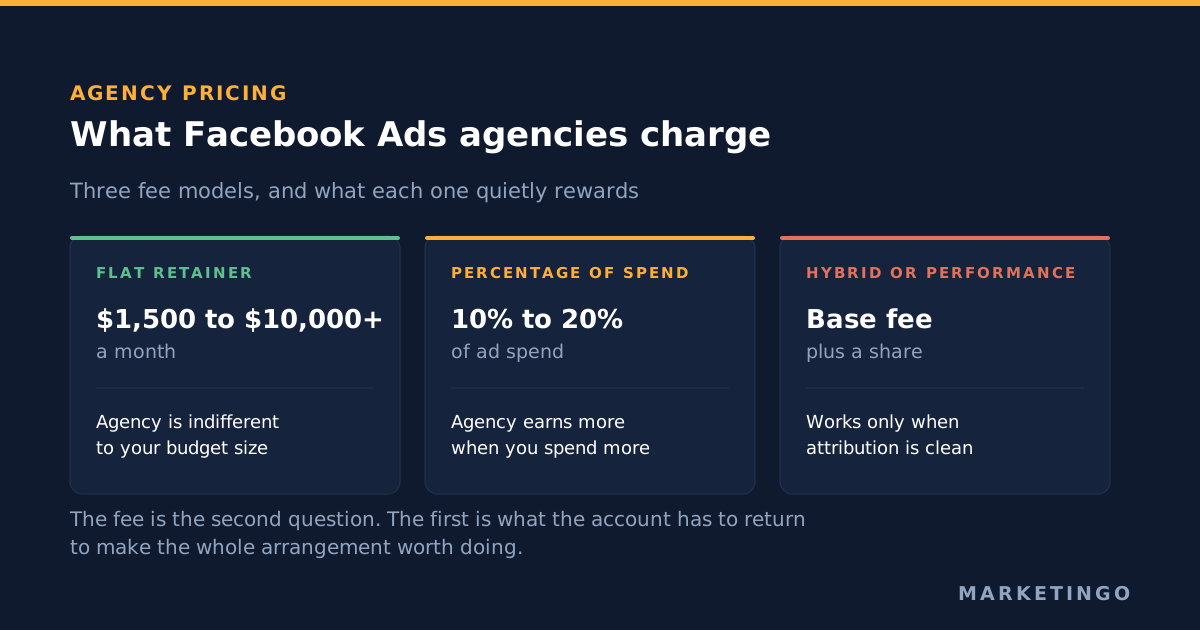
Flat monthly retainer. Most of this list. Predictable for you, and it keeps the agency indifferent to your budget size, which is the point. It also makes the return on investment easy to model, because the fee is a known number rather than a function of how much you spend. Typical ranges run from about $1,500 a month for a small single-channel account to $10,000 or more for multi-channel work with creative production attached.
Percentage of ad spend. Usually 10% to 20%, and the model WebFX publishes at 12% to 15%. It scales cleanly and it quietly rewards the agency for recommending that you spend more. If you take this model, agree in writing what happens when the account should be scaled down.
Hybrid or performance-linked. A base fee plus a share of revenue or a results guarantee, as Disruptive frames it. Workable when attribution is clean and a trap when it is not, because you will spend the relationship arguing about which conversions count.
Whatever the model, the fee is only the second question. The first is what the account has to return to make the whole arrangement worth doing. Work that out before you take the calls: the ecommerce return on ad spend calculator gives you the break-even multiple your store needs once cost of goods and fees are in, and the lead generation return calculator does the same for a pipeline, turning close rate and deal value into the cost per lead you can actually afford. An agency quoting $4,000 a month on a $10,000 budget needs to produce a very different result from the same agency on a $100,000 budget.
Questions to ask before you sign
Who owns the ad account, the Page and the dataset. Who is on the account day to day, by name and seniority, after the first month. How you will be shown Meta's reported conversions against the orders or leads in your own system. How many new creatives go live each month and who makes them. What happens to the fee when spend falls. What the exit looks like, and what you keep.
Find out what your Facebook account is really returning
Before you hire anyone, it is worth knowing which of your current problems are account problems and which are offer, tracking or margin problems. A free advertising audit covers the Meta account structure, the creative refresh rate, the conversion tracking and the gap between platform-reported return and what actually reaches the bank, and it produces a written list of what to fix in what order. You can hand that list to any agency on this page, including the ones that are not us.