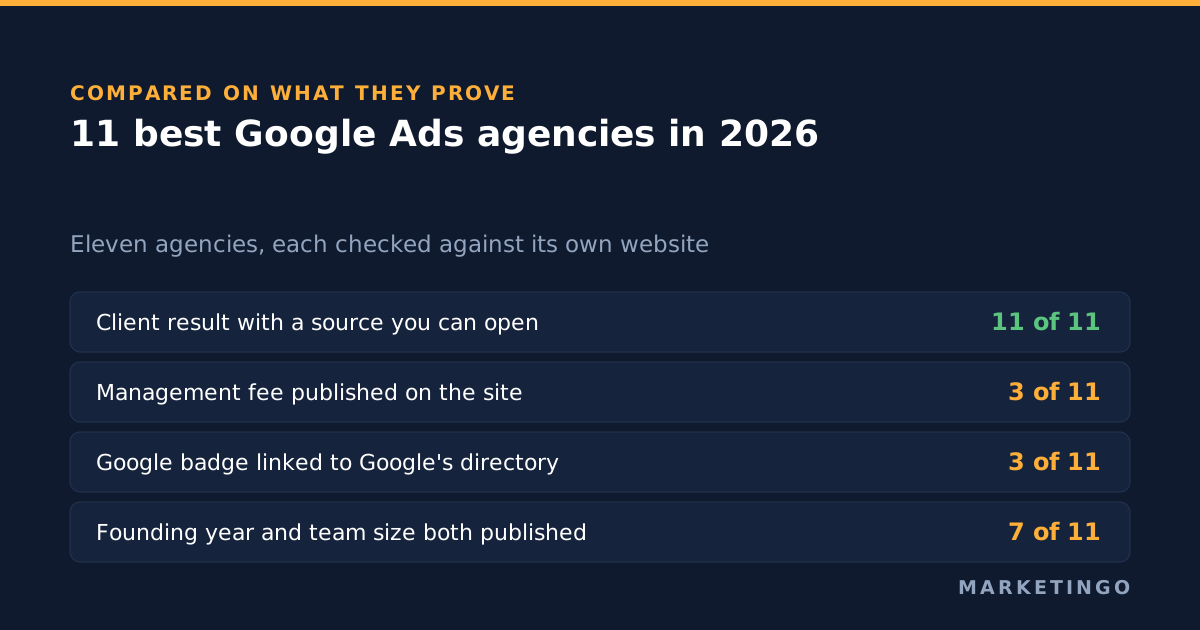
Choosing a Google Ads agency in 2026 means betting on judgement, because the platform now decides the bids, the match types and increasingly the ad text itself. The eleven agencies below were each checked against their own website: every client figure quoted here was read on the page that states it, every domain was re-resolved, and every partner badge was examined for whether it links to Google's directory or is simply an image. Where an agency publishes nothing checkable, that is recorded too.
If you want a wider shortlist, the general PPC agency ranking covers paid search and paid social together on the head term "best PPC agency", and the B2B paid media ranking is the better page if your buyers are businesses and LinkedIn matters as much as search. For narrower cases there is a SaaS-specific list and an ecommerce PPC list. This page is about one platform: who runs Google Ads well, and what each firm is actually built for.
At a glance: the best Google Ads agencies in 2026
| Agency | Best for | Beyond Google Ads | Pricing published? | Google partner status |
|---|---|---|---|---|
| MarketinGO | Advertisers who want senior operators running Google alongside two or three other channels | Meta, LinkedIn, Microsoft | On request | Google Partner |
| Solutions 8 | Buyers who want a shop whose core business is Google Ads and nothing else | Meta, Amazon, Microsoft on request | Fee model yes, amount no | Claims Premier, no badge or directory link |
| JumpFly | Small and mid-sized ecommerce running Google, Microsoft and Amazon from one small team | Microsoft, Meta, Amazon | No | Google Premier Partner, directory-linked |
| Logical Position | SMBs who want a full rate card before the first call | Microsoft, Meta, TikTok, Amazon | Yes, full rate card | Google Premier Partner |
| HawkSEM | Paid search buyers who want a named fee and pipeline reporting | Meta, Microsoft, LinkedIn | Yes, from $1,200 a month | Google Premier Partner, directory-linked |
| KlientBoost | Accounts whose real constraint is the page after the click | Meta, LinkedIn | No | Google Partner, directory-linked |
| Directive | B2B SaaS teams that measure paid search against pipeline, not form fills | Microsoft, programmatic | No | None claimed on site |
| Tinuiti | Enterprise retail brands needing search coordinated with Amazon and retail media | Meta, Amazon, streaming, retail media | No | Google Premier Partner |
| WebFX | Buyers who need a published rate to raise a purchase order | Microsoft, Meta, LinkedIn, Amazon | Yes, tiered | Google Premier Partner |
| Disruptive Advertising | Advertisers who want month-to-month terms and a stated guarantee | Meta, Amazon, Klaviyo | No | Google Premier Partner, self-hosted badge |
| Inflow | Ecommerce brands whose measurement is the bottleneck | Microsoft, Meta, Amazon, LinkedIn | No | Google Premier Partner |
How we selected these Google Ads agencies
Verified results only. Every metric in this article was read on the page that states it, and that page is linked. A number found only in a directory profile, an aggregator or another agency's ranking was treated as unverified and left out. This rule removed more candidates than any other, and it is the reason two frequently ranked firms are discussed below rather than listed.
Google Ads as a real discipline, not a line item. Each agency had to show paid search depth on Google specifically: Shopping and Performance Max for retail, search and Microsoft for lead generation, feed work, conversion tracking and the operational detail that only shows up when someone has run accounts through a platform migration. Firms that subcontract ad management were excluded.
Partner status checked, not assumed. Google Partner and Premier Partner badges were examined for whether they link to Google's partner directory or are a self-hosted image, and for the year stamped on them. The difference is noted in each profile, and the section on what the badge proves explains why it matters less than buyers assume.
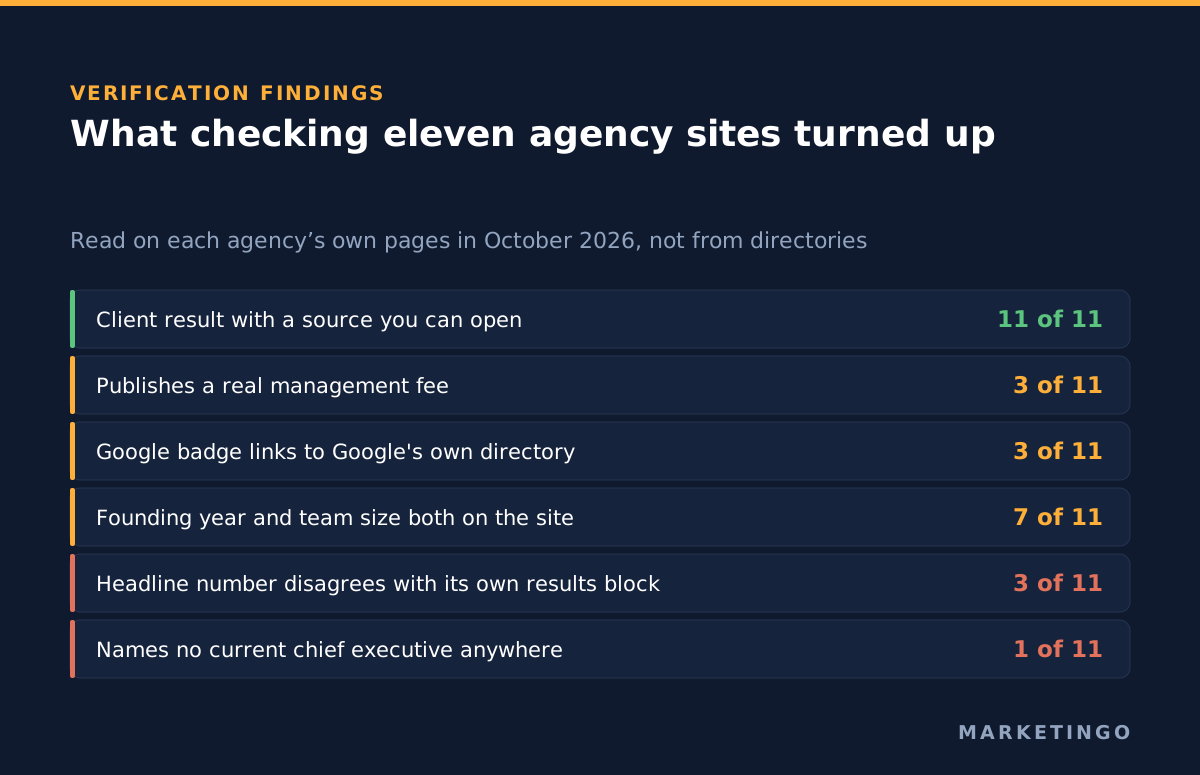
Published pricing where it exists. Three of the eleven publish real numbers. The rest gate fees behind a discovery call. Both are legitimate, but a buyer comparing Google Ads management costs deserves to know which is which before spending an hour on a call.
Honest limitations. Every profile carries a "where it stops" paragraph naming work the firm does not do and buyers it suits poorly. None of them are hedged compliments, including the one at the top of the list.
What checking every agency's own site turned up
Verification was meant to be a formality. It produced findings more useful than the ranking itself.
One agency on this list has quietly changed hands, and its website has not caught up. Solutions 8 still presents Kasim Aslam as founder and sitting chief executive on its about page. His own site describes him as "Founder and former CEO, Solutions 8" and says he sold the agency, and a podcast episode published in August 2025 refers to the exit in the past tense. Neither the buyer nor the date is public, and the agency names no current chief executive anywhere on its site. The work may be unaffected. The fact that a prospective client cannot find out who runs the firm is still a material gap.
A rebrand happened mid-research. Logical Position now resolves to lp.agency, and every logicalposition.com URL redirects there. The case studies survived the move intact, which is better than most rebrands manage, but any ranking still linking the old domain has not been re-checked since the change.
Duplicated numbers appear across unrelated clients. On Solutions 8's site, an identical metrics block covering July to August 2022, with $40,111.24 in spend and a 16,503% return on ad spend, appears on two case studies for two unrelated businesses. That is template bleed, not client data, and it undermines the surrounding figures that are real.
Headlines disagree with results blocks often enough to be a habit. Tinuiti's Murad case study is titled around a 125% new-customer lift that appears nowhere in its own results. Directive's case study index credits Placemakr with a 50% rise in paid search conversions while the linked page says 20%. A Solutions 8 case study headline claims "over a 500% MER" where the body reports 5.86.
Partner badges age, and some do not exist at all. Inflow's Premier badge is stamped 2024 on a 2026 site. Solutions 8 asserts Premier Partner status in body text on two pages, yet the most recent announcement of it on its own site is dated March 2024 and there is no Google-issued badge image and no directory link anywhere. Partner status is checked by Google daily and Premier is awarded annually, so a claim two cycles old is a fair question for a call.
None of this makes these poor Google Ads companies. It does mean the usual shortcut, trusting a ranking because the firm looks credible, is not doing the work you think it is. Open the case study, read the headline number against the results block, and treat anything you cannot open as marketing rather than evidence.
The 2026 Google Ads market
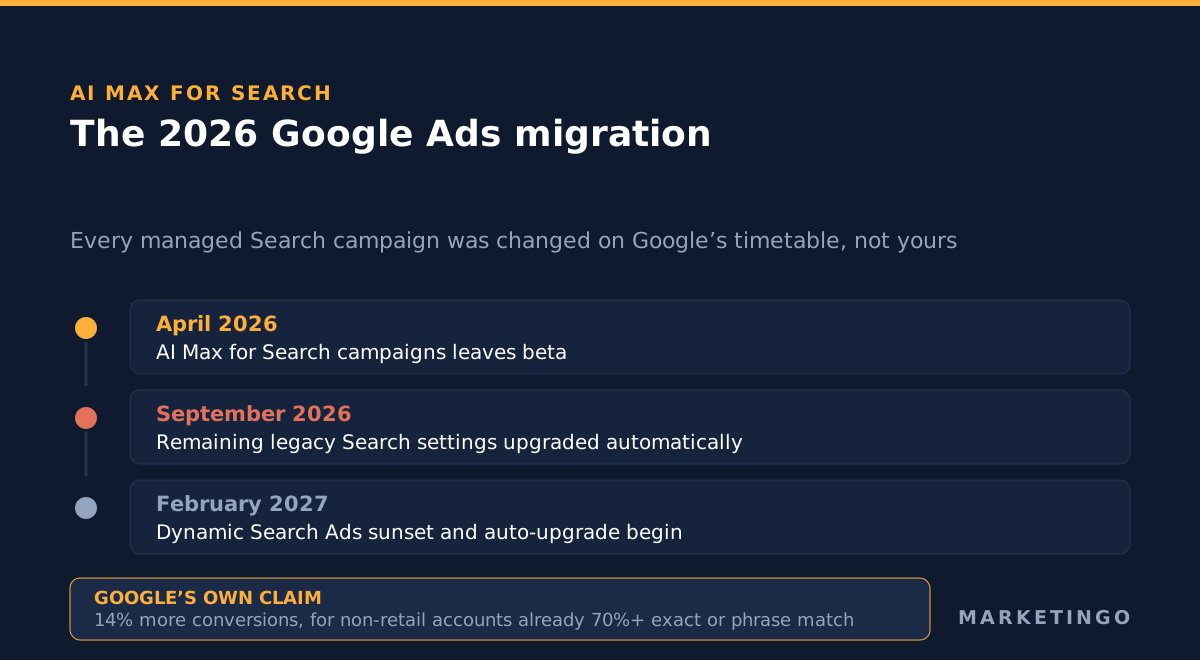
The platform rewrote the Search campaign, and the migration was not optional. AI Max for Search campaigns moved out of beta in April 2026, and Google announced that remaining eligible Search campaigns with legacy settings would be upgraded automatically, with "all upgrades for eligible campaigns to conclude by the end of September" (Google, 2026). Campaigns using automatically created assets had search term matching and text customisation switched on by default. Dynamic Search Ads got a reprieve: Google extended that sunset to February 2027. AI Max bundles broad match and keywordless matching, Google-written headlines, final URL expansion and brand controls into one setting, which means the keyword list an agency spent years refining is now a signal rather than a boundary. Google's own headline claim for it, from May 2025, is that advertisers activating AI Max "will typically see 14% more conversions or conversion value" at a similar cost per acquisition, and the footnote that usually gets dropped restricts that figure to non-retail advertisers whose campaigns already drew more than 70% of conversions from exact or phrase match keywords. Ask any agency you are considering what it did during September 2026, because every account it manages was changed that month.
Clicks did not get more expensive. Control got scarcer. The familiar pitch that costs are spiralling does not survive its own sources. Tinuiti's Q2 2026 benchmark report found Google Search spend up 14% year on year with average cost per click up only 1%, meaning the growth came from click volume rather than price. WordStream and LocaliQ's 2026 Google Ads benchmarks, drawn from 13,474 United States search campaigns running between April 2025 and March 2026, put the all-industry average cost per click at $5.42 and average cost per lead at $66.69, and recorded cost per lead falling for the first time in five years. Specific industries did move: real estate cost per click rose 27.27%, personal services and health and fitness each about 23.41%. An agency pitching itself as the answer to across-the-board cost inflation is selling a problem the benchmark data does not show. The thing that genuinely changed is how little of the auction an advertiser can now steer directly.
Google's share of search fell below half for the first time in two decades. eMarketer forecasts that Google will take 48.5% of United States search ad spending in 2026, and separately puts spending on advertising inside artificial-intelligence search at $2.08 billion for 2026, or 1.3% of total search ad spend, rising to $25.93 billion by 2029. Google is building for that shift rather than defending the old surface: in October 2026 it scaled ads in AI Mode to ten more countries, launched multiturn ads in the United States, and reported that AI Mode queries run on average three times longer than traditional searches (Google, 2026). None of this shows up as a separate campaign type, which is the point: Performance Max, Shopping and broad-match Search campaigns, AI Max included, are already eligible to serve there. Meanwhile Alphabet's own filings show the base is not shrinking. Google advertising revenue reached $294,691 million for the full year 2025 and $82,012 million in the third quarter of 2026 alone, with Search and other at $63,350 million in that quarter (Alphabet, 2026).
The measurement job moved from cookies to first-party plumbing. The 2021 consensus was wrong in both directions. Chrome kept third-party cookies, Google confirming in April 2025 that it would "maintain our current approach to offering users third-party cookie choice in Chrome", and then in October 2025 it retired most of Privacy Sandbox itself, including the Attribution Reporting API, Topics and Protected Audience, citing "low levels of adoption" (Google, 2025). What survived is the unglamorous work: consent mode signals, enhanced conversions and server-side data plumbing. Google states that advertisers bidding to conversion value who implement enhanced conversions see "an 8% incremental ROAS" on Search, from 99 conversion lift studies run between April 2024 and April 2025 (Google, 2026). From June 2026 offline conversion imports and enhanced conversions for leads migrated to the Data Manager API, and the two enhanced conversions settings began collapsing into one. An agency still pitching cookieless readiness is selling a 2023 problem.
Performance Max became reportable, slowly. Campaign-level negative keywords reached all advertisers in January 2025, along with brand exclusions for Search text ads and a search terms source column separating keywordless matches from search themes (Google, 2025). Channel performance reporting followed in April 2025, and it is reporting only: there are still no channel-level controls, so an agency cannot simply switch display off. Smart Bidding Exploration, which Google called "our biggest update to bidding in over a decade", uses flexible return targets to bid on less obvious queries and was credited with "a 19% increase in conversions" in Google's own global test (Google, 2025). The practical effect across all of it is that the skilled work sits upstream of the auction: conversion values that reflect profit, feed quality, creative volume, and negatives that constrain a system designed to spread.
MarketinGO 1. MarketinGO: best for senior operators running Google alongside two or three other channels
Founded: 2019 · HQ: Chisinau, Moldova, serving US and European clients · Team: ~5 senior operators · Website: marketingo.com
The structural choice that defines MarketinGO is staffing: the operator who builds the account is the operator who runs it, so nothing is handed from the strategist who won the pitch to a coordinator who inherits it. In a year when every Search campaign was rewritten by the platform, that continuity decided which accounts absorbed the change and which ones discovered it in a monthly report.
What they do. Google Ads management across search, Shopping and Performance Max, run alongside Meta, LinkedIn and Microsoft Ads as one funnel rather than four line items. The full-funnel strategy picks the two or three channels that can carry the budget instead of spreading it across six. Conversion tracking, conversion values that reflect margin rather than form fills, feed work, landing page changes and ongoing optimisation sit inside the engagement, which is why the measurement layer exists before spend scales rather than being retrofitted after a bad quarter. Shopping feed quality and negative keyword discipline get the attention that bid management used to, because that is where the remaining control is.
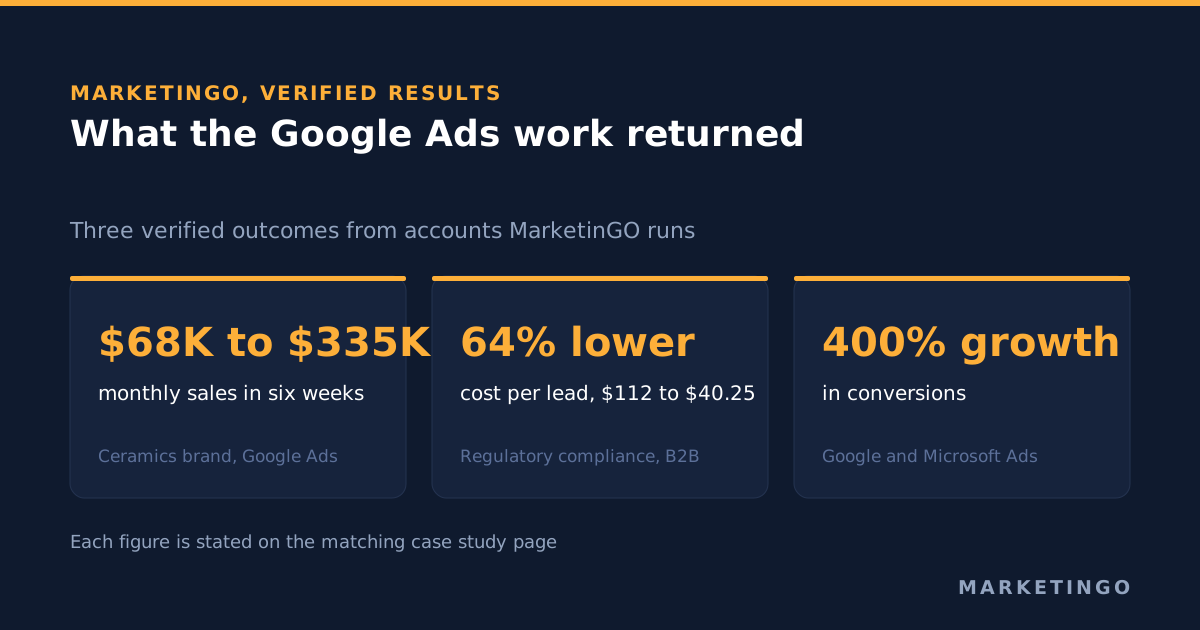
Verifiable results. A ceramics brand grew from $68K to $335K in monthly sales within six weeks on Google Ads. For a regulatory-compliance consultancy, cost per lead fell 64%, from $112 to $40.25, producing 557 extra high-value leads and 27% more traffic on $4,000 less spend over six months. On a 40,000-SKU dental supplies catalogue, the 37% of budget going to products that had never produced revenue was reallocated, and blended Google return on ad spend rose from 7.86 to about 8.5 while spend scaled. An AI compliance SaaS company grew demo requests 66% on a lean Google and LinkedIn setup with no budget increase, and a home improvement operator saw 400% conversion growth across Google and Microsoft Ads together.
Ideal fit. High-ticket B2B and service companies where one lead is worth four figures and cost per lead decides whether the model works, B2B SaaS selling demos and trials, DTC and ecommerce brands that need profitable scaling rather than a return-on-ad-spend screenshot, and home improvement operators running Google and Microsoft across service areas. Founders selling into the United States get answers in US hours, which matters more than it should when a campaign breaks on a Friday afternoon.
Where it stops. This is a paid media shop and nothing else: no SEO or SEO services, no content marketing, no email or lifecycle, no organic social media marketing, no web design or website optimization work, no PR, no outbound sales development. A brand wanting one vendor for every marketing function should hire a full-service digital marketing agency from further down this list. The team is deliberately small, so an advertiser who needs twenty named account managers on an org chart is a poor match, and so is anyone shopping purely on the lowest management fee.
Certifications: Google Partner, Meta Business Partner. Pricing. Managed monthly engagement, quoted against account scope and channel count rather than a published rate card.
Solutions 8 2. Solutions 8: best for buyers who want Google Ads as the core business, with caveats
Founded: about 2006, per its own FAQ · HQ: Chicago, Illinois, with an Arizona mailing address and phone · Team: not published · Website: sol8.com
Solutions 8 is the closest thing on this list to a single-platform shop: its services page lists four items, and three of the four are Google Ads, Google Ads consultation and paid channels it describes as support for existing Google clients. The operational detail it publishes is unusually specific for an agency site, covering manual call scoring, feed rebuilds, ad rotation after 100 clicks and account changes every three to seven days, which is real process documentation rather than positioning.
What they do. Google Ads across search, Shopping, Performance Max, YouTube Ads and Display, plus Merchant Center feed management, conversion tracking setup, landing page and conversion rate work, Meta Ads and Amazon Ads. Its own services page states that while "our primary business offering is still Google Ads", the adjacent channels exist "to help support and supplement your campaigns" (Solutions 8). Microsoft Ads is run on request, with the FAQ saying they typically wait until Google Ads is maxed out first. No SEO, no LinkedIn Ads, no web development.
Verifiable results. For Nutriganix, Solutions 8 reports spending $31,386.01 and generating $145,556.27 over four months, a marketing efficiency ratio of 4.64, against a stated average order value of $45 and a 65% repeat-customer rate. For Suffolk Latch Co, it reports turning a £14,550 investment into more than $2 million in revenue, with conversions up 48.19% and cost per click rising from £0.42 to £0.54. Read both against the caveats below: the Suffolk Latch page mixes sterling spend with dollar revenue, and its stated efficiency ratio does not reconcile with its own revenue and spend figures.
Ideal fit. Ecommerce advertisers between roughly $2,000 and $50,000 a month in Google spend who want a team whose attention is not divided across six platforms, and buyers who value disclosed commercial terms: no long-term contract, no hourly billing, client retains ownership of the account and the creative.
Where it stops. The leadership question is the serious one. The about page still names Kasim Aslam as founder and chief executive while his own site lists him as former chief executive and says he sold the agency; no current chief executive is named anywhere, no team page exists and no headcount is published. The Premier Partner claim appears in body text on the pricing and Google Ads pages, but the most recent announcement of it on their own site is dated March 2024, there is no Google-issued badge image and no link to Google's partner directory, so the credential rests on their own copy. No case study on the first page of the index covers a period after February 2024, which means nothing published covers the Performance Max and AI Max era, and an identical metrics block appears on two unrelated clients' pages. Seven or more live service pages, including email, customer relationship management and landing page work, are orphaned from the services navigation. One of the three case studies featured on the homepage states that the client has since left.
Certifications: claims Google Premier Partner in text, with no badge or directory link; Google Ads certified staff claimed; HubSpot and DigitalMarketer certified partner. No Meta or Microsoft partner status claimed. Pricing. Model disclosed, amount not: a base fee plus 10% of ad spend, a $1,000 ecommerce start-up fee, a recommended $2,000 minimum monthly ad budget, no long-term contract. The base fee is never stated (Solutions 8 FAQ).
JumpFly 3. JumpFly: best for SMB ecommerce running Google, Microsoft and Amazon from one small team
Founded: incorporated 2003, paid search work from 2001 · HQ: Hoffman Estates, Illinois · Team: 40+ · Website: jumpfly.com
JumpFly has been running paid search continuously since before Google Ads was called AdWords, which is a longer unbroken track record than anyone else here, and it has stayed deliberately small. The agency states 34 or more Google certified specialists against roughly 40 staff, an unusually high ratio of practitioners to headcount, and the practical consequence is that the person on your account has probably run paid search through three platform eras.
What they do. Paid search and display across Google and Microsoft, Google Shopping, Performance Max, paid social, Amazon advertising and marketplaces, SEO strategy, email, predictive audiences and an in-house creative design team. Around $6 million in ad spend is managed monthly across the agency. The Google work is the centre of it, with Microsoft run as a genuine second channel rather than a checkbox.
Verifiable results. For LIJA, JumpFly reports revenue up 65%, conversions up 53% and traffic up 181% year on year while holding the return on ad spend goal. For Battery Mart, it reports average order value 85% higher on machine-learning-enabled Google Ads campaigns than on all other traffic, with return on ad spend up 26% and revenue per user doubled.
Ideal fit. Small and mid-sized ecommerce advertisers spending roughly $3,000 to $150,000 a month who want Google, Microsoft and Amazon run by one team that does not rotate staff, and buyers who would rather have account continuity than agency scale.
Where it stops. No LinkedIn Ads, which rules out LinkedIn-led B2B demand generation. The client roster is SMB ecommerce throughout with no enterprise or widely recognised brands, so an advertiser spending $500,000 a month would be an outlier rather than a fit. Conversion rate optimisation exists as a page but is absent from the services navigation, so landing page and site work is not a first-class offering. No published pricing, and fees are discussed only after a qualification call.
Certifications: Google Premier Partner with a directory-linked badge, Meta marketing partner, Amazon verified partner. Pricing. Not published; month to month with no cancellation penalty, and a performance-linked fee option on Amazon work.
Logical Position 4. Logical Position: best for SMBs who want a full rate card before the first call
Founded: 2010 · HQ: Lake Oswego, Oregon, plus Palatine, Illinois · Team: not published · Website: lp.agency
Logical Position publishes the most complete pricing page in this category, broken out by service line, spend band and contract length, which makes it the reference point every other fee structure can be measured against. It also holds Microsoft Advertising Elite Channel Partner status and was named Microsoft's Global Channel Partner of the Year in 2024, a credential no other firm here can match. Note the domain: the company now operates as lp.agency, and logicalposition.com redirects there.
What they do. Google Ads, Microsoft Ads, Meta, TikTok, Pinterest and Amazon advertising, alongside SEO, email, SMS, local listings management and website development. The ad management operation is built for volume, and the company states it has managed $2.15 billion in ad spend across platforms. Google Shopping and Performance Max carry much of the ecommerce work.
Verifiable results. For iHostPoker, Logical Position reports conversions up 450%, click-through rate up 76% and cost per acquisition down 56% on a Google Ads lead generation account. Its case study index credits SMEG USA with a 9x return on ad spend and Maileg with 143% revenue growth.
Ideal fit. Small and mid-sized ecommerce and lead generation advertisers spending between $1,000 and $90,000 a month who value knowing the price before the first call, and any advertiser for whom Microsoft Ads is a meaningful channel rather than a rounding error.
Where it stops. No LinkedIn Ads at all: the paid social page names Meta, Instagram, TikTok and Pinterest and does not mention LinkedIn once, which rules the firm out for LinkedIn-led B2B. No conversion rate optimisation service line either, so a conversion problem tends to get answered with a website rebuild, which they also sell. Pricing runs on 6, 12 or 18-month terms with the best rate reserved for 18 months, so the transparency comes with lock-in, and above $90,000 in monthly spend there is no published rate at all.
Certifications: Google Premier Partner, Meta Business Partner and Meta Certified Company, Microsoft Advertising Elite Channel Partner. Pricing. Published rate card: ecommerce paid search at $749 a month on spend up to $6,999, 12% from $7,000, 10% from $12,001 to $90,000, with 5% and 10% discounts at 12 and 18-month terms.
HawkSEM 5. HawkSEM: best for paid search buyers who want a named fee and pipeline reporting
Founded: 2006 · HQ: Los Angeles, California, fully remote · Team: ~80 across three countries · Website: hawksem.com
HawkSEM is the only agency here that publishes a management fee ladder on its own paid search page and links its Google badge to the partner directory rather than hosting an image of one. Those two facts together make it the easiest firm on this list to evaluate without booking a sales call.
What they do. Google Ads management, paid social, conversion rate optimisation, SEO and content, with a proprietary reporting layer called ConversionIQ that stitches ad platform data to downstream conversions. Google and Microsoft search carry most of the work, with Meta and LinkedIn alongside. The agency has moved early into advertising inside answer engines, which reads as a reasonable hedge rather than a finished offering.
Verifiable results. For Datadog, HawkSEM reports sales demos up 75%, cost per acquisition down 40%, and click-through rate moving from under 1% to over 3%. The agency states $80 million in managed ad spend and a 98% client retention rate on the same services page that carries its pricing.
Ideal fit. B2B and SaaS advertisers whose primary channel is Google search and who want reporting that connects clicks to pipeline rather than to conversions counted in the ad platform. The published tiers make it workable for smaller accounts that most agencies of this size would decline.
Where it stops. No Amazon or marketplace advertising and no email or lifecycle offering, so a DTC brand needing retention and marketplace coverage will need a second vendor. The $1,200 entry tier sits awkwardly next to the claim that only senior staff touch accounts, so ask precisely what that fee buys in hours. A large share of the "top Google Ads agencies" articles that rank HawkSEM are published by HawkSEM, so treat its editorial as marketing.
Certifications: Google Premier Partner with a directory-linked badge, Meta Business Partner, Microsoft Advertising Partner. Pricing. Published: $1,200 a month for local businesses, $3,450 for full-service paid search management, $10,000 and up for larger brands, month to month with no contracts.
KlientBoost 6. KlientBoost: best for accounts whose real constraint is the page after the click
Founded: not stated on site · HQ: Costa Mesa, California, plus Raleigh and London · Team: not published · Website: klientboost.com
KlientBoost builds the landing page as part of the engagement rather than pointing traffic at whatever the client already has. For an advertiser whose Google Ads campaigns are fine and whose post-click experience is the actual constraint, that removes the usual standoff between the agency that wants a new page and the web team that owns it.
What they do. Google Ads, Facebook and LinkedIn advertising, paid search, SEO, content, link building, conversion rate optimisation, landing page design and build, and email marketing, run through an in-house platform called Kite. The agency states over 250 active clients and more than $50 million in managed annual ad spend. Landing page optimization is the differentiator rather than an add-on.
Verifiable results. For Salesloft, KlientBoost reports conversions up 27% alongside a 20% reduction in cost per acquisition, achieved through custom landing pages rather than account restructuring.
Ideal fit. B2B and SaaS advertisers with a working paid search account and a weak post-click funnel, and companies that would rather buy the landing page and the Google Ads management from one team than coordinate two vendors around one conversion rate.
Where it stops. There is no about page, no founding year, no leadership listing and no headcount anywhere on the site, which makes continuity and account staffing impossible to assess before a call. The published case study PDFs are 2021 and 2022 vintage and the case study sitemap was last modified in March 2025, so the proof on display is several years old and predates every automation change described above. No Amazon and no Microsoft Ads, so ecommerce advertisers with a marketplace component need a second vendor.
Certifications: Google Partner with a directory-linked badge, Meta partner directory listing. Pricing. Not published. The agency's own FAQ says fees are sometimes a percentage of ad spend and sometimes a flat fee, with clients from $5,000 a month upward.
Directive 7. Directive: best for B2B SaaS teams measuring paid search against pipeline
Founded: 2013 · HQ: Orange County, California, with Austin, New York, Mexico City, London and Toronto · Team: 100+ · Website: directiveconsulting.com
Directive built its reputation on refusing to optimise toward marketing qualified leads, arguing that a Google Ads account tuned to form fills produces volume the sales team cannot close. Customer Generation, the methodology it sells, is the discipline of holding paid search accountable to closed revenue instead, and in 2026 that argument matters more than it did: when the platform chooses the queries, the conversion value you feed it is most of the steering you have left.
What they do. Paid media, content, performance creative, programmatic and revenue operations under a performance division, with marketplace, Shopping and product feed management under commerce. The paid search page names Google and Microsoft as the platforms, and the work is built around sending qualified-pipeline signals back into the account rather than counting conversions in the interface.
Verifiable results. For Case Status, Directive reports demo bookings 20% above forecast, 54 completions against a quarterly goal of 45, alongside a 19% quarter-on-quarter rise in organic sessions and a 135% quarter-on-quarter increase in unassigned book-a-demo conversions.
Ideal fit. B2B SaaS companies with a defined ideal customer profile and a sales team that will push back on lead quality, particularly those who want Google Ads measured against pipeline rather than cost per lead.
Where it stops. No Google Partner or Meta Business Partner badge appears anywhere on the site, which is unusual at this size and a genuine problem if your procurement requires one. The portfolio has drifted toward SEO and answer-engine work: of the case studies on display, most cover LLM visibility, organic search or page layout testing, and only one reports a paid search outcome. Paid social sits in a separate division from paid search, so LinkedIn-led buyers should ask who owns the blended number. Its own case study index and the linked page disagree on whether Placemakr's paid search conversions rose 50% or 20%.
Certifications: none claimed on site. Pricing. Not published for agency services; the pricing page redirects to a self-serve course.
Tinuiti 8. Tinuiti: best for enterprise retail brands coordinating search with Amazon and retail media
Founded: 2004 as Elite SEM, rebranded 2019 · HQ: New York City, distributed · Team: 1,000+ · Website: tinuiti.com
At roughly $4 billion in media under management, Tinuiti operates at a scale where the interesting work is measurement rather than campaign management: incrementality testing, media mix modelling and a framework called Bliss Point that tries to find the spend level beyond which additional budget stops paying. Its quarterly benchmark reports are also the reason the rest of the industry knows what Google search cost per click actually did this year.
What they do. Paid search, Google Shopping and Performance Max, Meta, TikTok, Amazon and retail media, streaming and linear television, online video, audio, display, affiliate, influencer, conversion rate optimisation, email and SMS, plus creative. Commerce media is the centre of gravity, with Google search and paid social orbiting it.
Verifiable results. For Murad in the UK, Tinuiti reports a 28% return-on-ad-spend improvement during broad match and AI Max testing, a 98% year-on-year improvement on shoppable Performance Max, and 54% higher conversions with 84% more revenue year on year using new-customer-acquisition bidding.
Ideal fit. Retail and DTC brands spending eight figures a year that need Amazon, retail media and streaming coordinated with Google under one measurement model, and advertisers who have outgrown platform-reported attribution and need incrementality work to justify budget internally.
Where it stops. No LinkedIn Ads offering anywhere in the channel navigation, and B2B is a rounding error in the portfolio: the agency's own work filter shows one B2B case study against 22 social and 20 commerce. The intake form's lowest bracket is under $1 million in annual advertising spend, which sets a practical floor. And the Murad case study's own headline claims a 125% new-customer lift that appears nowhere in its results block, so read their titles against their numbers.
Certifications: Google Premier Partner, Meta Business Partner, Microsoft Advertising Elite Partner. Pricing. Not published; the contact form segments by annual spend from under $1 million to $50 million and up.
WebFX 9. WebFX: best for buyers who need a published rate to raise a purchase order
Founded: 1995 · HQ: Harrisburg, Pennsylvania · Team: 750 · Website: webfx.com
WebFX publishes a tiered rate card naming both the ongoing charge and the first-month setup cost, which is rarer than it should be and decisive in organisations where a number on a page is what gets a vendor approved. It is also the broadest service menu here by a wide margin, and the company states it has 150 or more Google Ads certified staff.
What they do. Google, Microsoft, Meta, LinkedIn, TikTok and other paid social, programmatic, connected television, Amazon, Walmart and Target Plus, Google Local Services Ads, plus SEO, conversion rate optimisation, landing pages, email, web design and development, and marketing technology work. The company states it has driven over $10 billion in client revenue.
Verifiable results. For Marketview Liquor, WebFX reports return on ad spend up 67%, revenue up 95% and site conversion rate up 10%. For Calhoun Super Structure, it reports a 30% increase in return on investment from paid search and a 210% rise in online lead conversions.
Ideal fit. Mid-market companies that want Google Ads, SEO, a website and marketing operations under one contract, and buyers in regulated or procurement-heavy organisations who need a published rate before a conversation can happen.
Where it stops. The middle tier charges $975 or 15% of spend, whichever is higher, so an advertiser spending $8,000 a month pays an effective 15% against Logical Position's 10% in the same band, plus a first-month optimisation fee. Paid media depth is diluted across a very wide menu, and the showcased case studies skew toward organic search rather than Google Ads. The Meta partnership is evidenced by a logo file alone while the Google Premier relationship is described in detail, so Meta-primary advertisers should probe it.
Certifications: Google Premier Partner, Meta Business Partner, Microsoft Advertising Partner, Amazon Ads Verified Partner. Pricing. Published: Lite at $750 a month on spend up to $5,000, Pro at $975 or 15% of spend on $5,000 to $30,000, Enterprise at $4,500 or 12% above $30,000, with initial optimisation fees of $1,200, $2,250 and $5,800.
Disruptive Advertising 10. Disruptive Advertising: best for advertisers who want month-to-month terms and a stated guarantee
Founded: not stated on site · HQ: Pleasant Grove, Utah · Team: 64 named staff · Website: disruptiveadvertising.com
Disruptive puts more commercial risk on itself than anyone else here, offering month-to-month terms with a stated 90-day money-back position. For a buyer who has been burned by a twelve-month contract and a mediocre quarter, that alone changes the shape of the decision.
What they do. Paid search, paid social, Amazon advertising, lifecycle and email through Klaviyo, conversion rate optimisation, creative and analytics. The Klaviyo Master Elite status is a real credential for DTC brands where retention revenue is the difference between a profitable account and a break-even one.
Verifiable results. For Crossover Symmetry, Disruptive reports monthly revenue from Facebook advertising rising 158% over three months, from $38,444 to $60,887. For Standartpark, it reports fourth-quarter revenue up 97%, adding $478,792 in sales with return on investment up 30% on Amazon.
Ideal fit. DTC and ecommerce brands running Meta and Amazon alongside Google who also want email and lifecycle handled by the same team, and advertisers who specifically want contract terms that let them leave quickly.
Where it stops. No LinkedIn Ads, so B2B buyers whose primary channel is LinkedIn are the wrong fit. The site publishes no founding year, no team size and no pricing, which is thin for vendor diligence. Its industry results page points to third-party review anchors rather than its own case studies in roughly 30 of 34 links, and the four actual case study PDFs are undated and hosted off-site. The sales motion, which caps new clients per month and asks you to see whether you qualify, means the buyer pitches the agency.
Certifications: Google Premier Partner and Meta partner badges, both self-hosted images, plus Microsoft, Amazon, HubSpot and Klaviyo Master Elite. Pricing. Not published; month to month with a stated 90-day guarantee.
Inflow 11. Inflow: best for ecommerce brands whose measurement is the bottleneck
Founded: 2007 · HQ: Tampa, Florida, fully remote · Team: 18 named strategists · Website: goinflow.com
Inflow is the smallest agency in this ranking and the most explicit about its boundaries, stating plainly that it focuses on what it does best and will refer you elsewhere for the rest. Putting Google Ads, conversion rate optimisation and analytics configuration in one team is the practical argument for hiring it, because those three functions usually sit with three vendors who each blame the other two.
What they do. Paid search across Google, Microsoft and Amazon, Google Shopping, paid social including Meta, Pinterest, Reddit and LinkedIn, SEO and content, conversion rate optimisation with a continuous testing programme, analytics and tag manager audits and training, plus email and SMS. It reports 97% client retention and a two-year average client relationship.
Verifiable results. For KEH, Inflow reports advertising revenue up 413% year on year, overall return on ad spend up 75.7%, conversion rate up 11.4%, and an $865,000 revenue increase attributed to conversion work. For Shore Excursions Group, it reports ad revenue up 149% with profit margin up 1,333%.
Ideal fit. Mid-market ecommerce brands that need senior attention rather than a large team, and advertisers whose real problem is measurement: broken analytics configuration, untrustworthy attribution, or a conversion rate that caps what any Google Ads campaign can return.
Where it stops. No web development, no design and no PR, stated openly, so landing pages get tested rather than built. At 18 named strategists it is the smallest option here and the team skews toward SEO, with six SEO and content titles against four paid. B2B lead generation is listed as an industry but no B2B case study appears in the portfolio. The Google Premier Partner badge is stamped 2024 on a 2026 site.
Certifications: Google Premier Partner, Meta Business Partner, Microsoft Advertising Partner, Buy With Prime agency partner. Pricing. Not published, with no stated minimum.
What a Google Ads agency actually does in 2026
The scope of services has shifted enough that two firms using the same words can be selling different work. A current Google Ads engagement should cover account structure and campaign management, keyword research and the negative keyword lists that now constrain broad match and keywordless matching, ad copy and creative volume for responsive search ads and Performance Max asset groups, Shopping feed quality, audience targeting signals, conversion tracking and the conversion values the bidding system optimises toward, landing page optimization or at least a view on it, and reporting that an executive can read.
What has genuinely gone is bid management as a craft. Smart Bidding sets the bids, and the honest version of the pitch is that an agency earns its fee on the inputs: whether the account measures profit or form fills, whether the feed is clean, whether there is enough creative for the system to test, and whether negatives keep a system designed to spread from spending into queries that never convert. A firm whose differentiator is daily bid adjustments is describing a job the platform took over several years ago.
The second half of the work is now interpretation. Channel performance reporting exists in Performance Max but channel-level controls do not, AI Max surfaces expanded matches and Google-written headlines in the search terms report but you cannot remove customised text in bulk from the interface, and Google advises waiting at least two weeks after enabling AI Max before adding negatives. Knowing which of those levers exists, and which the interface only appears to offer, is most of what separates a competent Google Ads partner from an expensive one.
Which of these Google Ads agencies fits your situation
If your Google Ads account is the whole marketing plan and you need two or three channels working together, MarketinGO is built for that, and so is HawkSEM if you want a published fee first.
If you want a team whose core business is Google Ads and nothing else, Solutions 8 is the closest fit on this list, with the leadership and badge caveats in its profile taken seriously.
If you are an SMB ecommerce brand running Google, Microsoft and Amazon, JumpFly does exactly that at a size where the same people stay on the account, and Logical Position is the alternative if you want the rate card up front.
If a purchase order needs a published price before anyone will talk to you, WebFX and Logical Position both publish real numbers, with HawkSEM naming its tiers too.
If your campaigns are competent and your conversion rate is the problem, KlientBoost builds the landing page as part of the engagement, and Inflow will tell you whether the measurement is lying to you first.
If you sell B2B software and your sales team argues about lead quality, Directive is the specialist, and MarketinGO is the lighter-weight option when the budget cannot carry a hundred-person agency.
If you spend eight figures a year and need Amazon, retail media and streaming in one measurement model, Tinuiti is the only firm here operating at that scale.
If you have been burned by a long contract, Disruptive Advertising publishes month-to-month terms with a stated guarantee, and JumpFly and HawkSEM both run month to month without cancellation penalties.
If you need SEO, email and a new website as well as ads, WebFX or Logical Position will sell you all of it, and that is a legitimate trade: one relationship, less depth per channel.
What Google Ads agencies charge in 2026
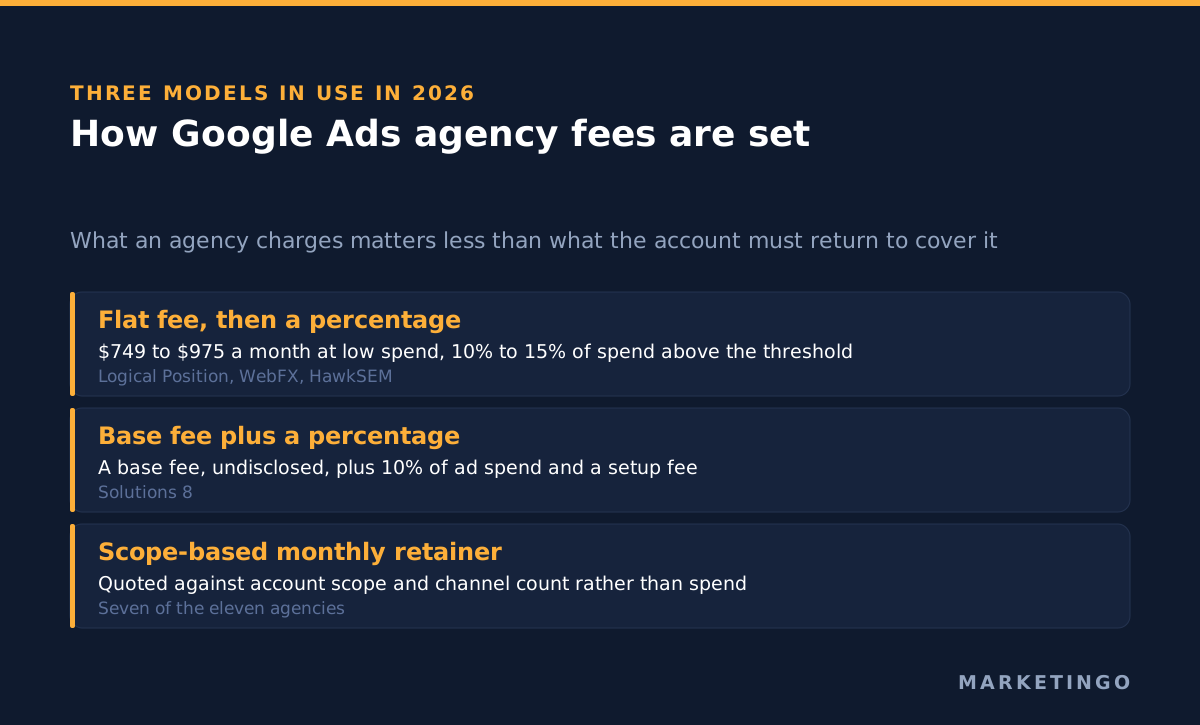
Three models are in use, and the difference between them matters more than the headline number.
Flat fee at low spend, percentage above a threshold. This is where the market has converged. Logical Position charges $749 a month up to $6,999 in spend, 12% from $7,000 and 10% from $12,001. WebFX charges $975 or 15% of spend, whichever is higher, on its middle tier. The effect is that small accounts pay a high effective rate and large accounts negotiate.
Base fee plus a percentage. Solutions 8 discloses the shape, a base plus 10% of ad spend with a $1,000 ecommerce setup fee, without publishing the base. This model is defensible and common, but it means you cannot compare quotes until you have the base in writing.
Scope-based monthly retainer. MarketinGO, JumpFly, KlientBoost, Directive, Tinuiti, Disruptive and Inflow all quote against account scope and channel count. It suits accounts where spend is a poor proxy for work, which is most B2B accounts and any ecommerce account with a large catalogue.
Whichever model you are quoted, the question that decides whether a fee is affordable is not what the agency charges but what the account has to return to cover it. Work that out before the call: for a retail brand the ecommerce ROAS calculator gives the return a given fee and margin require, and for lead generation the lead generation ROI calculator converts a cost per lead and a close rate into revenue. A $3,000 monthly fee on $10,000 of spend is cheap if it lifts return on ad spend by a point and expensive if it does not. Our own breakdown of PPC management pricing covers the fee structures in more detail, and the in-house versus agency comparison covers the case for not hiring one at all.
Google Ads agencies for small businesses
Small businesses face a different problem from the one most agency pages are written for. Below roughly $5,000 a month in spend, the effective rate on a percentage-of-spend fee is high, the account is simple enough that there is little structural work to do, and the thing that decides results is usually the website rather than the campaign. Several firms here will take that account: HawkSEM at $1,200 a month for local businesses, Logical Position at $749 up to $6,999 in spend, WebFX at $750 on its entry tier. Each buys a real set of Google Ads services at a predictable price, and each is a better outcome than a cheap reseller promising campaign optimization it cannot staff.
The alternative worth considering at that size is a fixed-scope build rather than an open-ended retainer: pay once to get the account structured properly, the conversion tracking right and the landing page fixed, then take over the ongoing optimization yourself with a quarterly review. That is cheaper than twelve months of digital advertising management and it leaves you with an asset rather than a dependency.
Whichever way you go, two diligence steps cost nothing. Read the client reviews on an independent platform rather than the testimonials page, because an advertising agency chooses which quotes appear on its own site. And ask what share of your website traffic the agency expects to come from brand searches, because a report showing a glorious return on ad spend built almost entirely on people already typing your name is the most common way a small account is told it is winning.
What a Google Premier Partner badge actually proves
Being a certified Google Ads partner is easier to reach than most buyers assume, and the requirements are public. Google requires a minimum optimisation score of 70% on the registered manager account, a 90-day ad spend of $10,000 across managed accounts, and at least 50% of account strategists certified in Google Ads, with the requirements checked daily (Google Ads Help). A single mid-sized client clears the spend floor, and the optimisation score is a number Google itself computes from recommendations an agency can simply accept.
Premier Partner status is narrower: the firm must meet the Partner requirements and be in the top 3% of participating companies within a given country, determined annually. The factors Google names are growth among existing clients, new client acquisition, client retention, share of spend in non-Search Google products, and total annual ad spend. Two of those five reward spending more money with Google, and none of them measures the return the agency produced for the specific service you are buying. Premier is also country-relative, so "top 3%" means top 3% of participating companies in that market rather than globally.
The useful way to read a badge, then, is as a filter rather than a recommendation. A directory-linked badge tells you the status is current, because Google checks it daily. A self-hosted image tells you nothing about today. A claim in body text with no badge and no directory link, which one firm on this list relies on, tells you to ask on the call. What no badge of any kind proves is that the agency will improve your return on ad spend.
Questions to ask before you sign
Ask who will touch the account day to day, by name and seniority, and what happens to that assignment in month four. Ask what the agency did to your campaigns during the automatic AI Max upgrade in September 2026, because every managed account was changed that month and the answer separates operators from reporters. Ask which conversion action the bidding optimises toward and whether its value reflects margin or a form fill. Ask to see the negative keyword list and the search terms report from an account like yours. Ask what the agency will not do, and whether it will tell you when paid search is the wrong answer. Finally, ask for one client result with the page that states it, and check the headline number against the results block yourself.
Find out what your Google Ads account is actually leaking
Most accounts we look at are not short of ideas. They are spending a measurable share of budget on queries, products or placements that have never produced revenue, and the number is usually larger than the agency fee being debated. A free ad audit gives you that figure for your own account: what is being wasted, what the conversion tracking is miscounting, and what the realistic ceiling is on the current structure. No pitch deck, and no obligation to hire anyone, including us. If you would rather read first, our guide to choosing a PPC agency covers the diligence process end to end.