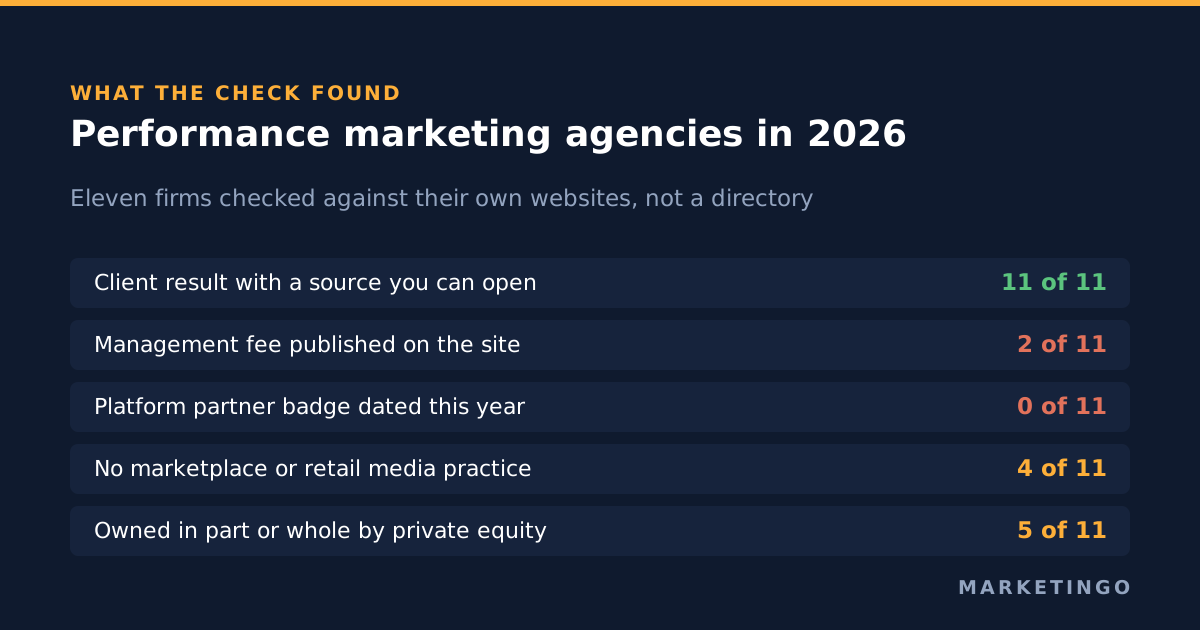
A performance marketing agency is one you pay to produce a measurable commercial outcome rather than a deliverable, which means the only honest way to compare them is against what each one can prove. The eleven agencies below were each checked against their own website: every client figure quoted here was read on the page that states it, every domain was re-resolved, every published price was recorded and every partner badge was examined for the year stamped on it. Where an agency publishes nothing checkable, that is recorded too.
Performance marketing is a buying posture, not a channel, so this ranking overlaps with narrower ones and the overlap is deliberate. If your question is about one platform, the Google Ads agency ranking answers it on the "google ads agency" term, and the general PPC agency ranking covers paid search and paid social together. If your buyers are businesses rather than consumers, the B2B paid media ranking is the better page, and there are narrower lists for software companies and online retailers. This page is for the reader choosing between firms that all claim to buy media against outcomes, and who wants to know which claims survive a check.
At a glance: the best performance marketing agencies in 2026
| Agency | Best for | Core channels | Published pricing? | Verified partner status |
|---|---|---|---|---|
| MarketinGO | Companies that want senior operators running two or three channels against cost per lead or return on ad spend | Google, Meta, LinkedIn, Microsoft | On request | Google Partner, Meta Business Partner |
| Tinuiti | Enterprise retailers needing search, Amazon and streaming coordinated in one plan | Search, social, Amazon, retail media, streaming | No | Google Premier Partner, badge dated 2024 |
| Brainlabs | Media-led buyers who want an experiment record rather than a pitch | Search, social, programmatic, connected television, retail media | No | Meta media certification 2024, Google Premier award 2023 |
| Directive | Software companies measuring paid media against pipeline, not form fills | Search, paid social, programmatic, marketplace | No | None published |
| KlientBoost | Accounts whose real constraint is the page after the click | Google, Meta, LinkedIn, Microsoft | Industry ranges only | Google Premier Partner, self-stated |
| NoGood | Funded consumer and software brands wanting answer-engine visibility alongside paid | Paid social, paid search, answer engine optimization | Yes, average retainer above $20,000 a month | None published |
| Power Digital | Mid-market brands buying measurement and media from one supplier | Search, social, Amazon, programmatic, retail media | No | None verifiable |
| Croud | United Kingdom and Europe reach, many markets and languages at once | Search, social, programmatic, retail media | No | Google Premier Partner, badge dated 2022 |
| Darkroom | Direct-to-consumer brands that want brand and performance in one team | Meta, Google, Amazon, TikTok Shop, retail media | Yes, full starting-price list | Shopify Plus partner, directory-listed |
| Common Thread Collective | Online retailers whose problem is forecasting and contribution profit | Meta, Google, TikTok Shop | No | None published |
| Disruptive Advertising | Buyers who want month-to-month terms and a stated results guarantee | Search, social, Amazon, lifecycle | No | Klaviyo Platinum Master, directory-listed |
How we selected these performance marketing agencies
Verified results only. Every metric in this article was read on the page that states it, and that page is linked. A number found only in a directory profile, an aggregator or another agency's ranking was treated as unverified and left out. This rule removed more candidates than any other, and it is why two frequently ranked firms are discussed near the end rather than listed.
Outcome accountability, not channel labels. Each agency had to show that it buys media against a commercial number: cost per lead, cost per acquisition, return on ad spend, contribution profit or pipeline. Firms whose case studies report only impressions, reach or engagement were excluded, as were firms that subcontract the media buying itself.
Partner status checked, not assumed. Google Premier Partner, Meta Business Partner and Amazon Ads partner designations were examined for the year stamped on them and for whether they link to the platform's own directory. These designations are annual, and most of the badges on these eleven sites are not current. The difference is noted in each profile.
Published pricing where it exists. Two of the eleven publish real numbers. One publishes industry ranges that are easy to mistake for its own. The rest gate fees behind a call. All three are legitimate choices, but a buyer comparing performance marketing costs deserves to know which is which before spending an hour on a discovery call.
Honest limitations. Every profile carries a "where it stops" paragraph naming work the firm does not do and buyers it suits poorly. None of them are hedged compliments, including the one at the top of the list.
What a performance marketing agency does, and how it differs from a digital marketing agency
The two labels get used interchangeably and should not be. A full-service digital marketing agency sells a portfolio of marketing services and is usually measured on delivery: campaigns shipped, content published, rankings moved. A performance marketing agency sells accountability for a commercial result and is measured on the number it agreed to move. The distinction shows up in how each one is staffed, how it reports, and what it argues about in month three.
The core service set. Buying and managing paid media across the performance marketing channels: paid search on Google and Microsoft, paid social media on Meta, LinkedIn, TikTok and Reddit, shopping and product feed work, programmatic display and connected television, and retail or commerce media on Amazon and the retailer networks. Around that sit the disciplines that decide whether the media spends well: performance creative, conversion rate optimization and landing page work, audience and feed management, and the conversion tracking that produces the performance data everything else runs on. Several of these firms also sell search engine optimization, content marketing, email marketing, affiliate marketing and influencer or creator marketing, and the better ones are explicit that those are separate lines rather than part of the media retainer.
What the work looks like in practice. A performance marketing strategy starts from a target cost per acquisition, return on ad spend or pipeline number and works backwards to the channel mix and the budget that can hit it. Campaign performance is reviewed against that target rather than against last month, performance tracking is built before launch rather than retrofitted, and marketing budgets move between channels on evidence. Performance marketers spend most of their time on three things: feeding the platforms better conversion signal, replacing creative before it decays, and finding the campaigns where more money produces less profit. The rest is reporting.
Where it overlaps with growth marketing and performance branding. Growth marketing is the broader discipline, taking in product, lifecycle and retention alongside acquisition; most of the agencies here touch a part of it and none of them own all of it. Performance branding, which several of these firms now sell, means buying upper-funnel inventory but holding it to measurable downstream effects rather than to recall studies. Both are useful labels and both are routinely used to make a general digital marketing offer sound accountable, so the test is the same in each case: which number appears in the report, and what happens if it does not move.
What this means when you compare firms. Four of the eleven below are genuinely narrow: they buy media, build creative for it and measure it, and will tell you to go elsewhere for the rest. The others are closer to full-service digital marketing agencies that lead with their performance media practice. Neither shape is better in the abstract. A company with an internal marketing team that needs one gap filled is usually better served by the narrow firm, and a company with no marketing function at all is usually better served by the broad one, provided it checks depth in the channel that actually drives its revenue.
What checking every agency's own site turned up
Verification was meant to be a formality. It produced findings more useful than the ranking itself.
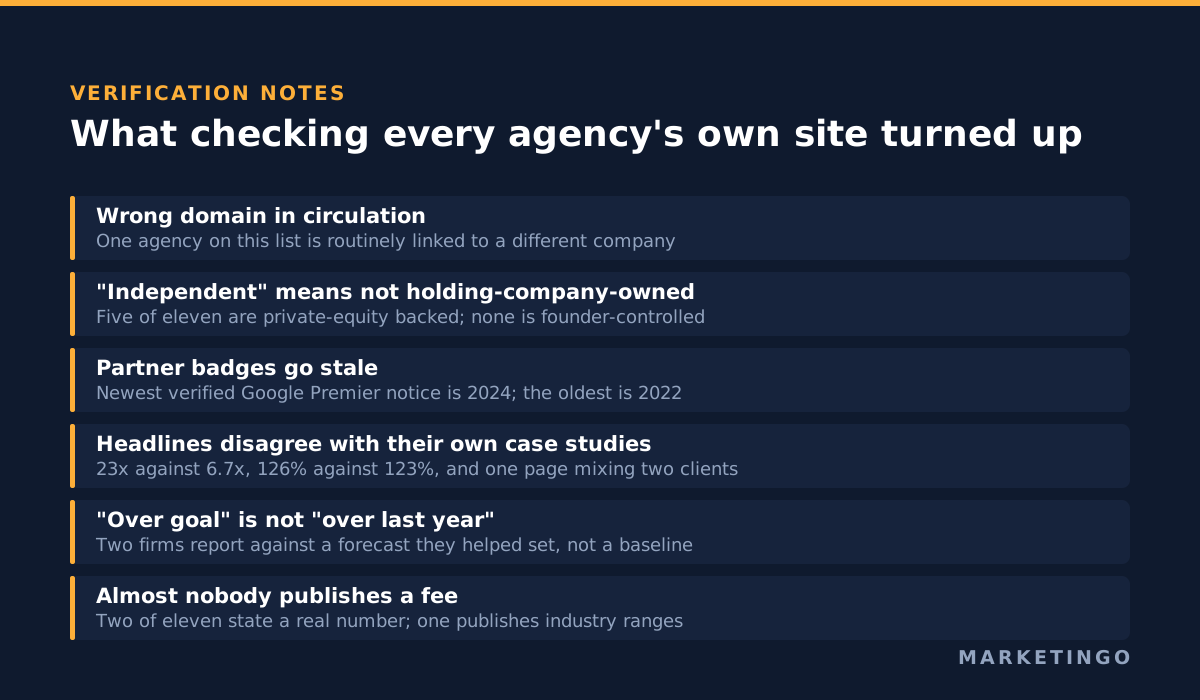
One agency on this list is routinely linked to the wrong company. Brainlabs lives at brainlabsdigital.com. The shorter brainlabs.com resolves to an entirely different business, a Spanish-language technology company with its own canonical tag and no connection to the media agency. Several rankings link the short domain. If you clicked through from one of them, you were never looking at the agency you thought you were.
"Independent" is doing a great deal of work. Five of these eleven are owned in part or in whole by private equity: Tinuiti by New Mountain Capital, Brainlabs by Falfurrias Capital Partners, Croud by ECI Partners, which took a majority stake in October 2024, Power Digital by Court Square Capital Partners, and Common Thread Collective by The Acacia Group. Tinuiti and Croud both use the word independent prominently. In this market it means not owned by a holding company such as WPP, Omnicom or Publicis. It does not mean founder-controlled, and a buyer who cares about who sets the margin targets should read it that way.
Partner badges decay annually, and most of these have. The most recent Google Premier Partner announcement on Tinuiti's site is from March 2024, which it calls the twelfth consecutive year. Croud's recertification notice is dated February 2022. Brainlabs holds a 2023 Premier Partner award and a 2024 Meta media certification. Directive, NoGood, Common Thread Collective and Darkroom publish no platform partner status at all, and the last of those is the most interesting: Darkroom's own machine-readable site summary states plainly that none are claimed, which is more candid than a stale badge.
Case study headlines disagree with their own bodies often enough to be a pattern. Croud's Timberland page carries Timberland results in its results block and body copy about a different client, IWG, in its background and strategy sections, so the traffic and conversion figures further down that page belong to a company its title never names. NoGood's SteelSeries study headlines a 23 times increase in traffic from answer engines while its own body says 6.7 times. Darkroom's Everlane study headlines a 126% rise over three months against body copy describing 123% over two, and the dollar figures support the body. None of these are fatal. All of them mean a buyer reading only the headline is working from a number the agency's own writer did not stand behind.
"Over goal" is not "over last year." Directive's dbt study reports sign-up volume 124% over projected goal and cost per sign-up 55% under projected goal. Those are real figures, but the baseline is a forecast the agency helped set, not the client's previous performance, and a conservative forecast makes a large overshoot arithmetically easy. The same construction appears in Single Grain's Learning A-Z study, which reports revenue 65% above projection. Ask what the projection was and who set it.
The page ranking against this one was written by an agency in it. The longest and most thoroughly optimized competing article on this term is NoGood's own ranking of twenty performance marketing agencies. That is a legitimate tactic and this page is the same tactic, which is why every number here is linked to the page that states it. Treat any agency ranking, including this one, as a document with an author and an interest.
Nobody is cheap and almost nobody will say so. Across eleven agencies there are exactly two published prices: Darkroom's starting-price list by service line and NoGood's statement that its average retainer is above $20,000 a month. Darkroom contradicts itself on the paid media entry point, listing $5,000 a month on its services index and $1,500 a month plus a percentage of media on the service detail page.
The performance marketing market a buyer is walking into
Four things have changed in the last two years, and each one changes what you should ask an agency.
Money kept moving in, and it concentrated. United States internet advertising revenue reached $294.6 billion in 2025, up 13.9% year on year and the highest figure recorded, with social at $117.7 billion, search at $114.2 billion and programmatic at $162.4 billion (Interactive Advertising Bureau and PricewaterhouseCoopers, Internet Advertising Revenue Report, April 2026). The same report puts the top ten companies at 84.1% of total revenue, up from 80.8% the year before, and the Interactive Advertising Bureau raised its 2026 United States forecast to 12.3% growth in September. One correction worth carrying: the $294.6 billion figure is United States only and is regularly quoted as global, where the 2025 number is about $1.14 trillion (WPP Media, December 2025).
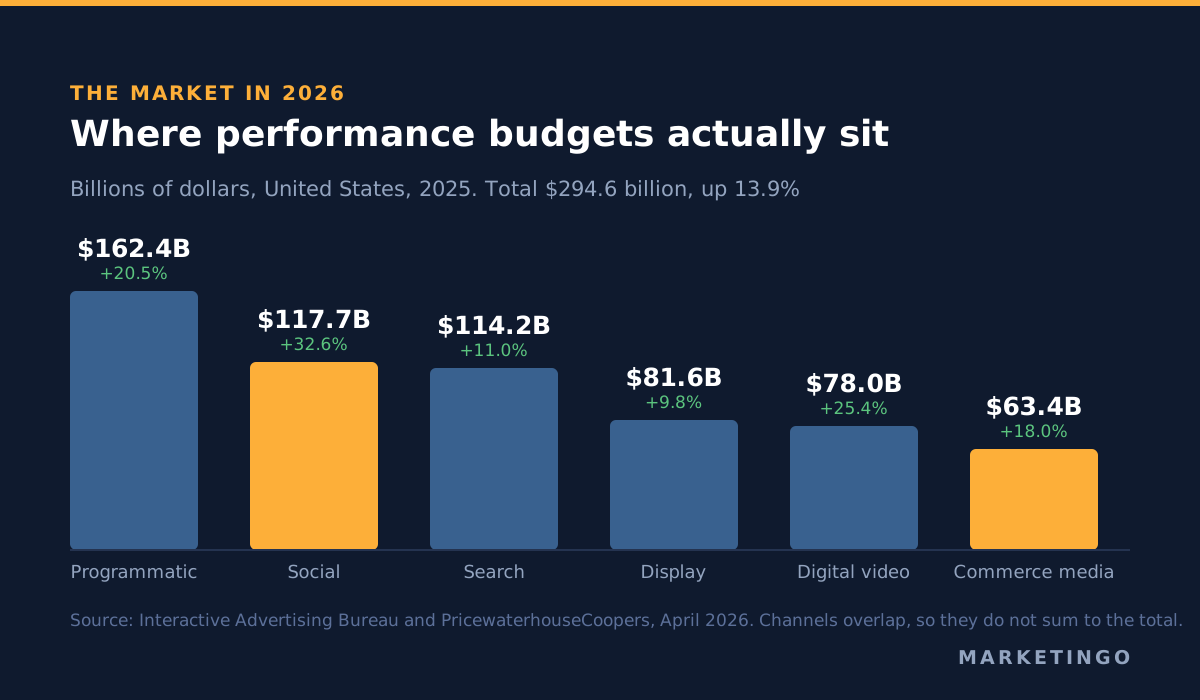
Retail and commerce media became a first-class performance channel. Commerce media reached $63.4 billion in the United States in 2025, roughly a fifth of all United States digital advertising revenue by the same report's own total, and globally commerce advertising hit $178.2 billion and passed total television advertising revenue of $167.5 billion for the first time (WPP Media, December 2025). United States retail media spending is forecast to rise from $58.79 billion in 2025 to $69.33 billion in 2026, with Amazon Ads and Walmart Connect accounting for more than 89% of that increase (EMARKETER, Retail Media Ad Spending Forecast and Trends, late 2025). The practical consequence: if a meaningful share of your sales happen on a marketplace, an agency with no retail media practice is managing a fraction of your demand. Four of the eleven below have no marketplace capability at all.
The platforms took over the levers, then published smaller numbers than they launched with. Google's AI Max for Search arrived in May 2025 claiming typically 14% more conversions or conversion value at a similar cost per acquisition or return on ad spend, rising to 27% for campaigns weighted to exact and phrase match. By the April 2026 post announcing general availability, Google's own published figure was an average of 7%, footnoted to internal data for non-retail advertisers. Dynamic Search Ads, automatically created assets and the campaign-level broad match setting are all being retired into it, with the Dynamic Search Ads sunset pushed to February 2027. Meta's Andromeda retrieval system is a smaller published effect than its marketing suggests, at a 2.4% increase in conversions on Facebook since 2025. And when an agency quotes the Performance Max figure of 27% more conversions, note that it still sits on Google's own help page footnoted to internal data from October and November 2023, before AI Max and before most of the control changes Performance Max has since absorbed. Anyone citing it as current is citing 2023.
Measurement stopped being about cookies and started being about server-side plumbing. The cookieless future was cancelled twice. Google decided in April 2025 to maintain its current approach and not show users a new third-party cookie prompt at all, then in October 2025 retired most of the Privacy Sandbox itself, including the Attribution Reporting application programming interface, Protected Audience and Topics, citing low levels of adoption. What matters now is consent and server-side transmission. Google states that consented users are typically two to five times more likely to convert than unconsented users, and its own worked example shows a 50% consent rate producing a 19% drop in observed conversions, with modelling recovering an 18% uplift. On the transmission side it reports an average 11% increase in search conversions from enhanced conversions against standard imports and an average 14% uplift from its tag gateway, and its Data Manager application programming interface is now built on the Interactive Advertising Bureau Tech Lab's event and conversions standard. The question to ask an agency is not what it thinks about cookies. It is who owns your consent configuration and your server-side conversion feed, and what happens to them if you leave.
How agencies get paid changed more than how they buy. Labour-based fees are now the main compensation model for only 19% of global brands, down from 54% in 2011, while fixed-fee and output-based models rose to 33% and labour plus performance to 21% (World Federation of Advertisers with Agency Mania Solutions, September 2026, 69 multinational companies representing $147 billion of marketing spend). Tenure tells a sharper story for this category: integrated full-service relationships now average 87 months, but media-only relationships average 44 months (Association of National Advertisers and the American Association of Advertising Agencies, April 2025). If you hire a pure media supplier, plan for a relationship about half as long as the headline figure suggests, and make sure your accounts, pixels and conversion feeds are built so a change of agency is a handover rather than a rebuild.
In-housing is a smaller countercurrent than the headlines suggest. Among Association of National Advertisers members, 82% report having an in-house agency, but 92% still work with external agencies and only 54% of those in-house teams touch media planning or buying at all. The realistic pattern is a hybrid: an internal owner of strategy and data, an external team doing the buying. The in-house versus agency comparison works through the cost side of that decision.
MarketinGO 1. MarketinGO: best for senior operators running two or three channels against one commercial number
Founded: 2019 · HQ: Chisinau, Moldova, serving the United States and Europe · Team: ~5 senior operators · Website: marketingo.com
Most performance marketing engagements fail on execution speed and seniority rather than strategy. MarketinGO is built around that observation: the people who plan the account are the people who build and run it, the first campaigns are usually live within about a week, and the reporting answers one question rather than forty. The firm runs paid media only, across Google, Meta, LinkedIn and Microsoft, for two kinds of buyer: business-to-business and high-ticket service companies measured on cost per lead and pipeline, and direct-to-consumer retailers measured on return on ad spend and profitable scale.
What they do. Full-funnel strategy across the two or three channels that matter for a given business, then Google Ads management, Meta advertising, LinkedIn Ads and Microsoft Ads run as one account rather than four silos, with shared audiences, one conversion taxonomy and unified attribution. The work includes the parts that decide whether media spends well: conversion tracking and server-side event configuration, feed and shopping structure for retailers, landing page and offer testing, and search term hygiene. There is no separate analytics retainer, because measurement is where the buying decisions come from.
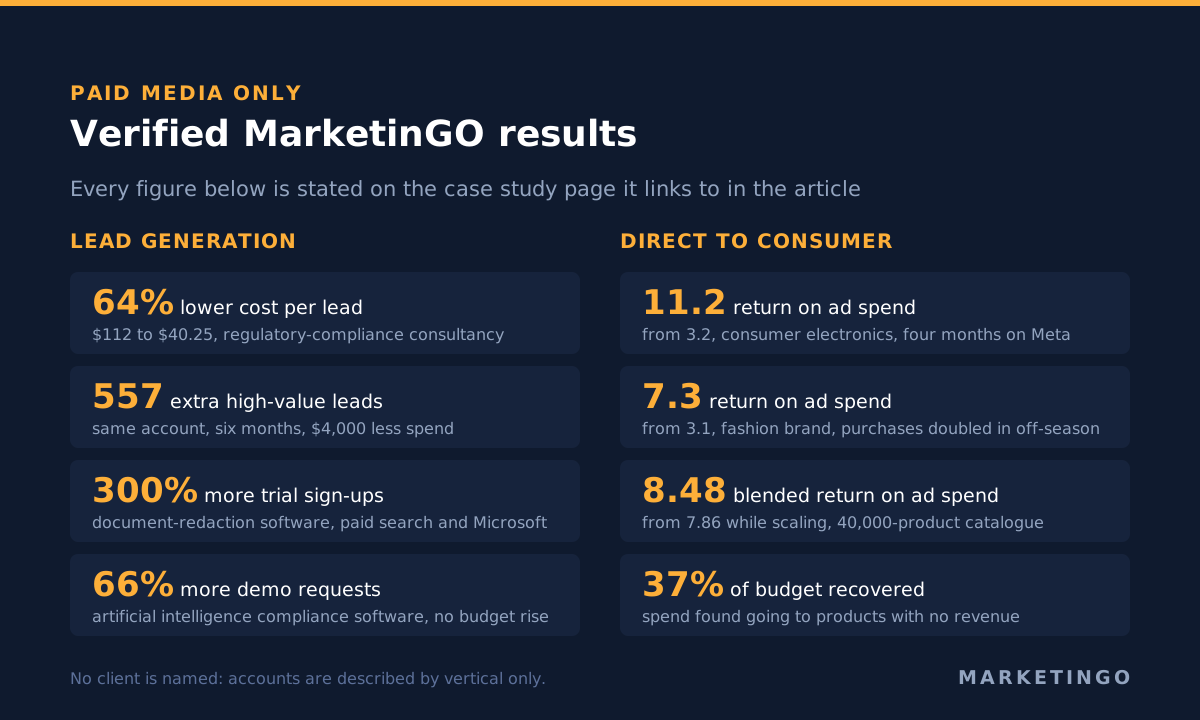
Verifiable results. For a regulatory-compliance consultancy, cost per lead fell 64%, from $112 to $40.25, with 557 extra high-value leads and 27% more traffic while spending $4,000 less, in six months. For an artificial intelligence compliance software company, demo requests grew 66% on a lean Google and LinkedIn setup with no budget increase. For a document-redaction software company, trial sign-ups rose about 300% while cost per trial fell, with Microsoft Ads added as a second high-intent channel. On the retail side, a United Kingdom consumer electronics brand went from 3.2 to 11.2 return on ad spend and from zero to profitable scale on Meta in four months; a fashion brand moved from 3.1 to 7.3 return on ad spend with purchases doubled in its off-season; and a roughly 40,000-product dental supplies catalogue lifted blended Google return on ad spend from 7.86 to 8.48 while scaling spend, after 37% of budget was found going to products with no revenue at all.
Ideal fit. Companies spending between roughly $5,000 and $150,000 a month who want the people doing the work to be senior, and who are measured on a single commercial number rather than a dashboard. The strongest fits are high-ticket business-to-business services, software companies, multi-location home improvement operators and direct-to-consumer retailers. Founders selling into the United States from outside it tend to value the combination of United States market fluency and same-day responsiveness.
Where it stops. This is a paid media firm and nothing else. It does not do search engine optimization, content marketing, email and lifecycle marketing, outbound sales development, organic social, public relations, influencer programmes, web development or marketplace operations beyond the advertising layer. It is not a creative or branding shop, and a brand needing a new identity should buy that elsewhere first. Nor is it right for an enterprise advertiser needing linear television, audio and out-of-home in the same plan, or for a company whose growth problem is a product problem.
Certifications: Google Partner and Meta Business Partner. Pricing. A managed monthly engagement, quoted against the channels and scope involved, with the figure given before any work starts.
Tinuiti 2. Tinuiti: best for enterprise retailers coordinating search, Amazon and streaming
Founded: 2004, as Elite SEM · HQ: New York, New York · Team: 1,000+ employees · Website: tinuiti.com
Scale is the argument here, and it is a real one. Tinuiti's own about page claims more than $4 billion of digital media under management, which is an order of magnitude above most firms on this list, and the breadth that comes with it is the point: a retailer whose demand is split across Google, Amazon, retail media networks and streaming can buy all of it from one team working to one measurement framework.
What they do. Search, social, Amazon and retail media, streaming and linear television, audio, display, affiliate, creative, conversion rate optimization, email and short message service, and influencer work. The connecting layer is Bliss Point, described as a marketing operating system with modules for incrementality testing, media mix modelling and creative analysis. Worth noting for anyone comparing old notes: the firm's previous named framework and platform, GAMMA and Mobius, have both been retired, and its technology branding turns over roughly every two years.
Verifiable results. For Sun Auto, a network of nearly 40 automotive service brands across 350 locations, Tinuiti reports a 230% increase in conversions in the first year, cost per lead down 64% and cost per car down 59%, with call volume up more than sevenfold and paid campaigns accounting for 36% of calls in 2025 against 4% in 2024. Other named results appear as headlines on the firm's work index, including figures for poppi and Murad, but those pages were not opened for this article and are not treated as verified here.
Ideal fit. Enterprise and upper mid-market retail and consumer brands spending eight figures a year, particularly where Amazon or a retail media network is a major sales channel and television or streaming sits in the same plan. The contact form's spend bands run from under $1 million a year to above $50 million, which is a fair read on where the firm expects to be useful.
Where it stops. This is not a mid-market shop. Smaller advertisers are routed to a separate brand, Foundation, which the firm's own site describes inconsistently as both a midsize offering and one for small businesses and startups. There is no website or application development, no brand strategy or above-the-line creative, and no marketing technology implementation. A buyer who wants named senior operators guaranteed on the account should press hard on staffing, because at this headcount the pitch team and the delivery team are rarely the same people. The independence claim also deserves a question: the firm markets itself as the largest independent full-funnel marketing agency while being a New Mountain Capital portfolio company.
Certifications: Google Premier Partner, most recently announced in March 2024 as the twelfth consecutive year, and Amazon Ads advanced partner status since 2022. Several other platform designations are self-stated. Pricing. Not published anywhere, and the specific dollar figures circulating for Tinuiti's fees come from automatically generated competitor pages rather than any primary source.
Brainlabs 3. Brainlabs: best for media-led buyers who want an experiment record rather than a pitch
Founded: 2012, by a former Google employee · HQ: no declared headquarters; London-founded with a United States parent entity · Team: 1,000+ across five continents · Website: brainlabsdigital.com
Brainlabs sells a method rather than a roster. Its stated approach, Test and Earn, is backed by what it describes as a repository of more than 2,500 logged experiments accumulated over thirteen years, and its proprietary layer, Cortex, is described as 32 tools built by more than fifty in-house engineers. For a buyer who has sat through five pitches that all promised data-driven media, an agency that can show what it has already tested and what failed is a different conversation.
What they do. Paid search, paid social, programmatic and connected television, retail media, influencer work, digital partnerships, performance creative, search engine optimization, answer engine visibility, site experience and data services, plus a Google Marketing Platform reselling arm, across retail and ecommerce, financial services, travel, consumer technology, business-to-business software and healthcare.
Verifiable results. The named-client evidence here is the cleanest of any agency on this list, because the figures are channel-specific and the clients are quoted. For easyJet holidays, Brainlabs reports a 13% improvement in return on ad spend from value-based bidding, with a 6% increase in revenue and a 4% increase in margin from bidding to margin rather than to revenue. For On The Beach, it reports a 49% reduction in cost per acquisition and an average return on ad spend increase of 105%, alongside recovering 15% of conversions through consent mode and a further 16% through enhanced conversions, with the client's own performance marketing lead quoted on a 31% recovery of additional conversions. That second case is a useful illustration of the measurement point made earlier: the gain came from the plumbing, not the bidding.
Ideal fit. Enterprise and large mid-market advertisers who want media bought by a firm with a documented testing culture, particularly in travel, retail, financial services and business-to-business software, and particularly where programmatic and connected television belong in the same plan as search.
Where it stops. No public relations, no standalone affiliate programme management, no above-the-line brand work and no product development, and the industry list excludes local and small-business services entirely. The heavy emphasis on agentic artificial intelligence and the Cortex platform means a buyer who wants named humans accountable should ask directly who does the work and how much is automated. Two smaller signals for anyone judging operational care: the about page ships visible placeholder text in a team biography, and the contact page returns a not-found error.
Certifications: Meta Certified Company in Media badge, awarded April 2024, and a 2023 Google Premier Partner award for brand awareness. The site also claims premier partnership with all major advertising platforms, which is a blanket self-claim rather than verifiable per-platform status. Microsoft's own blog describes Brainlabs as an independent agency that was a finalist in its partner awards, so the elite designation sometimes attributed to the firm is not supported by Microsoft's wording. Pricing. Not published.
Directive 4. Directive: best for software companies measuring paid media against pipeline
Founded: 2013 · HQ: Orange County, California, with offices in Austin, New York, Mexico City, London and Toronto · Team: 130 to 150 strategists · Website: directiveconsulting.com
Directive built its reputation on refusing to optimize to marketing qualified leads, and that refusal is still the clearest reason to hire it. Its Customer Generation framework replaces volume targets with pipeline and closed-won revenue as the optimization goal, which in practice means buying against target accounts and high-intent segments and accepting a lower lead count in exchange for a better one. For a software company whose sales team complains about lead quality, this is the agency whose entire model is built around that complaint.
What they do. Three divisions: Performance covers paid media, content and search, performance creative, programmatic and revenue operations; Commerce covers marketplace advertising, product feed management and shopping; Communications covers public relations, influencer work and social. The firm claims $2.2 million a year of research and development spending and runs a newer methodology, DiscoverabilityOS, aimed at visibility inside answer engines, plus an internal platform called Stratos that unifies customer relationship management, media and search data.
Verifiable results. For AxisCare, a home care software company, Directive reports a 200% year-on-year increase in scheduled demos, a 70% increase in relevant organic traffic, and 24 net-new leads attributed to large language models between March and August 2025, with those models rising from under 4% to 15% of referral traffic. For Case Status, it reports a 20% increase in demo bookings over forecast. For dbt, it reports sign-up volume 124% over projected goal and cost per sign-up 55% under projected goal across Google, LinkedIn and Reddit. As noted earlier, those last two are measured against forecasts rather than prior periods, which is a weaker claim than the percentages suggest. Amazon, Gong and Hewlett-Packard appear in logo strips without attached figures.
Ideal fit. Business-to-business software companies from Series A to initial public offering, and adjacent technology, industrial and professional services firms with a real sales team, a customer relationship management system that is actually maintained, and a willingness to be measured on pipeline rather than volume.
Where it stops. No self-serve or small-business tier exists, and the six-office structure implies a retainer well above a small company's budget. Because the firm publishes no pricing, a prospective client cannot work out whether they qualify without a call. Directive does not do product or user experience design, demand generation tooling implementation, or outbound sales development, and pure direct-to-consumer brands wanting a single-channel Meta buyer are the wrong fit. One thing to question in a pitch: three competing named frameworks now appear on the site, and two different team sizes appear on two of its own pages.
Certifications: none published. The firm's partners page is a referral network recruitment page rather than a certifications page, and the only third-party mark on the site is a review widget. Pricing. Not published.
KlientBoost 5. KlientBoost: best for accounts whose real constraint is the page after the click
Founded: 2015 · HQ: Santa Monica, California, with offices in Raleigh and London · Team: not published · Website: klientboost.com
Most performance marketing agencies will tell you your landing page is the problem and then send traffic to it anyway. KlientBoost sells conversion rate optimization and landing page design as standalone service lines alongside media buying, which means it builds and tests the page rather than advising you to. For an advertiser whose cost per acquisition is being set by a weak page rather than a weak auction strategy, that pairing is the whole value.
What they do. Paid search and paid social across Google, Meta, LinkedIn and Microsoft, plus search engine optimization, content, link building, conversion rate optimization, landing page design and email marketing. Its named method, the Growth Grid, models the funnel from lead through marketing qualified lead and sales qualified lead to customer return on ad spend, and uses that model to decide where the next increment of budget goes. In-house software called Kite flags performance anomalies and budget leaks, and in-house creative and business intelligence teams are listed, which is unusual at this size.
Verifiable results. For Fashionphile, a luxury resale retailer, KlientBoost reports a 54% increase in revenue, 36% more transactions, a 28% increase in return on ad spend and 65% more sales leads, all measured month over month, from search, shopping and display remarketing. For Segment, a business-to-business software company, it reports reaching 195% of the conversion goal at 12% under the target cost per acquisition, with paid producing more sales qualified leads than organic for the first time. Both are published as the firm's own case documents, and both are old: the Segment work dates to 2016.
Ideal fit. Advertisers spending from roughly $5,000 a month upward, in either lead generation or retail, whose conversion rate is the binding constraint, and who have the operational capacity to absorb more volume. The firm's own fit list asks for clients who treat marketing as an investment and have the bandwidth to handle more business, which is an honest screen.
Where it stops. No programmatic or connected television, no marketplace or feed management, no account-based marketing data stack, no public relations or influencer work. The case study library is ageing, with several documents from 2016 to 2021 and little recent flagship proof, which matters when you are buying 2026 judgement. Two self-reported averages on its own site disagree, quoting both a 32% and a 30% or more reduction in cost per acquisition within 90 days, neither with a stated method.
Certifications: Google Premier Partner, stated on its own Google Ads page alongside HubSpot and Salesforce partnerships. No Meta or Microsoft partner status is claimed in text, only linked directory logos. Pricing. Not published. Its pricing page contains no figures and offers a free plan instead. The ranges that appear in its Google Ads frequently asked questions, from $2,000 to $15,000 a month and 12% to 30% of ad spend, are described there as industry figures and are not KlientBoost's own rates, which is a distinction several rankings get wrong.
NoGood 6. NoGood: best for funded brands buying answer-engine visibility alongside paid media
Founded: 2016 · HQ: 491 Broadway, New York, with hubs in Miami and Dubai · Team: 70+ · Website: nogood.io
NoGood is the only agency on this list that publishes what it costs, and it is also the one most clearly built for the shift in how buyers find products. Its recent work is weighted toward answer engine optimization: getting a brand cited inside ChatGPT, Gemini, Perplexity and Google's artificial intelligence overviews, and measuring the traffic and conversions that come back from them. For a brand watching organic click-through rates fall while assistants answer the question on the results page, that capability is worth more than another percentage point of auction efficiency.
What they do. Answer engine optimization, search engine optimization, paid social, paid search, performance branding, conversion rate optimization, lifecycle marketing, performance creative, content and video, earned media, and a fractional chief marketing officer offering, with internal units for design, creator content, TikTok and an artificial intelligence lab. Delivery is a cross-discipline growth squad per client rather than a channel-by-channel handoff.
Verifiable results. For SteelSeries, the gaming hardware brand, NoGood reports visibility scores rising from 44 to 77 on Perplexity and 51 to 73 on ChatGPT between January and October 2025, with traffic from answer engines growing to more than 1,500 daily visitors; the page headlines a 23 times increase in that traffic while its own body says 6.7 times, so the larger figure should not be quoted without the caveat. For Spring Health, it reports a 113% increase in provider qualified leads and a 149% increase in conversion rate. For MongoDB, 3.4 million impressions in the third quarter of 2024 and a 103.5% increase in LinkedIn engagement rate. For Inflection AI, a 40% decrease in cost per account creation. The consistent weakness across these pages is missing baselines and date ranges, so cite the case study page rather than the homepage and name the metric.
Ideal fit. Funded software, business-to-business, healthcare, financial technology, consumer and artificial intelligence companies that can carry a retainer above $20,000 a month and want answer-engine visibility treated as a performance channel rather than a content project. This is the strongest consumer-brand roster on the list.
Where it stops. NoGood states a closed vertical list and says plainly that it does not take on industries it has not mastered, which rules out industrial, manufacturing, local services and most regulated categories outside healthcare and financial technology. There are no standardized packages and no fixed-scope projects, so a fast cheap engagement is not available, and there is no marketplace or feed operation, no traditional public relations retainer and no development work. At its stated average retainer it is out of reach for small businesses and unfunded early-stage companies.
Certifications: none published. The site shows awards from the Shorty, Webby and Drum programmes without years or categories. Pricing. Published, and the only real figure on this list: engagements are monthly retainers and the average is stated as above $20,000 a month, with no standardized packages. One of its own landing pages contradicts this by saying fees vary widely with no figures, so take the homepage statement as the live one.
Power Digital 7. Power Digital: best for mid-market brands buying measurement and media from one supplier
Founded: 2012 · HQ: San Diego, California, with offices in New York, Atlanta and Medellin · Team: not published · Website: powerdigitalmarketing.com
The argument for Power Digital is that measurement and media sit in the same building. Alongside paid media it sells data infrastructure, incrementality testing, media mix modelling and marketing operations, and it runs a separate measurement and strategy consultancy, fusepoint. For a mid-market brand that cannot justify an internal analytics hire but keeps losing arguments about what its advertising actually caused, buying both from one supplier is a defensible choice.
What they do. The broadest service set on this list: paid media across Amazon, TikTok, programmatic, paid social and paid search; earned media including public relations, affiliate and influencer; owned media including search engine optimization, email and short message service, content, organic social, generative engine optimization and conversion rate optimization; data intelligence; go-to-market consulting; creative; and marketplace work on Amazon and TikTok Shop. The firm runs a named artificial intelligence stack, with Omega as an operating system of automated agents, Iris as an intelligence layer and Creative Affinity for creative prediction. Anyone holding older notes should know its previous platform, nova, has been superseded.
Verifiable results. For Victrola, the turntable brand, Power Digital reports revenue up 115%, web sessions up 160% and transactions up 108%, plus more than 30,000 new email subscribers. For TomboyX, it reports first page rankings up 175%, new users and sessions up 51% year on year and revenue up 50%. Both are genuine named case studies, and they are the exceptions: much of the firm's case study library is anonymised by category rather than named, which makes those entries unverifiable by definition. A company-level claim that clients grow 2.5 times faster than the industry average appears in a press release with no methodology or benchmark named, and should not be repeated.
Ideal fit. Mid-market to lower-enterprise consumer and retail brands that want one supplier across media, measurement and earned channels, and private equity firms buying diligence on a target's marketing, which the firm markets as a distinct service.
Where it stops. No linear television or audio buying of consequence, no out-of-home, no product or application development. The breadth is the thing to stress-test: a service list spanning public relations, affiliate, influencer, search, media mix modelling, creative, marketplaces and consulting raises a fair question about depth per channel, and the answer should come from the named person who would run your account. The firm publishes neither a headcount nor an investor on its about page, which says only that it is privately held; it is backed by Court Square Capital Partners after a prior sponsor exited.
Certifications: none verifiable. No platform partner status for Power Digital itself could be confirmed on the firm's site or in any platform's own partner directory, and a TikTok beta credential sometimes attributed to it belongs to uptickk, an agency it acquired. Pricing. Not published.
Croud 8. Croud: best for United Kingdom and European reach across many markets at once
Founded: 2011 · HQ: London, with offices in Shrewsbury, New York, Atlanta and Dubai · Team: 600+ in-house plus an on-demand network · Website: croud.com
Croud's structure is genuinely different from everyone else here, and it is both the reason to hire the firm and the thing to interrogate. Alongside its employed staff it runs the Croudie Network, an on-demand pool of marketing specialists it numbers at around 2,900, and its own site states that about 40% of client work is delivered through that network. For a brand that needs twenty markets and twelve languages covered competently without paying for twenty permanent specialists, this is the most efficient model on the list.
What they do. Brand planning and strategy, integrated media, social, creative and data, packaged as audience, creative, media and commerce suites. Channels cover programmatic, paid social, paid search, search engine optimization, ecommerce, retail media and advanced analytics, with a dedicated luxury practice, Croud Luxe.
Verifiable results. For Timberland, Croud reports a 7 percentage point lift in aided awareness, 51% year-on-year growth in brand searches and triple-digit sales growth. A caution that bears repeating: that page's background and strategy sections contain copy about a different client entirely, so the traffic and conversion percentages that appear further down it do not belong to Timberland. For First Watch, the restaurant chain, it reports 11% more page views per session and a 2.7 second average load time across a site serving more than 100,000 users a day, with the client's own senior vice president quoted. Verify anything you read on a Croud case study in the rendered body rather than from a search snippet, because the page metadata on at least two of them names the wrong client.
Ideal fit. Enterprise and upper mid-market advertisers with an international footprint, strongest in the United Kingdom and Europe, and in travel, retail, restaurant and luxury categories. A brand selling in one country gets less of what makes Croud distinctive.
Where it stops. No above-the-line brand agency work at scale and no product development. The 40% network delivery figure is the honest point of friction: a buyer who needs a guaranteed badged in-house team on every hour of the account should look elsewhere, and should in any case ask how data access, continuity and accountability work when a contractor is doing the buying. There is no single named proprietary platform, and the firm's own page gives two different names for its network layer and two different figures for its size. The United States presence is newer and was partly built by acquisition.
Certifications: a Google Premier Partner recertification notice dated February 2022 is the only verifiable designation, and four years is a long time in partner tiers. No current Microsoft, Meta, Amazon or TikTok status could be confirmed. Pricing. Not published. The network model implies a variable cost structure, but no rate card is public.
Darkroom 9. Darkroom: best for direct-to-consumer brands wanting brand and performance in one team
Founded: 2017 · HQ: New York, New York, with offices in Lisbon and Sao Paulo · Team: described as a 100+ person cross-functional group · Website: darkroomagency.com
Darkroom is the most transparent firm on this list and the most explicit about who it will turn away, which for a buyer is worth more than another case study. It publishes starting prices by service line, and it publishes a disqualification list naming the clients it is a poor fit for. Its model treats brand and performance as one team rather than two suppliers, and every engagement requires a planning artifact, the Flight Plan, that ties goals to a channel-level profit and loss and daily pacing.
What they do. Paid media and marketplace work across Meta, Google, Amazon, TikTok Shop, Walmart Connect, Instacart, Criteo and Target Roundel; performance creative, brand studio, creator content and organic social; retention and conversion rate optimization; strategy and web. Its artificial intelligence layer, Shadow, is described as building marketing mix models, running root-cause analysis and recommending budget reallocation scored on contribution profit, though no technical detail or efficacy evidence is published, so treat it as positioning rather than proven capability. Self-reported scale is more than $250 million of annual media managed.
Verifiable results. For Everlane, Darkroom reports Amazon revenue climbing from $78,312 in January 2026 to $174,326 in March, which the body describes as a 123% increase over two months across 87 products; the page headline claims 126% over three months, and the dollar figures support the body. For Morphe, it reports a 75% year-on-year increase in Shopify revenue during the 2025 Black Friday period and a 23% higher order rate from a rebuilt welcome series against the legacy flow. For Necessaire, it reports a 118% paid media revenue lift from influencer-led performance, with no baseline or timeframe given.
Ideal fit. Consumer brands between roughly $10 million and $500 million in revenue, selling a transactional product through their own storefront and at least one marketplace, who want creative, media and retention run by one team against contribution profit.
Where it stops. Darkroom's own disqualification list is the clearest statement of limits any agency here publishes: it is a poor fit for last-resort turnarounds in an imminent crisis, for buyers who want the cheapest single-channel vendor, for non-consumer categories including business-to-business software, industrial and professional services, for lead generation businesses with no transactional storefront, and for brands that want execution without measurement. It does not do paid search for lead generation at any depth, and it has no business-to-business practice at all. Two internal contradictions to raise in a first call: the paid media entry price is listed as $5,000 a month on one page and $1,500 a month plus a percentage of media on another, and the revenue floor below which the firm considers itself a poor fit is given as $5 million in one place and $2 million in another.
Certifications: listed in Shopify's own partner directory at the Plus tier, the only independently verifiable designation here. The firm states that it claims no platform certifications, which is unusually candid. Pricing. Published as starting points by service line, from $2,500 a month for retail media and $5,000 for paid media, retention or creator content, through $6,000 for Amazon management, $8,000 for performance creative and $10,000 for growth strategy, up to $12,500 for brand studio work and $60,000 for a website build as a project. The firm notes these are entry points rather than quotes.
Common Thread Collective 10. Common Thread Collective: best for online retailers whose problem is forecasting
Founded: 2012 · HQ: Costa Mesa, California, remote-first across 27 states · Team: ~70 · Website: commonthreadco.com
Common Thread Collective calls itself an ecommerce profit agency, and the framing is accurate rather than decorative. Its delivery model, the Prophit Engine, puts one named operator, a Prophit Engineer, in charge of a client's forecast and its daily execution, with a qualified backup for absences and a bench of data scientists maintaining the underlying models. The firm claims a forecast-to-plan accuracy figure of 3.15% for 2025. For a retailer whose real problem is that nobody can say what next month will do, a single accountable human owning a number is a sharper offer than a channel team.
What they do. A deliberately narrow set: growth strategy, Meta buying, Google buying, TikTok Shop, ad creative and incrementality. Unified forecasting merges revenue, marketing and cost data into one model tracked against daily targets. Self-reported scale is more than $3 billion of gross merchandise value managed annually across more than 170 brands.
Verifiable results. For UAG, the device case brand, the firm reports a 191% increase in purchase conversions, a 13.6% relative lift in sales volume and a 65.7% reduction in cost per acquisition with view-through conversions, measured in a Google unified lift study. For Igloo Coolers, it reports sales up 796% year on year for April 2020 and growth of 4.6 times year to date, though that work is from 2019 and 2020. The recency problem is real: the deep narrative case studies are all from 2019 to 2021, and the recent ones are co-marketing studies produced with platform partners.
Ideal fit. Direct-to-consumer retailers between roughly $10 million and $100 million in revenue, selling primarily through their own storefront, who want forecasting and contribution margin treated as the product and are willing to give an agency the financial data that requires.
Where it stops. There is no Amazon or Walmart service line at all, which is a significant gap given that marketplaces now take most of the growth in retail media; TikTok Shop is the only marketplace covered, and that capability was acquired rather than built, through the purchase of an agency called TBAR Partners in 2026. No search engine optimization, no conversion rate optimization, no web development and no retail media. The methodology is also mostly unpublished: of nine methodology documents, only forecasting is live, the four proprietary models are never named, and the forecast accuracy figure carries no disclosed method or audit. No pricing, no minimum and no stated list of buyers it is wrong for.
Certifications: none published. The TikTok Shop partner designation sits with the acquired subsidiary rather than with Common Thread Collective itself. Pricing. Not published.
Disruptive Advertising 11. Disruptive Advertising: best for buyers who want month-to-month terms and a stated guarantee
Founded: 2012 · HQ: Pleasant Grove, Utah, with a distributed team · Team: 160+ employees · Website: disruptiveadvertising.com
Commercial terms are the differentiator here. Disruptive Advertising publishes a promise of meaningful results in 90 days for qualifying brands, with no long-term contract, which is the opposite of the twelve-month minimum most firms this size want. Self-reported scale is more than $450 million of annual media managed and over 10,000 account audits, and it claims more than ninety clients retained for four years or longer, which is the more interesting number given that media-only relationships average under four years across the industry.
What they do. Paid search, paid social, search engine optimization, Amazon, lifecycle marketing, conversion rate optimization, creative, data analytics and lead generation, across business-to-business, consumer, ecommerce, local and software verticals. Its named framework, VSET, is presented as the method for closing the gap between executive expectations and marketing execution, though the acronym is never expanded anywhere on the site, so treat it as a brand token rather than a documented method. The one genuinely concrete process artifact is a six-step onboarding timeline running from discovery through a strategy workshop to ongoing strategy.
Verifiable results. For First Lite, the hunting apparel brand, the firm reports more than $300,000 in additional monthly revenue, a 148% increase in email conversion rate and a 210% increase in revenue per recipient, within two weeks. Its client results index headlines further named work, including a 510% year-on-year revenue increase for Nani Swimwear and 329% website sales growth for Bunny James, though those detail pages were not opened for this article. Several other case studies are anonymised by category, which makes them weaker evidence than the named ones.
Ideal fit. Mid-market advertisers in either lead generation or retail who want month-to-month terms, a stated performance guarantee and a single supplier across media, email and conversion work. Local and multi-location service businesses are genuinely served here, which is rarer on this list than it should be.
Where it stops. This is not an ecommerce specialist: retail is one of nine verticals and the named client roster skews toward large non-retail brands. No programmatic or connected television, no influencer or public relations work, no Walmart or broader retail media beyond Amazon. No pricing, no minimum spend and no street address are published, and the claim of turning away more than 80% of prospective clients is unverifiable positioning. The capacity framing on its site, offering only ten new client slots a month, is marketing rather than a qualification bar.
Certifications: Klaviyo Platinum Master, confirmed in Klaviyo's own partner directory, although the firm's own site describes the same designation with different wording. Google Premier Partner and HubSpot certification are self-stated. Amazon, Microsoft and Meta badges appear on its partners page as images with no accompanying text, so none of those three could be verified. Pricing. Not published, but the stated terms are month-to-month with a 90-day results guarantee for qualifying brands.
Considered and not listed, with the reason
Single Grain was a strong candidate on capability and was left out on data quality. Its case studies are internally inconsistent to a degree a buyer should not have to untangle: the Klassy Network result is labelled profit on the case study index and revenue in the body, and the stated return on ad spend of 4,212% does not reconcile with the dollar figures on the same page, which imply roughly 4,304%. The Learning A-Z result is measured against projection rather than prior period, and the Simon Pearce headline attributes a 25% monthly rise to conversions while the body attributes it to revenue. The firm publishes no headcount, no headquarters and no partner certifications, though its contact form accepts budgets below $3,000 a month, which makes it genuinely accessible to smaller advertisers. Worth a conversation if you are a small brand focused on search and answer-engine visibility. Not a firm whose published numbers you can quote without checking each one.
Inflow has the best-documented firmographics of any agency researched here, including a press kit stating a December 2003 founding, 25 full-time employees and a target client range of $10 million to $27 million in annual revenue. It is listed in the ecommerce PPC ranking and the Google Ads ranking because it belongs there. It is absent here because $7 million of media under management, its own homepage figure, is the wrong scale for most readers of a general performance marketing comparison.
Canopy Management was left out on scope: a pure Amazon, Walmart and Chewy operator with no capability on a brand's own website, which makes it a strong marketplace partner and the wrong answer to the question this article asks. Sellers Alley could not be verified at all, because its pages returned no readable content and no primary source for its founding, team, clients or results could be found. Under the rule used here that is an exclusion rather than a judgement about the firm.
How to choose between them
If you sell to businesses and your sales team complains about lead quality, start with Directive, whose entire model optimizes to pipeline rather than lead volume, and consider MarketinGO if you want the same posture with senior operators on a smaller account and a published cost per lead result to check it against.
If your conversion rate, not your auction strategy, is setting your cost per acquisition, KlientBoost is the one firm here that will build and test the page as a service line rather than advise you to.
If a marketplace is a real sales channel for you, the shortlist is Tinuiti at enterprise scale, Darkroom for a brand that needs creative and marketplace in one team, or Canopy Management as a specialist alongside whoever runs your own site. Common Thread Collective is the wrong choice for this specific need.
If you need twenty markets covered competently, Croud's network model is the most cost-efficient way to get there, provided you are comfortable with contractors doing part of the buying.
If nobody in your company can forecast next month, Common Thread Collective sells exactly that, with one named person accountable for the number.
If assistants are answering your buyers' questions before they reach your site, NoGood has the clearest proof of moving visibility inside answer engines, and Directive and Single Grain both have recent work in the same direction.
If you are a direct-to-consumer brand that needs brand and performance from one team, Darkroom, and read its disqualification list first because it may save you a call.
If you want month-to-month terms and a stated guarantee, Disruptive Advertising publishes both.
If you want an agency that can show what it has already tested, Brainlabs has the deepest documented experiment record and the cleanest named-client channel metrics on this list.
If you want measurement and media from one supplier without hiring an analyst, Power Digital, with the caveat that you should stress-test depth per channel.
If you are spending under about $5,000 a month, most of this list is not for you. Look at the general PPC agency ranking for firms with lower entry points, or read how to choose a PPC agency before you shortlist anyone.
What performance marketing agencies charge, and how to read a fee
There is no standard price, and the evidence on models is thinner than the industry pretends. The best current data on how brands pay comes from the World Federation of Advertisers' September 2026 study of 69 multinational companies representing $147 billion of marketing spend: labour-based fees are now the main model for only 19% of them, down from 54% in 2011, with fixed-fee and output-based arrangements at 33% and labour plus performance at 21%. On the agency side the most recent real survey is older: in a 2021 study of 883 agencies and freelancers, 35% charged a fixed retainer regardless of ad spend, 21% charged a percentage of ad spend, most of those taking 6% to 10%, and only 4% charged on performance alone. An Association of National Advertisers study found commissions used by 24% of advertisers for digital, search and social buying and 40% for programmatic, though that report's own authors describe its channel tables as directional only.
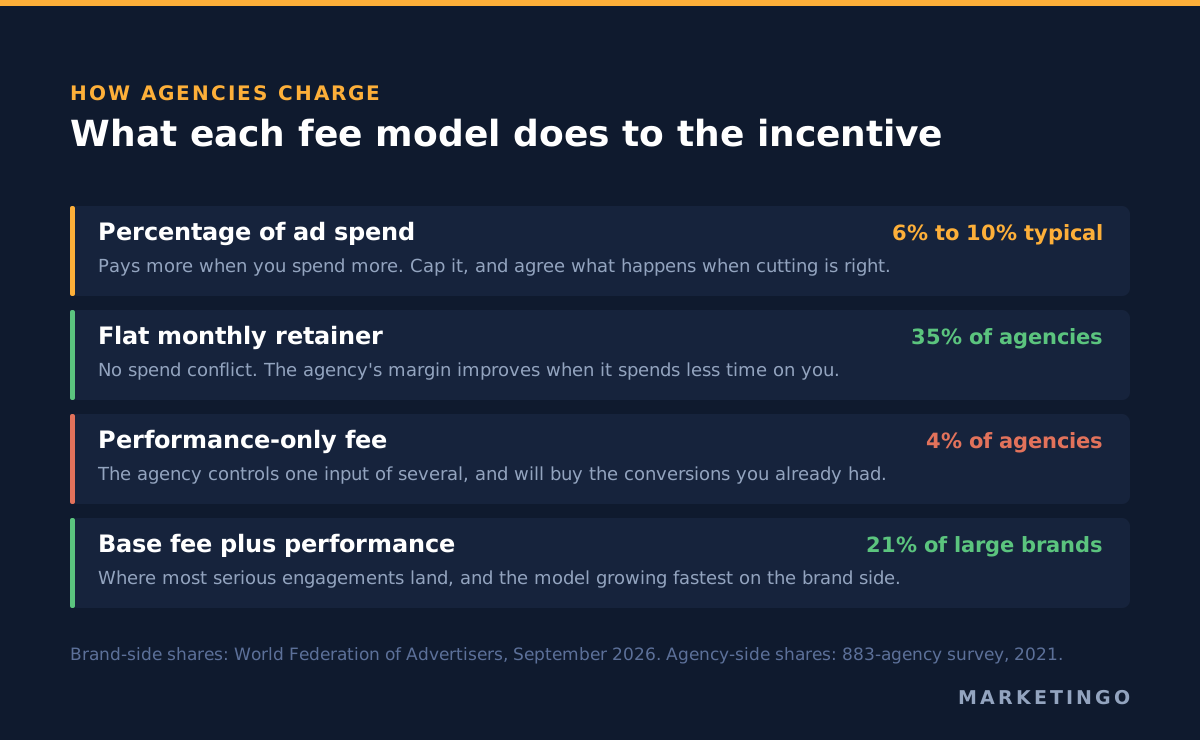
What matters more than the model is what it does to the incentive.
A percentage of ad spend pays the agency more when you spend more, which is fine while scaling is the right answer and actively harmful when the right answer is to cut a campaign. If you agree to this, cap it, and agree in writing what happens when efficiency requires spending less.
A flat retainer removes that conflict and introduces another: the agency's margin improves when it spends less time on your account. Ask who is assigned, for how many hours, and what happens to that allocation in month six.
Performance-based fees sound like the answer and almost never are, because the agency controls one input out of several. A firm paid on revenue has every reason to buy the branded search terms that would have converted anyway. If you use this model, pay on incremental outcomes and agree the measurement method before the first dollar is spent.
A hybrid of a base fee plus a performance element is where most serious engagements land, and it is the 21% of brands in the World Federation of Advertisers data that now pay labour plus performance.
Two practical rules regardless of model. First, before signing anything, work out what the engagement has to return to be worth it: the lead generation return on investment calculator does this for a lead generation business and the ecommerce return on ad spend calculator does it for a retailer, and both take about two minutes. A retainer that needs a 40% lift in conversion rate to break even is a bad deal at any fee. Second, own your assets. The accounts, the pixels, the conversion configuration and the server-side feed should be in your name, because media-only relationships average 44 months and the cost of a bad ending is measured in whether your next agency inherits a working account or rebuilds one. Our own breakdown of what PPC management should cost goes further into the arithmetic.
Where to start if you are still deciding
The fastest way to narrow this list is not more reading. It is to find out what is actually wrong with your accounts, because the answer usually eliminates most of the shortlist: a measurement problem, a creative problem, a landing page problem and a bidding problem each point at different firms above.
MarketinGO runs a free advertising audit that does exactly that. A senior operator goes through your Google, Meta, LinkedIn or Microsoft accounts and reports what is costing you money, where the measurement is wrong and what the realistic ceiling is on your current setup, with no obligation and no pitch deck. If the answer is that you need a creative shop or a marketplace specialist, you will be told that, and this article names several. If the answer is that your accounts need senior paid media operators working to one commercial number, that is the work MarketinGO does, and the case studies linked above are what it has produced doing it.