The Conversions API, often shortened to CAPI, is Meta's server-to-server route for conversion data. Rather than a browser reporting a purchase from the shopper's device, your server, shop platform or customer database sends it straight to Meta. Meta's documentation frames the purpose as optimising ad targeting and measuring outcomes, and recommends running the conversion API alongside the Meta Pixel rather than instead of it.
The situation
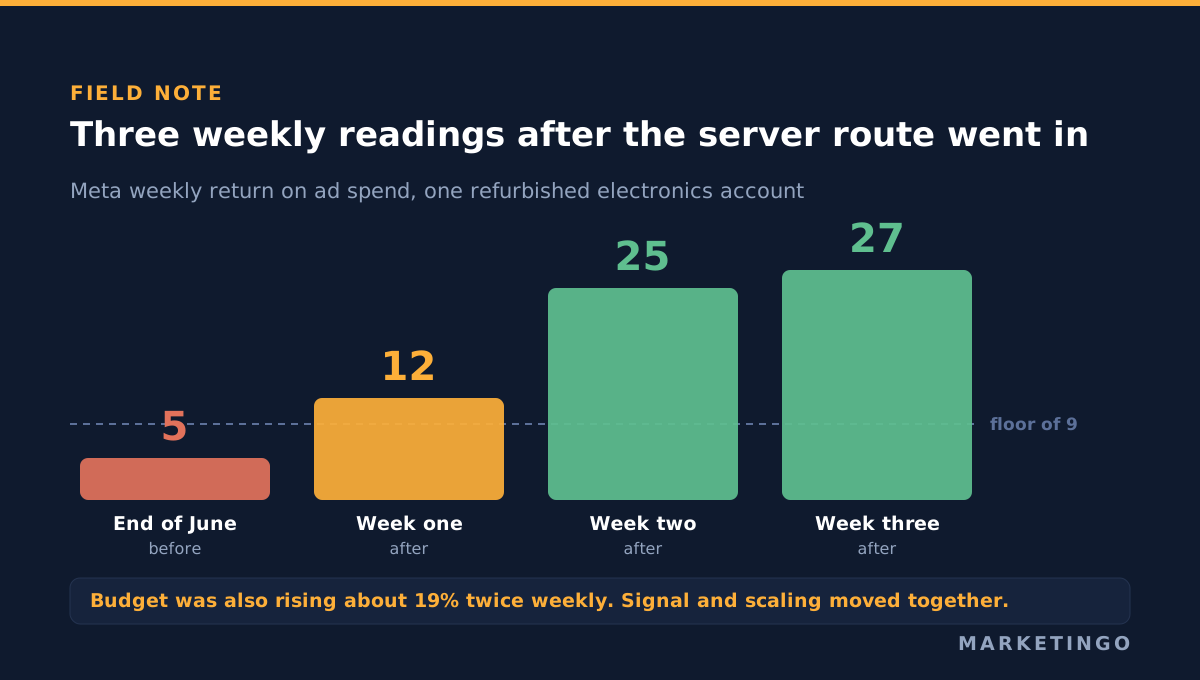
A United Kingdom retailer of refurbished consumer electronics had an account that was delivering fine and reporting badly. Weekly return on ad spend had fallen to about 5 by the end of June 2026, below the floor of 9 the account was held to, and nobody could say whether the sales had gone or the measurement had. We put the server route in alongside the existing pixel and started reading the weekly numbers again.
Meta reported weekly return on ad spend of 12, then 25, then 27 across the three consecutive weekly reports that followed, in July 2026. Over the same three weeks we were raising budget by about 19% twice a week and cutting or scaling individual creatives and ad groups on their own numbers, so the server data is not the only thing that moved. That matters, and we come back to it.
The mechanism, which is about bidding rather than reporting
A server-side conversion is not a second copy for the report. It is a better-matched signal for the system that decides who sees your Meta ads.
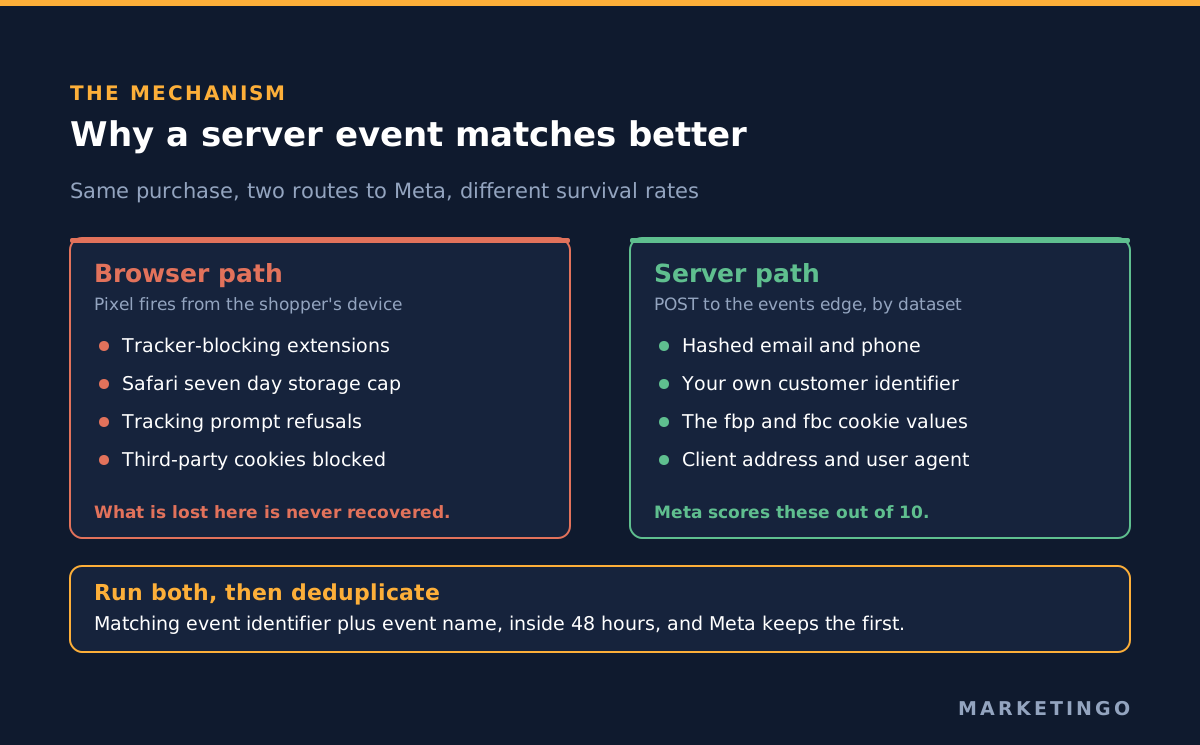
A browser event has to survive the browser. Apple's WebKit team capped all persistent cookies written by script at a seven day expiry with Intelligent Tracking Prevention 2.1, then extended a seven day cap to all script-writeable storage and blocked third-party cookies outright in Safari. An ad blocker removes the pixel before it fires at all. Apple's App Tracking Transparency prompt on iOS removes another slice. Meta's own chief financial officer told investors the cumulative changes on iPhone were "on the order of $10 billion" of headwind to 2022 revenue, while saying in the same answer "we can't be precise on this. It's an estimate."
What survives all of that is a request from your own server, authenticated with an access token generated once by a system user in Business Manager. The call is a POST to the /events edge of the Graph API, addressed by the pixel ID of the dataset you are writing to, documented at developers.facebook.com, and it carries whatever customer information you choose to put in it.
That last clause is the whole mechanism. The matching depends entirely on the user data you attach, which Meta reads from the user_data block: hashed email, hashed phone, name, city, state, postcode, country, your own external_id, the fbp and fbc cookie values, the client Internet Protocol address and the client user agent. Meta's best practices page says additional customer information parameters may help increase event match quality, scores that quality out of 10, and notes it is currently available only for web events. Contact information has to arrive hashed: Meta's parameter reference marks hashing as required for email, phone, name, birthdate, gender, city, state, postcode and country, recommended for external_id, and forbidden for the Internet Protocol address, which it says must never be hashed.
Sending both without counting the same purchase twice
The first objection every engineering team raises is double counting, and Meta's answer is specific enough to design against. Deduplication runs on two keys: the event identifier and the event name. The browser eventID must equal the server event_id, and the browser event must equal event_name. If Meta receives the same pair for one dataset ID within 48 hours, it discards the later events, and where the two do not differ meaningfully it keeps whichever arrived first.
A second route exists, matching on fbp or external_id, with a limitation worth knowing before you rely on it. Meta documents that it only works for events sent first from the browser and then from the server: a server call is not discarded if no browser event arrived in the previous 48 hours, even if an identical one turns up afterwards. Guides that say deduplication works in any order are describing the first method and not the second.
With no engineering time at all, the Conversions API Gateway is a self-serve configuration in Events Manager that builds the redundant pair without code and generates the event identifier for you. A reasonable first integration, and a black box when something goes wrong, which is the next section.
What we actually sent
The parameter list is where a CAPI integration is either worth having or decorative.
- A hashed email address on every purchase event. The shop already had it at checkout. It is the single highest-value matching parameter.
- A hashed phone number where the customer gave one. Partial coverage still raises the match on the orders that carry it.
- An
external_id, hashed, from the shop's own customer record, so repeat buyers resolve to one person across orders. - The
fbpandfbccookie values, passed from the browser to the server with the order and not hashed. These are what tie the server-side conversion back to the click that caused it. - The client Internet Protocol address and user agent, taken from the shopper's originating request rather than from our own server, which is the mistake that quietly ruins match rates.
action_sourceset towebsite. Meta marks this required and allows nine values in the server event reference: email, website, app, phone_call, chat, physical_store, system_generated, business_messaging and other. You are agreeing it is accurate, so set it to what happened.
Offline conversions go the same way. A phone order or an in-store sale can be posted to the same dataset with the matching action source, which is how a business whose revenue completes away from the website gets it into the optimisation at all.
How to tell it is working, and the failure that survives a green tick
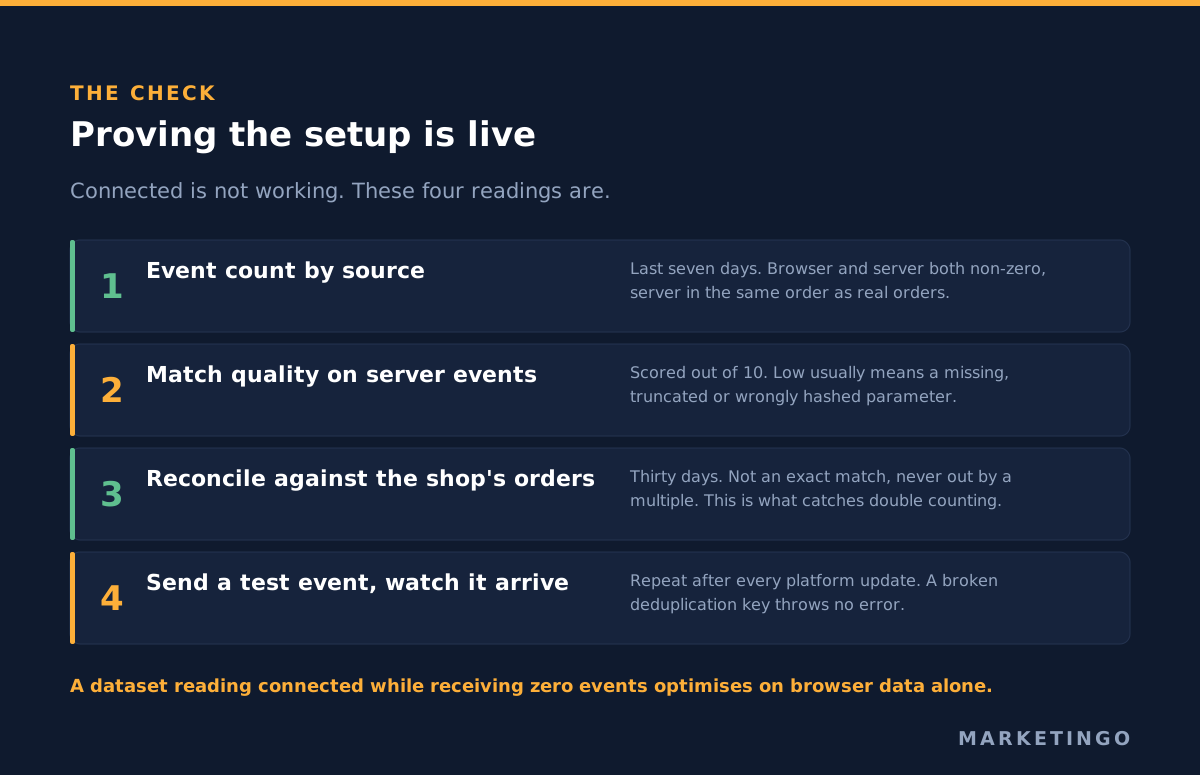
We have audited a live account whose dataset had received zero events. The interface showed the integration as connected. The dataset was empty, so every campaign in that account had been optimising on browser data alone while its owner believed the server was covering the gap. That turned up in a routine deduplication audit, not because anything on the screen raised a flag.
So the check is never "is it connected". It is four readings, in this order.
Read the event count on the dataset, by source, for the last seven days. Browser and server counts should both be non-zero, and the server figure should be in the same order of magnitude as your real orders. A dataset receiving nothing is the failure above.
Read the match quality score on the server-side events. It is scored out of 10. A low score usually means one of the six parameters above is missing, truncated, hashed when it should not be, or taken from the wrong request.
Reconcile the purchase count against the shop's own orders over a fixed window. We use 30 days. Platform-reported purchases will not match exactly and should not be out by a multiple. On a different account we found product analytics counting every purchase twice, once from the server and once from the confirmation page, which made every revenue figure read from it roughly double. Reconciling against the orders catches that, and it is a different test from anything inside the advertising platform.
Send a test event and watch it arrive. Then do it again after any shop platform update. Deduplication keys are the thing most likely to break silently in a deployment, and a broken key throws no error. It just inflates your conversions.
What it did not do
Three limits, because the figure at the top of this article is easy to over-read.
It was not the only change in those three weeks. Budget was rising about 19% twice weekly and creatives were being cut and scaled on their own numbers over the same period. Better signal and active scaling moved together. Anyone who tells you a tracking change alone produced a jump from 5 to 27 is selling you something.
Meta's own published figure is correlational. Meta says advertisers with a Conversions API setup for web events saw an average 17.8% lower cost per result than those without it, in an announcement dated April 2026. That compares two different populations of advertisers with no published sample or method, and advertisers who implement it are not a random sample. Treat it as Meta's claim rather than as a measured lift.
Server matching is not automatically as good as browser matching. A peer-reviewed paper in Proceedings on Privacy Enhancing Technologies found Meta's server route could match between 34% and 51% of website visitors when fed only Internet Protocol address, user agent and location, against 42% to 61% for pixel-based matching, but with under 65% accuracy where the pixel achieved 100%. That is the strongest technical argument there is for sending hashed email, phone and external_id rather than letting the server call rest on network-level signals.
And one claim to stop repeating. "Only 4% of users opted in to App Tracking Transparency" is quoted constantly and it is not an opt-in rate. It began as a Flurry Analytics figure for the share of the whole Apple mobile user base, counted per app per day. AppsFlyer's prompt-level measurement across roughly 550 apps put the global average nearer 37%, on a different denominator and not comparable. Signal loss on Apple devices is real. That number is not evidence of it.
The same problem on Google, and why the answer differs
Google's version of better-matched conversion data is enhanced conversions, which hashes first-party customer data with SHA-256 before sending it, plus server-side tagging in Google Tag Manager, which is also how Google Analytics data gets routed through your own server. Google reports an average 11% increase in Search conversions from enhanced conversions against standard conversion imports; the footnote on that figure names a 14 day window of internal data in January 2026, which is worth reading before you quote it.
Two context points people still get wrong. Chrome is not removing third-party cookies: Google confirmed in April 2025 that it would keep its current approach. And most of the Privacy Sandbox replacements are gone, with the Attribution Reporting API, Topics and Protected Audience retired in October 2025, so building measurement on those is building on withdrawn technology.
The Google-side settings run longer than this piece. We have written them up in our walkthrough of Google Ads conversion tracking, the better page if search is your problem rather than Meta.
When this is not your bottleneck
Server data fixes a signal problem. It does not fix the three problems most often mistaken for one.
If your conversion value is gross order value, better-matched purchases make the bidding more confident about a number that was already wrong. That is a profit question, and it is the subject of deriving a target return on ad spend from the profit and loss rather than from a margin assumption.
If your ads are being rejected or your catalogue is serving products nobody can buy, measurement is not the constraint. We wrote up the deleted-product-page version of that in why Meta keeps rejecting catalogue ads.
And if the account takes fewer than a few dozen purchases a week, a matching improvement will not be visible against the noise. Fix volume first.
Get the measurement checked before you judge the account
Most accounts we audit have a tracking gap somewhere, and the owner rarely knows which of two stories is true: the campaigns are losing money, or the campaigns are fine and the data is wrong. Those look identical in a dashboard and call for opposite decisions.
Our free advertising audit is a read-only pass over the account and its measurement, including the dataset event counts and match quality described above. If the problem is the setup rather than the spend, we say so. For the paid work itself, our Meta advertising service and the ecommerce and direct-to-consumer practice are where this kind of account sits, and the consumer electronics account we scaled from 3.2 to 11.2 return on ad spend is the public version of the vertical. To check your own floor first, the ecommerce return on ad spend calculator gives the number the bidding should be held to.