A client running a consumer electronics catalogue in Europe asked us to steer Google Shopping to a target return on ad spend of 7.0. The reasoning was sound on its face: break-even sat at 5.7, so 7.0 left a margin of safety. We asked for the profit and loss before changing a single bid, and the number it produced was not 5.7.
What a target return on ad spend can and cannot see
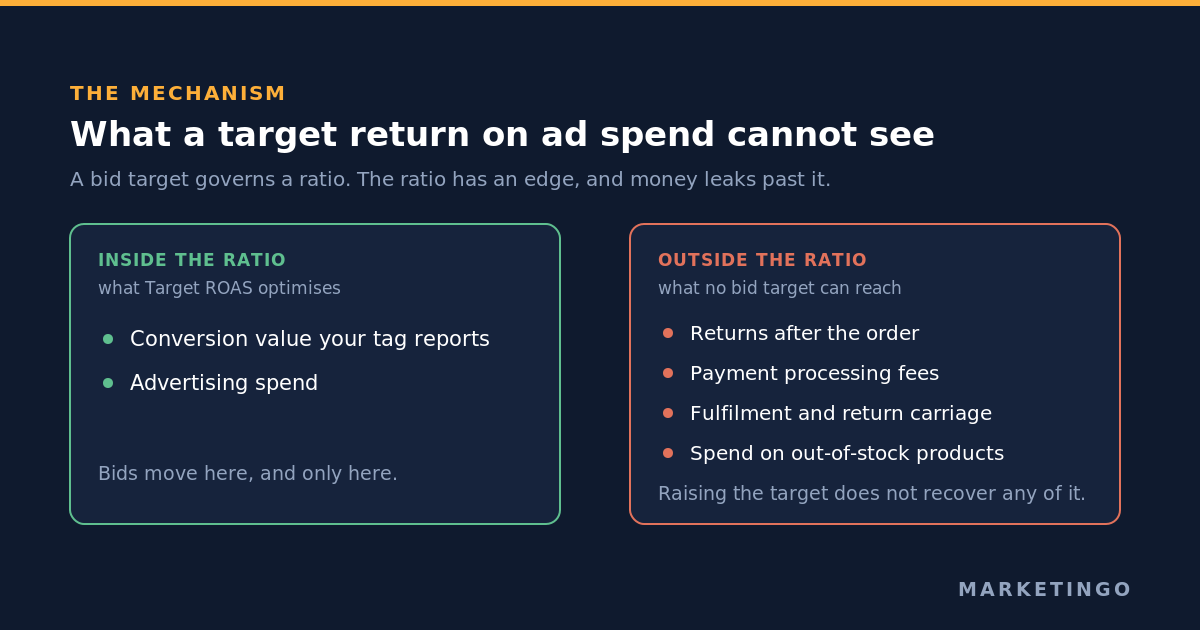
A target return on ad spend is a ratio between the conversion value your tracking reports and the money you spent getting it. Google is explicit that the strategy works from your own reported figures: it sets bids to "maximize your conversion value, while trying to achieve an average return on ad spend (ROAS) equal to your target", and it predicts future conversions "using your reported conversion values" (Google Ads Help, About target ROAS bidding). Whatever your tag sends is the universe the algorithm optimises inside.
In almost every store we audit, the tag sends gross order value. Not margin, not net of returns, not net of payment fees. So the bidding system is steering a revenue ratio while the business is trying to protect a profit number, and the distance between those two things is exactly where accounts quietly lose money.
The number we were handed, and the number the accounts gave
The client's 5.7 came from a gross margin assumption, which is the standard way the figure gets built: one divided by gross margin. It is the method every break-even calculator on the first page of results uses, and we have written before about why that formula understates the real floor.
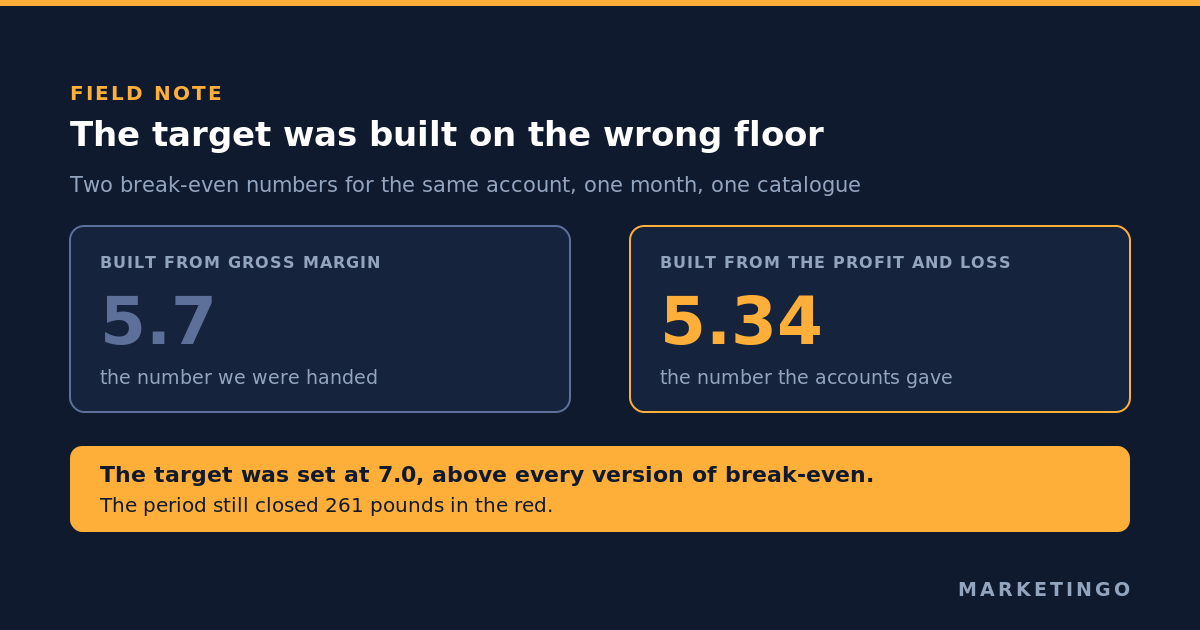
We read the September profit and loss for the same trading period instead of arguing about the method. Roughly £21,100 of advertising spend, and the period closed at minus £261 net. Worked back through the actual contribution left after the costs that sat below revenue, break-even came out at about 5.34, not 5.7.
That gap looks small and it points the opposite way to the one people expect. The client was not being reckless. He was being more conservative than he knew. Bidding to 7.0 against a true floor of 5.34 is a wider cushion than bidding to 7.0 against 5.7, and Google's own documentation warns where that leads: "setting a target that's too high may limit the amount of traffic your ads may get". He was buying less volume than he had decided to buy, on the basis of a number nobody had checked.
Why a conservative target still closed in the red
Here is the part worth keeping. The account was running a target of 7.0, comfortably above any version of break-even, and the period still finished at minus £261.
A target return on ad spend cannot fix that, because the loss was not inside the ratio. Everything between platform-reported revenue and money in the bank is invisible to the bid: returns, payment processing, fulfilment, and spend on products that cannot be bought at all. We found the last one in the same read. On a single day in September about £581, roughly 3% of Google spend, went to products that were already out of stock, because stock updates between the shop and Merchant Center can lag by up to an hour and the ads keep serving in the gap.
Raising a bid target does nothing about that £581. The clicks it bought converted at zero, which the algorithm reads as poor performance on those products and corrects for in time, but only after the money is gone and only on the products it has enough data about. Value-based bidding is good at allocating budget between things that convert. It has no view at all of a cost that lands after the conversion, or of revenue that reverses three weeks later.
The costs your conversion value never carries
Four categories usually sit between the number your tag reports and the number your accountant reports.
Returns. The National Retail Federation put online returns at an estimated 19.3% of online sales for 2025, with total returns across retail reaching $849.9 billion, or 15.8% of annual sales (National Retail Federation, 15 October 2025). Your conversion tag fires on the order. It does not fire again when the parcel comes back.
Payment processing. A percentage of gross plus a fixed fee per transaction, charged on the full order value including the part that gets refunded.
Fulfilment and shipping. Pick, pack, carriage, and the carriage on the return leg, which is frequently paid twice on one order that nets nothing.
Spend on unbuyable stock. Ours was 3% of one day's Google spend. In catalogues with fast-moving inventory and no automated stock control, we have seen it run higher.
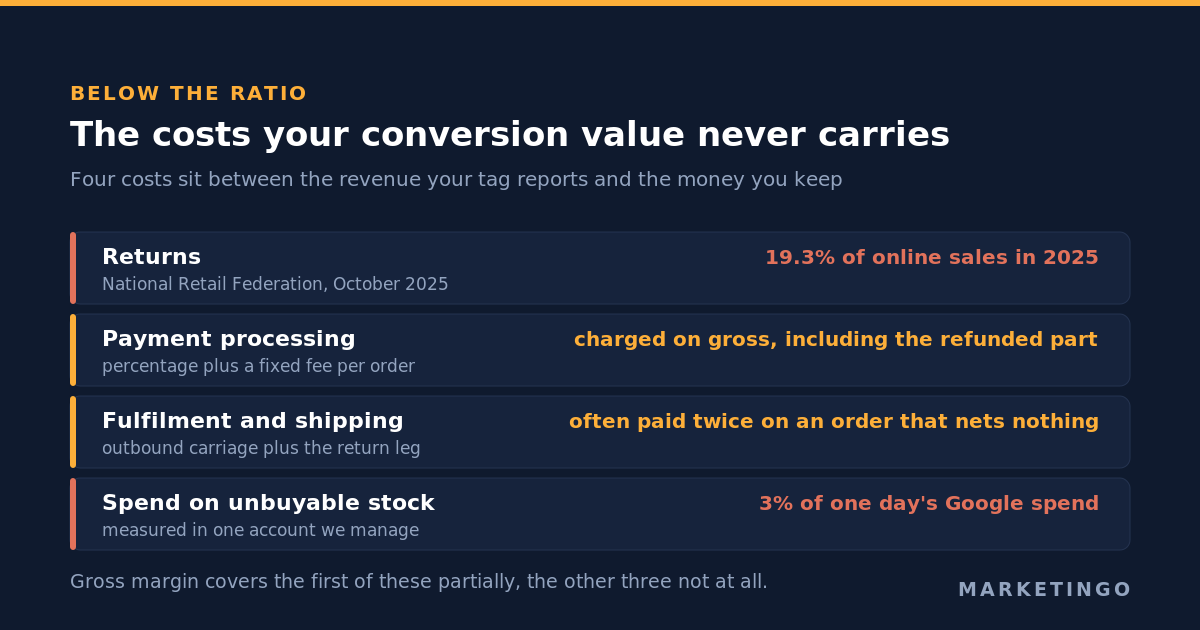
Gross margin accounts for the first of those costs only partially and the other three not at all. That is the whole reason a break-even derived from gross margin reads low and a target built on top of it reads optimistic.
How to derive the target from the profit and loss
This is the sequence we now run before accepting any target a client arrives with.
- Take a profit and loss for the same window as the ad spend. Not the quarter, not last year. The period you are about to bid against, so seasonality and promotions line up.
- Find contribution, not gross profit. Revenue less cost of goods, less returns at your actual rate, less payment fees, less fulfilment. Leave fixed overhead out: it does not change with the next click and it does not belong in a bid decision.
- Divide one by the contribution margin rate. That is your break-even return on ad spend, and it will be higher than the figure your margin spreadsheet gives.
- Reconcile it against the number you were handed. Where the two disagree, the difference is a cost somebody left out. Name the cost before you move the target, because the gap is information.
- Find the leakage outside the ratio first. Spend against out-of-stock products, duplicate conversion counting, refunds that never reach the platform. Fixing these raises real profit without touching the bid at all, and it is usually faster.
- Set the target from the margin and the growth decision, not from habit. The distance between break-even and target is a deliberate choice about how much volume you are willing to give up for profit per order. Write it down as that choice.
- Check the strategy has enough to learn from. Google asks for at least 15 conversions in the past 30 days at the conversion tracking level before target return on ad spend is available on Search and Shopping campaigns. Below that, a target is a wish.
The cheapest version of step 5 is a tracking audit, because duplicate or inflated conversion values make every ratio downstream wrong in the same direction. We cover that groundwork in Google Ads conversion tracking, and the mechanics of which automated bidding strategy to use once the number is right in Google Ads bid strategy.
Where the number goes once you have it
A figure derived from the profit and loss still has to be put somewhere. Target ROAS is one of several value-based bidding options inside Google's Smart Bidding family, and the choice between them is mostly a question of how much signal the account has.
Maximise conversion value without a target lets the system spend the budget and find the best value it can, which is the right automated bidding strategy while you are still gathering data. Adding a target constrains that search to a ratio, which only helps once the ratio is trustworthy. Target CPA is the lead generation equivalent, holding a cost per action rather than a return, and it is the correct choice when you have no revenue value to pass.
Portfolio bid strategies apply one target across several campaigns, which is efficient when those campaigns share a margin profile and quietly destructive when they do not. If your catalogue spans very different contribution margins, either split the campaigns or use conversion value rules so the value reported to the bidding system reflects what you keep rather than what you charged.
When this does not apply
Lead generation accounts. If you do not pass a revenue value with the conversion, there is no meaningful return on ad spend to target. The equivalent exercise is a cost per lead ceiling derived from close rate and contract value.
Accounts under the data threshold. Below Google's conversion minimums, a target constrains delivery without having enough signal to optimise against. Maximise conversion value without a target, or Maximise conversions, usually does better until volume arrives.
Subscription and repeat-purchase models. If the first order is deliberately unprofitable and lifetime value justifies it, break-even on order one is the wrong floor. Use payback period instead and treat the first-order loss as an acquisition cost.
Portfolio bid strategies across mixed margins. One target across products with 15% and 60% margins optimises to the blend and quietly starves the profitable half. Split the campaigns, or use conversion value rules so the reported value reflects margin rather than revenue.
Periods that do not match. A profit and loss covering a promotional week will produce a break-even number that only holds during promotions.
Check the number before you raise it
The useful habit here is small. When someone hands you a target return on ad spend, treat it as a claim with workings behind it, and ask for the workings. Most of the time the number came from gross margin, and most of the time the real floor is somewhere else.
That reflex is part of how we run Google Ads management, and it is the same instinct behind auditing a platform representative's recommendations against the account data rather than applying them because they arrived from Google. If you want to run the arithmetic on your own figures, our ecommerce return on ad spend calculator does the contribution margin version, and break-even return on ad spend walks through the formula in full.
Most of our work in ecommerce and direct to consumer starts here, with the accounts rather than the ad platform. The same habit produced an earlier field note from this vertical, on how a rejection wave in one catalogue turned out to be caused by deleted product pages rather than by anything in the ads. In our ecommerce Google Ads case study that sequence meant cutting the 37% of budget going to products that produced no revenue at all, then lifting blended return on ad spend from 7.86 to about 8.5 while spend went up rather than down.
If a target is steering your account and nobody can show you where the number came from, a free ad audit is a read only pass where we check your reported conversion values against what the business actually keeps. No obligation, and the findings are yours either way.