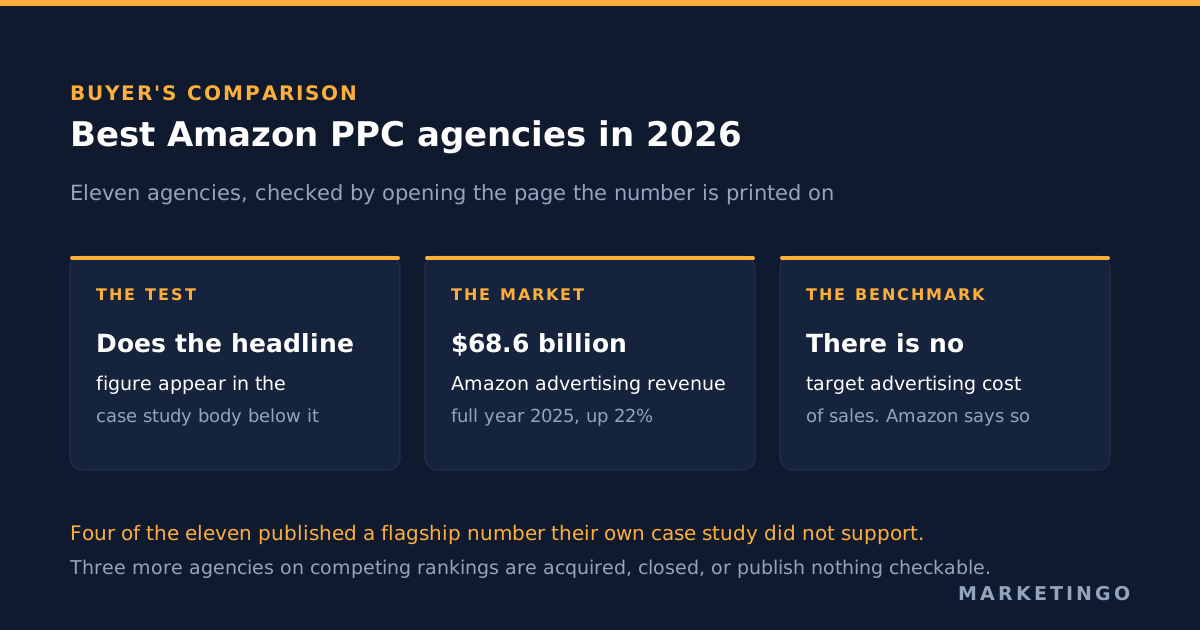
Choosing an Amazon PPC agency, meaning one that runs the pay-per-click auctions Amazon calls Sponsored Products, Sponsored Brands and Sponsored Display, comes down to a test almost no shortlist applies: open the agency's own case study and check whether the number in the headline is the number in the body. This guide puts 11 Amazon advertising agencies through that test, and reports what survived it.
Four of the eleven failed it on at least one flagship client, and those failures are written into the profiles rather than smoothed over, because a headline figure that the page below it does not support is the single most useful thing a buyer can learn about an agency before signing. Three further agencies were researched and left off entirely, one of them because it closed in October 2026 while its marketing site stayed live.
Most rankings of the top Amazon PPC agencies are assembled from each other, which is how a closed company and a retired brand are still being recommended elsewhere this week. The best agencies here are not the ones with the largest numbers on the page; they are the ones whose numbers hold up when you open the page. Every firm profiled sells into the United States, and most of the Amazon PPC agencies in the USA now serve brands from distributed teams rather than from the city in the footer, which is worth knowing before office location becomes a selection criterion.
A note on who this is for. If you sell on Amazon you almost certainly also run Google Shopping or Meta for the same catalogue, and the two budgets are usually managed by different people who never reconcile their numbers. That problem is addressed at the end, after the agencies.
At a glance: the best Amazon PPC agencies in 2026
| Agency | Best for | Amazon scope | Strongest evidence | Amazon Ads partner status |
|---|---|---|---|---|
| 1. Tinuiti | Large brands that need Amazon Marketing Cloud analysis, not just bid management | Sponsored ads, display, video, audio, Amazon Marketing Cloud | The Honest Company: 36% of new-to-brand purchases from 17% of budget, published by Amazon | Advanced partner, confirmed on Amazon's own page |
| 2. Acadia | Brands buying Amazon alongside Walmart, Instacart, Kroger and Target | Sponsored Products, Brands, Display, demand-side platform, Amazon Marketing Cloud | Krinos: Amazon sales up 59% after catalogue and content work | Advanced partner, plus 2025 Partner Awards winner |
| 3. Envision Horizons | Buyers who want to read the method, not just the result | Sponsored ads, demand-side platform, Amazon Marketing Cloud, affiliate, retail operations | Coterie: new-to-brand customers up 53% over a dated seven-month window | Advanced partner, self-stated |
| 4. Podean | Selling in more than one country, especially Australia, the UK and Latin America | Sponsored ads, demand-side platform, retail media across 30-plus countries | Spectrum Brands: Amazon Australia sales up 709% year on year | Advanced partner in all markets, self-stated |
| 5. Blue Wheel | Brands that want Amazon, Walmart, Target and TikTok Shop under one roof | Amazon advertising, demand-side platform, marketplace operations | Sol de Janeiro: Prime Day advertising sales up 2,394% | Badge only, no written claim |
| 6. Canopy Management | Mid-market sellers who need listings fixed before advertising scales | Pay-per-click, demand-side platform, listing and creative work | ZUGU: conversion rate up 22.6% in under three months | Label conflicts with its own badge |
| 7. SupplyKick | Buyers who want a fee quoted before the first call | Sponsored Products and Sponsored Brands only | Johnson Hardware: Amazon sales up 111% year on year | Verified partner since 2019, self-stated |
| 8. My Amazon Guy | Sellers who need Seller Central problems and advertising handled together | Sponsored Products, Brands, Display, demand-side platform, plus Seller Central operations | Chirp: advertising sales from $190K to $7.9M over four years | No tier claimed in writing |
| 9. AMZ Pathfinder | Smaller catalogues that want a named senior operator | Sponsored ads, demand-side platform, Google Ads pointed at Amazon | Premier Craft Supplies: $5.6M advertising sales at 22.59% advertising cost of sales | None claimed |
| 10. Stella Rising | Beauty and wellness brands buying Amazon inside a wider media plan | Sponsored ads and demand-side platform inside full-service media | Elemis: topline revenue up 66% year on year | None claimed |
| 11. Ave7 | Catalogue and listing clean-up at enterprise scale | Marketplace operations with advertising attached | No named client anywhere on the site | Verified partner badge |
How these top Amazon PPC agencies were selected
Published results that survive being opened. Every figure in the profiles below was checked by loading the page that states it and reading the number in context. Where the headline on an index page and the number in the case study body disagree, the profile says so and quotes the lower one. Where a figure appears only in a directory listing or on another agency ranking, it was dropped.
Named clients. A result attached to "a leading supplements brand" cannot be checked by anyone, which makes it marketing rather than evidence. Agencies that name their clients rank higher here than agencies that do not, and one agency on this list names none at all, which is stated plainly in its profile rather than hidden.
Partner status, checked against what the agency actually wrote. Amazon awards two tiers, verified and advanced. Several agencies display an advanced partner badge as an image while writing no claim in text, and one displays a label that is not an Amazon tier at all. Those distinctions are reported, because a badge in a logo strip is not the same as a statement a company is willing to put in a sentence.
Honest limits. Every profile carries a "where it stops" paragraph naming what the agency does not do, which clients it suits badly, and any documentation problem a buyer would find uncomfortable in month three. An agency with no stated limits has not been examined.
Relevance to a brand that also advertises off Amazon. The reader assumed here sells on Amazon and also runs Google Shopping, Meta or both. Agencies that work only inside Seller Central, with no view of what the same product costs to sell elsewhere, are marked as such. The list deliberately mixes narrow Amazon specialists with a full-service Amazon agency or two and one retail media agency that buys half a dozen marketplaces, because the right answer depends on how much of your revenue sits on Amazon.
What changed inside Amazon Ads in 2026, and why it changes who you hire
The buying platform was merged and renamed, and nobody has been told when the old one switches off. On 29 September 2026 Amazon introduced Amazon Ads Agent, which it describes as the new name of a unified platform combining sponsored ads, Full-Funnel Campaigns and its display, video and audio buying. Amazon's own unBoxed recap calls it a buying experience that replaces the former demand-side platform, Amazon DSP, and the ads console. What Amazon has not published is a sunset date for the old consoles or any required action for advertisers, so an agency telling you that a migration deadline is forcing a decision is adding urgency Amazon has not created. The honest question to ask instead is whether the agency has run campaigns in the new surface yet, and on which accounts.
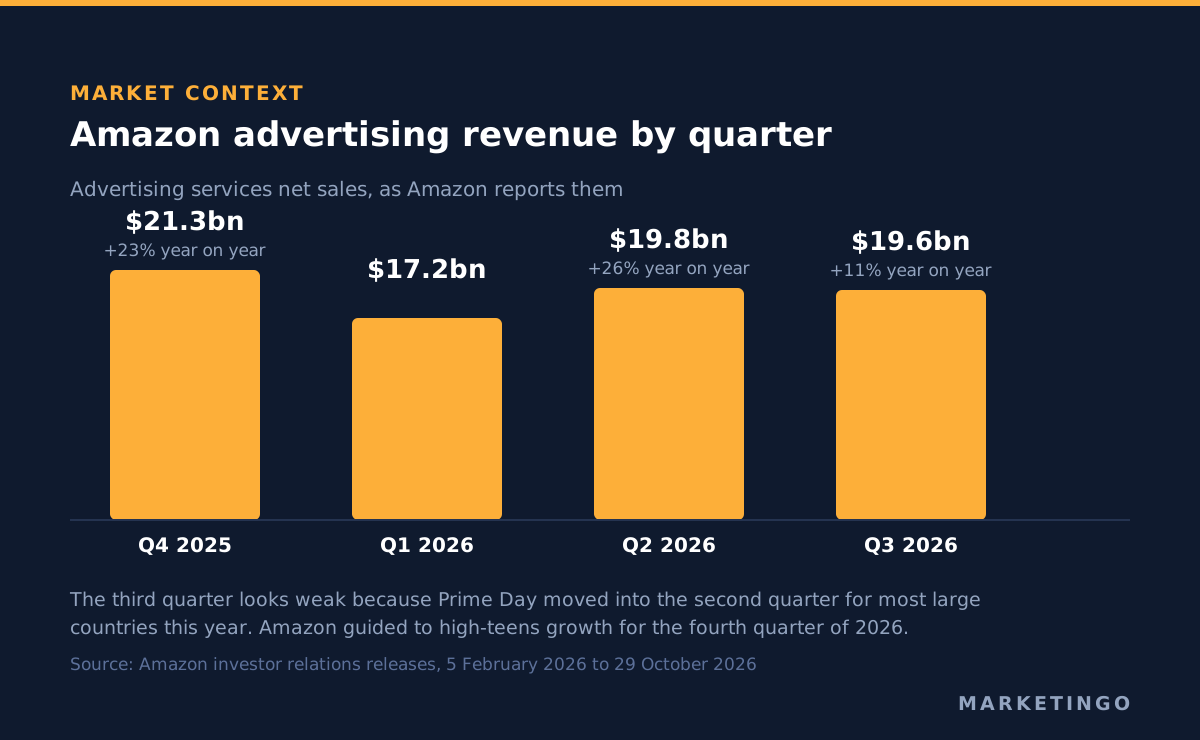
Amazon's advertising business is still growing, and the quarter that looks weak is not. Amazon reported advertising services net sales of $19,637 million for the third quarter of 2026, up 11% year on year, in its results release of 29 October 2026. That number is lower than the 26% it posted in the second quarter, and the release explains why: Prime Day moved into the second quarter for most large countries this year, having sat entirely inside the third quarter in 2025. Amazon guided to high-teens growth for the fourth quarter. For the full year 2025, advertising services reached $68,635 million against $56,214 million in 2024, a rise of 22%, per Amazon's annual report filed on 6 February 2026. Amazon does not break that figure down by ad product, so any agency deck splitting it between Sponsored Products and the demand-side platform is estimating.
Ads now appear inside the shopping assistant, and your campaigns were enrolled without being asked. Amazon's shopping assistant, launched as Rufus and renamed Alexa for Shopping in May 2026, now carries Sponsored Products prompts and Sponsored Brands prompts. Amazon's own release says these reached general availability in the United States on 25 March 2026, that charging began at that point under existing cost-per-click bidding, and that eligible campaigns are enrolled automatically with no additional setup. They can be paused individually. A second format, Branded Conversations, launches in the United States in January 2027 and again enrols eligible Sponsored Brands campaigns automatically, billing on the opening prompt only. Ask any agency you are considering whether it has audited which of your campaigns are serving prompts and what those clicks cost, because the default is on.
The analysis window doubled. Amazon Marketing Cloud, the clean room where an advertiser can query its own ad and purchase events, expanded its ad traffic lookback from 13 months to 25 months in an open beta that started in the United States and Canada on 11 November 2025. That is the first time a year-on-year comparison or a long-horizon customer value analysis has been possible inside the tool. Agencies that sell Amazon Marketing Cloud access but only ever produce 30-day reports are not using what they are charging for.
The benchmark problem, stated honestly
Most Amazon agency pages quote a target advertising cost of sales, the share of advertising-attributed revenue that advertising spend consumes, which Amazon shows as ACOS in its campaign manager. Amazon's own guide to the metric says the opposite of what those pages claim: "There isn't a definitive number for a good Amazon ACOS," because every brand carries a different margin and a different objective. No study with a published sample size and method gives an advertising cost of sales benchmark by category. The widely repeated "a good figure is 15% to 25%" cannot be traced to one.
Total advertising cost of sales, usually shortened to TACOS, which measures advertising spend against total sales rather than advertising-attributed sales, is not an Amazon metric at all. It is an industry convention, defined differently by different agencies, and Amazon publishes no definition or benchmark for it. That does not make it useless, since it is the only figure that catches an account buying its own organic sales, but it does mean two agencies quoting it may be computing different things.
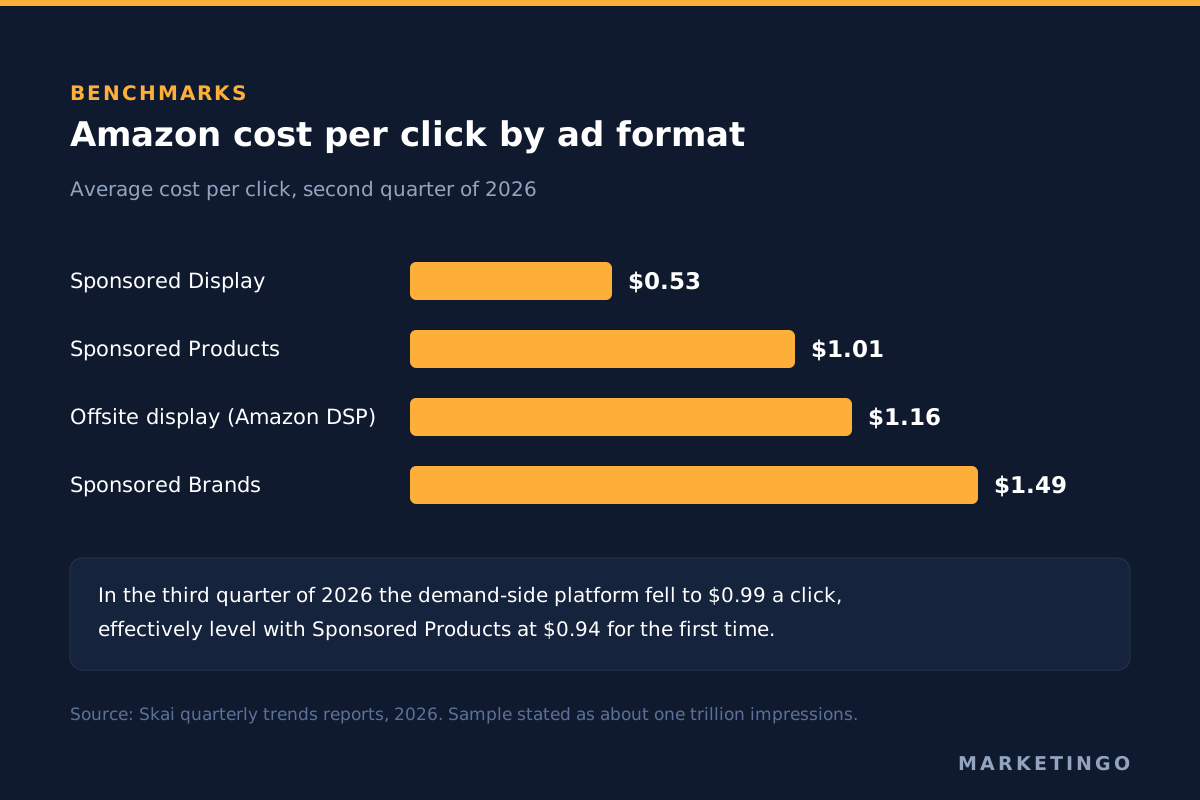
What does exist, with a stated method, is cost-per-click data. Skai, which publishes its quarterly figures without a form, reported Amazon cost per click by format for the second quarter of 2026 in its quarterly trends report: Sponsored Products at $1.01, Sponsored Brands at $1.49, Sponsored Display at $0.53 and offsite display through the demand-side platform at $1.16. Its third-quarter release of 27 October 2026 reported Amazon cost per click down 16% year on year and conversion rate down 11%, with demand-side platform spend up 34% and its cost per click down 44% to $0.99, now effectively level with Sponsored Products at $0.94. Skai states its sample as roughly one trillion impressions, ten billion clicks and ten billion dollars of platform activity, which is a real method, though it reports no advertising cost of sales and no category split.
Category figures come from Pacvue's second-quarter 2026 benchmark report, which puts the cheapest Sponsored Products clicks in clothing, shoes and jewellery at $0.55 and the most expensive in health and household at $2.18, with return on ad spend strongest in electronics at $10.19 and weakest in beauty at $3.13. Pacvue publishes no sample size, so treat those as directional. The grocery conversion rate of 36.7% in the same report is a subscribe-and-save artefact and should not be used as a target by anyone selling anything else.
One thing Amazon does give you, and almost nobody asks for. Amazon's benchmarks reporting, generally available in 18 marketplaces since 18 May 2026, compares your account against category peers on eight metrics including click-through rate, cost per click, cost per new-to-brand purchase and new-to-brand purchase rate. Advertising cost of sales and conversion rate are not among the eight. It is available in the ads console and through the reporting interface. Ask a prospective agency to pull that report on your own account during the pitch. It is the only category comparison Amazon stands behind, it takes minutes, and an agency that cannot produce it is telling you something.
What an Amazon PPC management service should cover every month
The price of Amazon PPC management varies less between agencies than the scope does, which is why two quotes that look alike can buy completely different work. Use the list below as the scope document when you compare proposals, and ask each agency to mark what is included, what is extra and what it does not do at all.
Campaign architecture. The structure decides how much control the bidding gives you. A service worth paying for separates branded from non-branded, isolates the products carrying the margin, and keeps automatic and manual targeting in campaigns that do not compete with each other. Restructuring is usually the first month's work, and an agency that starts with bid changes on an inherited structure is optimizing the wrong layer.
Bids, budgets and placements on live PPC campaigns. Daily and weekly bid work against a target the two of you agreed, placement multipliers for top of search and product pages, dayparting where the data supports it, and budget caps that do not leave a profitable campaign dark at 11am. Ask how often bids are reviewed and by whom, because a sizeable share of Amazon ads management in this market is a rules engine with a human reading the output once a week.
Search term harvesting and negative targeting. Every week the search term report produces terms to promote into exact-match PPC campaigns and terms to block. This is the least glamorous part of Amazon PPC services and the one that most reliably moves advertising cost of sales, because an account bleeds money through irrelevant matches long before it bleeds it through bids that are a few cents high.
Amazon DSP and audience work, where it is included. The Amazon demand-side platform, shown as Amazon DSP in the console, buys display, video and audio inventory against Amazon audiences on and off the marketplace, which is programmatic advertising with first-party retail signals behind it. Several agencies on this list treat it as a separate product with its own minimum. Confirm in writing whether it sits inside the retainer, because an advertising strategy that depends on remarketing to detail-page viewers needs it.
Listing and catalog management alongside advertising. Titles, bullets, images, A-plus content, variations and the backend search terms that Amazon search optimization depends on, which most agencies sell as Amazon SEO. Advertising performance is capped by conversion rate, and conversion rate is set on the detail page, so a dedicated Amazon PPC service with no route to fix a listing will stall. Confirm who writes the copy and who uploads it.
Stock and account health alongside sponsored ads. An Amazon FBA stockout, meaning the Fulfilment by Amazon inventory running dry, kills an advertising campaign's ranking faster than any bid error, and a suppressed listing kills it outright. The question is not whether the agency manages your supply chain, because it does not, but whether anyone is watching the signals that make advertising campaigns pointless and telling you in time.
Reporting on Amazon data that a finance team can read. A monthly report should carry spend, advertising-attributed sales, total sales, advertising cost of sales, total advertising cost of sales and new-to-brand share, with the decisions taken and the ones coming. Ask for the Amazon benchmarks report against category peers alongside it. An agency that reports only PPC performance inside the ad console is reporting on itself.
Before you hire an Amazon PPC agency, ask these five questions
Who is on the account day to day, and are they an experienced Amazon specialist or the agency's junior layer with an account manager in front. What exactly did you change in the first 30 days on your last three accounts. Show me one Amazon Marketing Cloud query you have run and the decision it changed. What is the pricing structure, in writing, including what happens to the fee if we pause spending for a quarter. And who holds the advertiser account, which is the one covered further down and the one most buyers skip.
The honest version of the answer to the first question, at most agencies, is that a team of Amazon specialists is pooled across accounts and the senior names on the pitch are not the ones in the console. That is not disqualifying. It becomes disqualifying when the agency says otherwise and the work says different.
Tinuiti 1. Tinuiti: best for large brands that need Amazon Marketing Cloud analysis, not just bid management
Founded: 2004 · HQ: New York, United States · Team: ~1,000 employees · Website: tinuiti.com
Tinuiti is the only agency on this list whose advanced partner status is confirmed on a page Amazon itself publishes rather than on the agency's own site, which removes the single biggest verification problem in this market. It is also the largest, which cuts both ways.
What they do. Sponsored ads, display, video and audio buying, Amazon Attribution, product detail page strategy and retail operations, with Amazon Marketing Cloud as the centre of gravity. The firm describes itself as an accredited Amazon Marketing Cloud services and software provider, and its Amazon page positions the clean room as the analysis layer rather than a reporting add-on. It publishes a quarterly benchmark report drawn from its own managed accounts, which is useful context as long as you remember it is one agency's client base, not the market.
Verifiable results. Amazon's own library carries the strongest proof here. For The Honest Company, Amazon reports that audiences built from Amazon Marketing Cloud flexible shopping insights drove 36% of total new-to-brand purchases from 17% of the ad budget in a second-quarter 2024 test, with the cost per point of new-to-brand reach falling 52%. On its own case study for the same client, Tinuiti reports a cart-abandoner campaign returning 172% above campaign averages and new-to-brand cost per acquisition down 65%.
Ideal fit. Brands spending enough that a clean-room analyst is a reasonable line item, typically eight figures of Amazon revenue upward, and brands that want the same team buying Amazon alongside search and social rather than running Amazon as an island.
Where it stops. For the largest firm here, the Amazon page is oddly unspecific about mechanics: it never names Sponsored Products, Sponsored Brands or Sponsored Display, and the commerce services page names no retail media network at all, not Walmart Connect, not Target Roundel, not Instacart. No case study carries a publication date. The self-reported numbers also move in opposite directions, with the 2022 press release announcing advanced partner status citing over 1,200 employees and more than $3 billion under management against the current about page's 1,000-plus and $4 billion. A Sony Electronics result sits in a homepage block with no case study behind it. Small sellers will be mismatched here.
Partner status and pricing. Amazon Ads advanced partner, confirmed by Amazon. No pricing or minimum published; the firm's own answer is that it scopes to the level needed for meaningful impact, which tells a buyer nothing.
Acadia 2. Acadia: best for brands buying Amazon alongside Walmart, Instacart, Kroger and Target
Founded: 2021 · HQ: Atlanta, United States · Team: ~150 in retail media and marketplaces · Website: acadia.io
Acadia was assembled rather than grown. Its Amazon capability came in through the acquisition of Bobsled Marketing in March 2022, a firm that had been running Amazon and Instacart since before most of this list existed. Worth correcting a mistake that circulates on other rankings: Acadia did not absorb Orca Pacific, which went to MightyHive and S4 Capital in 2020 and now sits inside Monks.
What they do. The widest Amazon surface on this list: Sponsored Products, Sponsored Brands, Sponsored Display, the demand-side platform and Amazon Marketing Cloud, extended across Walmart Connect, Instacart, Target Roundel, Kroger Precision Marketing, Ulta and Chewy. Analytics and business intelligence sit alongside the media buying, which is the point of hiring them: if your category is being bought on five retail media networks at once, one team holding all five is worth more than five specialists.
Verifiable results. For Krinos, Acadia reports Amazon sales up 59% after catalogue and content work, with one product gaining 550% in impressions and 78% in sales. For SAXX, it reports order items up 40% and sessions up 41% across 118 listings. Acadia was also named a winner in the 2025 Amazon Ads Partner Awards for challenger brands and announced Amazon Marketing Cloud service provider status in November 2024.
Ideal fit. Mid-market and enterprise brands in grocery, household and apparel whose growth now depends on retail media networks beyond Amazon, and brands that need the advertising team to also hold the catalogue data.
Where it stops. Both case study pages ship with unfilled "0%" placeholder stat blocks next to the real numbers, which is a quality-control problem on the pages meant to prove quality control. No case study carries a date. The SAXX figure comes from a two-week pre-and-post window across 118 listings, which the index page does not disclose and which is too short to separate a campaign effect from a seasonal one. Several named clients carry no figures at all, and the about page mentions none of the acquisitions the firm is built from.
Partner status and pricing. Amazon Ads advanced partner, stated in text on the retail media page. No pricing or minimum published.
Envision Horizons 3. Envision Horizons: best for buyers who want to read the method, not just the result
Founded: 2017 · HQ: United States, distributed · Team: not published · Website: envisionhorizons.com
Laura Meyer left Amazon's media group in 2017 and started this firm, and the ex-Amazon origin shows in the only place it matters: the case studies are dated, state their measurement windows, and publish the unflattering audit findings alongside the wins. That is rare enough in this market to be the headline.
What they do. Amazon advertising across sponsored ads and the demand-side platform, Amazon Marketing Cloud, affiliate, and catalogue, fulfilment and policy operations, extended to Walmart Connect, Target Roundel, Ulta and Chewy. The account management model is built around a documented audit at the start rather than a bid sweep, which is why the method is legible in the published work.
Verifiable results. The Coterie case study, published June 2026, compares a March to September 2025 baseline against October 2025 to April 2026 and reports new-to-brand customers up 53%, repurchase rate up 16.9 percentage points and return rate down 39.5%. The same document states what the audit found before any of that: 39% of ad spend was generating zero sales, and campaigns were exhausting budget by 11am, leaving 52% of the day dark. On its results page, the firm reports total advertising cost of sales down 20.6% and return on ad spend up 35.2% for Ollie, July sales up 124% for ELEMIS, and an aggregate return on ad spend of 21.5 for bareMinerals.
Ideal fit. Brands in beauty, baby, pet and wellness that want to see the working, and buyers who intend to read the monthly report rather than skim the headline.
Where it stops. The Coterie return on ad spend figure appears as three different numbers across three surfaces, 54% on the index and the chart against 58.5% in the demand-side platform section of the same document, which is exactly the kind of drift this list penalises elsewhere. A Winky Lux result lives in a page title with no case study behind it. Two studies are for unnamed brands. The Amazon Ads Partner Awards badge on display is a 2022 finalist placement, four years old, and the positioning is broadening away from pure Amazon without the site saying so.
Partner status and pricing. Amazon Ads advanced partner, stated on the homepage alongside the badge. No pricing or minimum published.
Podean 4. Podean: best for selling in more than one country
Founded: 2018 · HQ: New York, United States · Team: ~160 employees · Website: podean.com
Podean takes its name from "antipodean" and the Australian origin is the commercial point: this is the agency to call when the growth question is a marketplace you do not yet understand. It operates across more than 30 countries and buys on Amazon, eBay, Walmart, Tesco, Target, Shopee, Lazada, Mercado Libre and TikTok Shop.
What they do. Media planning and buying across sponsored ads and the demand-side platform, content, retail account management, logistics and Amazon Marketing Cloud analytics, with two proprietary measures it publishes: a marketplace index built with Jungle Scout and a waste-of-ad-spend figure. Markets are run by local teams rather than from a single hub, which matters on marketplaces where the search behaviour and the retail calendar are genuinely different.
Verifiable results. For Spectrum Brands on Amazon Australia, Podean reports sales up 709% year on year and new-to-brand sales up 917% from Sponsored Brands and Sponsored Display. For TIGI's Bed Head on Amazon UK, it reports a new-to-brand purchase rate up 31%. The firm states it holds advanced Amazon partner status in all markets globally and cites an Amazon top global agency award for 2023.
Ideal fit. Brands launching into Australia, the United Kingdom, Latin America or South East Asia, and brands already selling in several marketplaces whose reporting does not currently roll up.
Where it stops. Three published case studies against a claimed 200 brands is the thinnest proof-to-scale ratio here. None is dated. The TIGI results are mostly impressions, completion rates and reach, with only the new-to-brand purchase rate functioning as an outcome, and it carries no baseline. In the Spectrum study a single 19% figure appears both as a return-on-ad-spend decline in the body and as a cost-per-click reduction in the stat box, unexplained. The 709% comes off an Amazon Australia base, which is a small denominator. The firm's own site states no founding year, no headquarters and no headcount.
Partner status and pricing. Advanced partner in all markets, self-stated in text. No pricing or minimum published.
Blue Wheel 5. Blue Wheel: best for brands that want Amazon, Walmart, Target and TikTok Shop under one roof
Founded: 2011 · HQ: Birmingham, Michigan, United States · Team: not published · Website: bluewheelmedia.com
Blue Wheel became what it is through a 2023 merger that joined a marketplace management business to a direct-to-consumer advertising business, and the combination is the reason to consider it: the same team runs your Amazon marketplace, your retail media buying and the social advertising pointing at both.
What they do. Amazon advertising and the demand-side platform alongside Walmart, Target, eBay, Costco and TikTok Shop, plus paid search, paid social, influencer, email, catalogue management, brand protection and fulfilment. It is the broadest service surface here after My Amazon Guy, and the firm describes partnerships with more than 80 platforms.
Verifiable results. For Sol de Janeiro, Blue Wheel reports Prime Day advertising sales up 2,394% year on year. For Ariat, it reports click-through rate up 620% on Amazon's Performance+ demand-side platform product.
Ideal fit. Brands with real revenue on three or more marketplaces, and brands whose Amazon growth is being held back by catalogue and brand-protection problems rather than by bidding.
Where it stops. No case study on the site carries a date, which is a deliberate omission rather than an oversight: the sorting control on the index offers "post date" as an option, so the dates exist and are being suppressed. Results are given as percentages with no absolute spend or revenue behind them, so the Sol de Janeiro figure cannot be sized and the study never says which Prime Day it refers to. Several of the loudest numbers on Amazon-tagged pages are not Amazon numbers: PowerBlock is tagged Amazon advertising while its headline figure is Meta revenue, and Edgewell's 823% is paid social. The Ariat headline is click-through rate, a traffic metric, not sales. The advanced partner evidence is an image file with no alternative text in a logo strip, with no claim written anywhere on the site.
Partner status and pricing. Advanced partner badge displayed, no written claim. No pricing or minimum published.
Canopy Management 6. Canopy Management: best for mid-market sellers who need listings fixed before advertising scales
Founded: 2015 · HQ: United States Virgin Islands, distributed team · Team: ~100 specialists · Website: canopymanagement.com
Canopy sells advertising and listing optimization as one job rather than two, which is the correct diagnosis for a large share of underperforming Amazon accounts: the bids are rarely the binding constraint when the detail page converts at half the category rate.
What they do. Full account management across Amazon, Walmart and Chewy, pay-per-click and demand-side platform buying, listing optimization, Amazon search optimization, product photography and video, inventory management, reimbursement recovery and customer service management. Advertising sits inside a wider Amazon business service rather than standing alone.
Verifiable results. For ZUGU, Canopy reports a 22.6% conversion rate lift in under three months following listing work. That is the figure the case study body supports, and it is the one quoted here.
Ideal fit. Sellers between roughly $2M and $30M in Amazon revenue whose conversion rate, not their traffic, is the problem, and sellers who would rather buy one service than assemble four.
Where it stops. The headline numbers live on index tiles rather than in the case studies. The ZUGU tile claims a 161% sales increase; open the case study and the body substantiates only the 22.6% conversion lift, with 161% appearing nowhere. The tile header rounds 22.6% up to 23%. Another study's figures exist only inside the page URL, not in the page text. Two of the loudest demand-side platform results are impression counts, 21.6 million for one client and 26 million for another, which are volume, not outcomes. Seventeen awards are claimed and none is named. The partner label on the site reads "Preferred Partner", which is not one of Amazon's two tiers, while the same logo's alternative text reads "Amazon Ads Advanced Partner". There is no about page.
Partner status and pricing. Partner labelling is internally inconsistent; treat the tier as unconfirmed. No pricing or minimum published, though a free audit is offered.
SupplyKick 7. SupplyKick: best for buyers who want a fee quoted before the first call
Founded: 2016 · HQ: Fishers, Indiana, United States · Team: ~20 named staff · Website: supplykick.com
SupplyKick is the only firm on this list that publishes what Amazon agencies charge, in ranges, with worked examples. In a market where every competitor routes pricing to a quote form, that alone changes the conversation, and the pricing article is a better briefing document than most agencies' entire sites.
What they do. Amazon account management, Sponsored Products and Sponsored Brands, brand and intellectual property enforcement, logistics and supply chain. It states it has managed more than $100 million in Amazon ad spend and has held verified partner status since 2019.
Verifiable results. For Johnson Hardware, SupplyKick reports Amazon sales up 111% year on year. For Dometic, the case study body reports sales up 30% and unit sales up 44% after a year. For Oneida Air Systems, it reports peak-season sales up 66% year on year.
Ideal fit. Manufacturers and established brands with a counterfeit or unauthorised-seller problem as well as an advertising one, and buyers who want a number before a discovery call.
Where it stops. The advertising scope is the narrowest here: only Sponsored Products and Sponsored Brands are named, with no Sponsored Display and no demand-side platform, so a brand wanting to buy display audiences will outgrow it. The firm also buys inventory and resells, which is a real conflict to raise directly, because a partner that both advises on your pricing and competes for your margin needs the arrangement in writing. The Dometic body figure of 30% sits against a 140% average claimed on the results index. No case study attributes its result to advertising specifically, and the Johnson Hardware gain is explicitly credited to consolidating to a single seller. One case study quotes a 2020 projection alongside actual results. Nothing is dated.
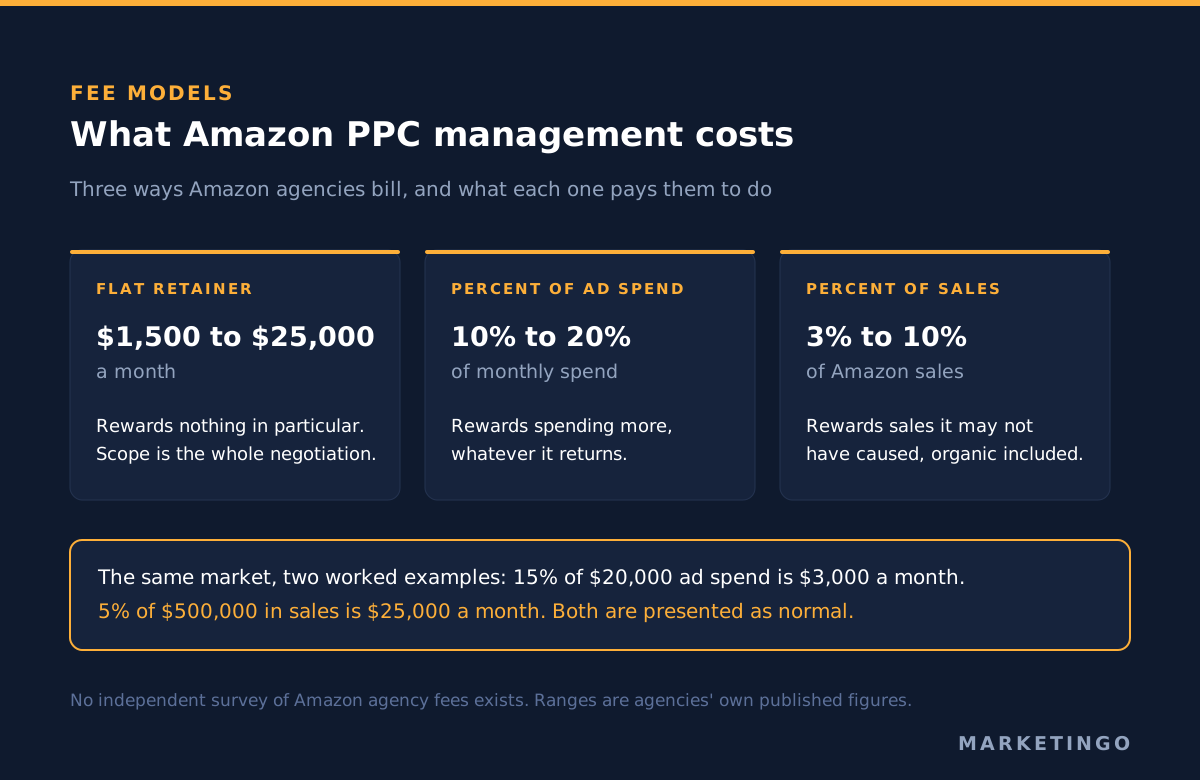
Partner status and pricing. Verified partner, self-stated, with the claim written three different ways across the site. Published ranges: retainers from $1,500 to $25,000 a month, 10% to 20% of ad spend, or 3% to 10% of revenue.
My Amazon Guy 8. My Amazon Guy: best for sellers who need Seller Central problems and advertising handled together
 My Amazon Guy
Founded: ~2018 · HQ: Atlanta, Georgia, United States · Team: ~300 employees · Website: myamazonguy.com
This is the most visible brand in the category, built on a free content library that has taught a large share of the sellers reading this list. It is also the agency whose published numbers fall apart fastest under examination, and both facts belong in the same profile.
What they do. The widest scope here. Seller Central account management, Sponsored Products, Sponsored Brands and Sponsored Display with sub-formats named individually on its advertising page, the demand-side platform, Amazon search optimization, brand store and A-plus content design, suspension and listing reinstatement, brand registry, trademark work, Vendor Central, Walmart and TikTok Shop, plus a direct-to-consumer arm covering search optimization, email and web advertising. If the problem is that your listing is suppressed rather than that your bids are wrong, this is a reasonable call.
Verifiable results. For Chirp, My Amazon Guy reports advertising sales growing from $190,000 to $7.9 million over four years. That is the figure quoted here because it is the one the page states consistently.
Ideal fit. Sellers facing an account health or compliance problem alongside an advertising one, and smaller sellers who want one vendor for everything inside Seller Central.
Where it stops. The documentation problems are specific and they are on the flagship pages. The Chirp headline of 519% growth does not reconcile with the same page's statement that sales went from $500,000 to $8 million in two years, which is roughly 1,500%, and the 519% is applied to best-selling products in one sentence and to total revenue in three others. Two day counters on that page give different elapsed times from the same December 2022 start. The Chinook Seedery page gives September 2018 in its header statistics and September 2020 in its text as the onboarding date, and its "215%" is written once as a multiple and once as a growth rate, which are different quantities. A 33x return on ad spend appears as an unattributed best case rather than a client result. Headcount is given as 300-plus on one page while another celebrates 500 jobs created. No partner tier is claimed anywhere in text; the partner wording exists only as alternative text on badge images.
Partner status and pricing. No tier claimed in writing, only certifications in sponsored ads and the demand-side platform. No pricing or minimum published.
AMZ Pathfinder 9. AMZ Pathfinder: best for smaller catalogues that want a named senior operator
Founded: 2015 · HQ: fully remote, no office stated · Team: ~23 specialists · Website: amzpathfinder.com
The smallest firm here and the only one that dates its case studies, which is why its stale work is visible while other agencies' stale work is not. That is a point in its favour, not against it, and it says something about how the rest of this market presents itself.
What they do. Amazon pay-per-click management, the demand-side platform, Google Ads pointed at Amazon listings, listing optimization, storefront builds and standalone advertising audits. No Walmart, no Target, no Instacart. Accounts are run by a small team with a named lead rather than pooled, which is the practical difference a seller under $5 million in revenue actually feels.
Verifiable results. For Premier Craft Supplies, published March 2024, the firm reports total advertising sales of $5.6 million in 2023 against $3.7 million the year before, at an average advertising cost of sales of 22.59% and a total advertising cost of sales of 16.15%. Those four numbers together are more useful than any single percentage elsewhere on this list, because they let a reader reconstruct the account rather than admire it.
Ideal fit. Catalogues under roughly $10 million in Amazon revenue, brands that want the person doing the work on the call, and sellers who need Amazon and Google working on the same listings.
Where it stops. Several clients in the case study rotation are pseudonyms presented exactly like real names, with the confidentiality note buried in a footnote, so a reader cannot tell which brands are checkable. Material from 2018 and 2019 still sits in the current carousel. One study's title claims an overall return on ad spend of 3.25 while its body says 3.62 under the same label, and the homepage credits that client with 125% product sales growth where the case study reports 67% and 95% for two separate months. The strongest study, the one quoted above, never names the client in its body text. No partner status is claimed at all, which is more honest than a decorative badge but leaves a buyer with nothing to check.
Partner status and pricing. None claimed. No pricing published.
Stella Rising 10. Stella Rising: best for beauty and wellness brands buying Amazon inside a wider media plan
Founded: not stated · HQ: New York, United States · Team: not published · Website: stellarising.com
Stella Rising is a full-service media agency that runs Amazon, not an Amazon specialist, and it is on this list because for some brands that is the right shape. If Amazon is one of five channels in a plan that also carries search, social, video and consumer research, a specialist creates a coordination problem rather than solving one.
What they do. Amazon and marketplace services covering sponsored ads and the demand-side platform, plus TikTok Shop and wider retail marketplace work, inside a media business that also runs paid search, paid social, search optimization, video and consumer research. The vertical focus is beauty, health, food and lifestyle, and the category knowledge is the asset being bought.
Verifiable results. On its marketplace services page the firm reports topline revenue up 66% year on year for Elemis and up 114% for J Lo Beauty, along with results measured against client revenue goals for Bondi Sands and Ro.
Ideal fit. Beauty, wellness and food brands running a real multi-channel plan, where Amazon has to be scheduled around retail resets and launches rather than optimized in isolation.
Where it stops. It makes no Amazon Ads partner claim at all. Its badges are Google, Meta, Microsoft and TikTok, which is a reasonable statement of where the firm's depth sits but leaves the Amazon credential blank. The Amazon page names only "sponsored ads" and the demand-side platform, with no breakout of Sponsored Products, Sponsored Brands or Sponsored Display. The four client figures are undated one-liners on a service page with no case studies behind them, and two of the four are measured against an internal revenue target the reader cannot see, which is not a verifiable metric. A brand whose Amazon business is the whole business should hire a specialist instead.
Partner status and pricing. No Amazon Ads partner status claimed. No pricing or minimum published.
Ave7 11. Ave7: best for catalogue and listing clean-up at enterprise scale
Founded: 2019 · HQ: San Antonio, Texas, United States · Team: ~100 specialists · Website: ave7.com
Ave7 was Avenue7Media until 16 November 2026, four days before this article was published, so expect its links to move. It is included because the operational work it describes, rogue listing removal, brand-attribution repair and catalogue reconstruction across tens of thousands of listings, is a real problem that most advertising agencies will not touch. It is ranked last because none of that work is attached to a named client.
What they do. Marketplace operations across Amazon, Walmart, Target, eBay Motors and Wayfair, with advertising attached to a catalogue and brand-control service rather than sold as the main product. Its own framing is proprietary, built around named internal frameworks rather than deliverables, which makes the scope harder to pin down than it should be.
Verifiable results. None that can be checked. Across twelve published case studies, not one client is named: they are a Fortune 50 brand, a heritage textile brand, a premium intimacy retailer. Aggregate claims of 550 brands, $1.55 billion in managed revenue and 64% average first-year sales growth are attached to no client, period or method. One headline figure is explicitly a projection rather than a result. The figures that can be checked do reconcile internally, which is worth saying, but internal consistency is not external evidence.
Ideal fit. Large catalogues with a genuine control problem, unauthorised listings, duplicated items or broken brand attribution across thousands of items, where the advertising question is downstream of the data question.
Where it stops. Everything above. No named client, no dated case study, no Amazon ad type named anywhere on the site, and a rebrand four days old. Two of the twelve studies describe what may be the same engagement twice. Ask for a reference call and a redacted account walkthrough before signing anything here; the badge on display is verified partner, which is Amazon's entry tier, not advanced.
Partner status and pricing. Amazon Ads verified partner badge. No pricing or minimum published.
Three agencies that appear on other Amazon rankings and should not be on this one
Momentum Commerce no longer exists as an independent agency. PMG acquired it in June 2025, per Fort Worth Inc., and the brand was retired: momentumcommerce.com now redirects to pmg.com, and Momentum's case studies, platform and results pages went with the domain. PMG itself states advanced partner status, but its site names no marketplace management, no demand-side platform and no retail media network, so the specialist capability that made Momentum worth hiring is not visible on the acquirer's site. Several current rankings still list it.
Nuanced Media closed on 14 October 2026. Its site is still live and still reads in the present tense, with a 2026 copyright, but every page opens a notice saying the company closed on that date. The notice is in the page code, not a stale banner. Its results section contained no metrics even before that, only testimonials.
Amazowl publishes nothing a buyer can check. Two case study entries, no metrics, no dates, no individual pages, and a logo wall with no results attached to any of the brands on it. Its advertising page names no ad types and still uses "Amazon Marketing Services", a product name Amazon retired years ago. The "agency partner programme" link on its site is its own recruitment programme, not an Amazon credential, which is easy to misread.
A fourth, eStore Factory, was researched and left out on a narrower point: its verified partner claim exists only as alternative text on an image and in a self-issued press release from October 2022, which is four years old and carries no Amazon-side citation.
Choosing an agency: how to pick the right Amazon PPC agency
If your conversion rate is the problem, not your traffic, start with Canopy Management or My Amazon Guy. Both sell listing work and advertising as one job, and on an account where the detail page converts below category, better bidding buys more expensive failure.
If you are spending enough to justify a clean-room analyst, Tinuiti and Acadia are the two with real Amazon Marketing Cloud practice behind the claim. Ask either to show you an actual query they have run and what decision it changed.
If you want to read the working, Envision Horizons publishes dated case studies with baselines, measurement windows and the uncomfortable audit findings. That is a proxy for how the monthly report will read.
If you sell in more than one country, Podean has local teams in markets where the others have a spreadsheet, and the Australia, United Kingdom and Latin America evidence is specific.
If Amazon is one of five retail media networks you buy, Acadia or Blue Wheel. Both hold Walmart, Target and more besides, and a single team across them removes a reconciliation job nobody enjoys.
If you want a fee before a discovery call, SupplyKick publishes its ranges, with the caveat that its advertising scope stops at Sponsored Products and Sponsored Brands.
If your Amazon revenue is under roughly $10 million, AMZ Pathfinder gives you a named senior operator rather than a pooled team, which is usually the live issue at that size.
If Amazon sits inside a wider media plan in beauty or wellness, Stella Rising runs it as one channel among several, which is the right shape when the plan matters more than the channel.
If your real problem is catalogue control at scale, Ave7 does that work, and you should ask for references rather than rely on its published results.
One caution that applies whichever you pick. Expert Amazon operators are scarce and most firms on this list are growing faster than they can train them, so ask who specifically will hold your account and how much experience managing PPC at your catalogue size that person has. Profitability on Amazon is decided by a few hundred small decisions a month, and the name on the contract does not make them.
What Amazon PPC management costs, and why two quotes can differ eightfold
No independent survey of Amazon advertising agency fees exists, which means the pricing structure you are quoted reflects the agency's own habits rather than a market rate. Every range in circulation, including the ones below, traces back to an agency's own marketing page with no stated method, so treat them as orientation rather than market data.
Four models are in use. A flat monthly retainer, which SupplyKick's published guidance puts between $1,500 and $25,000 depending on scope. A percentage of ad spend, which the same source puts at 10% to 20%. A percentage of sales, put at 3% to 10%. And hybrids, typically a lower retainer plus a share of revenue above an agreed threshold.
The arithmetic matters more than the headline rate, and SupplyKick's own two worked examples make the point better than any argument: 15% of a $20,000 monthly ad spend is $3,000, while 5% of $500,000 in monthly sales is $25,000. Both are presented as normal, and they differ by a factor of eight on accounts that are not far apart in size. A percentage of ad spend rewards an agency for spending more; a percentage of sales rewards it for sales it may not have caused, including the organic ones you already had.
Marknology is one of the few agencies publishing actual numbers rather than ranges: full account management from $2,000 a month plus 3% of that month's Amazon sales in any month reaching $10,000, no percentage-of-ad-spend fee at all, a 90-day minimum and then month to month with 30 days' notice either way. On its own worked example of $70,000 in monthly sales, the total comes to $3,800, or 5.4% of sales.
Whatever the model, the number to work out before the first call is what the engagement has to return to be worth signing. Put the retainer, your gross margin and your current return on ad spend into the ecommerce return on ad spend calculator and read the break-even figure. If the agency's fee needs a 20% lift in advertising-attributed revenue just to pay for itself, that is the target to put in the contract, not the "growth partnership" language in the proposal.
The question almost nobody asks: who owns the account
This is where Amazon engagements go wrong, and the rules are public.
No agency should ever hold your login. Amazon's partner network policies state at section 5.1 that a partner "shall not solicit, collect, store, proxy, buy, sell or transfer Amazon login credentials", and at section 5.3 that a partner may act only for users who have granted express and verifiable authorisation. An agency asking for your Seller Central password, rather than asking to be invited as a user, is operating against the policy it claims membership of. That is a concrete red flag you can check in one email.
The correct mechanism is an invited user on an account you own. Amazon's advertiser account guide describes standard roles of administrator, editor and viewer, applied across both sponsored ads and the demand-side platform, and a billing choice between "bill to partner" and "bill to advertiser". Make that billing decision deliberately rather than inheriting whichever one the agency defaults to.
Insist the manager account is yours. Amazon permits an agency to create a manager account on behalf of an advertiser, and publishes no statement about who owns the advertiser account underneath it and no process for transferring access when a brand changes agency. The absence is the finding. If the agency creates the structure and you are a guest inside it, there is no documented route to take it with you. Ask for the advertiser account to sit under a manager account your company controls, with the agency invited in.
The Seller Central account itself belongs to your business. Amazon's business solutions agreement makes the account the property of the registering business entity, requires that registration details match that entity, and states that the agreement may not be assigned without Amazon's prior written consent. It also makes you solely responsible for anything done under your credentials, which is the other reason not to share them.
If you also run Google Shopping or Meta for the same catalogue
Most brands reading this are buying the same products in at least two places, and the two budgets rarely meet. The Amazon agency reports an advertising cost of sales. The search agency reports a return on ad spend. Nobody reports what the product costs to sell, all in, across both, which is the only number that decides whether scaling it is a good idea.
MarketinGO does not run Amazon and is not on the list above. It runs Google, Meta, LinkedIn and Microsoft, which for a brand selling on Amazon usually means Shopping, Performance Max and paid social against the same catalogue. That work is covered on the Google Ads service page, and the approach for catalogue-driven brands is set out for ecommerce and direct-to-consumer. On a roughly 40,000-product dental supplies catalogue, cutting the 37% of budget going to products that produced no revenue lifted blended Google return on ad spend from 7.86 to about 8.5 while spend grew. The same exercise on an Amazon catalogue is a conversation worth having with whichever agency above you pick.
If the off-Amazon half of your advertising is the part nobody has examined lately, a free ad audit will tell you where the waste is before you commit to another retainer. It is not a free Amazon audit, since Amazon is not a channel MarketinGO runs, but for most catalogue brands the ecommerce and Amazon halves of the budget are competing for the same stock and the same margin, so knowing what the other half costs changes what you ask your Amazon growth partner to do. Two companion guides go deeper on that side: ecommerce pay-per-click agencies for the general ecommerce market, and Google Shopping agencies if the feed is where your problem sits.