The short answer
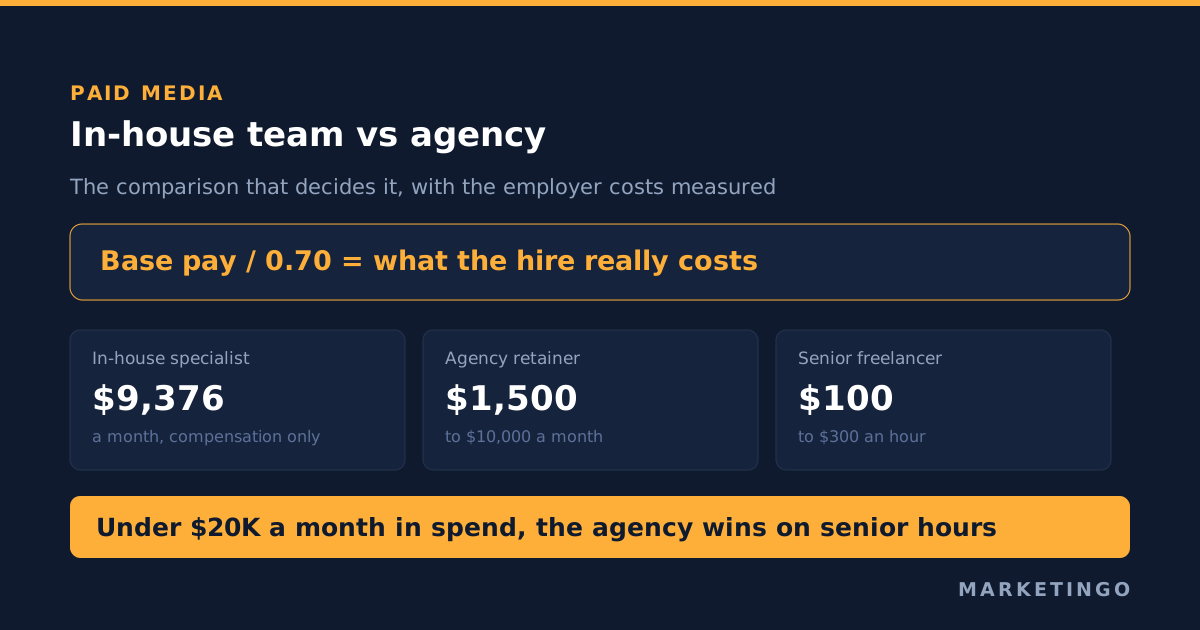
Below roughly $20,000 a month in ad spend, an agency almost always wins on cost per hour of senior attention, because one in-house hire costs more than the retainer and covers fewer platforms. Between $20,000 and $150,000 a month, a hybrid wins: one internal owner plus outside execution. Above that, a full in-house team becomes defensible, and most companies still keep an outside pair of eyes.
That is the conclusion. The rest of this page is the arithmetic, because the agency vs in-house decision is usually lost at the arithmetic stage rather than the strategy stage, and because the figures people plug into it are mostly wrong.
What each of the three models actually is
Worth settling the terms before the money, because the words get used loosely and the loose usage is half the confusion.
An in-house marketing team is salaried staff on your payroll. At one person it is a marketing role rather than a marketing department: a single marketer who owns campaign setup, optimisation and reporting, and who reports to a founder or a commercial lead. At three or more it becomes a genuine in-house marketing department with its own marketing operations, usually a marketing manager plus platform specialists. Companies sometimes go further and build an in-house agency, a fully staffed internal unit with creative and media planning, which is an enterprise structure rather than a growth-stage one.
External marketing agencies sell you a slice of a standing team. Ad agencies and paid media specialists run campaign execution across platforms; a full-service agency adds the disciplines around it, and a digital marketing agency label can mean either. The defining feature is that the team serves multiple clients, which is simultaneously the source of their pattern recognition and the reason your account is not the only thing on their mind.
A freelancer is one contracted specialist, typically on a monthly or project fee, with no team behind them.
The reason choosing between an in-house team and an agency goes wrong is that these are not three prices for the same product. They are three different bundles of hours, skills, tools and risk, and the comparison has to price all four or it prices none of them.
The difference between in-house marketing and agency marketing, and why the comparison goes wrong
The standard comparison looks like this. A paid media specialist costs about $80,000 a year, which is $6,667 a month. An agency retainer costs $4,000 a month. The agency looks cheaper, so hire the agency; or the $6,667 buys a full-time person against a fraction of an account manager, so hire internally. Either way the comparison sets one salary line against an invoice, and base pay is not what an employee costs.
The United States Bureau of Labor Statistics measures the difference directly. In its Employer Costs for Employee Compensation release for June 2026, total employer compensation costs for private industry workers averaged $46.89 per hour worked. Wages and salaries were $32.82 of that, or 70.0%. Benefits were $14.07, or 30.0%.
Read that number carefully, because this is where the common rule of thumb breaks. Practitioners say "add 25% to 30% for payroll taxes and benefits", and treat 30% as a markup on base pay. The BLS figure is not a markup. It is benefits as a share of total compensation. If benefits are 30.0% of the total, then wages are 70.0% of the total, and the correct multiplier on base pay is 1 divided by 0.70, which is about 1.43.
The gap between those two readings is real money:
| Base-pay-plus-30% rule | BLS measured share | |
|---|---|---|
| Base pay | $78,760 | $78,760 |
| Employer load | $23,628 | $33,754 |
| Annual total | $102,388 | $112,514 |
| Monthly total | $8,532 | $9,376 |
Roughly $10,000 a year, or $844 a month, disappears between the rule of thumb and the measurement. On a decision that often hangs on a few hundred dollars a month, that single arithmetic slip decides it.
The $78,760 is not an estimate either. It is the median annual wage for market research analysts and marketing specialists, the occupation most paid media practitioners sit inside, as published in the Bureau of Labor Statistics Occupational Outlook Handbook for May 2025, where the hourly equivalent is given as $37.87. If you need someone who can own the function rather than execute inside it, the relevant occupation is advertising, promotions and marketing managers, whose median pay is $165,780 a year, or $79.70 per hour. Apply the same 1.43 and that role costs about $236,800 a year fully loaded.
What building an in-house marketing team actually costs
Compensation is the largest line and not the only one. A working in-house paid media function needs four things beyond the person.
Tooling that the agency already owns. Call tracking, feed management, a reporting layer, competitive research, and creative production software. At small scale this lands between $300 and $1,500 a month. An agency amortises the same stack across its whole book, which is the one genuine economy of scale in this business.
Recruitment. A contingency fee on a $80,000 role commonly runs 15% to 25% of first-year pay, so $12,000 to $20,000, paid once and again if the hire does not work out.
Ramp time. A capable specialist still needs six to ten weeks to learn your product, your margins, your sales cycle and your tracking setup. During that period the accounts are maintained rather than improved.
Management. Someone has to review the work. If that person is you, cost it; if nobody does it, you have bought execution without oversight, which is the expensive version of in-house. A one-person marketing team has no second opinion in it by definition, so the review either comes from the founder or it does not happen.
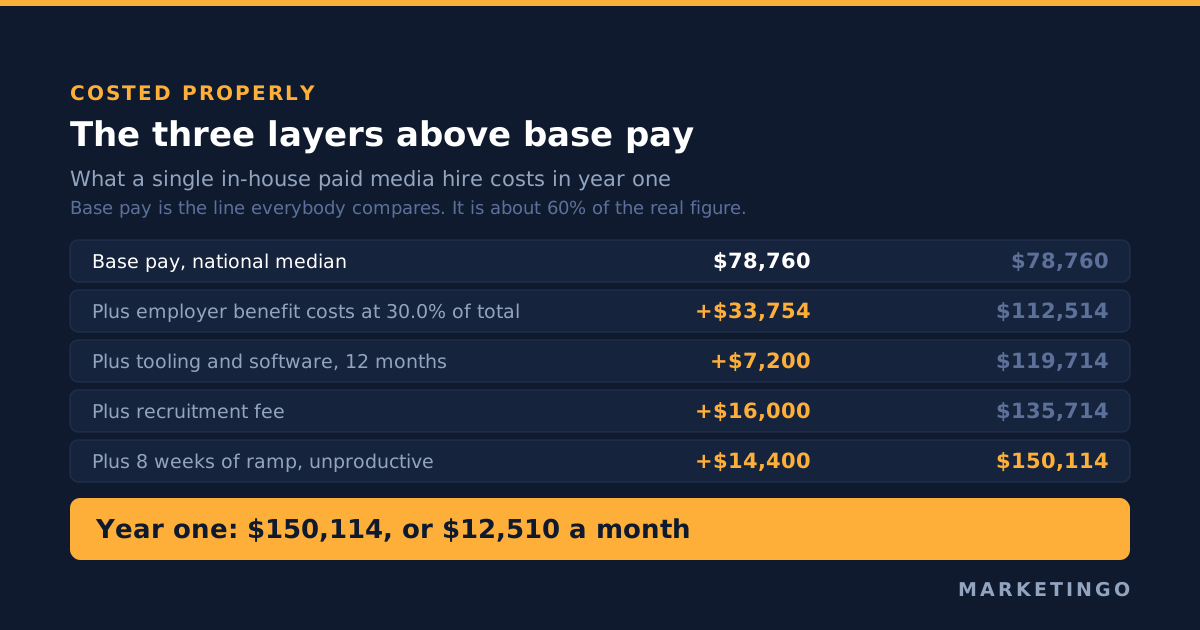
Put the layers together and a single in-house specialist at the national median is a year-one commitment of about $150,000: $78,760 in base pay, $33,754 in employer benefit costs at the measured 30.0% share, roughly $7,200 of tooling, a $16,000 recruitment fee, and about $14,400 of pay during eight unproductive weeks of ramp. That is $150,114, or $12,510 a month across the first year. It settles to around $9,400 a month once the one-off costs fall away in year two. The year-one figure is what to hold next to a retainer, and it is the number almost nobody puts there.
What it costs to hire an agency, and what the fee actually buys
A competent agency retainer for a US business lands between $1,500 and $10,000 a month on top of media, and percentage-based fees usually sit between 10% and 20% of ad spend, sliding down as budgets rise. The four fee models, what each should include, and how to tell whether yours is fair are set out in our guide to PPC management pricing, so this page will not repeat them.
The useful move is to convert both options into the same unit: funded hours of senior attention.
At a blended $150 an hour, a $4,000 retainer funds about 27 hours a month. The in-house specialist, at $9,376 a month in compensation alone, gives you roughly 150 working hours, which looks like a landslide until you ask what those hours contain. They contain all of the execution and all of the admin, at one person's single skill level, on whichever platforms that person happens to know. The agency hours are senior-weighted, spread across specialists, and informed by pattern recognition from other accounts in the same vertical. Neither is strictly better. They are different goods priced in the same currency, and the comparison only becomes honest once you say which one your account needs more of. Accounts that are already structured well and need marketing strategies tested at pace want senior hours; accounts that need daily housekeeping want volume of hours.
The freelancer option, and the two situations where it wins
A freelancer is the third model and it gets left out of most in-house vs agency comparisons, usually because it is inconvenient to the argument being made.
Rates run roughly $50 to $100 an hour for junior execution, $100 to $175 for a mid-level specialist, and $175 to $300 for a senior strategist, which puts a serious freelancer close to agency rates and well above an in-house hourly equivalent. What you gain is zero overhead, no notice period, and direct access to the person doing the work. What you give up is coverage, backup and process.
Freelancers win in two specific situations. The first is a single-platform account under about $15,000 a month in spend, where one person genuinely can hold the whole thing in their head. The second is a bounded project with an end point: a tracking rebuild, a Shopping feed overhaul, a one-off account audit. Outside those two cases the model struggles, for a reason that has nothing to do with talent: one freelancer takes holidays, gets ill, and takes on other clients, and a paid media account does not pause while that happens.
Four platforms, five certifications, one person
Here is the coverage problem stated precisely, and it is the part of this decision that cost arithmetic hides.
Google alone issues certifications in five separate product areas: Google Ads Search, Google Ads Display, Google Ads Video, Shopping ads, and Google Ads Apps. Google's own documentation states that a certification "will remain valid until the product area certification expires (one year)", and that "you'll need to retake and pass the certification assessment in the respective product area to renew your certification" (About Google Ads certifications).
So a single internal hire running Google properly is holding and annually renewing up to five credentials. Add Meta, LinkedIn and Microsoft, each with its own training track, its own release notes and its own quarterly changes to bidding and audience controls, and you are asking one salaried person to stay current across four platforms while also running them. Most do not, and the honest version is that they specialise in one platform and maintain the other three.
This is not a knock on in-house marketers. It is a statement about how many hours exist in a week. Agencies solve it by having different people hold different platforms, which is the second genuine economy of scale after tooling, and it is the main reason companies outsource execution while keeping strategy in. An in-house team solves it by hiring a second and third person, which is why the in-house option becomes cheaper per platform only once the budget supports three or more hires.
The continuity risk that never appears in the business case
Median employee tenure in the United States was 4.1 years in January 2026, and for workers aged 25 to 34, the band most paid media specialists sit in, it was 3.0 years (Bureau of Labor Statistics, Employee Tenure). Even management, professional and related occupations, the highest group in that release, run a median of 4.9 years.
Plan accordingly: your in-house hire is statistically likely to leave inside three years, and the account knowledge leaves with them. The mechanical version of that risk is worth spelling out, because Google documents it. On account access, Google warns that "if your account has only one administrator, you may lose access to your tags if that user becomes unavailable" (Google Ads Help). A single internal owner with sole administrator access is a single point of failure on your conversion tracking, not only on your campaign management.
Agencies carry their own version of this risk through account manager churn. The difference is that the agency absorbs the handover internally and the account keeps running, whereas an in-house departure leaves the account unattended until a replacement is hired, which the recruitment timeline puts at two to four months.
In-house team vs agency vs freelancer, side by side
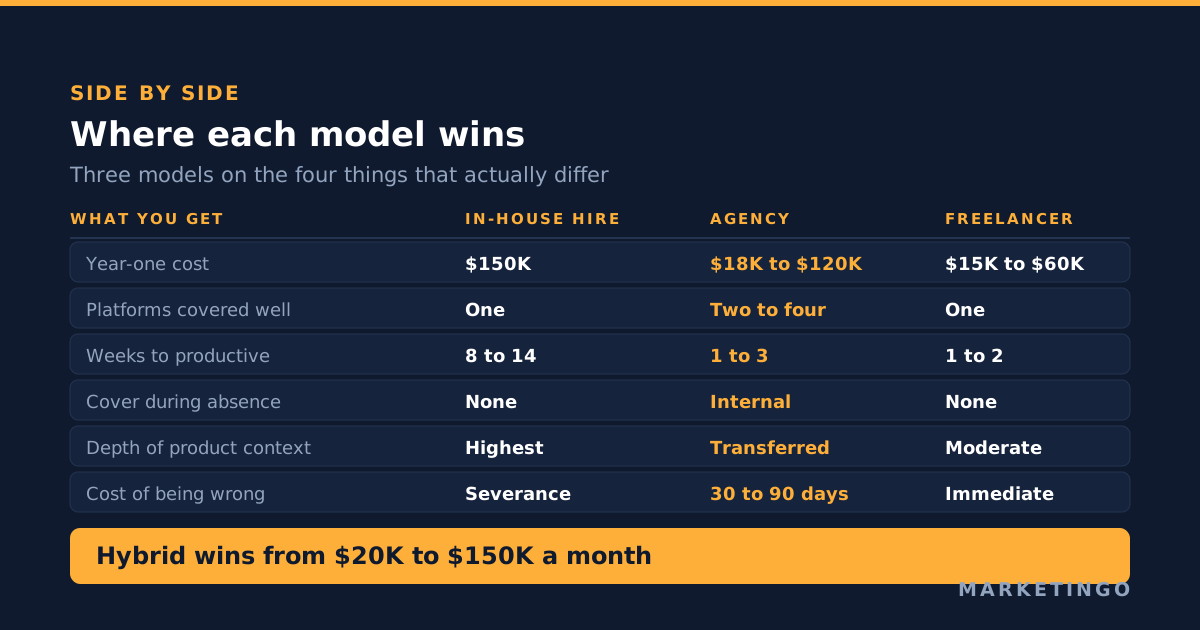
| In-house hire | Agency retainer | Freelancer | |
|---|---|---|---|
| Year-one cost | About $150,000 for one specialist | $18,000 to $120,000 | $15,000 to $60,000 |
| Platforms covered well | Usually one, maintained on two | Two to four | One |
| Funded senior hours | Low, most hours are execution | Senior-weighted | Mid to senior |
| Time to productive | 8 to 14 weeks including hiring | 1 to 3 weeks | 1 to 2 weeks |
| Continuity | Single point of failure | Internal handover | Single point of failure |
| Tooling | You buy it | Included or rebilled at cost | Partly theirs |
| Product knowledge | Deepest | Needs building and maintaining | Moderate |
| Cost of being wrong | Severance plus a second search | 30 to 90 days notice | Immediate |
The pattern in that table is consistent, whichever way you run the numbers. An internal team buys depth of product knowledge and pays for it in coverage and continuity. Outside marketing agencies buy coverage and continuity and pay for it in context, which has to be transferred deliberately rather than assumed.
What each option needs from you to work
Both models fail for the same reason, which is being bought and then left alone. What each one needs is different.
An internal marketing team needs management and marketing tools. Somebody senior has to set priorities, review the work and decide what gets killed. You also buy the stack: call tracking, feed management, reporting and competitive research. Budget $300 to $1,500 a month for that at small scale, and expect to invest in marketing training on top, because the platforms change faster than any one person keeps up with unaided.
An agency needs context and a decision-maker. Agencies provide specialised expertise and arrive knowing the platforms; what they do not know is your margins, your sales cycle, which leads your team actually wants, or why last year's campaign failed. Hand that over deliberately in the first fortnight rather than expecting it to emerge. You also need one person internally who can approve things inside a day, because an agency that waits a week for creative sign-off bills the same and delivers less.
A freelancer needs scope and a backup plan. Write down what is in and what is out, and decide in advance what happens to the account during a two-week absence.
The common failure across all three is the same: a marketing budget approved without a named owner for the result.
Should you build an in-house team or outsource? The spend level where the answer flips
Fee models stop mattering once you divide by ad spend. Work in bands.
Under $5,000 a month in media. Neither a hire nor a full retainer is justified. The management cost consumes too much of the total for the arrangement to pay for itself. Run the accounts yourself, keep the scope to one platform, and buy a paid audit once or twice a year.
$5,000 to $20,000 a month. The agency band. A $1,500 to $4,000 retainer buys active management across one or two channels, and an in-house hire at $12,510 a month across year one would absorb most of your media budget to cover one platform. This is the clearest case in the whole decision and it is also where most companies get it wrong in the other direction.
$20,000 to $150,000 a month. The hybrid band, and the one that generates the most argument. Hire one internal owner, usually a paid media manager rather than a specialist, and keep execution outside. The internal person owns the numbers, the margin data, the sales feedback loop and the agency relationship. Outside specialists own platform execution across Google, Meta, LinkedIn and Microsoft. You are paying for the one thing an agency cannot buy, which is daily access to your own commercial context, and renting the thing you cannot hire four times over.
Above $150,000 a month. A full in-house marketing team is defensible on cost. Three to four people covering platforms, creative and analytics, plus the tooling, runs roughly $45,000 to $60,000 a month fully loaded against a percentage fee that would now be larger. Most companies at this level still keep an outside relationship for audits and for channels they have not built depth in, which is the correct instinct.
Two cautions on the bands. They are media spend, not revenue, and they assume the spend is efficient enough to be worth managing. If your average cost per click is $8, a $3,000 budget buys under 400 clicks a month, which is too little data for anyone to improve against, internal or external.
The best of both worlds: the hybrid model, specified properly
"Hybrid" is often where this decision goes to die, so here is a version with the lines drawn.
The internal owner holds strategy, budget allocation across channels, margin and lifetime value data, creative direction, and the relationship. They are accountable for the blended number, not for a platform's reported one. The outside team holds campaign structure, bidding, audience and feed work, conversion tracking implementation, and platform-level testing, and reports into the internal owner weekly. In practice the agency can offer platform depth and testing volume, while the internal owner supplies the commercial judgement about which tests are worth running at all.
Two failure modes to design against. The first is the internal owner who becomes a message relay, which adds a headcount and no judgement. The second is the agency reporting platform-attributed results while the internal owner is accountable for blended ones, which guarantees a disagreement about what happened every quarter. Fix the second one before it starts by agreeing the measurement first: whose conversion tracking definition counts, which cost per lead is the number of record, and whether success is judged on platform return on ad spend or on customer acquisition cost.
In-house marketing vs agency: where each model honestly wins
Hire in-house when your product is complex enough that context takes months to build, your spend is above $150,000 a month, you have a marketing department to manage the hire, or paid media is your primary growth channel and you need the capability permanently.
Use an agency when you need more than one platform, you are below $150,000 a month in spend, you need to be live in weeks rather than months, or the account needs senior judgement more than it needs hours. The questions to ask, the red flags, and the proof to demand are in our guide on how to choose a PPC agency.
Use a freelancer when the work is a bounded project, or a single platform under about $15,000 a month, and you have the internal capacity to cover the gaps.
One honest hand-off. The models above are priced for paid media. If your real marketing needs are SEO, content marketing, email marketing or organic social media marketing, this comparison does not transfer cleanly, because those disciplines have different ramp curves and different tooling, and a full-service agency or a specialist in that discipline will serve you better than a paid media team. MarketinGO runs paid media only: paid search and paid social across Google, Meta, LinkedIn and Microsoft, plus the landing pages and conversion tracking that support them. Working with a marketing agency only pays when the agency's specialism matches the channel carrying your growth, so decide which marketing activities you are actually buying before you price the models.
Signs you have outgrown your current marketing model
Most companies change model late, because the trigger is a slow deterioration rather than an event. Four signals are worth watching.
Your in-house team may have hit its ceiling when the same two campaigns get optimised every week and nothing new launches, when a second platform has been "next quarter" for three quarters, or when your single marketer is now the only person who understands the tracking. That is a capacity problem, and more management will not fix it. You need an agency alongside, or a second hire.
Your agency may have outgrown you, or you them, when reporting arrives on time and insight does not, when the person on your calls changes twice in a year, or when the account has been stable for six months in a market that has not been. Stability in paid media is usually a sign that nobody is testing.
Either model is in trouble when marketing results are reported in platform-attributed numbers while the business is judged on blended ones, and nobody will reconcile the two. Agency costs and base salaries are both defensible; an unreconciled measurement argument is not.
You are ready to bring it in when one platform clearly carries your growth, your spend on it alone would fund a specialist, and you have someone senior who can manage that person. Until all three are true, renting marketing experts stays cheaper than employing them.
Running the comparison on your own numbers
The arithmetic above is national. Yours is not, so run it with your figures before deciding.
For a lead generation business, the input that settles it is cost per lead and close rate. Put your real numbers into the lead generation ROI calculator and see what a 20% improvement in cost per lead is worth per month. If that figure is larger than the difference between a retainer and a fully loaded hire, you are choosing on capability rather than cost, which is the right basis. For a store, the same test runs on return on ad spend through the ecommerce ROAS calculator.
For context on what outside execution changes in practice: for a regulatory-compliance consultancy, MarketinGO cut cost per lead by 64% in six months, on less spend than before. That improvement came from senior attention on account structure and tracking, which is precisely the good a retainer buys and the good one stretched internal hire has least of.
If you would rather not model it in the abstract, the fastest way to settle the question is to have someone read the accounts as they stand. A free ad audit will tell you how much of your current spend is recoverable, and that number decides the in-house vs agency question more reliably than any pay comparison, because it tells you what capability is worth to you specifically. Our work in high-ticket B2B lead generation and across Google Ads management and multi-channel full-funnel strategy is built around that one measurement first.