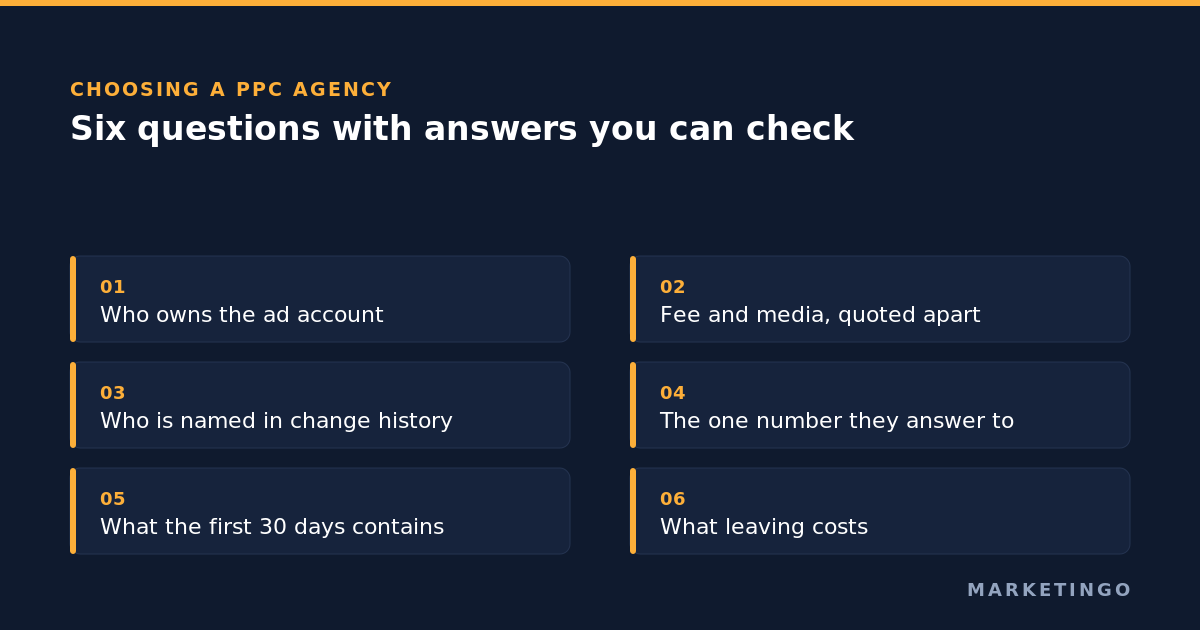
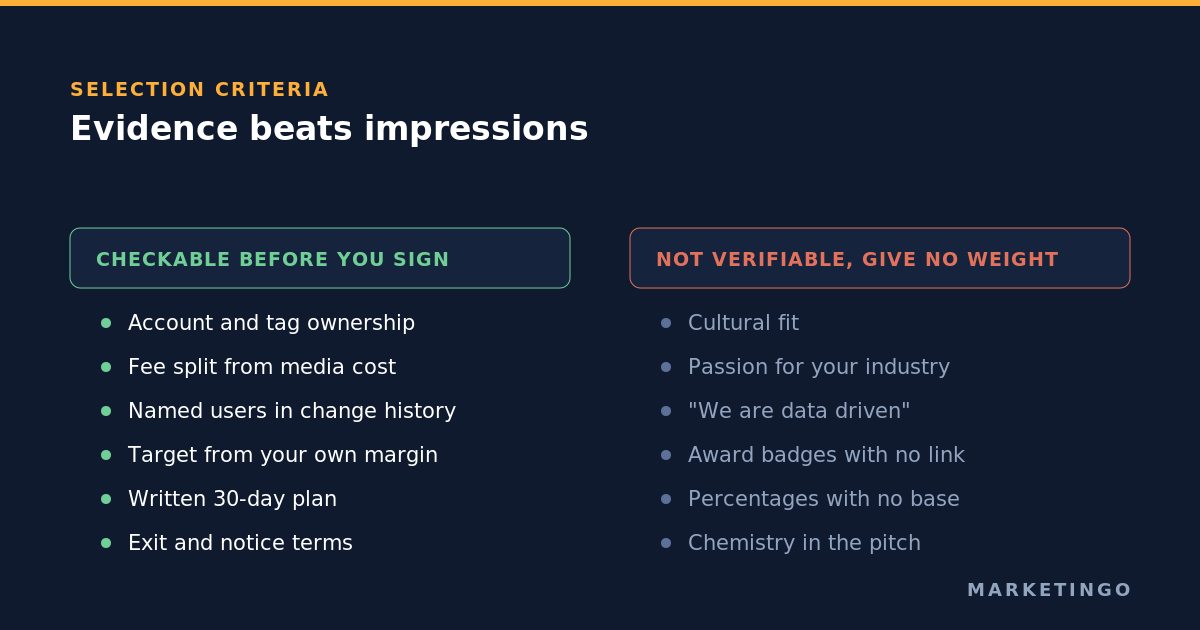
Choose a PPC agency on evidence you can verify before you sign, not on impressions formed in a pitch. Six things are checkable in advance: who will own the ad account and the conversion tracking, what the management fee is and how it behaves as ad spend changes, which named people will work on the account, what the agency will be measured against, what happens in the first 30 days, and what leaving looks like. Everything else in a pitch, including enthusiasm, chemistry and the phrase "we are data driven", is unverifiable and should carry no weight.
That sounds obvious until you read the standard advice. Most guides on selecting the right PPC agency ask business owners to assess communication style, cultural fit, passion for your industry and whether the agency "understands your business". None of those can be tested before money changes hands, which is why the selection process so often comes down to whoever presented best. Learn how to choose on the checkable half and the rest sorts itself out.
Google, meanwhile, publishes a short list of things advertisers are entitled to and a named list of warning signs, in its own help pages, and almost nobody cites them. This guide is built on those, plus the specific account mechanics you can inspect yourself with no tooling and no permission from the agency.
What PPC agencies actually do, and what you are buying
Before comparing providers it helps to be precise about the work, because "PPC management" covers a wide range of effort and the price differences between agencies usually come from scope rather than from talent.
A retained PPC management engagement normally contains six things: account structure and settings, keyword research and negative keyword work on the search side, ad copy and creative production, bidding and budget control, landing page and conversion rate optimization, and measurement. Some agencies stop at the first four and treat landing page optimization as the client's problem, which is fine as long as you know it before you hire a PPC agency to grow your business. Others run creative in house. A few will not touch your tracking at all. None of that is wrong, but it changes what the fee buys, so get the services for your business written down as a list of deliverables rather than as a paragraph about partnership.
Two items in that list deserve particular attention, because they are where most accounts are actually won or lost.
Measurement. If the conversion data is wrong, every other activity is optimizing toward the wrong target. Ask who owns conversion tracking, when it was last verified, and what the agency does when the platform's numbers disagree with your customer relationship management system. The success of a PPC programme is decided here more often than in the bidding.
Landing pages. Paid traffic converts on a page, and the page is usually outside the agency's control. Agencies that include conversion rate optimization in scope tend to produce better measurable results, and agencies that exclude it should say so plainly rather than promising outcomes they cannot reach.
Where PPC services stop is just as useful to know. Most paid media specialists do not do search engine optimization, email or web development, and a digital marketing agency that offers all of it is buying you average quality across the set. Decide which problem is the constraint before you shortlist.
What the Google Partner badge actually certifies
"Check they are a Google Partner" is the single most repeated line in this category. It is worth knowing what the badge measures, because the answer is not client outcomes.
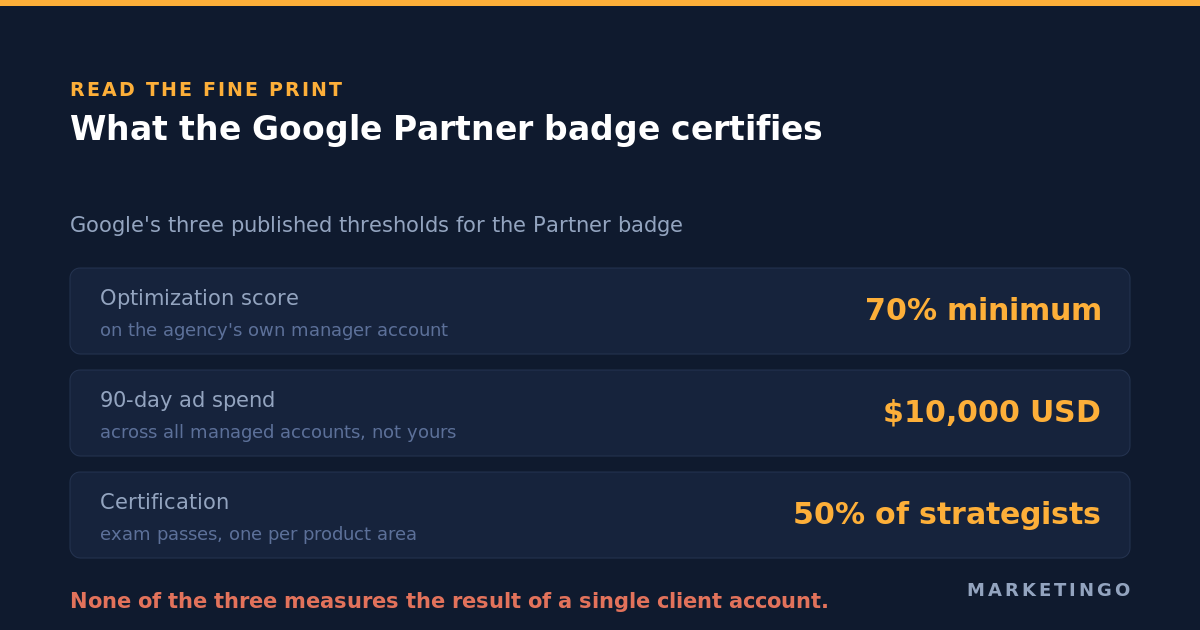
Google publishes three requirement categories for the Google Partner badge, and all three are measured on the agency's own manager account rather than on yours:
| Requirement | Google's published threshold | What it measures |
|---|---|---|
| Performance | "a minimum optimization score of 70%" | adherence to Google's own recommendations across the agency's book |
| Spend | "a 90-day ad spend of $10,000 USD across managed accounts" | the size of the agency's book, not its results |
| Certification | "a minimum of 50% of your account strategists certified in Google Ads (capped at 100 users), with at least one certification in each product area" | exam passes, half the staff |
The performance requirement is the interesting one. Optimization score is Google's own number, and Google defines it as "an estimate of how well your Google Ads account is set to perform", scored 0 to 100% and "calculated in real-time, based on the statistics, settings, and the status of your account and campaigns, the relevant impact of available recommendations, and recent recommendations history" (About optimization score). It rises when recommendations are applied and falls when they sit unactioned. It is an estimate of configuration, not a record of revenue.
So the badge that buyers are told to look for certifies that an agency spends at least $10,000 every 90 days across all its clients, has passed enough exams, and keeps its recommendation adherence above 70%. A $10,000 quarterly spend is roughly $3,300 a month across the entire client base, which a single small business account can clear on its own. None of the three thresholds asks whether one client made money.
Premier Partner is a genuinely narrower filter. Google restricts it to companies "in the top 3% of participating companies within a given country (determined annually)", and the annual evaluation looks at client growth, retention, product diversification beyond Search and annual ad spend across managed accounts. Retention is in there, which is a real signal. Still, it is a ranking of agencies against other agencies in the programme, not a guarantee about your account.
Treat the badge as a floor rather than a recommendation. Its genuine use is the opposite of the one it is usually put to: Google tells advertisers that if a company displays the badge you should "click the badge on its website" and you will be taken to its profile page on Google. A badge image that is not clickable, or that leads nowhere, is a fabricated credential and tells you a great deal.
Where to find PPC agencies worth shortlisting
Most buyers start by searching, which produces a list of PPC agencies ranked by who invested in ranking rather than by who is good. Three sources produce better shortlists when you are finding a good PPC partner rather than the best agencies in a directory.
Referrals from companies with your shape of problem. Not from your network generally, but from a business with a comparable sales cycle, a comparable target audience and a comparable budget. One of those is worth ten directory entries.
The platforms' own partner directories, used as a filter rather than as a ranking of top PPC agencies. They confirm a provider exists, holds current certifications and manages real spend.
The agency's own advertising. A paid media specialist that does not run PPC ads for itself is either fully booked or does not believe its own pitch, and either answer is informative.
Shortlist three potential PPC partners, not eight. Briefing multiple agencies feels thorough and mostly produces decision fatigue, because every pitch sounds the same after the third one. Three comparable conversations with a written scope from each is a better basis than eight impressions. If you are looking for a PPC partner for the first time, it is also worth reading one competitor's proposal before you write your brief, since it will teach you which questions the category is used to being asked and which it is not.
One thing not to select on: the latest PPC trends. Every agency can recite them, they change annually, and they tell you nothing about whether this provider will run your account well. Ask about their standing practices instead: the trends and best practices they apply to every account, what they do in week one of an engagement, and why.
Six questions to ask PPC agencies before you hire one
Ask these six. Each has an answer that can be confirmed with a document, a screen share or a settings page, which is what separates them from the questions a pitch is designed to absorb.
1. Who owns the ad account, the conversion tracking and the data?
The correct answer is that you own all three and the agency holds administrator access to accounts that sit in your name. The wrong answer, which is common, is that the agency creates a new ads account inside its own manager account, builds your conversion tracking inside its own tag container, and grants you read only access if you ask.
Google's access levels are published and worth knowing before the conversation: admin access is the level that can "give account access, change access levels, and cancel invitations from other users", link the account to Google Analytics and complete advertiser verification. Standard access can edit campaigns. Read only can look. If the agency holds the only admin seat, it controls who else ever sees the account.
Google itself flags the failure mode on that same page: "If your account has only one administrator, you may lose access to your tags if that user becomes unavailable." Read that with an agency in the administrator seat and the risk is obvious. Ask for admin access on your own account, in writing, before the first campaign goes live. Reputable agencies expect this question and have a standard process for it. An agency that will not give it is telling you what leaving will cost.
2. What are the agency fees, and what does the media cost separately?
There are three common structures for PPC management pricing and each rewards different behaviour.
A percentage of ad spend, typically 10% to 20%, is the most common and the only one where agency income rises automatically when your budget rises, whether or not the extra budget earns anything. It is workable when the account genuinely has headroom and dangerous when it does not.
A flat monthly retainer removes that incentive and makes the agency's margin depend on how efficiently it works your account. It is harder to scope for accounts with seasonal swings.
A hybrid or performance element ties part of the charge to an outcome. The question to ask is which outcome, because a fee tied to conversion volume and a fee tied to cost per acquisition pull in opposite directions when budget is tight.
Whatever the model, agency fees and media have to be legible separately. Google's advertiser guidance is unambiguous that the two numbers must be separable: "you have the right to know the number of clicks, impressions, and the total cost of your Google ads" (Advertiser guide: working with third parties). Google's third-party policy puts the same obligation on the agency, requiring third parties to "be transparent and honest when describing your company, your services, the costs associated with those services, and the results that advertisers can expect". An agency that quotes one blended monthly figure covering both media and management, and cannot break it out on request, is outside Google's own policy. We wrote a full breakdown of the models and the ranges in our guide to PPC management pricing.
One more line to put in the contract: whose credit card pays the platforms. When the agency pays and invoices you, you cannot see the platform's own billing page, and the cost of the media becomes something you are told rather than something you can read.
3. Who actually works on the account, and what will the change history show?
Agencies sell with senior people and often deliver with junior ones, and the question of who will manage your account day to day is the one most likely to get a vague answer. This is checkable after the fact, and knowing that it is checkable changes the answer you get in the room.
The platform keeps a change history of "changes made to your account, campaigns, and ad groups during the past 2 years", and "the 'User' column will show the email address of the person who made the change if it was done through the interface". Every keyword added, every budget edited, every campaign paused, with a name and a timestamp attached, going back two years.
Two things follow. First, ask a prospective agency for a screen share of the change history on a live account they manage, with the client's identifying details hidden. You will see the real cadence of work and the real names doing it, which no case study can show you. Second, if you are already with an agency and considering a move, open your own change history before the renewal conversation. A quiet month is visible.
Google notes one limit on the same page, and it is worth reading closely: "not all account-level settings changes or changes made by Google representatives during consultations are listed". Changes made by automated systems appear under machine names rather than a person's. An account whose recent history is mostly automated entries is an account nobody is working on, however successful the PPC reporting looks.
4. Which metric will you be judged on, and where did the target come from?
Ask which metric the agency will report on in month three, and refuse any answer built on clicks, impressions, click through rate or optimization score. Those describe the account. They do not describe the business.
For a lead generation programme the working number is cost per qualified lead rather than cost per lead, and the target has to come from your own economics rather than from an industry average. Work out what a lead can cost you before the programme stops making money and hold the agency to that number: our lead generation ROI calculator does the arithmetic from deal value, gross margin and close rate. For ecommerce the equivalent is break-even return on ad spend derived from your own margin, which the ecommerce ROAS calculator will produce in a minute.
A good agency will ask for those numbers in the first conversation, because without them there is no way to tell whether a campaign is working. An agency that proposes a target return on ad spend or a cost per conversion goal before it knows your gross margin is guessing, and it will keep guessing for the length of the contract. If you want the deeper version of this, our article on cost per lead covers why the published benchmarks disagree with each other by up to six times for the same industry.
5. What happens in the first 30 days?
The honest answer to this question is almost always some version of "we audit what exists, we fix measurement, and we change as little as possible until the data is trustworthy". Conversion tracking is where most accounts are broken, and an agency that starts rebuilding a PPC campaign before it has verified what the account is counting will optimize toward numbers it has not checked. Our Google Ads conversion tracking guide sets out what that verification involves and which defaults quietly bid toward the wrong action.
Ask for the first 30 days as a written plan with dates, and treat it as the first real sample of their PPC strategy. Ask specifically what they will do if the audit finds the previous setup was counting the wrong thing, because the answer determines whether your reported cost per acquisition is about to get much worse on paper while the business gets better. Any agency that has run this situation more than twice will tell you that before you ask.
6. What does leaving look like?
Ask three sub-questions and write the answers into the contract. What is the notice period. What happens to the ad accounts, the conversion tags, the audiences and the creative files on the last day. Who holds the administrator seat after the handover.
The answers cost nothing at signature and are expensive to negotiate at month eleven. An agency confident in its work has no reason to make the exit difficult, and one that hesitates here has just answered a different question honestly.
Case studies, reviews and success stories: the proof to ask for
Case studies are the standard proof that PPC agencies offer, and they are worth almost nothing in the form most of them are presented. A percentage with no starting number, no time period and no spend attached can describe any outcome. Three filters make them useful again.
Ask for the denominator. "Increased conversions by 300%" means one thing from a base of four conversions a month and another from a base of four hundred. A figure worth reading carries the before, the after, the period and the spend. Our own case studies are written that way deliberately: the high-ticket B2B services engagement records a cost per lead falling from $112 to $40.25 over six months with 557 additional high-value leads and $4,000 less spend, because those four numbers together are checkable in a way that "64% improvement" is not.
Ask for the account that did not work. Every agency has one. The answer tells you whether they diagnose or whether they blame the client, and it is the single most predictive question in a pitch. Anyone who claims a perfect record across a hundred accounts is describing a sales process rather than a delivery record.
Ask for a reference in your vertical, at your size, from the last twelve months. Not the flagship client. Not the logo they put on the homepage. A comparable account, recent, with the account manager on the call. Verticals behave differently enough that a superb ecommerce record predicts very little about a high-ticket B2B lead generation account, where the sales cycle runs months and the platform never sees the revenue. If an agency has no reference at your size in your category, that is not disqualifying, but it should change what you pay and how long the first term runs.
Two things you can check without the agency's help. Their own paid search presence, which tells you whether they use the channel they sell, and their client list against the Google Partner directory badge link described above. Neither is decisive. Both are free.
Matching agency size to yours
Big and small PPC agencies fail in predictable ways, and the failure modes are almost mirror images.
Large agencies bring process, cover when somebody leaves, and pattern recognition across many accounts. They also tend to put their senior people in the pitch and their junior people on the work, and a small business account inside a large book gets the attention its fee justifies rather than the attention it needs. If you are talking to a large provider, ask what percentage of their revenue your account would represent and who is on it day to day.
A small agency or a strong independent digital agency gives you senior time directly and usually moves faster. The risk is concentration: one person carrying your account, no cover during holidays, and a hard ceiling on how many channels they can run well. Ask who else can manage your PPC accounts when that person is unavailable for two weeks.
Neither shape is better in the abstract. For small and mid-sized businesses the practical test is whether the people who impressed you in the meeting will be the people in the account, and that is answerable in one question: name them, and show me their recent work in the change history.
One more thing worth saying about shortlists. Most buyers find an agency through a directory, a referral or a list of PPC agencies, and then judge between them on reviews. Reviews are worth reading for the complaints, not for the praise. A wall of 5-star reviews with no detail says less than one detailed three-star review that explains what went wrong and how the agency handled it. Look for agencies whose published success stories carry numbers you could check, and be wary of agencies whose proof is entirely adjectives.
Red flags when selecting the right PPC agency
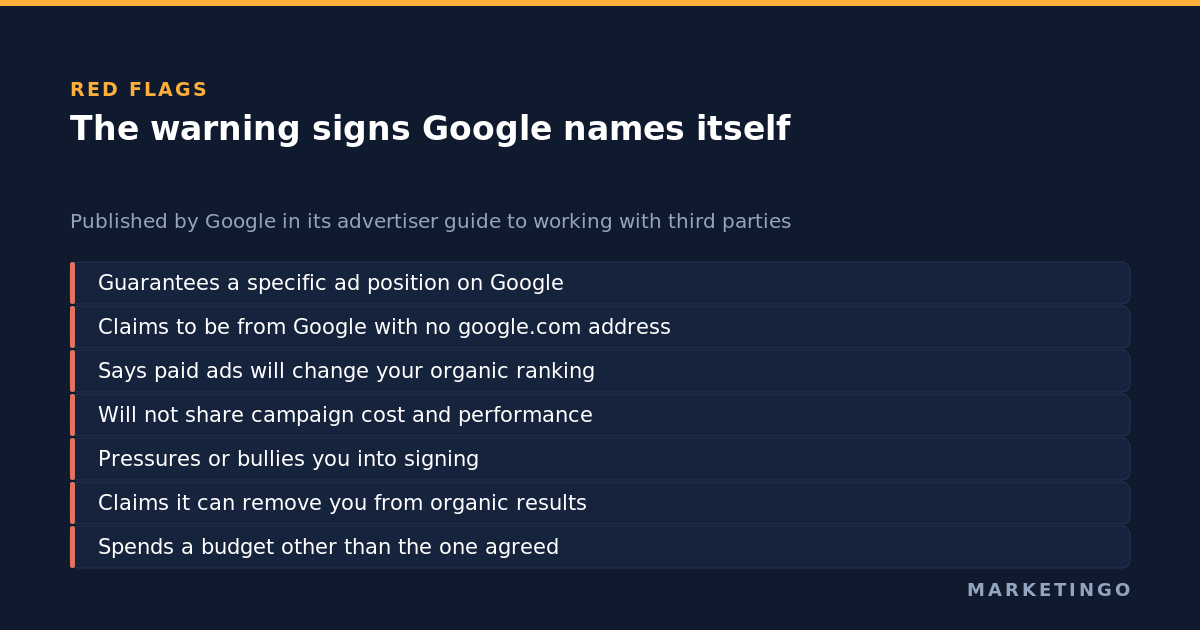
Google publishes a list of warning signs for advertisers dealing with third parties, and it is more specific than anything in the average checklist for evaluating PPC agencies. Straight from Google's advertiser guide, be wary of any party that:
- guarantees "a specific ad position on Google.com search results pages"
- claims to be from Google without a verifiable google.com email address
- suggests that "advertising on Google will affect your organic or natural ranking"
- is "not sharing the cost and performance of advertising campaigns"
- is "harassing or bullying you into signing up"
- claims it "can remove your business from the natural or organic search results"
- uses an "incorrect advertising budget as agreed with you"
The position guarantee deserves its own paragraph because it is the one that still gets made. Google calculates Ad Rank from your bid, "the quality of your ads and landing page", Ad Rank thresholds, "the competitiveness of an auction", the context of the person's search and the expected impact of assets and other ad formats, and it does this "in each auction", twice: once to decide whether your ad is eligible at all and once to rank it against the others. Position is recomputed per query against a competitive set that changes minute to minute. Nobody outside Google can guarantee it, and anyone who does is either uninformed about the auction or counting on you being so.
Four more red flags that Google does not list and that we would add from the buying side.
A proposal with no questions in it. An agency that can write your strategy before seeing your conversion data, your margin and your sales cycle is presenting a template. The first deliverable of any real engagement is a diagnosis, which is why our own free ad audit exists as a standalone thing rather than as a slide in a pitch.
Reporting that only ever goes up. Every successful PPC account has bad months. A reporting culture where the chart always rises is a reporting culture that has learned which chart to show.
A twelve month lock with no break clause. Three to six months is enough to prove a paid search or paid social programme is working. Longer terms transfer all the risk to you at exactly the point when you know least.
One channel proposed for every problem. An agency that runs only paid search will propose paid search. That is sometimes right, and PPC advertising on search is the default answer for good reasons. The question to ask is what they would do if the answer were LinkedIn Ads or Microsoft Ads, and whether they can run it themselves or would hand it off.
When hiring a PPC management agency is the wrong move
Three situations where hiring any PPC agency is premature, and where the honest recommendation is to wait.
Spend under roughly $3,000 a month. At that level a 15% charge buys very few hours and a flat fee eats a large share of the media. Learn to manage your account yourself first, or buy a fixed-scope setup and a quarterly review rather than ongoing campaign management.
No conversion tracking and no intention of fixing it. Without reliable measurement an agency is optimizing toward a proxy, and you will spend the engagement arguing about whose numbers are right. Fix measurement first, even if that means paying for a one-off project, because qualified leads cannot be counted until the tracking agrees with the sales record. Our Google Ads audit checklist is the version of that work you can run yourself in an afternoon.
A product or offer that is not converting organically at all. Paid media buys attention. It does not fix a landing page nobody wants, a price the market rejects or a sales team that does not follow up. An agency that takes this engagement anyway and blames lead quality in month four is a common and avoidable expense.
A 45 minute due diligence sequence for choosing a PPC agency
Run this on each shortlisted agency after the first call and before any contract.
- Ten minutes on the badge and the directory. Click the Google Partner badge on their site. Confirm it resolves to a Google profile page. Note whether they hold Premier status and in which country.
- Ten minutes on their own advertising. Search the terms their ideal client would search. See whether they run ads, what the landing page does and whether the offer matches what they pitched you.
- Ten minutes on the change history. Ask for a screen share of a live account's change history with identifying details hidden. Watch for named users, working cadence and the ratio of human edits to automated entries.
- Ten minutes on one case study. Pick the one closest to your situation and ask for the before number, the after number, the period and the spend. Ask what they would do differently.
- Five minutes on the exit. Notice period, account ownership, tag ownership, administrator seat on the last day. Get the answers in writing.
Anything that survives all five is worth a trial. Choose an agency on that evidence and the first quarter stops being a gamble. Nothing that fails step one should reach a contract.
Get a second opinion before you sign
The fastest way to test any agency's proposal is to have somebody independent look at what the account is actually doing first. Most proposals are written from a screenshot of the last 30 days, and most accounts are counting something other than what the owner assumes.
Our free ad audit covers the same ground a first month should: what the conversion tracking is really recording, where the budget is going against your own economics, and which of the proposed changes would move anything. It is a genuine audit rather than a sales call with slides, you keep the findings either way, and it works just as well as a way to check somebody else's pitch as it does as a way to start with us. If you would rather compare providers first, our list of the best PPC agencies sets out who is strong at what, and our full-funnel strategy and Google Ads management pages describe how we work across the two to three channels that matter for a given account. For online stores, the ecommerce and DTC page covers the same ground on the retail side, and the dental supplies ecommerce engagement shows what the diagnosis looks like on a large catalog.