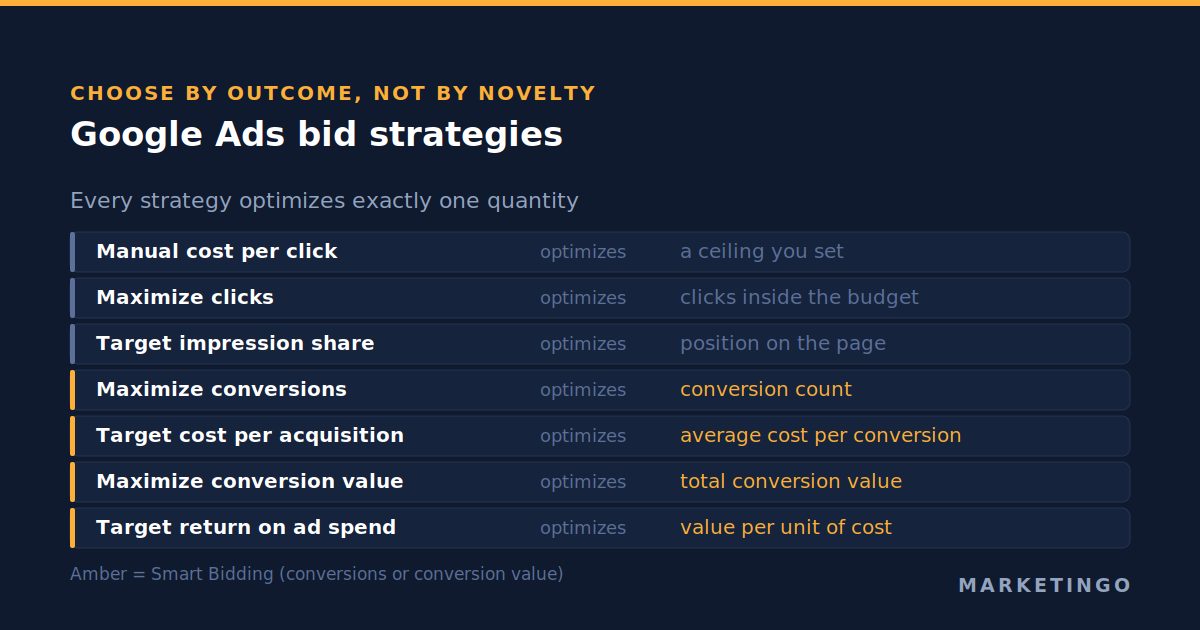
A bid strategy is not a setting that makes an account perform better or worse in general. It is an instruction about which single quantity the auction should try to maximize or hold steady. Maximize clicks buys the most clicks your budget allows. Target cost per acquisition, the setting Google labels Target CPA, tries to hold your average cost per conversion at a number you nominate. Neither is smarter than the other. They answer different questions, and most of the damage in real accounts comes from an operator asking one of them for an outcome it was never built to produce.
Something else matters more than that choice right now. On 17 August 2026 Google began rolling out a change to how target-based bid strategies behave when a campaign is short of budget, and completed it globally on 27 August 2026. Google's own description of the consequence is unusually direct: "This may impact campaigns that were previously overperforming on bidding targets if you take no action." If you have a budget-capped campaign that has quietly been beating its target cost per acquisition for months, the behaviour you were relying on has changed. That section is further down, and it is the one to read first if you only read one.
How Google Ads bidding actually works before you pick a strategy
Two mechanics decide what happens in your account, and both are worth stating plainly because the rest of the article depends on them.
The first is that bids are set per auction, not per day. Google calls this auction-time bidding, and describes it as a feature that uses "Google AI to optimize for conversions or conversion value in every auction." A search happens, Google assembles the signals it holds about that particular search, and a bid is calculated for it. Nothing is averaged in advance.
The second is the signal set. Google publishes the list of contextual signals its automated bidding uses, and it is longer than most operators assume: device type, physical location and location intent, weekday and time of day, remarketing list membership, ad characteristics, interface language, browser type, operating system, the actual search query, the Search Network partner, web placement, site behaviour, product attributes for Shopping, hotel and itinerary attributes, mobile app ratings, price competitiveness and seasonality for Shopping.
Read that list next to what a manual bid can express. A manual maximum cost-per-click bid is one number per keyword, adjustable by a handful of percentage modifiers. The automated strategies are pricing each individual search against sixteen or more inputs. That gap is the honest argument for automated bidding, and it is a mechanical argument rather than a marketing one.
It is also the limit of the argument. Every one of those signals is about the search. None of them is about whether the conversion you recorded was worth having. That distinction runs through the whole of this article.
The bid strategies, and the one thing each of them optimizes
Google frames the choice around what it calls "five basic types of goals," and the strategies sort cleanly underneath them. Only four of them count as Smart Bidding: Google states that "Target CPA, Target ROAS, Maximize conversions, and Maximize conversion value are all Smart Bidding strategies." Everything else is automated, or manual, but not Smart Bidding, and the distinction matters because the conversion requirements and the learning behaviour apply only to that group of four.
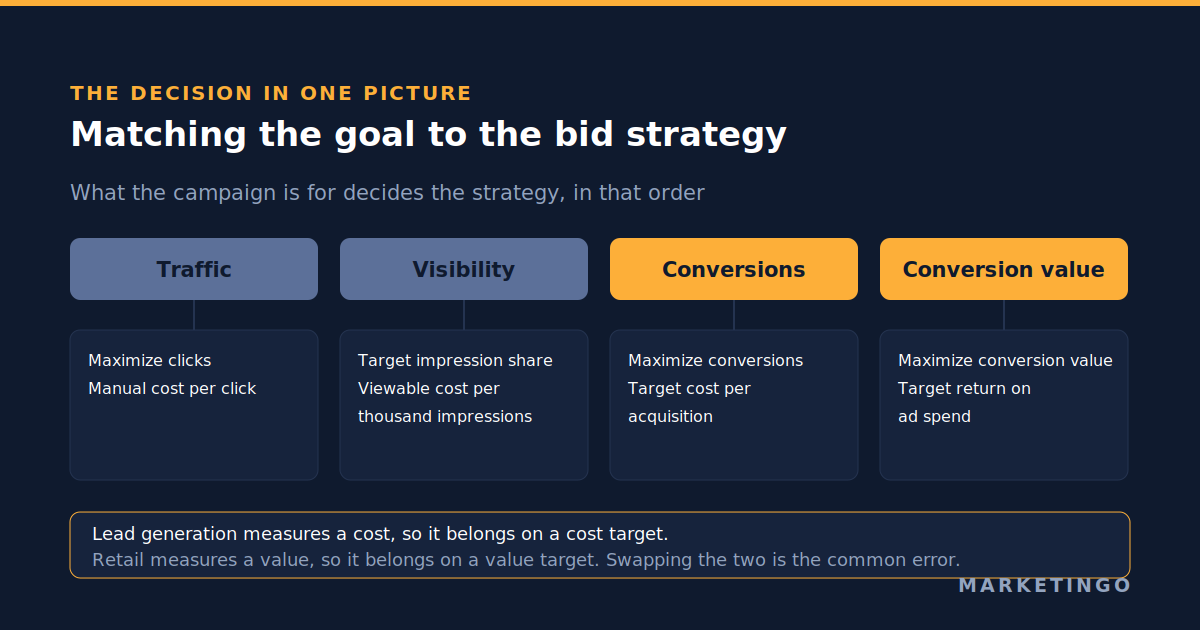
| Strategy | What it optimizes | What you set | Smart Bidding |
|---|---|---|---|
| Manual cost per click | nothing; you set the ceiling per keyword | maximum cost per click | no |
| Maximize clicks | the number of clicks inside the budget | optional bid limit | no |
| Target impression share | how often your ad appears in a chosen position | position and a maximum bid limit | no |
| Maximize conversions | the number of conversions inside the budget | nothing | yes |
| Target cost per acquisition | average cost per conversion | a target cost | yes |
| Maximize conversion value | the total conversion value inside the budget | nothing | yes |
| Target return on ad spend | conversion value per unit of cost | a target percentage | yes |
| Viewable cost per thousand impressions | paid reach | a bid per thousand | no |
| Cost per view | video views or interactions | a bid per view | no |
Manual cost per click
You name a ceiling for each keyword and Google charges up to that. It expresses no goal at all, which is occasionally the point: it is the only strategy that cannot decide to spend more on a search than you told it to. It is also the only strategy that cannot react to any of the sixteen signals above.
Maximize clicks
Google buys the most clicks your average daily budget will pay for. There is no conversion logic in it whatsoever. It is a traffic instrument, and Google places it under the goal of generating website traffic, where "cost-per-click (CPC) bidding may be right for your campaign." Use it to gather data in an account with no conversion history, cap it with a bid limit, and expect to leave it.
Target impression share
This one buys position rather than outcomes. You choose where you want to appear and how often, and Google bids toward that. Google documents three placements: "top," meaning ads adjacent to the top organic results, "absolute top," the first ad among the top ads, and "anywhere" among the search results.
Two cautions come from Google's own page rather than from folklore. The strategy takes a maximum bid limit, and Google warns that "it's important not to set this limit too low," because the whole strategy is bounded by it. And the measurement excludes part of the network: "Impression share only includes the Google Search Network (excluding Search Partners)." A brand-defence campaign is the legitimate use. Pointing this at a non-brand term because a competitor outranks you is how accounts end up paying for position they cannot convert.
Maximize conversions and Maximize conversion value
These two spend the budget. That is not a criticism, it is the design, and Google is explicit about the consequence in the reporting. Google states that these strategies "are designed to spend the full daily budget, and are 'limited by budget' by design," and tells advertisers not to read the Lost impression share (budget) column for campaigns using them. If you have ever opened a weekly report, seen impression share lost because the budget ran out, and raised the budget in response, this is the sentence that explains why the number never improved.
Google also warns about the transition: "if you're currently spending much less than your budget, Maximize conversions could increase spend significantly." A campaign that had been under-delivering against a manual bid will find the whole budget within days.
Target cost per acquisition and Target return on ad spend
These hold an efficiency number instead of spending a budget. Google's language on both is worth quoting because it sets expectations that the account reporting will otherwise break. On target cost per acquisition: "Some conversions may cost more than your target and some may cost less, but altogether, Google Ads will try to keep your cost per conversion equal to the target CPA you set." On target return on ad spend, the same structure: "Some conversions may return a higher ROAS and some may return a lower ROAS, but altogether Google Ads will try to keep your conversion value per cost equal to the target ROAS you set."
The target return on ad spend figure is set as a percentage, and Google's own worked example is the arithmetic most operators get backwards: "$5 USD in sales ÷ $1 USD in ad spend x 100% = 500% target ROAS." Five dollars back per dollar spent is a target of 500%, not 5. Getting a decimal point wrong here is a real failure mode, because a target of 5% will bid to almost nothing and a target of 50,000% will bid to nothing at all.
One combination Google rules out directly. Do not reach for Maximize conversions and then try to bolt an efficiency target onto it. Google's guidance is to switch strategy instead: if you have return-on-investment goals, "you may want to switch to a Target CPI, Target CPA, or Target ROAS bid strategy," because those "set bids for each auction" with the goal of hitting the target "rather than spending your full budget." Budget-spending and target-holding are two different jobs.
What changed in August 2026, and why a campaign that was beating its target may now stop
This is the most consequential bidding change in years and it has had very little written about it, so here it is in Google's own terms.
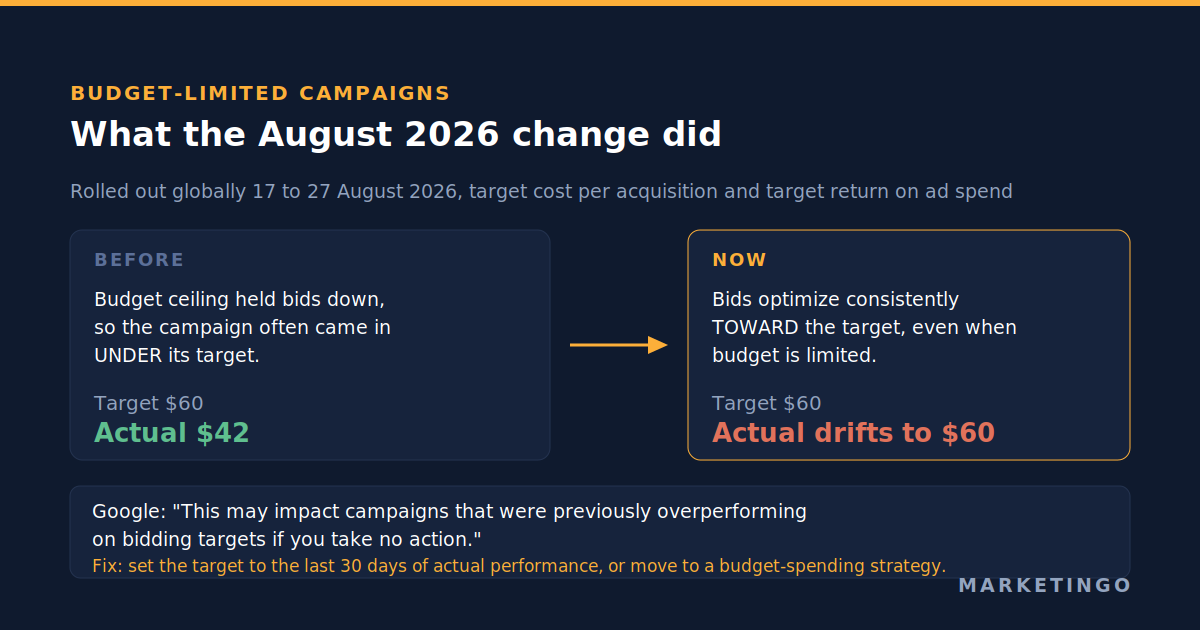
Before the change, a target-based strategy on a campaign that ran out of budget behaved inconsistently. In practice many budget-capped campaigns overperformed: they returned a cost per acquisition below the target, or a return on ad spend above it, because the budget ceiling stopped the strategy from bidding up into the more expensive auctions it would otherwise have entered. Plenty of accounts were quietly built on that behaviour, with a target set deliberately loose and a budget doing the real constraining.
Google has now removed the inconsistency. Its description of the update: "With this update, your bids are optimized more consistently to your target when your campaign has a limited budget." The affected strategies are "Target CPA and Target ROAS across most campaign types," plus target cost per click for Demand Gen campaigns, across Search, Shopping, Performance Max, Demand Gen and Travel. The rollout began on 17 August 2026 and Google records that it "was completed on August 27, 2026, and the new bidding behavior is now fully live across all affected accounts."
Three things follow, and Google states all three.
Spend does not run away: "This change will not directly result in increased spend for you. Your daily and monthly budget limits will always be respected." So the change does not break a budget.
Efficiency can get worse if you sit still: "Campaigns now optimize more consistently toward their set target. This may impact campaigns that were previously overperforming on bidding targets if you take no action." A campaign holding a $60 target while actually delivering at $42 will now drift toward $60, because that is what you asked for. Nothing has broken. The instruction is simply being followed properly.
And the fix is to make the target honest. Google's recommendation is to "update targets to match recent performance averages using the Target Adjustment Tool," or, if the budget is the real constraint, to "switch to Maximize conversions or Maximize conversion value to maximize your ROI within a set budget." Google spells out when to prefer the second: "if your budget is strictly inflexible and you are comfortable with ROI fluctuations when budgets are adjusted."
There is one more line on this page that quietly rewrites how budgets should be planned: "If you adopt demand-led budgeting, you are free to set higher daily budgets, but you should not expect those daily budgets to be spent in full." A target-based campaign with a generous budget is now a target-enforcing campaign, not a budget-spending one.
The operational conclusion is short. If any campaign in your account uses a target and has been sitting at "limited by budget," open the last 30 days, read the actual cost per acquisition or return on ad spend, and set the target to that number rather than to the aspiration it was set to originally. If the target stays loose, the strategy will spend its way up to it.
The conversion thresholds the industry keeps getting wrong
Three numbers circulate as eligibility rules for Smart Bidding: 15 conversions, 30 conversions, 50 conversions. All three appear in Google's documentation, none of them is an eligibility rule, and they are not describing the same thing.
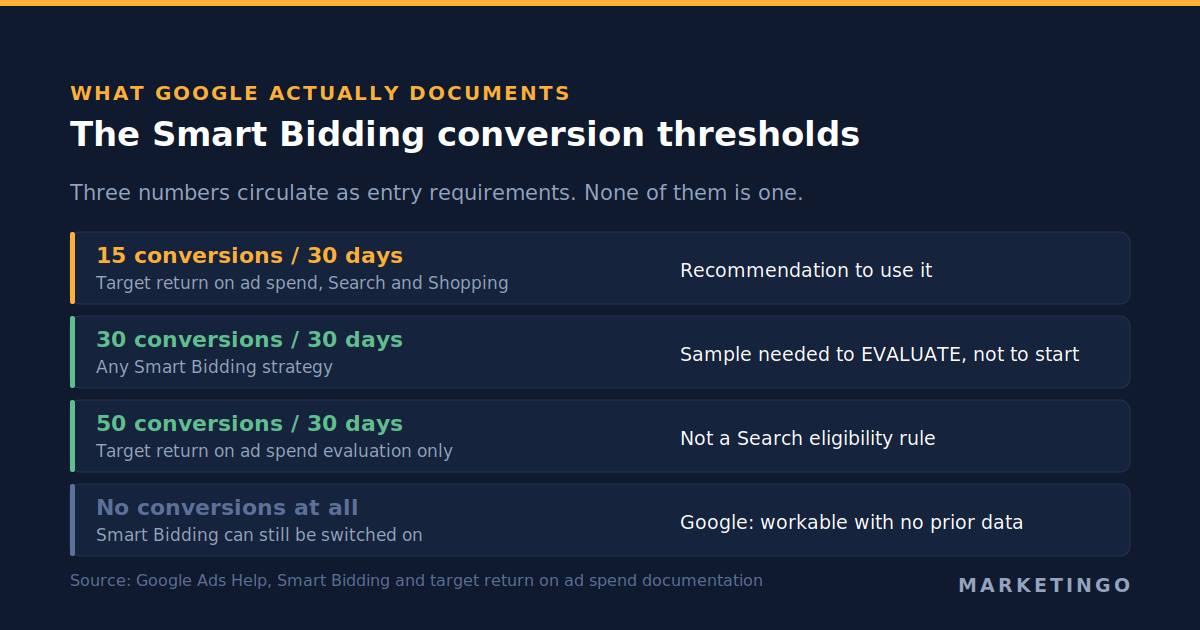
Start with what Google says about eligibility. "While you can turn on Smart Bidding without prior data, Google recommends meeting certain conversion baselines." Target cost per acquisition is documented as workable with no conversion history at all and "effective for campaigns of all sizes." So the common claim that you must bank 30 conversions before you are allowed to switch on Smart Bidding is not a rule Google publishes. It is a recommendation that hardened into folklore.
Next, the number attached to target return on ad spend. For Search and Shopping campaigns Google's documented recommendation is "at least 15 conversions in the past 30 days," not 50. The 50 figure belongs to other campaign types entirely: Demand Gen asks for "at least 50 conversions in the past 35 days," hotel campaigns for "at least 50 conversions per week," travel campaigns for "at least 50 conversions in the past 7 days." App campaigns want "at least 10 conversions every day (or 300 conversions in 30 days)," and Video Action campaigns "at least 30 conversions in the past 30 days." A Search account being told it needs 50 conversions for target return on ad spend is being handed a hotel campaign's number.
Finally, the 30 and the 50 that get quoted most often are about reading results, not about switching a strategy on. Google recommends "measuring performance over longer time periods that have at least 30 conversions, such as a month or longer (50 conversions for Target ROAS)," and on the target cost per acquisition page: "For evaluation, we recommend you measure performance for the last 30 days, including at least 30 conversions."
That reframes the number usefully. Thirty conversions is not permission to start. It is the smallest sample in which the result means anything. A campaign with nine conversions last month has not proved that target cost per acquisition failed, whatever the cost per acquisition column says, because nine conversions cannot distinguish a bad strategy from an ordinary run of luck.
The learning period is counted in conversion cycles, not days
Ask how long Smart Bidding takes to settle and you will be told seven days, or fourteen, with confidence. Google's documentation does not give a day count. It gives a different unit: "It can take a few conversion cycles (1-2 typically) for the bid strategy to calibrate to the new objective, although it can be faster depending on the amount of conversion data present."
A conversion cycle is your own lag between click and conversion, so the learning period is a property of your sales cycle rather than of the platform. For a direct-to-consumer store where most purchases land the same day, one or two cycles is a handful of days. For a business-to-business account where a demo request converts to an opportunity three weeks later, the same sentence means six weeks. Judging the second account on a seven-day timetable is how a working strategy gets reverted before it has calibrated once.
Google names what restarts the clock: creating a new strategy, changing its settings, changing the composition of campaigns or keywords inside it, and in Shopping, sometimes adjusting ad group targets. It also notes that previous data carries over, because "conversion data from previous campaigns can help drive faster results by speeding up the initial learning period."
And one line that should end the habit of watching the status field: "Our algorithms continue to learn even when the bidding status no longer shows 'Learning'." The label going away is not a finish line.
Enhanced cost per click no longer exists, and some accounts have not noticed
Enhanced cost per click was for years the standard first step away from manual bidding. It is gone. Google's page states it flatly: "Effective the week of March 31, 2025 Enhanced CPC (ECPC) is no longer available for Search and Display campaigns."
The detail that matters for anyone auditing an older account is what happened to campaigns nobody migrated. They were not moved to a Smart Bidding strategy. They now function as manual cost per click, with no conversion optimization of any kind. Google also kept displaying the old setting in the interface until May 2025 while the transition finished, which means there was a window in which the screen said one thing and the auction did another.
So a Search campaign that was set and left before spring 2025 may today be bidding one flat number per keyword while its owner believes an optimization layer is running. That check takes a minute and belongs in any Google Ads audit: open the bid strategy column, and if it reads manual cost per click on a conversion-focused campaign, it is almost certainly a migration artefact rather than a decision.
Reading bid strategy status before you blame the strategy
The bid strategy status column explains most apparent failures, and it is the first place to look when a target is not being met. Google documents these states.
Learning. A change was made, and "there may be minor performance fluctuations as Google Ads optimizes your bids." Read results after the conversion cycles above, not during.
Limited. The strategy is constrained by something outside itself, in one of four ways. Limited by inventory means "your bid strategies are limited by available search volume," so there is nothing more to buy. Limited by bid limits means a maximum or minimum bid you set is preventing the strategy from bidding where it wants to. Limited by budget means "many of the keywords using this strategy are Limited by budget. As a result, Google Ads may not be able to raise bids enough to meet your goals," which since August 2026 is the state to take most seriously. Limited by bidding strategy means a campaign-level strategy needs upgrading.
Misconfigured, conversion setting. This appears when a conversion-based strategy has no properly configured conversion action behind it. It is the most important of the lot, because a target cost per acquisition strategy with broken measurement is not optimizing toward your business at all. It is optimizing toward whatever event still fires. Fixing that is a conversion tracking problem, not a bidding problem, and no target will hold until it is fixed.
Misconfigured, shared budget. A maximize strategy is sharing a budget with campaigns on a different portfolio strategy.
When Smart Bidding is the wrong choice
Automated bidding wins on the signal argument set out earlier, and in most accounts it should be the default. There are four situations where it is the wrong answer, and they are worth being blunt about because the platform will not volunteer them.
When the conversion you are optimizing toward is the wrong event. Smart Bidding maximizes what you told it to count. If the conversion action is a form fill, it will buy the cheapest form fills available, and the cheapest form fills in a business-to-business account are frequently students, job applicants and competitors. Nothing in the signal list can tell whether a lead was qualified. The fix is upstream: feed real values back, so the strategy optimizes toward revenue rather than toward form submissions. Until that is in place, an automated strategy will pursue volume of a metric you do not actually want more of, and it will be very good at it.
When the conversion volume is genuinely tiny and the values differ wildly. A campaign producing three conversions a month, one worth $400 and one worth $90,000, gives the algorithm almost nothing to model and a distribution in which the mean is meaningless. Manual bidding on a short, deliberately chosen keyword list is defensible here, and often better, because a human knows which three search terms are worth real money.
When you need a hard ceiling on what a click can cost. Target strategies control an average, not a maximum. If a single $90 click is a problem for reasons of cash flow rather than mathematics, manual bidding or a bid limit is the only setting that guarantees it.
When the goal is not a conversion. Brand defence, holding a position against a competitor bidding on your name, or buying data in a brand-new account are not conversion problems, and target impression share or maximize clicks answers them directly. Reaching for Smart Bidding because it is the newer option produces a strategy optimizing toward a goal you did not have.
There is a fifth case that is less about mathematics and more about honesty. Where an account has never had reliable measurement, moving to automated bidding does not fix the account, it hides the problem one layer deeper, because now the numbers in the interface are being produced by a system optimizing toward a broken signal. Fix the measurement first.
How to choose, in the order the decision actually happens
The choice is made by three questions in sequence, not by comparing nine strategies on their merits.
First: is the conversion measurement trustworthy? If the answer is no, the only correct choice is a non-conversion strategy while you fix it. Maximize clicks with a bid limit, or manual cost per click, will not pretend to optimize toward a broken goal.
Second: does the account measure a cost or a value? Lead generation almost always measures a cost, because a lead is a lead and the money arrives later, so target cost per acquisition is the natural home. Retail measures a value, because a $40 order and a $400 order are not the same conversion, so target return on ad spend is the natural home. Getting this wrong is the single most common misconfiguration: a store on target cost per acquisition will happily buy cheap small orders, and a lead generation account on target return on ad spend is bidding against a value it invented.
Third: is the constraint the budget or the efficiency number? If you must not exceed a spend, use Maximize conversions or Maximize conversion value and accept that efficiency will move around. If you must not exceed a cost per acquisition or fall below a return, use a target strategy and accept that the budget may go unspent, which since August 2026 is now the documented expectation rather than a surprise.
The budget question that arrives with this, usually phrased as whether $20 a day is enough, is answered by that third question rather than by a benchmark. Twenty dollars a day is about $608 a month. In a market where clicks cost $6, that is roughly a hundred clicks, and at a 5% conversion rate, five conversions. Five conversions a month is below every evaluation threshold Google publishes, which means the budget is not too small to run, it is too small to learn from quickly. The answer is to narrow the keyword list until the same money buys enough clicks on fewer terms to produce a readable result. Work the arithmetic backwards from your own margin with the lead generation return on investment calculator, or the ecommerce return on ad spend calculator if you sell products, and the budget question answers itself.
Standard or portfolio
A standard strategy governs one campaign. A portfolio strategy governs several, optimizing across them toward one shared target, and Google offers target impression share, target cost per acquisition and target return on ad spend in both forms.
Portfolio helps when several campaigns serve the same business goal and individually have too few conversions to model well: three small campaigns with eight conversions each are a better dataset pooled than separately. It hurts when the campaigns have genuinely different economics, because a shared target will subsidise the weak campaign out of the strong one's budget and the reporting will not show you that it happened. Pool campaigns that are economically alike. Keep brand and non-brand apart, always.
Bid adjustments, and the strategies for campaigns that are not about clicks or conversions
Two parts of the bidding system get skipped in most guides because they sit outside Search, and both come up in real accounts.
Bid adjustments. These are the percentage modifiers that raise or lower a bid by device, location, audience, time of day or a handful of other dimensions. Under manual bidding they are the main lever an operator has. Under the four Smart Bidding strategies they are largely redundant, because every dimension a bid adjustment can express is already in the signal list Google publishes, and applied per auction rather than as a flat percentage. The one that still functions across strategies is the device adjustment set to minus 100%, which removes a device entirely rather than pricing it. If you find a campaign carrying a dozen inherited bid adjustments alongside a target strategy, most of them are doing nothing, and one of them is probably suppressing traffic somebody forgot about in 2022.
Video and display goals. Google's own goal framework covers more than conversions, and the strategies change with the campaign type. For increasing brand awareness, Google points to "cost-per-thousand viewable impressions (vCPM) bidding," where you pay for impressions that were actually viewable rather than merely served. For video ads aimed at views or interactions, it names "cost-per-view (CPV) or cost-per-thousand impressions (CPM) bidding," and for video aimed at product or brand consideration, cost per view again. A cost per view bid is what you are willing to pay for one view of the video, and cost per thousand impressions bids for reach rather than for any action at all.
The practical point is that these are not weaker versions of Smart Bidding. They price a different thing. A campaign on the Google Display Network bought on viewable cost per thousand impressions is buying attention, and judging it by cost per acquisition will always make it look like a failure, because it was never bidding for a conversion. Decide what the campaign is for, then let the bid strategy price that, and report it against a metric that matches. Mismatched reporting kills more upper-funnel campaigns than mismatched bidding does.
What this looks like when it is run properly
Bidding is where an account's measurement problems become visible, which is why it is rarely a standalone fix. In the accounts we take over, the bidding change that helps is almost never the first change made: the order is to repair what counts as a conversion, feed real values back where they exist, then let a target strategy optimize toward something worth having.
The size of the difference that makes is not marginal. In one business-to-business software account, rebuilding the measurement and then rebidding against it took trial signups from roughly 28 a week to about 84 while cost per trial fell from $64 to about $27, with the core non-brand campaign settling around $23 a trial across more than 700 trials. The bidding strategy was part of that, but it was the last part. The full sequence is in the compliance and document security software case study, and the same pattern holds on the retail side, where a large catalogue store's blended return on ad spend moved from 7.86 to about 8.5 while spend increased, once the 37% of budget going to products that had never produced revenue was cut out.
If you want to know which of these applies to your account before changing anything, that is what a free ad audit is for: we read the bid strategy column, the strategy statuses, the conversion actions feeding them and the last 90 days of target-versus-actual, and tell you which of the four "wrong choice" cases above you are in. For ongoing work, our Google Ads management service covers this, and for business-to-business accounts specifically, the high-ticket business-to-business pages set out how the measurement side is handled. If the concern is what the media itself should cost before any of this, the Google Ads cost article works through that arithmetic, and Performance Max covers the campaign type where bidding choice is narrowest.