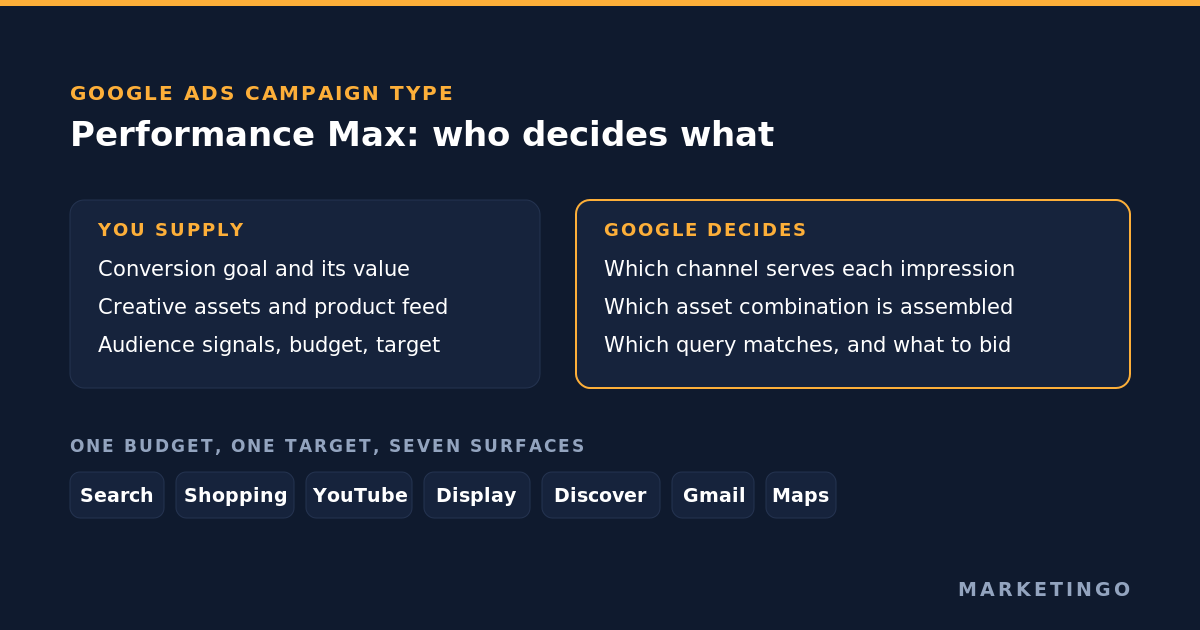
Performance Max is a single Google Ads campaign type that serves across Google Search, Shopping, YouTube, Display, Discover, Gmail and Maps from one budget and one bid target. You supply creative assets, a conversion goal and a product feed if you have one. Google decides where each impression goes, which asset combination shows and how much to bid.
That description is uncontroversial. What follows it usually is not. Most published advice on Performance Max, or PMax as almost everyone in the industry shortens it, was written between 2022 and 2024, when the campaign type genuinely did hide almost everything, and it has not been updated for the controls and reporting Google shipped in 2025 and 2026. Advertisers are still being told to build brand negative keyword lists that Google now advises against, still being told to wait for 30 conversions before launching a threshold Google does not publish for this campaign type, and still working from a picture of Performance Max as an opaque budget drain.
This is the operator's version. What the campaign optimises for, every control that exists as of September 2026, what the reporting exposes and what it still withholds, and the two changes this year that moved live account numbers without anybody touching a setting.
How Performance Max works
Performance Max is a goal-based Google Ads campaign type. You tell it what a conversion is worth, hand it creative assets and a product feed, and Google AI decides the rest: which of the Google channels to serve on, which asset combination to assemble, which query or placement is likely to convert, and what to bid in each auction. Keyword-based search campaigns work the other way around, with the advertiser declaring the demand to buy and the system pricing it. Performance Max asks you to declare the outcome instead.
The reach is the reason it exists. A single Performance Max campaign can show your ads across all of Google: Search and search partners, Shopping, YouTube, Display, Discover, Gmail and Maps. Running the equivalent through standard campaigns means separate campaigns per surface, each with its own budget, its own bidding and its own view of the same customer. Google upgraded Smart Shopping campaigns and Local campaigns into this campaign type during 2022, which is why so many retail accounts inherited a Performance Max campaign rather than choosing one.
The pieces you supply are short to list. A conversion goal with values attached, wired through conversion tracking in your Google Ads account and usually cross-checked in Google Analytics. At least one asset group holding headlines, descriptions, images, logos and video. A Google Merchant Center feed if you sell products. Audience signals if you have useful first-party data. A budget and, optionally, a target.
Google's own claim for the campaign type is that advertisers adopting it see an average increase of 27% more conversions or value at a similar cost per acquisition or return on ad spend, even where they already run broad match and Smart Bidding in Search. That figure is Google internal data from October and November 2023, so treat it as a directional vendor claim rather than an independent finding, and note that it is now approaching three years old.
Setting up a Performance Max campaign
The setup flow is short enough that most of the work sits either side of it. Create a campaign in your Google Ads account, pick the goal, connect Merchant Center if you sell products, set the budget and bid strategy, build the first asset group, add listing groups to segment the feed, attach audience signals, and add search themes for demand you know exists. What determines whether campaign performance is any good is almost entirely upstream: whether the conversion you are optimising toward is the one that makes money, and whether the products or service lines inside the campaign share the same economics.
What Performance Max actually optimises
A Performance Max campaign optimises toward one conversion goal configuration using one of two bid strategies: Maximize conversions, with an optional target cost per acquisition, or Maximize conversion value, with an optional target return on ad spend. From June 2026 those two targeted strategies are labelled simply "Target CPA" and "Target ROAS" in the Google Ads interface. Google states plainly that the relabelling is purely a visual change that does not alter how the strategies work, which is worth knowing because the change generated a wave of alarmed content that misread a naming update as an algorithm update.
The target is set at campaign level and only at campaign level. Portfolio bid strategies are not available for Performance Max, and there is no ad group inside a Performance Max campaign to hold a different target. Every asset group in the campaign shares the same target. That single fact drives most sound Performance Max account structure: if two parts of your catalogue or two parts of your service line need materially different efficiency targets, they need different campaigns, because there is no lever inside one campaign to separate them.
The matching is keywordless. Performance Max does not run on a keyword list. It reads your landing pages, your feed, your assets and your audience signals, then matches to queries and placements it predicts will convert. This is the part that unsettles search marketers most, and it is also the part where the controls have expanded fastest.
The Performance Max controls that exist in 2026
The line that Performance Max is a black box with no controls is no longer accurate. Google's own campaign documentation now enumerates a set of campaign-level controls and maintains a dedicated help topic on search targeting and controls for the campaign type. Here is the full surface as it stands.
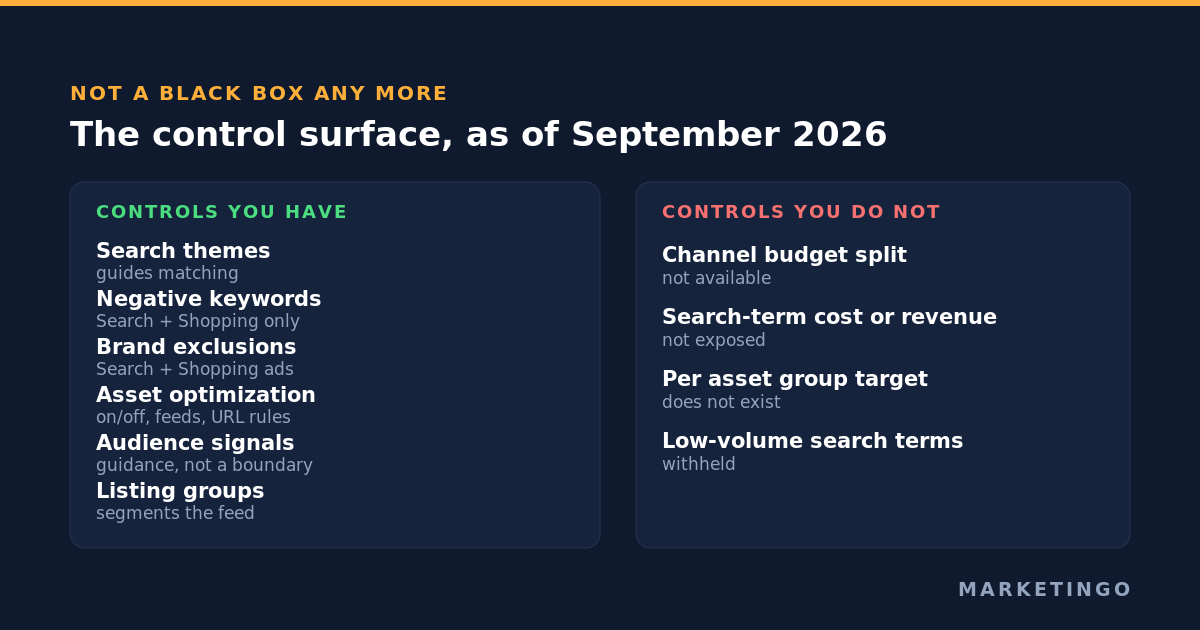
| Control | What it does | Scope |
|---|---|---|
| Search themes | Tells Google which queries you believe matter | Ranks equal to phrase and broad match |
| Negative keywords | Blocks queries | Search and Shopping inventory only |
| Brand exclusions | Blocks your brand or a competitor's brand | Search and Shopping ads |
| Asset optimization (Final URL expansion) | Lets Google pick the landing page | On or off, with page feeds and URL rules |
| Audience signals | Suggests who is likely to convert | Guidance, never a boundary |
| Listing groups | Segments the product feed | Inside each asset group |
| Excluded content keywords | Blocks placements | Display and YouTube, via content suitability |
| Customer acquisition goal | Weights or restricts to new customers | Campaign level |
Two of those deserve more than a table row, because the way they behave surprises experienced advertisers.
Negative keywords now reach 10,000, and Google would rather you did not use them for brand
Performance Max supports both account-level negative keyword lists and campaign-level negative keywords, and campaign-level negatives can now be applied as an existing shared list rather than pasted in one by one. The campaign-level cap rose from 100 to 10,000 in March 2025, confirmed by Google Ads Liaison Ginny Marvin. Account-level negatives apply automatically across all Search and Shopping inventory, including inside Performance Max.
The scope limit matters more than the cap. Google's documentation states that Performance Max negative keywords are applicable to Search and Shopping inventory only. A negative keyword will not stop your ad appearing next to unwanted content on YouTube or Display. That job belongs to excluded content keywords in the content suitability settings, which is a different control in a different part of the account, and the number of advertisers who have added 400 negatives and then wondered why their YouTube placements did not change is not small.
The genuinely counterintuitive part is Google's own guidance. On the current help page for these controls, negative keywords are described as a highly restrictive control that can harm performance, with the explicit recommendation to use brand exclusions instead for brand queries. Most agency advice still says the opposite. Brand exclusions block the brand name plus common misspellings and related subsidiary brands automatically, where a negative list only blocks the strings you thought to write down, so on this one Google's advice is simply better than the conventional wisdom.
Asset optimization behaves in reverse depending on whether it is switched on
Final URL expansion, now labelled asset optimization in the newer controls documentation, lets Google replace the final URL you set with a more relevant page from your site based on the query, then generate a headline that matches that page. You can restrict it with page feeds, with URL rules on the "URL contains" pattern, and with exact-URL exclusions.
Here is the part that catches people. With expansion switched on, page feeds and URL rules only inform the matching. With expansion switched off, the same page feeds and rules restrict it. So an advertiser who adds a page feed to keep traffic away from a set of pages, while leaving expansion on, has changed nothing at all. The mirror-image trap is that URL exclusions can only be added while expansion is on, which means the setting that reads like the safe conservative choice removes your ability to exclude specific pages.
Google now also surfaces expansion being off as a negative diagnostic in the channel report, phrased as final URL expansion limiting serving on Search. Read that as a nudge rather than a verdict, but do read it: switching expansion off is a real restriction on where the campaign can go, and it should be a decision rather than a default.
Audience signals are not targeting, and Google says so
This is the single most common misreading of the campaign type, and Google's documentation is unambiguous about it. On the audience signals help page, in a boxed note: "Performance Max may show ads to relevant audiences outside of your signals if they have a strong likelihood of converting to help you meet your performance goals." Google's best practices page puts the same point positively, saying Performance Max campaigns do not limit ads to a selected set of audiences.
Nowhere does Google describe a signal as targeting. The campaign setup documentation frames the advertiser's job as sharing customer intent preferences to guide learning, and Google's job as accelerating campaign learning using high-intent audiences. A signal is a starting hypothesis about who converts, which the system tests and then departs from.
Practically, that changes what a good signal looks like. If a signal cannot constrain delivery, a broad in-market segment adds very little, because it tells the system something it can work out inside a week. What helps is a signal dense with information the system cannot infer: your own customer match list, your converter remarketing lists, and custom segments built from the search terms and competitor URLs your buyers actually use. Google's own tip on that page points at search-term-based custom segments specifically.
Asset groups, listing groups and how to structure a Performance Max account
An asset group is a set of creative assets built around one theme or one audience. Each Performance Max campaign needs at least one and can hold up to 100 asset groups, and asset groups cannot be shared between campaigns. Inside a single asset group you can hold up to 15 headlines, 5 long headlines, up to 5 descriptions, 20 images, 5 logos and 15 videos.
For retail, the listing group sits inside the asset group and subdivides the Merchant Center feed by category, brand, item ID, condition, product type, channel or any of five custom labels. Each asset group can hold up to 1,000 listing groups, though Google adds that going past a thousand is not a best practice and performance may suffer.
The listing group is where catalogue economics get enforced, and it is the structural decision that pays back hardest in a retail Performance Max account. A large catalogue always contains products that consume budget and return nothing, and inside one undifferentiated campaign those products are subsidised by the winners while the shared target absorbs the damage. On a roughly 40,000-SKU store, MarketinGO found 37% of budget going to products that had generated zero revenue, and separating them lifted blended Google return on ad spend from 7.86 to about 8.5 while spend went up rather than down. Nothing exotic was required. The work was segmenting the feed so that the products with different economics stopped sharing a target.
The same logic applies to services and lead generation, using asset groups per service line rather than listing groups, and it is the reason the "one Performance Max campaign for everything" setup underperforms so reliably. One campaign is one target, and one target across mixed economics prices everything wrong.
If you are working out what a defensible target looks like before you set one, the ecommerce ROAS calculator works back from margin, and the lead generation ROI calculator does the equivalent for cost per lead and close rate.
Channel performance and what Performance Max reporting shows now
Channel-level reporting is the change that most invalidates older Performance Max advice. Under Insights and reports, channel performance splits the campaign into Google Search, Display, YouTube, Discover, Maps, Gmail and search partners, with impressions, clicks, interactions, conversions, conversion value and cost for each. Google announced it on 30 April 2025 and the data goes back to 6 June 2025 in the date picker.
A genuine search terms report also exists. Under Campaigns, Search terms, the dropdown for search terms and landing pages for Performance Max returns actual queries, segmentable by ad format so you can separate Shopping from text ads, with data available from March 2023. Alongside it, search categories group queries into auto-generated themes, and Google notes that these groupings take all search terms into account including the ones withheld from the search terms report for privacy reasons.
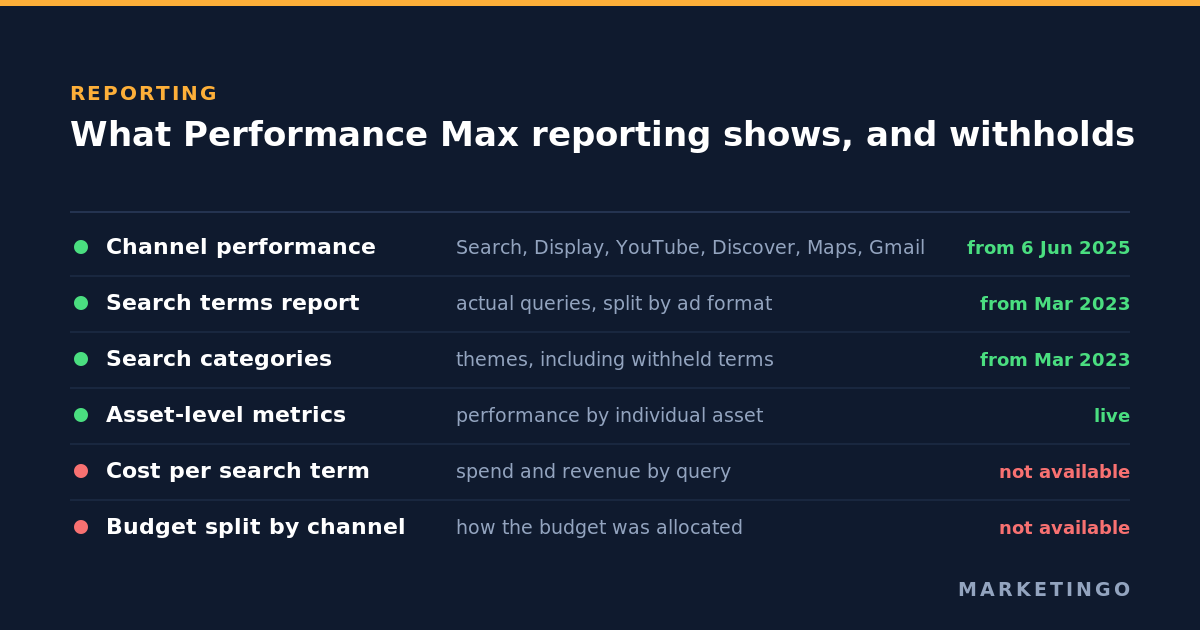
What you still cannot see or set is the honest residue of the black box claim, and it is narrower than the claim but not empty. You cannot control budget allocation per channel. You cannot see cost or revenue at the individual search term level. You cannot set a different target for one asset group. Low-volume search terms remain withheld. Google is testing a channel-level adjustment control in alpha as of August 2026, first spotted in the wild rather than announced, which relaxes or tightens the acceptable cost per acquisition on a given channel rather than splitting budget. Treat it as a signal about direction, not a feature to plan around.
One caution on using the channel report to make decisions. The conversions attributed to a channel are last-touch, and last-touch cost per acquisition is not channel value. Tightening YouTube because its attributed cost per acquisition looks bad can suppress the Search conversions that YouTube was warming up, and the report will show you the Search decline without ever connecting it to the change you made.
Does Performance Max cannibalise your Search campaigns?
Partly, and Google's own documentation supplies both the mechanism and the exceptions.
The stated prioritisation rule is that an exact-match keyword identical to the query wins over Performance Max. Search themes rank equal to phrase and broad match. Where neither applies, the system uses predicted relevance and then Ad Rank. So far this reads as reassurance for anybody with a well-built Search account.
The exceptions list is where it comes apart. The rule does not hold when the Search campaign is restricted by budget, when there is a targeting mismatch, when ads are disapproved, for Shopping formats, and in what Google calls advanced search experiences including Lens, AI Mode and AI Overviews, where keywords may not automatically be prioritised. The Performance Max page concedes the first case directly: if your Search campaign is budget-limited, Performance Max may occasionally serve on exact match terms.
Read the list again and notice what it means in practice. The most common cause of Performance Max eating your Search traffic is your own Search campaign being budget-limited. That is diagnosable in about a minute and fixable without touching Performance Max at all.
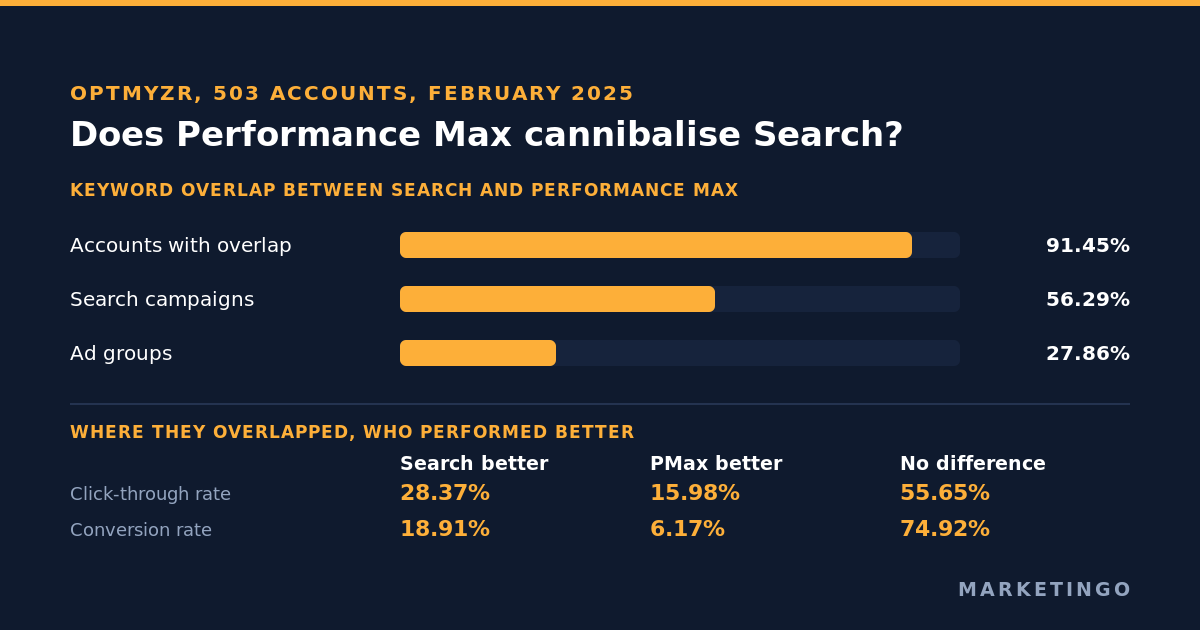
For scale, Optmyzr studied 503 accounts across February 2025 and reported keyword overlap between Search and Performance Max in 91.45% of them, affecting 56.29% of 5,768 Search campaigns and 27.86% of 40,642 ad groups, with overlap occurring across all match types including exact. The performance half of that study is the more useful half and gets quoted far less. On click-through rate, Search performed better in 28.37% of overlaps, Performance Max in 15.98%, and there was no significant difference in 55.65%. On conversion rate, Search won in 18.91%, Performance Max in 6.17%, and 74.92% showed no significant difference.
The fair summary is that overlap is close to universal, harm is real but usually modest, and where it does hurt, Search wins the comparison far more often than Performance Max does. Which argues for brand exclusions and a properly funded Search campaign rather than for keeping Performance Max out of the account.
Two Performance Max prerequisites that are not real
"You need 30 conversions in 30 days before Performance Max will work." Google publishes conversion thresholds for target return on ad spend across seven campaign types on the bid strategy requirements page, listing 15 for Search, Shopping and Display, 300 for App, 50 for Demand Gen, 30 for Video Action, 50 a week for Hotel. Performance Max is not on that list at all. Google's target cost per acquisition documentation says the opposite of the folk rule, stating that advertisers can start with no conversion history and that the strategy is effective for campaigns of all sizes. Google's own Performance Max lead generation guidance uses 15 conversions in 30 days, and uses it to choose which conversion goal to bid toward rather than as a gate on launching. The number 30 appears in Google's documentation only as a measurement guideline, recommending you assess the last 30 days including at least 30 conversions before judging results. A rule about when to read the numbers has been quietly promoted into a rule about when you are allowed to start.
"Performance Max needs a six-week learning period." Two different things are being run together here. The bid strategy learning status resolves in up to three weeks or one to two conversion cycles. Separately, Google recommends allowing at least six weeks before making major changes to a lead generation Performance Max campaign, and one to two weeks of stabilisation after any significant change. Six weeks is a recommended hands-off window, not a technical calibration phase. The accurate version is that the algorithm calibrates within about three weeks and Google would prefer you left it alone for six, which is a different claim with different implications for how long you tolerate poor results.
The 2026 bidding change that moved accounts without anybody touching them
On 17 August 2026 Google updated its bidding systems to deliver more consistent performance against stated targets even when budgets change. It applies to Search, Shopping, Performance Max, Demand Gen, Display, Hotel and Travel.
The effect lands on budget-limited campaigns. A campaign constrained by budget frequently overperforms its target, because the system takes only the very best available auctions. Under the updated behaviour those campaigns drift back toward the target you actually set. A Performance Max campaign sitting at "limited by budget" with a target return on ad spend of 400% while delivering 700% will now move toward 400%, and the efficiency you were enjoying was never something you asked for.
For multi-channel campaigns Google adds a second warning that is easy to miss: Performance Max and Demand Gen may also see shifts in how traffic is distributed across channels. So a Performance Max campaign can change channel mix in the same period, which makes any before-and-after read on channel performance across mid-August genuinely ambiguous.
Google states it will not adjust your targets or budgets for you, and made a bid target adjustment tool available from 6 July 2026. The practical instruction is short. Find every target-based campaign flagged as limited by budget, compare delivered efficiency against the stated target, and either reset the target to what you were actually getting or raise the budget so the constraint stops doing your bidding for you. Doing neither is a decision to accept the drift.
Also arriving this year, announced at Google Marketing Live on 7 May 2026: Smart Bidding Exploration is coming to Performance Max and Shopping in beta, letting you set a tolerance around target return on ad spend so the system can pursue less obvious queries, and campaign total budgets are already live for Performance Max.
Performance Max for lead generation is a different problem
For retail, the conversion is a purchase with a value attached, and Performance Max optimises toward something real. For lead generation the conversion is a form fill, and the campaign type will find you an enormous number of form fills of whatever quality your goal definition permits. This is the failure mode we see most often in high-ticket B2B accounts, and it is not a bidding problem. It is a measurement problem that bidding then amplifies.
Three things make the difference. Pick the conversion goal closest to a real sale that still carries enough volume to bid on, which is where Google's 15-conversions-in-30-days guidance actually applies. Feed offline conversion data back so the system optimises toward qualified pipeline rather than raw form fills. And use the customer acquisition goal deliberately: the new customer modes need an audience segment with at least 1,000 active members in at least one network before the campaign can bid differently for new customers, and a misconfigured new-customers-only setup without an existing customer list is one of the documented reasons a campaign fails to serve at all.
Without that work, Performance Max in a lead generation account optimises efficiently toward the wrong number. The same argument runs underneath the customer acquisition cost and LTV to CAC ratio pieces, and it is the same reason platform-reported results and business results drift apart.
For DTC and ecommerce accounts the equivalent discipline is margin. A target return on ad spend set on gross revenue prices in nothing about the margin differences across your catalogue, which is exactly what listing group segmentation exists to fix. The ROAS formula piece works through the input definitions if you want the arithmetic.
Benefits of Performance Max: when this campaign type works best, and when it does not
The benefits of Performance Max are real and they are narrower than the marketing suggests, so it is worth being precise about fit before committing budget. It works best where three conditions hold together: conversion volume is steady enough for the system to learn from, the conversion you are measuring is genuinely worth what you say it is, and the products or service lines sharing the campaign share an acceptable acquisition cost. Retail accounts with a clean Google Shopping feed and honest revenue values are the natural home, which is unsurprising given that this campaign type absorbed Smart Shopping.
Where it earns its place, the argument is about coverage rather than magic. Standard campaigns make you decide in advance how much of the budget belongs to search ads, how much to display campaigns and how much to YouTube, and that split is a guess refreshed monthly at best. A PMax campaign reallocates continuously against measured outcomes. It also reaches surfaces most advertisers never staff properly, Discover and Gmail in particular, where relevant ads can find demand that no keyword list would have caught.
Where it goes wrong is equally predictable. A thin account with a handful of conversions a month gives the system almost nothing to optimise against, and campaign performance will look like noise for months. A lead generation account with a form-fill goal and no offline data will get exactly what it asked for and regret it. An account whose existing campaigns are already capturing the demand efficiently often finds PMax adding incremental spend against the same buyers, which shows up as flat total revenue with a larger bill.
The useful question is not whether Performance Max is good. It is whether the campaigns in your account are currently leaving demand uncaptured, and whether your conversion data is trustworthy enough that handing more decisions to Google AI improves the outcome rather than accelerating a measurement error. Where the answer to both is yes, this campaign type earns its budget. Where the answer to either is no, fix that first, because Performance Max will not fix it for you.
How to audit a Performance Max campaign
Run these in order. Each one is a question the reporting can now answer, which was not true two years ago.
- Is the Search campaign that shares these queries limited by budget? Fix that before blaming Performance Max for anything.
- Are brand queries excluded, using brand exclusions rather than a hand-built negative list?
- Does the campaign hold mixed economics under one target? If so, split it by asset group or by campaign.
- On retail, what share of spend went to products with zero revenue in the last 90 days? Segment those into their own listing group.
- Is asset optimization on or off, and do your page feeds and URL rules match that decision rather than contradicting it?
- What do the search terms and search categories reports show that you did not expect?
- In channel performance, has channel mix moved since mid-August 2026, and is the target still the one you would set today?
- Are the audience signals carrying information the system could not have inferred by itself?
- For lead generation, is the bid goal tied to qualified pipeline or to raw form fills?
That sequence is deliberately the same shape as the wider Google Ads audit checklist, because a Performance Max problem is usually an account problem showing up in the campaign with the least visibility.
Getting more out of your Performance Max campaigns
Performance Max rewards the accounts that treat it as a system to be configured rather than a switch to be flipped. The controls exist. The reporting exists. What is scarce is the discipline to separate mixed economics into separate targets, to measure the conversion that matters rather than the one that is easy to fire, and to re-read your targets after Google changes how targets behave.
MarketinGO runs Google Ads, Shopping and Performance Max for DTC brands and B2B advertisers across the US and Europe, alongside Meta and Microsoft Ads where the mix justifies it. If you want a second read on whether your Performance Max campaigns are pricing your catalogue or your service lines correctly, our free ad audit goes through the checklist above against your actual account and comes back with the specific findings, not a template. You can also see how we approach Google Ads management before you decide.