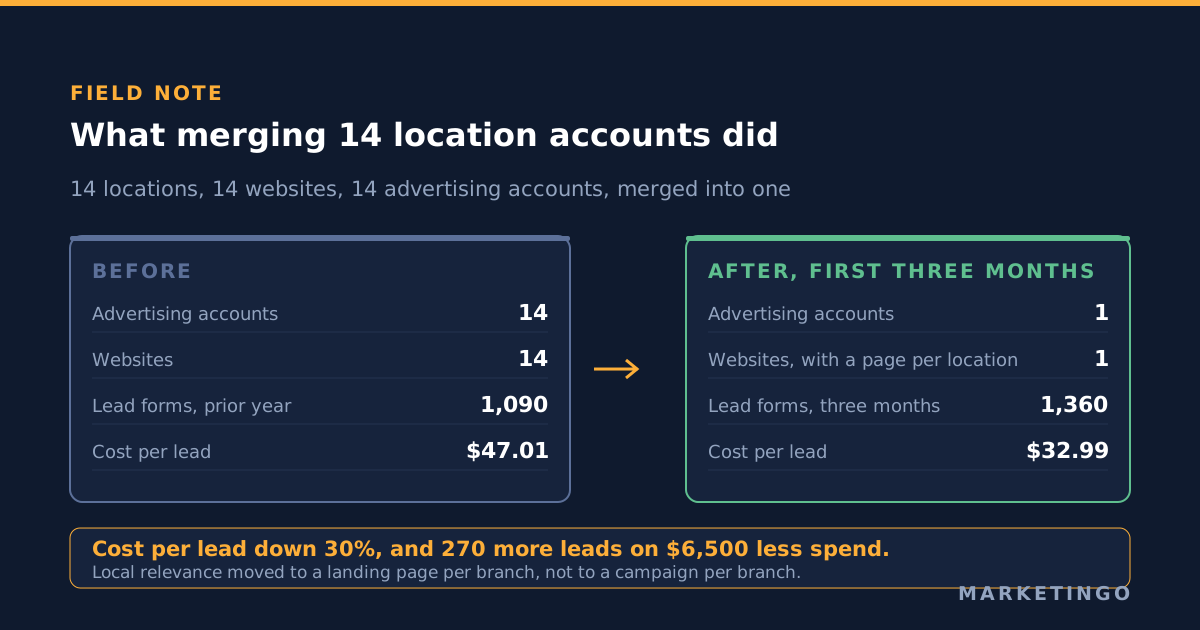
A home improvement company we run paid search for sells an installed building product through 14 regional locations across the United States. Each location arrived with its own website and its own Google Ads account, which meant 14 budgets that could not be compared, 14 conversion tracking setups of varying quality, and no way to answer the only question that matters at that size: which markets are buying leads cheaply and which are not.
We merged the 14 advertising accounts into one, consolidated the 14 websites into a single site with a location page for each branch, and brought the locations back online one at a time to keep the risk contained. Lead form submissions went from 1,090 in the year before the engagement to 1,360 in the first three months after, cost per lead fell from $47.01 to $32.99, and the account produced 270 more leads while spending $6,500 less. Those figures are public, and the full before-and-after sits in the multi-location home improvement case study.
The interesting part is not the consolidation. It is what happened eighteen months later when we tested the opposite.
The decision that sets up a multi-location account
The question is not where to advertise. It is which unit of geography gets its own campaign.
Two structures are available. Either each location gets a campaign, or a smaller number of campaigns each cover a group of markets, with geography handled by the location targeting settings inside the campaign and read back through the geographic performance reports. Both reach the same people. They behave completely differently once bidding and budgets get involved.
Almost every multi-location advertiser picks the first one, because it mirrors the organisation. Each branch manager can see a campaign with their city's name on it, and a budget nobody else can touch. It feels like control. What it actually produces is a set of campaigns too small to learn from, each one holding a few conversions a month, with the budget frozen in place by politics rather than by performance.
What consolidation changed, mechanically
Three things, and only the third one is about geography.
One conversion history instead of 14. Automated bidding sets a price per auction from conversion data, and Smart Bidding does that well when the data is pooled and badly when it is sliced thin. Fourteen accounts meant fourteen separate learning problems, each with a fraction of the evidence.
Budget that can move. In one account, a weekly reallocation away from expensive markets and into cheap ones is a routine edit. Across 14 accounts it is a negotiation. In the same account more recently, switching off the most expensive markets and moving that money to cheaper ones was one of the levers that took cost per lead back under $40 against a $44 baseline, after it had drifted to $63.
Local relevance kept at the page, not at the campaign. A location page per branch, with that branch's address, service area and proof, does the work people expect campaign-level separation to do. The ad and the keyword do not need to be local for the lead to be local. The landing page does. We write more about the structural side of this in the Google Ads account structure guide.
We tested the opposite, and it produced the five worst performers in the account
Eighteen months in, the account drifted back toward splitting. Five new campaigns were launched across one spring, carved out either by city or by a narrow set of high-intent keywords in a single metro. This is the test most advertisers never get to see, because they split once and never run the comparison.
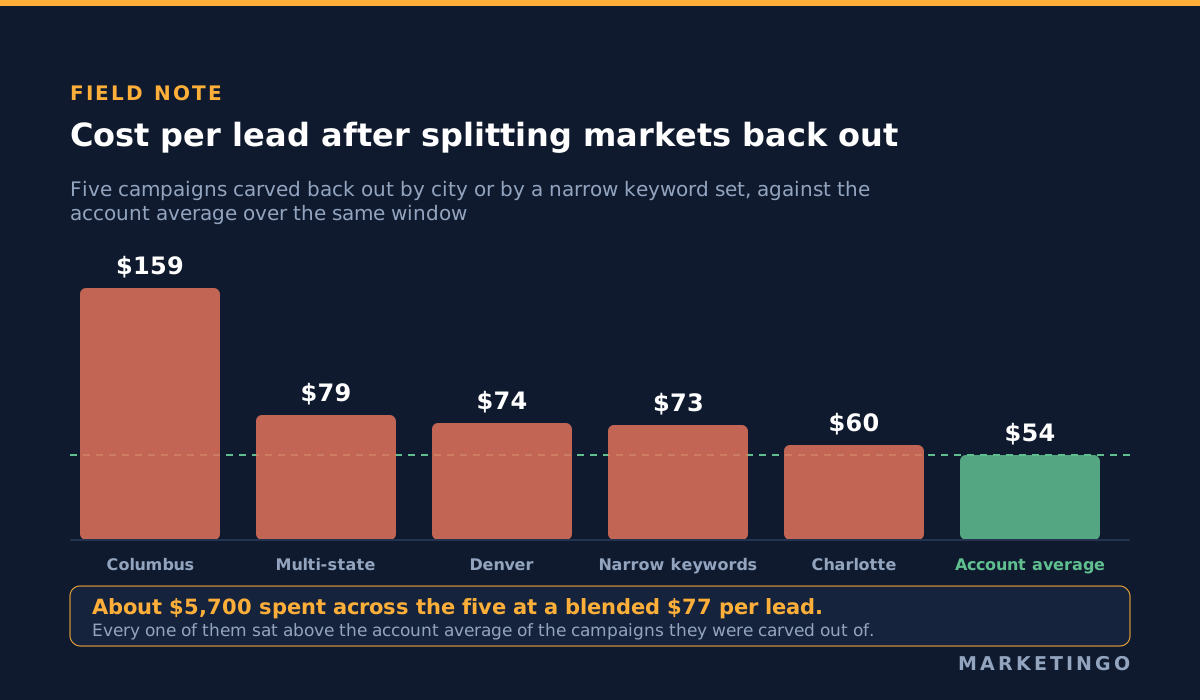
About $5,700 went through those five campaigns at a blended cost per lead near $77, against an account average of $54 in the same window. Columbus ran at $159 across seven leads in total. A broad multi-state campaign landed at $79, a keyword-narrowed campaign in one large metro at $73, Denver at $74 and Charlotte at $60. Every one of the five sat above the account average. None of them beat the consolidated campaign that already covered its territory.
The reason is arithmetic, not strategy. A city campaign producing three or four leads a month will never give a target cost per action bid strategy enough signal to price an auction, so it either overbids into the expensive tail of the keyword or sits below the auctions worth winning. Add the fixed overhead of each campaign holding its own budget, and a split account spends more per lead to learn less.
The waste sits below the metro, not at it
When the city campaigns were paused and their markets absorbed into a regional campaign, those absorbed metros ran at $34 to $40 per lead. The anchor city of that same campaign, the one everybody assumed was carrying it, ran at $55. Consolidation did not dilute the good markets. It exposed them.
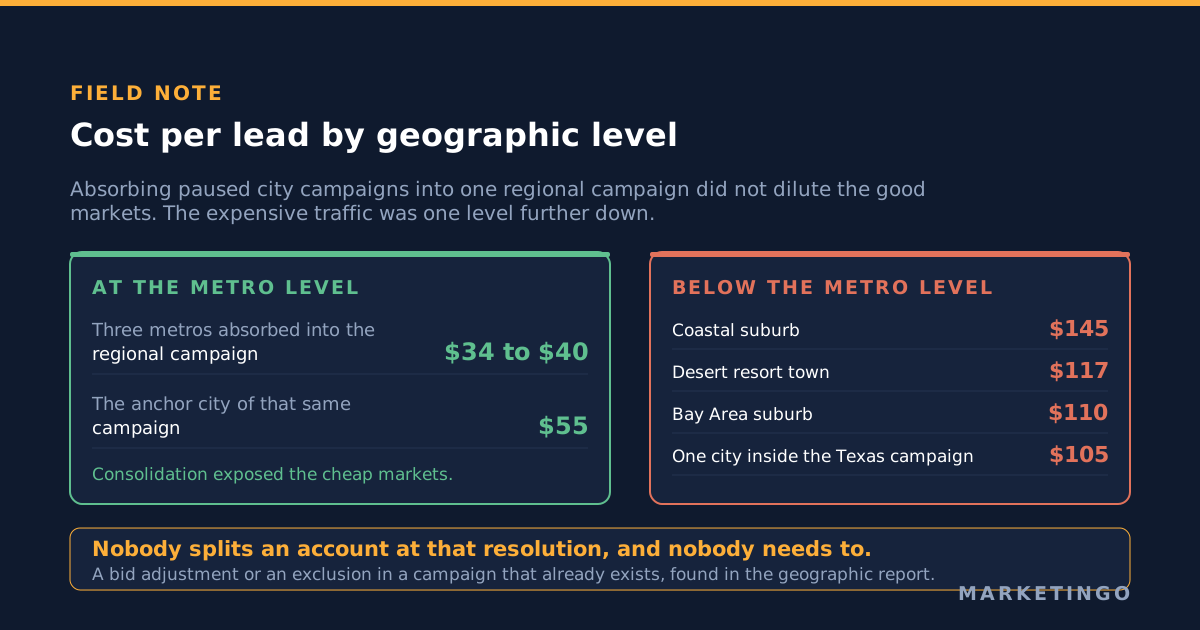
The expensive traffic was a level further down. Inside the campaigns, individual suburbs and secondary towns were buying leads at $145, $117 and $110, and one city inside the Texas campaign at $105. Nobody splits an account at that resolution, and nobody needs to. Those pockets are a bid adjustment or an exclusion in a campaign that already exists, found in the geographic report in about ten minutes a month.
This is the part that changes how you read a multi-location account. Splitting by city answers a question about reporting. The cost sits in geography that is smaller than any campaign you would ever create, and the only way to see it is to look underneath the campaigns you have.
The three location targeting settings that cost multi-location advertisers money
Three settings inside Google Ads location targeting do most of the damage in accounts like this one, and all three are defaults nobody revisited.
The first is presence or interest, which is the default and serves your ads to people outside the area who merely searched with its name. For a business that installs something in a building, that traffic converts into enquiries you cannot serve. Switch it to presence.
The second is choosing a radius around a location where a city or a set of postal codes would be sharper. Radius targeting is the right tool for a single showroom with a genuine drive time, and the wrong one for 14 branches whose territories overlap, because overlapping circles put your own campaigns into the same auction and inflate what you pay for a click. Where the territory follows administrative boundaries, target the areas within a country directly rather than drawing circles around addresses.
The third is leaving location bid adjustments at zero everywhere. In a consolidated account these adjustments are the entire mechanism for controlling cost by market: you keep one campaign and one pooled conversion history, and you pay less in the markets that convert expensively. An account that splits markets into separate campaigns in order to control spend is using the heavy tool when the light one was sitting unused.
The mistakes to avoid are not exotic. They are the settings page as it shipped, read once during setup and never opened again.
The method, in the order we run it
- Count conversions per market over the last 12 months before touching the structure. This is the input to every decision below, and almost nobody has it on hand.
- Set the campaign unit by lead volume, not by the org chart. A market that cannot produce roughly 30 conversions a month on its own does not get its own campaign; it joins a regional one.
- Consolidate into one account, with one primary conversion action. A phone call and a form fill both matter, but one of them leads bidding.
- Build one landing page per location on one site, and keep the local proof on the page.
- Use presence targeting rather than presence or interest, unless you genuinely sell to people planning a move into the area. The difference is in the advanced location options, and the default costs multi-location advertisers real money by serving outside the service area. The targeting mechanics are documented in Google's guide to targeting geographic locations.
- Relaunch locations one at a time rather than all at once, so a bad market is a contained problem instead of an account-wide one.
- Read the geographic report monthly at the level below the metro. Bid down or exclude anything above your cost per lead ceiling, and set that ceiling from your own contract values rather than from a benchmark. The lead generation return on investment calculator gives you the number, and the cost per lead article covers how to read it by service line.
- Before blaming structure or budget for a decline, check impression share lost to rank against impression share lost to budget. In this account the second was close to zero while the first ran at 71% to 82%, which pointed at auction prices and landing pages rather than at anything the structure could fix.
When this does not apply
Consolidation is not a universal answer, and we have seen it sold as one.
It does not apply to franchise networks where each franchisee funds their own spend and owns their own legal entity. One account with pooled budget is a commercial arrangement nobody has agreed to, and the reporting will not survive the first month.
It does not apply across countries, currencies or languages, where the campaign has to change anyway.
It does not apply to a market big enough to carry itself. If one metro produces well over 30 conversions a month, giving it a campaign costs nothing in signal and buys you real budget control.
And it does not apply when the right split is not geography at all. Businesses with service lines of very different value should split by service line and set a separate cost per lead ceiling for each, because a $900 job and a $40,000 job cannot share a target. Geography is often the least useful way to cut a multi-location account.
One more caution from the same account. When leads fell, the first explanation offered was the budget cut, and an 18-month read of the data did not support it: cost per lead rose 21% in January, the highest spend month in the period, before any cut happened, and when spend was restored in the summer cost per lead got worse rather than better. Campaigns whose budgets had not moved in 19 months lost 36% to 38% of their leads anyway. Structure and budget are the two things everyone reaches for first, and they are frequently not the cause.
Where to start if you run more than one location
Pull your geographic report for the last 12 months, grouped below the metro level, and sort by cost per lead. If the worst pockets are three times your average, that is this month's work and it needs no restructuring at all. If your markets each hold a handful of conversions a month in their own campaign, the structure is the work.
We do this read as part of a free advertising account audit, and the mechanics of how we run the channel are on the Google Ads management page. If you sell through branches or dealers, the home improvement and multi-location industry page covers how we approach the vertical, and the Google Ads audit checklist is the version you can run yourself.