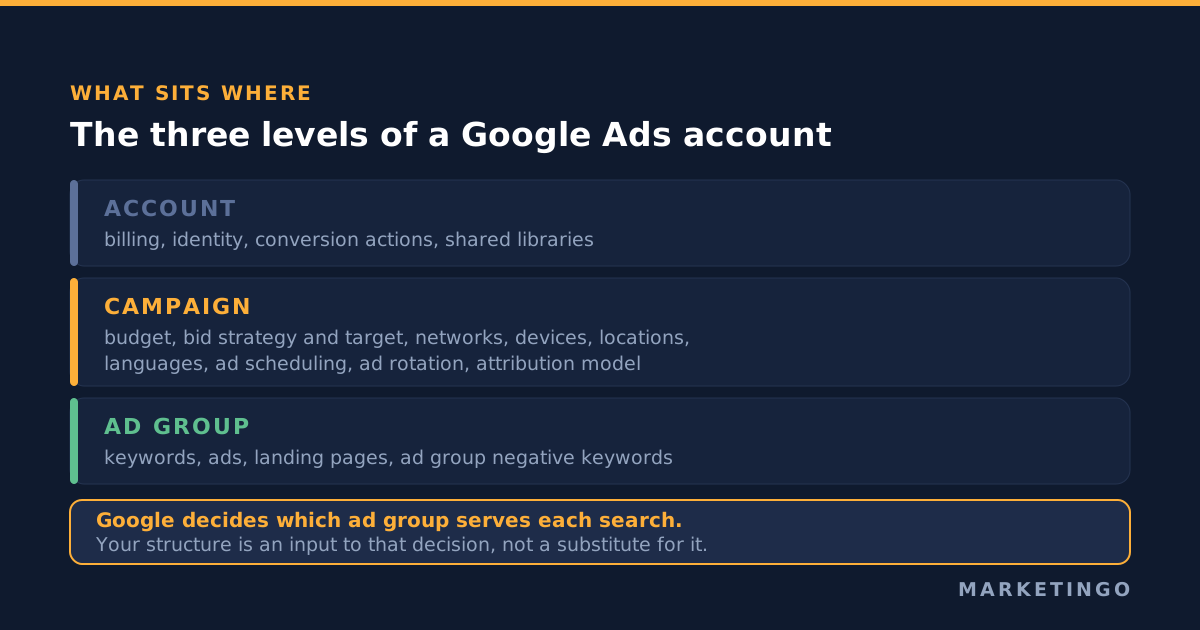
Most structure advice in circulation was written to solve a problem that has been taken off the table. For roughly a decade the reason to build an account a particular way was control over which keyword matched which search and therefore which ad appeared. Google now publishes the procedure it follows to answer that question itself, in four ordered steps, and your containers are an input to that procedure rather than a substitute for it.
That does not make structure unimportant. It moves what structure is for. Every setting that decides how much money is at risk, where it is spent, what the auction is being asked to optimize and what you will be able to see afterwards still lives in a container you choose. The argument about keyword grouping was always the smaller half of the job.
What Google Ads account structure means, and the one thing it no longer does
Google Ads account structure is the arrangement of three levels: the account, which holds billing and identity, campaigns, which hold budget, bid strategy, geography and networks, and ad groups, which hold keywords, ads and landing pages. Structure sets where money and settings apply. It no longer decides which ad group serves a given search, because Google decides that itself.
That last sentence is the one worth checking rather than accepting, so the next two sections do the checking.
The three levels, and what each one actually holds
Google's own description of the hierarchy is short. The account "is associated with a unique email address, password, and billing information". Campaigns "have their own budget and settings that determine where your ads appear". Ad groups "contain a set of similar ads and keywords".
The useful version of that is a map of which decision sits at which level, because a decision you need to make separately for two sets of traffic is the only honest reason to create a second container.
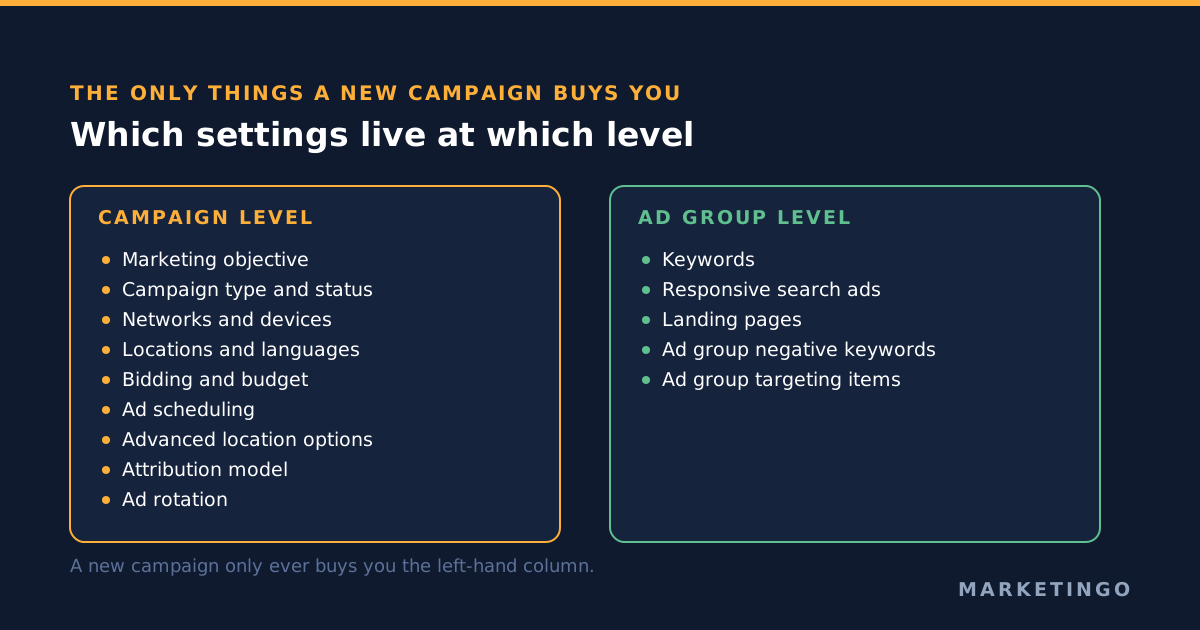
| Level | What it holds | What it means in practice |
|---|---|---|
| Account | billing, identity, conversion actions, shared libraries, account level negative keyword lists | one commercial relationship with Google, one measurement definition |
| Campaign | marketing objective, campaign type, status, networks, devices, locations and languages, bidding and budget, ad scheduling, advanced location options, attribution model, ad rotation, conversion tracking selection, audience signals for Performance Max | the money and the market |
| Ad group | keywords, ads, landing pages, ad group level negative keywords, ad group targeting items | the message and the match |
The campaign settings in that middle row are Google's own list from its campaign settings documentation, not a paraphrase. Read it as a checklist of the only things a new campaign can buy you. If the answer to "what would this new campaign let me set differently" is nothing on that list, the new campaign is splitting data rather than adding control.
Google decides which ad group serves, in four steps
This is the part that changes the rest. When several ad groups or asset groups in the same account are eligible for the same search, Google applies four tiers in order.
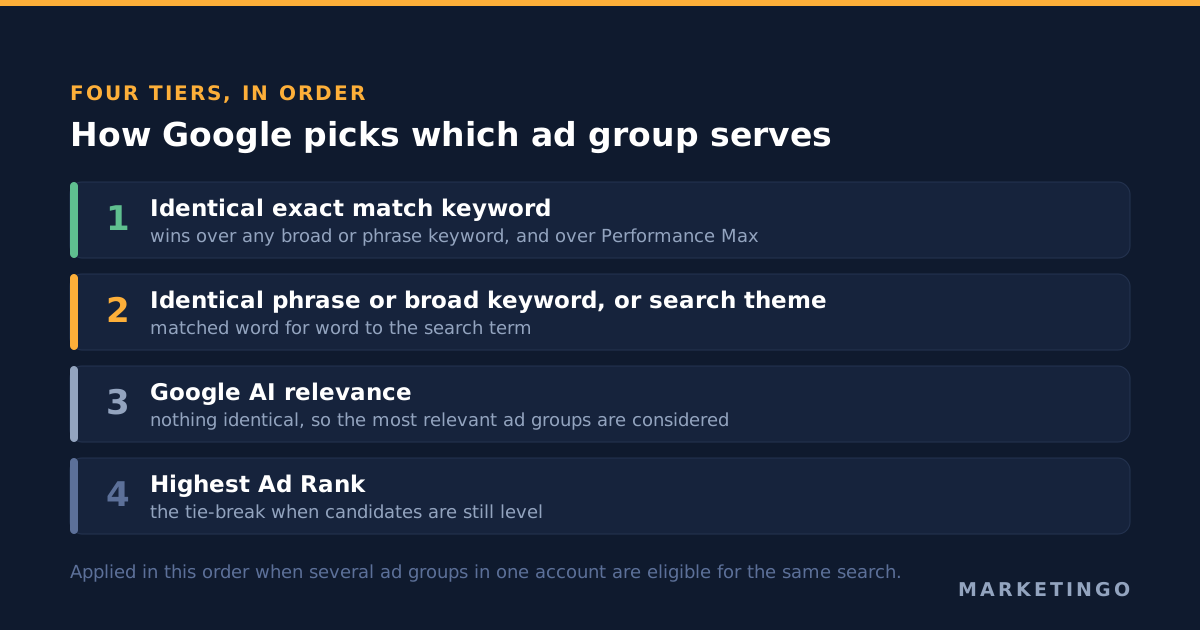
- An identical exact match keyword wins. Google states that the exact keyword is "prioritized over any other broad or phrase keyword or a Performance Max campaign". Spelling corrections count as identical. Plurals and synonyms do not.
- An identical phrase or broad match keyword, or an identical search theme, comes next. Search themes in Performance Max "behave like any phrase or broad match keyword in Search campaigns".
- If nothing is identical, relevance decides. Google says that in this case "only the most relevant ad and asset groups are considered", judged from the meaning of the search term, the ad group's keywords and its landing pages.
- If candidates still tie, Ad Rank decides. The ad group "that generates the ad with the highest Ad Rank will be prioritized".
Dynamic Search Ads, ad groups running without keywords and Performance Max asset groups without search themes are "selected based on the highest Ad Rank in comparison with other ads in the account". Google also lists the cases where a preferred ad group loses anyway: low search volume on its keyword, every ad or landing page disapproved, targeting that excludes the user, or a campaign held back by budget.
Read tier three again. The moment a search is not word for word identical to one of your keywords, your grouping stops being the deciding factor and Google's reading of relevance takes over. In a mature account most impressions arrive on terms that are not identical to anything in the keyword list, which is why structure feels less decisive than it used to.
What single keyword ad groups still do, and what they stopped doing
The single keyword ad group, one keyword isolated so that it owns its own ad and landing page, is the clearest case of structure built for control. The common claim is that it guarantees which ad serves for that term. Checked against the prioritization rules, it half holds.
For a search that is word for word the keyword, tier one does guarantee it, and spelling corrections are included. That is a real property and it is worth having on a handful of terms where the ad text has to be exact, usually competitor defense, a branded term, or a product name where the wrong headline costs you the click.
For everything else it has stopped working as control. Close variants mean an exact match keyword is eligible for searches that are not identical to it, and the instant that happens the search falls to tier three, where relevance across all your ad groups is assessed and isolation buys nothing. Meanwhile the structure has a cost that scales: every split divides conversion history, and target based bidding gets worse as the data per unit gets thinner. Google's advice in the other direction is to "create campaigns with single objectives, and use accurate conversion data".
So the honest position is narrow rather than absolute. Single keyword ad groups are a tool for a small number of terms that need exact ad text, not a structural principle for an account.
Quality Score, ad relevance, and what structure can actually do for them
The oldest structural argument is that tight ad groups produce a higher Quality Score, which lowers the average cost per click, the column Google labels Avg. CPC. It is the most repeated claim in digital marketing about account structure, and it is half true. Two things in Google's own documentation are why.
The first is what the number is. Google describes Quality Score as "a diagnostic tool meant to give you a sense of how well your ad quality compares to other advertisers", reported at keyword level on a scale from 1 to 10, and then says flatly that "Quality Score is not an input in the ad auction." Managing an account to raise the reported figure is managing a dashboard rather than the auction.
The second is the breakdown. The score has three components: expected clickthrough rate, ad relevance, and landing page experience. Each is graded as above average, average or below average against other advertisers whose ads showed for the same search over the previous 90 days. Of the three, only ad relevance, the closeness of the match between the search intent and your ad copy, moves when you regroup keywords. Expected clickthrough rate is a property of your offer and your ad creative. Landing page experience is a property of the page.
So the best practice that survives here is narrow and testable. Filter the keyword table by ad relevance below average and look at what those keywords have in common. If one ad group holds terms that no single effective ad can serve honestly, splitting it is justified, and the diagnostic will say so afterwards. If ad relevance already reads average or above across the account, further splitting will not improve it, and the cost per click you were hoping to reduce is being set by expected clickthrough rate and competition instead. Match type belongs to the same conversation: a broad match keyword sitting inside a tightly themed ad group will pull searches the ad text was never written for, and that shows up in ad relevance before it shows up in cost.
What structure controls completely
Having taken something away, here is the list that is entirely yours. Nothing in Google's prioritization logic touches any of it.
- How much money is at risk. Budget is a campaign setting. Two product lines in one campaign share one budget and compete for it.
- What the auction is told to optimize. Bid strategy and its target are campaign settings. A campaign is the smallest unit that can carry its own target cost per acquisition or target return on ad spend. If two offers need different targets, they need different campaigns, and this is the most common legitimate reason to split. Our guide to Google Ads bid strategies covers which target belongs where.
- Where the ads run. Networks, devices, locations and languages are campaign settings. A campaign is the smallest unit that can be geographically separate, which is why country or region splits are structural rather than optional.
- When they run. Ad scheduling sits in campaign settings.
- What gets excluded. Negative keywords apply at campaign and ad group level, and shared lists apply across campaigns. The negative keyword system is where structure still does real match control.
- What you can see. Reporting granularity follows the containers. A metric you cannot segment is a metric you cannot act on, and no amount of analysis recovers a split you did not make.
Four of those six are money or market decisions. That is the shape of the modern answer: structure is a budgeting and measurement instrument that happens to also hold keywords.
The four decisions that justify a new campaign
A rule that produces the same answer twice from the same facts is worth more than a template. Create a new campaign when, and only when, one of these four needs to be set separately.
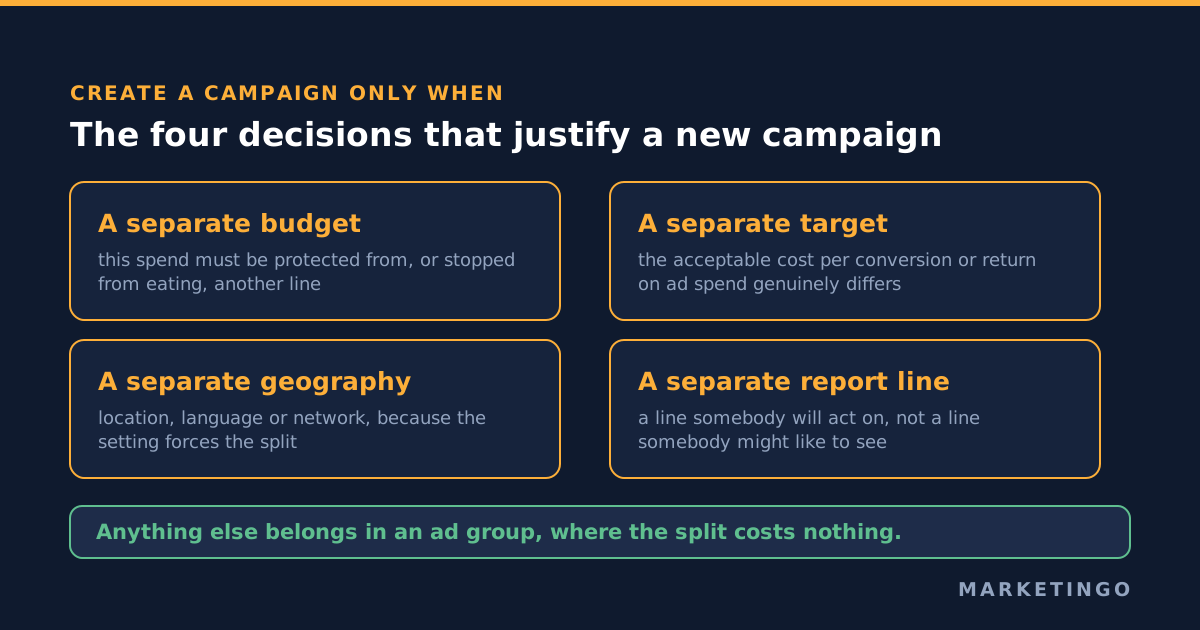
- A separate budget. The traffic must be protected from, or prevented from eating, another line of spend.
- A separate target. The acceptable cost per conversion or return on ad spend genuinely differs, usually because margin or deal size differs.
- A separate geography, language or network. A campaign setting forces the split whether you like it or not.
- A separate line in reporting that somebody will act on. Not a line somebody might like to look at. A line that will change a decision.
Everything else belongs in an ad group, where splits cost nothing but a little admin because ad groups inside a campaign share its budget and its bidding.
Two patterns fall out of this that are worth stating plainly. Branded search almost always earns its own campaign, because its acceptable cost per conversion is nothing like the non branded number and mixing them hides both. And a second channel is never an ad group, because it is a different campaign type entirely. In one business to business software account we run, adding Microsoft Ads as a second high intent channel produced more than 128 trials in its own right, which is visible precisely because it was never blended into the Google reporting line. The document redaction software case study has the full sequence.
How many ad groups, how many keywords
There is a number everyone repeats here, usually somewhere between seven and twenty keywords per ad group, and Google does not publish it. Its guidance on building a keyword list says to "group your keywords and ads into ad groups based on your products, services, or other categories" and gives no count. Its page on organizing an account with ad groups is more direct: "there isn't one correct way to organize your account." It asks for "a narrow theme" per ad group and keywords "closely linked to your ad text", and warns against the opposite extreme of putting everything in one ad group, because a search may then trigger an ad for an unrelated product.
Since no number exists, use three tests instead.
Can one responsive search ad be honestly good for every keyword in this ad group? If a headline that suits half the keywords misleads on the other half, the group is too broad. This is the only test Google's own relevance language supports, and it maps onto tier three of the prioritization rules.
Does the landing page answer every keyword in this ad group? Google names landing pages as an input to its relevance judgment, so a group spanning two pages is a group that cannot win tier three cleanly.
Will this split still have enough conversions to be read? An ad group that produces one conversion a month is not a reporting unit, it is noise. Conversion volume is the brake on splitting, and it is the reason modern accounts look consolidated compared with 2018.
Apply those three and the count lands where it lands, usually between five and thirty closely related terms, and you will never need the folklore number again.
Two worked structures
Abstract rules are easier to trust once they have produced something, so here are the two Google Ads structure shapes we build most often.
A business to business lead generation account. Campaign setup starts with branded search alone, on its own small daily budget, carrying a target cost per acquisition far below the non branded number. Then one non branded search campaign per service line that has a genuinely different acceptable cost per lead, each with its own target CPA, and separate ad groups inside it per theme rather than per keyword. Then one campaign per additional country, because locations are a campaign setting and nothing else will separate them. Microsoft Ads runs as its own account alongside, never as an ad group. Keyword research in Keyword Planner tells you which themes carry enough demand to deserve their own groups, and anything too thin to measure becomes a keyword inside an existing group instead.
A retail account. The organizing unit is the product category, not the keyword. Create ad groups and listing groups that separate products with different margins, because margin decides the target ROAS and one target across a mixed catalog quietly subsidizes the thin end. The test is the one the four decisions already gave you: two products or services belong apart when they need different targets, not when they look different in the shop. Branded search again sits alone. Performance Max carries the catalog, segmented by margin band, and shopping campaign performance is read per product group rather than per campaign. The structure your account ends up with resembles your profit and loss statement more than it resembles your website structure, which is a search engine optimization concern rather than a paid search one.
Two things these shapes have in common are worth naming. Neither contains a campaign producing fewer than a handful of conversions a month, and neither uses an ad group to express something a campaign setting controls. A well-structured account is largely an exercise in refusing to create containers. Ad structure inside each group follows from the same test: if one responsive search ad cannot serve every keyword in the group, the group is the problem rather than the ad. And importing accurate conversions, whether from Google Analytics or from your customer relationship system, does more for campaign performance than any amount of regrouping.
The limits that are real, and the ones that are folklore
Google publishes its account limits, and they are far larger than the numbers people manage against. These are the ones that matter for structure, taken from that page.
| Limit | Published value |
|---|---|
| Campaigns per account, active and paused | 10,000 |
| Ad groups per campaign | 20,000, and 100 for Local and App campaigns |
| Performance Max campaigns per account | 100 |
| Ad group targeting items per ad group | 20,000 |
| Ad group targeting items per account | 5 million |
| Enabled responsive search ads per ad group | 3 |
| Active text and non image ads per ad group | 50 |
| Negative keywords per campaign | 10,000 |
| Keywords per negative keyword list | 5,000 |
| Negative keyword lists | 20 |
| Location targets per campaign | 10,500, of which 500 can be proximity targets |
| Shared budgets per account | 11,000 |
The practical reading is that no normal account is anywhere near a structural ceiling. The constraint on how many campaigns you should run is conversion volume per campaign, not a Google limit. The one line in that table that does bite in real accounts is three enabled responsive search ads per ad group, which caps how much ad testing a single ad group can hold and is occasionally a genuine reason to split.
Worth noting what is not on the list: Google publishes no limit on ad groups per account or keywords per ad group, and no recommended figure for either.
Where Performance Max changes the question
Performance Max does not have ad groups or keywords. It has asset groups, and for retail accounts listing groups inside them, with a published ceiling of 1,000 listing groups per asset group. Audience signals are a campaign setting. So the structural decisions move: instead of grouping keywords you are grouping products and assets, and the segmentation that matters is the one that separates things with different margins or different targets.
Two interactions with the rest of the account are worth holding in mind. A Performance Max campaign loses tier one to an identical exact match keyword in a Search campaign, so a well kept branded exact match keyword still defends branded traffic. And Performance Max cannot use portfolio bid strategies, which removes one of the tools for pooling data across campaigns.
On the retail side, the structure question is almost always product segmentation rather than keyword grouping. In one large catalog account of roughly 40,000 products, the finding that changed the account was that 37% of budget was going to products that had never produced revenue, and cutting that out while scaling spend moved blended return on ad spend from 7.86 to about 8.5. That is in the large catalog store case study, and none of it was reachable until the catalog was split into groups that could carry separate targets. The Performance Max article covers what the campaign type optimizes and what you still control.
Naming, and why it is an operations decision rather than a taxonomy
Naming is the cheapest part of structure and the part that decays fastest. The only requirement is that a name tells you, without opening it, what the campaign would do differently from its neighbours. Since the four decisions above are what differentiate campaigns, name after those: market, campaign type, intent tier. Something on the pattern of US | Search | Non-brand | Compliance reads instantly in a filtered list and sorts predictably.
Two habits make this hold up. Put the fields that you filter on earliest in the name, because the campaign table truncates. And never encode anything that changes, such as a budget figure, a quarter or a target, because a name that lies is worse than a name that is vague.
How to restructure an account without wiping its history
Google states the cost of restructuring in unusually plain words: "Reorganizing your account after you've created several campaigns and ad groups wipes out all the valuable data", and warns that this may affect performance. That is the risk the sequence below is designed around.
- Fix measurement first, before anything moves. A restructure built on conversion actions that count the wrong events relocates the problem. Repair what counts as a conversion and feed real values back where they exist. Our conversion tracking guide is the order to do this in, and the attribution models article covers what the reported numbers can and cannot tell you.
- Write down the four decisions for the account as it should be. Budgets, targets, geographies, reporting lines. This is the target structure, and it should fit on one page. If it does not, it is too complicated to run.
- Compare it with what exists and list only the differences. Most audits produce a handful of real changes and a long tail of cosmetic ones. The cosmetic ones are not worth the data loss. A structured way through this is in the Google Ads audit checklist.
- Move in one direction at a time, and never rebuild the whole account in a week. Consolidate first where data is too thin to bid on, then split only where a target or a geography genuinely differs.
- Use shared budgets and portfolio bid strategies to pool what you just split. A portfolio bid strategy is, in Google's words, a strategy that "groups together multiple campaigns, ad groups, and keywords". A shared budget lets "underutilized budgets to automatically reallocate to budget-capped campaigns", and Google cites internal data showing around 13% more conversions for advertisers using shared budgets together with portfolio bid strategies on Search campaigns. These two tools are how you keep separate reporting without starving separate budgets.
- Leave the new structure alone long enough to be judged. Target based bidding needs conversion cycles to recalibrate, so a restructure assessed after one week is an assessment of the learning period rather than of the structure.
When this does not apply
There are accounts where the right structural decision is to change nothing.
An account spending a few thousand a month with one offer and one country does not have four decisions to separate, and consolidating it further is the only move available. An account in the middle of a measurement repair should not be restructured until that lands, because you cannot read the result. An account whose problem is creative or landing pages will not be helped by containers at all, and restructuring is an expensive way to avoid the harder work. And a seasonal account two weeks before its peak should wait, because the data loss lands exactly when the bidding needs history.
The general version: structure is worth changing when a decision you need to make is impossible to make in the current arrangement. If you can already set the budgets, targets, geographies and reports you need, the structure is fine and the problem is somewhere else.
What this looks like when it is run properly
Structure work is rarely the first change we make in an account we take over, because it is downstream of measurement. The order that holds up is to repair what counts as a conversion, then arrange the account so each real target gets its own container, then let bidding optimize against something worth having.
The size of that difference is not marginal. In the business to business software account mentioned above, rebuilding the measurement and then the account arrangement around separate campaigns for separate intent took trial signups from roughly 28 a week to about 84, while cost per trial fell from $64 to about $27 and the core non branded campaign settled near $23 a trial across more than 700 trials. The detail is in the document redaction software case study. On the retail side, the large catalog store case study is the same argument applied to products rather than keywords.
If you want to know which of the four decisions your current structure cannot express, that is what a free ad audit is for: we read the campaign settings column, the conversion volume per campaign, the shared budget and portfolio arrangement, and the search terms your ad groups are actually catching, then tell you which splits are earning their keep and which are only thinning your data. Ongoing work sits in our Google Ads management service, and for business to business accounts the high-ticket business to business pages set out how the measurement side is handled, while ecommerce and direct to consumer covers the catalog side.
Before you commit to a structure, it is worth knowing what each separated line has to return. The lead generation return on investment calculator gives you the cost per lead a campaign can afford on your own deal size and close rate, and the ecommerce return on ad spend calculator does the same for margin, which is the number that tells you whether two product groups really need two targets.