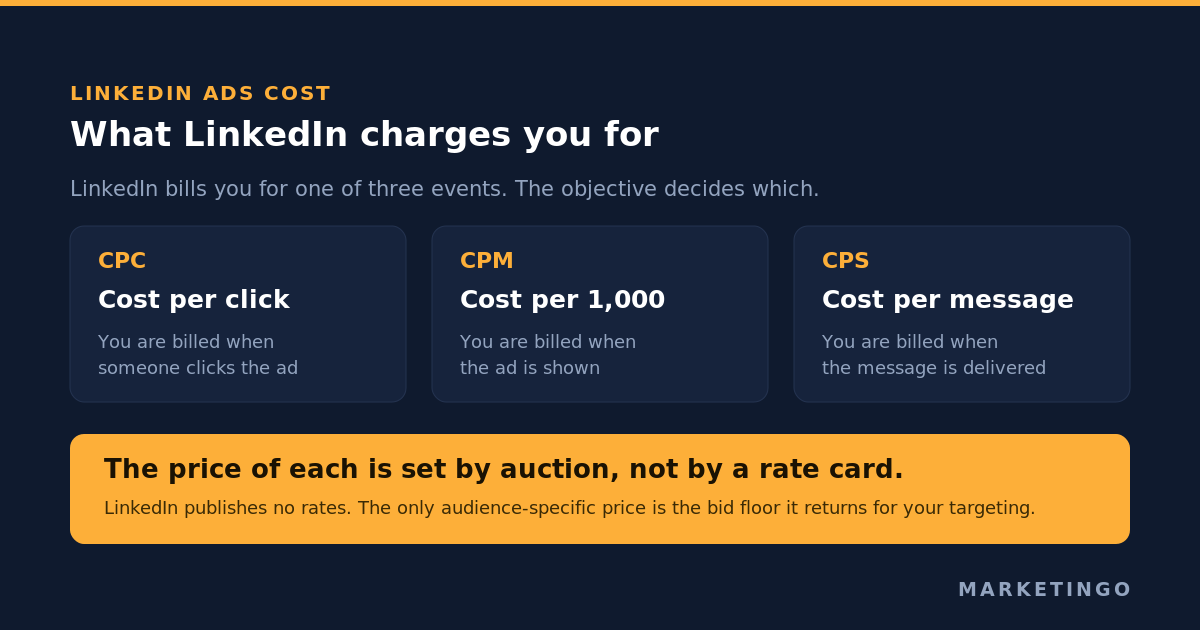
LinkedIn charges you for one of three things: a click, a thousand impressions, or a message delivered. Which one you are billed for is decided by the campaign objective you pick, and the price of each is decided by an auction against every other advertiser chasing the same people. There is no rate card. Open LinkedIn's own advertising pricing page and you will find an explanation of the auction, a description of objective-based pricing, and not a single number.
That absence is the reason this question is so badly served. The public answers fill the gap with averages, and those averages contradict each other by multiples. What you can get, and what almost nobody tells you to ask for, is the price LinkedIn will quote for your specific audience: a minimum bid, a suggested bid range and a daily budget floor, all returned per targeting definition. This article covers what LinkedIn documents, what the circulating figures are worth, and how to work back from your own economics to a budget that holds up.
What LinkedIn actually publishes about advertising cost
Three mechanics, all stated on LinkedIn's pricing page and worth reading literally.
You place a bid, and the auction settles it. Your bid competes with other advertisers who want to reach the same people. LinkedIn's wording is that the cost required to win depends on the bid and on "the desirability of your target audience". Desirability is the operative word. A senior job title at a large company in a high-value industry is contested by hundreds of advertisers; a mid-level role in an unfashionable sector is not, and the price difference is enormous.
Pricing is objective-based. The billable event changes with the objective you choose. Pick Website Visits and you are charged when someone clicks through. Pick Brand Awareness and you are charged for impressions. LinkedIn publishes a bidding strategy and pricing chart mapping each objective and optimization goal to its chargeable event. This matters more than it looks, and section four explains why.
The platform reserves the right to change the terms. The same page states that LinkedIn periodically runs tests through its platform and third-party properties such as the LinkedIn Audience Network, and that these modifications may affect pricing or performance. In plain terms, the auction you bought into last quarter is not guaranteed to be the auction you are in now.
What LinkedIn does not publish is any figure at all. No average, no range, no benchmark by industry. Every number you have read about LinkedIn advertising costs came from somebody else's account data or somebody else's estimate.
The published "average LinkedIn CPC" does not survive a check
This is the claim worth interrogating, because it is repeated in almost every article on the subject and it falls apart on contact with the sources.
Take the two most visible answers. Zapier's LinkedIn advertising costs guide, updated 15 January 2026 and ranking second for this query, puts the platform at $2 to $3 per click, $5 to $8 per thousand impressions, and $0.26 to $0.50 per message sent. Benchmark pages published in the same year put the cost per click at $5.50 to $8.00 and the cost per thousand impressions at $30 to $50. Same platform, same year, roughly three times apart on clicks and five times apart on impressions.
At least one of those is wrong, and a reader has no way to tell which. Neither set discloses what would make it checkable: how many accounts, how much spend, over what date range, with what mix of objectives and countries. Compare that with the Google Ads side of the house, where WordStream's benchmark names a sample of 13,474 search campaigns and the twelve months it covers, which is why the cost per lead article can use it and say plainly where it breaks. Nothing equivalent is published for LinkedIn.
Zapier is at least candid about the problem, writing that LinkedIn "isn't winning any prizes for transparency" and does not disclose pricing ranges until you have a campaign built and a card on file. That is an accurate description of the situation, and it is also a reason to treat the numbers on the same page as estimates rather than measurements.
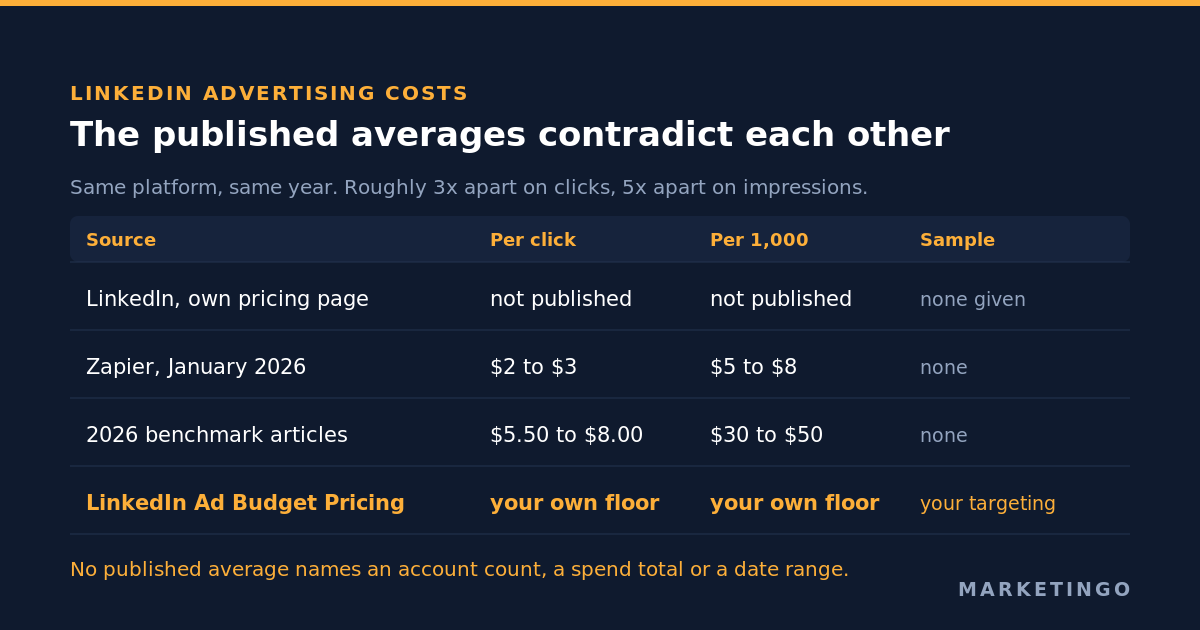
| Source | Cost per click | Cost per 1,000 impressions | Sample disclosed |
|---|---|---|---|
| LinkedIn, pricing page | not published | not published | n/a, no figures given |
| Zapier, January 2026 | $2 to $3 | $5 to $8 | none |
| 2026 benchmark articles | $5.50 to $8.00 | $30 to $50 | none |
| LinkedIn Ad Budget Pricing API | returns your floor and suggested bid | returns your floor and suggested bid | your exact targeting |
The practical conclusion is not that the figures are useless. It is that they are the wrong tool. An average drawn from an undisclosed sample cannot tell you whether $9 a click is expensive for the audience you are buying, and the audience is the whole story on this platform.
The one price LinkedIn will quote: your own bid floor
LinkedIn does state a price, per audience, on request. It sits in the Ad Budget Pricing API, documented publicly by Microsoft, and it is also what drives the suggested bid you see in Campaign Manager. Give it your targeting, your bid type and your objective, and it returns four things that matter:
bidLimits.min, the minimum bid for that audiencesuggestedBid.default,.minand.max, the range LinkedIn thinks will deliverdailyBudgetLimits.minand.default, the floor and the recommended starting spend- All of it recalculated when you change
matchTypebetweenEXACTandAUDIENCE_EXPANDED
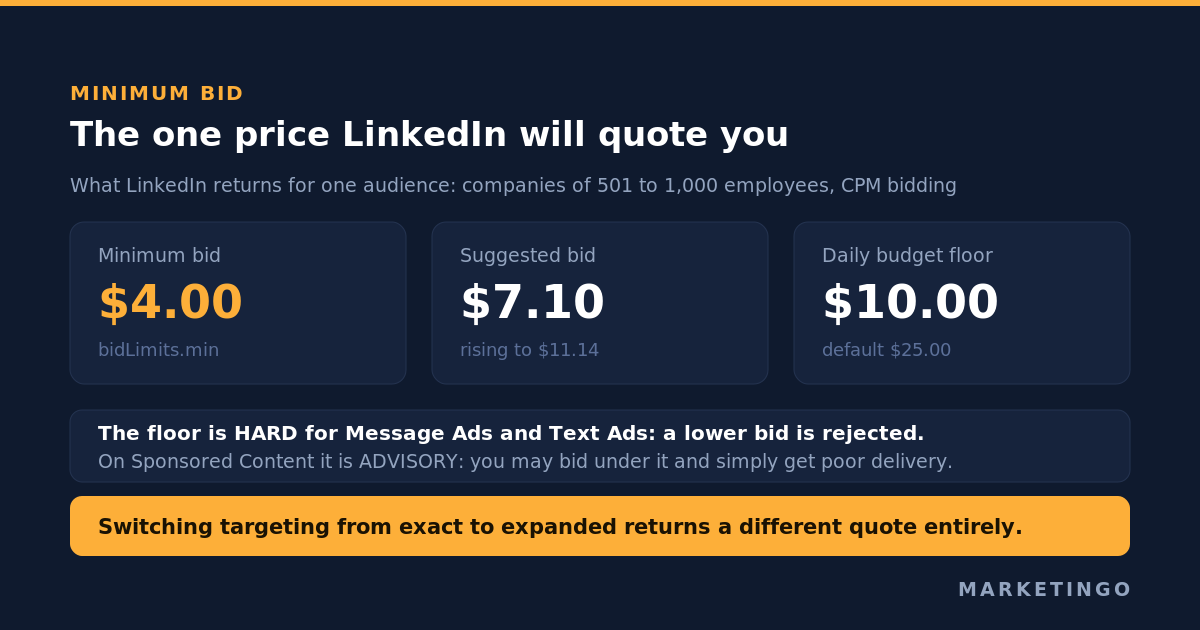
The documented example is instructive. For an audience of members at companies with 501 to 1,000 employees, bidding on a cost per thousand impressions basis, the response carries a minimum bid of $4.00, a suggested bid of $7.10 rising to $11.14, a daily budget minimum of $10.00 and a default daily budget of $25.00. That is a real quote for a real audience, and it is nothing like a single platform average.
Two details in that documentation are worth more than the numbers.
The floor is hard for some formats and advisory for others. Microsoft's schema describes bidLimits.min as the amount below which "campaign delivery may be poor for Sponsored Update format campaigns", then adds that if the campaign format is not Sponsored Update, "the bid can't be below this value". Read that carefully. On Sponsored Content you are allowed to bid under the floor and simply receive weak delivery, which is exactly how a campaign ends up spending a third of its budget and reporting a flattering cost per click on almost no volume. On Message Ads and Text Ads the system will not accept the bid at all.
Audience expansion changes the quote. Because pricing is returned per matchType, the floor and suggested bid for your exact targeting differ from the ones for the expanded version of the same audience. Expansion is the cheaper number and the looser audience. If you are comparing a campaign that ran with expansion on against one that ran with it off, you are not comparing like with like, whatever the cost per click column says.
If you or your agency has API access, pull this for your three or four core audiences before setting any budget. If you do not, Campaign Manager shows you the same suggested range when you build the campaign, and it is the only audience-specific price LinkedIn will give you.
The minimums, and the real minimum
The published floors are low and slightly misleading.
| Item | Amount |
|---|---|
| Minimum daily budget | $10 |
| Minimum lifetime budget, new campaign | $100 |
| Default daily budget in the API response | $25 |
| Suggested daily spend, new advertisers | $25 |
Those numbers are what it takes to advertise on LinkedIn at all. Anyone can set up a LinkedIn ad campaign in Campaign Manager with a card and ten dollars a day, which is why the platform is often described as accessible to small advertisers, and why so many of those advertisers conclude after a month that it does not work.
Those are the mechanical limits. The useful minimum is a different calculation, and it comes from volume rather than from policy. At a $40 cost per thousand impressions and a 0.5% click-through rate, which is an ordinary result for Sponsored Content, $10 a day buys 250 impressions and roughly one click. A campaign producing one click a day cannot be optimized, cannot be tested, and will not reach the conversion volume its optimization goal needs to learn anything.
Work it the other way instead. Decide how many leads a month you need the channel to produce, apply a landing page conversion rate you have actually measured, and multiply back up through click-through rate to impressions and spend. For most B2B advertisers running a single audience with one message, that arithmetic lands somewhere between $2,000 and $5,000 a month per audience before the channel tells you anything trustworthy. Budgeting below that is not thrift, it is buying an experiment that cannot conclude.
Why a cost per click is not comparable across campaigns
Objective-based pricing has a consequence almost nobody states. When the billable event is an impression, your reported cost per click is a derived figure: total spend divided by clicks that happened to occur, not a price you agreed to pay. When the billable event is a click, it is a price. The two are presented in the same column of the same report.
This is how the $2 estimates and the $8 estimates can both be honest. A Brand Awareness campaign charged per impression, running broad targeting with audience expansion, can post a low reported cost per click because it bought cheap reach and collected accidental clicks. A Website Conversions campaign charged per click, aimed at named accounts and senior buyers, cannot. Averaging the two produces a number that describes no campaign anyone would run.
Before you compare any cost per click, check the objective, the billable event, and whether audience expansion and the LinkedIn Audience Network were running. The same discipline applies to what you count as a conversion, which is where most B2B accounts lose the plot entirely. The account-level version of that check is laid out in the Google Ads audit checklist, and the reasoning carries directly across to LinkedIn's Insight Tag.
Bid strategy: what each one does to your cost
LinkedIn gives you three ways to bid, and the choice changes both the price and how much you can say about it.
Maximum delivery hands the whole budget to the algorithm to spend on whatever it judges will produce the most results. It is the right starting point when you have conversion volume and no strong prior on price. It is the wrong one when your budget is small, because it will happily pay your ceiling on the first expensive impressions of the day.
Cost cap lets you set the most you will pay per result while keeping automated delivery. This is the bid strategy most B2B accounts should live on once they know their break-even. Set the cap at your target cost per lead rather than at your break-even, and you retain room to be wrong.
Manual bidding sets the bid per click or per thousand impressions yourself. It gives the tightest control and demands the most attention, and it is the only option that lets you sit deliberately just above the floor you pulled from the pricing data.
There is no free choice here. Cost cap and manual bidding suppress delivery when your cap sits below what the auction clears at, so a campaign that looks efficient and underspends is usually a capped campaign losing auctions rather than a cheap one.
What actually moves the price
In rough order of how much difference each makes to a typical B2B account:
Who you are trying to reach. Audience desirability is the largest single lever, and LinkedIn members are contested by job title, seniority, company size and industry all at once. A campaign aimed at chief financial officers at enterprises in financial services will clear several times higher than the same creative aimed at operations managers at mid-market manufacturers. Most B2B marketing teams discover this the expensive way, by writing an advertising budget against a seniority filter they never priced.
How narrow the audience is. Narrow targeting raises the clearing price twice over: fewer impressions are available, and the ones that exist are wanted by more advertisers. Below roughly 50,000 members an audience starts to behave like a fixed inventory you are bidding against yourself for over the course of a month.
Ad relevance. LinkedIn discounts ads that earn engagement and charges more for ads that do not, in the same way every online advertising platform running an auction does. There is no published relevance score to read, but the effect is real and it is the cheapest lever available: creative earning a click-through rate twice the account average lowers effective cost per result without touching a bid.
Ad format and placement. Sponsored Content in the feed, Message Ads in the inbox, and Text Ads or Dynamic Ads in the right rail are priced in completely different auctions. Message Ads are billed per message sent rather than per click, which makes them cheap to deliver and expensive to waste. Text Ads clear far lower than feed placements and convert far worse, which is why a cost per click comparison between them tells you nothing.
Seasonality and competitive pressure. Budget flushes at quarter end and the January planning season raise clearing prices across B2B audiences. Nothing about your account changes; the auction gets more crowded.
Landing page quality. It does not change what you pay per click, and it changes what you pay per lead more than anything on this list. Halving the bounce rate on the page behind the ad halves the cost per lead without lowering the cost per click by a cent.
What each ad type typically costs, and why the comparison misleads
LinkedIn sells several ad types in what amount to separate auctions, and a single blended number for "how much does LinkedIn advertising cost" hides the differences. The table below is a working guide to the cost structure of each rather than a price list, because the platform publishes none.
| Ad type | Billable event | Where it appears | Cost character |
|---|---|---|---|
| Single image ads | Click or impression | In-feed, Sponsored Content | The reference auction; highest volume, mid-to-high cost per result |
| Video and carousel ads | Click, impression or view | In-feed, Sponsored Content | Similar clearing price, engagement rate decides effective cost |
| Document ads | Click or impression | In-feed, Sponsored Content | Cheap per lead, weak on intent; the download is not a buying signal |
| Message Ads and InMail ads | Per send | LinkedIn inbox | Priced per message delivered, often under a dollar, capped by frequency rules |
| Conversation ads | Per send | LinkedIn inbox | Same per-send structure, better response rate, same delivery ceiling |
| Text and Dynamic Ads | Click or impression | Right rail on desktop | Lowest clearing price on the platform, lowest conversion rate |
The pattern worth reading here is that cheap ad types are cheap because they buy weaker attention. Text Ads sit in the right rail where nobody looks, which is why they clear far below feed placements. InMail ads are priced per send rather than per click, so a campaign with a 2% reply rate and one with a 0.2% reply rate cost the same to run and differ tenfold in what they produce. Comparing cost per mille or cost per click across these formats tells you which auction is quietest, not which is working.
One practical consequence for anyone who wants to run LinkedIn on a small budget: the temptation is to pick the format with the lowest apparent cost per ad. The better move is to pick the format that matches the job, then reduce the audience rather than the ambition.
The number that decides your budget: break-even cost per lead
The honest answer to "what should LinkedIn Ads cost" is that it should cost less than the lead is worth, and that ceiling comes out of your own economics rather than out of a benchmark.
Multiply the gross profit a new customer leaves you by the share of leads that become customers. That is the most you can pay for a lead before the campaign loses money. A workable target sits 20% to 30% below it. The lead generation ROI calculator runs this in both directions: give it your deal value, margin and close rate and it returns the cost per lead you can afford, or give it a cost per lead and it returns the pipeline you need for the maths to work.
For a B2B consultancy with a $12,000 average deal, 50% gross margin and an 8% lead-to-customer rate, the break-even lands at $480 a lead and the target at about $360. A LinkedIn cost per lead of $250 is excellent in that business and catastrophic in one selling a $400-a-month subscription. This is why an industry average cannot answer the question, and why the customer acquisition cost and LTV to CAC ratio numbers matter more than the cost per click ever will. On the ecommerce side the equivalent ceiling is a break-even return on ad spend, worked through in the break-even ROAS article and computable in the ecommerce ROAS calculator.
Working the budget forward
Take the arithmetic end to end, using figures you can replace with your own.
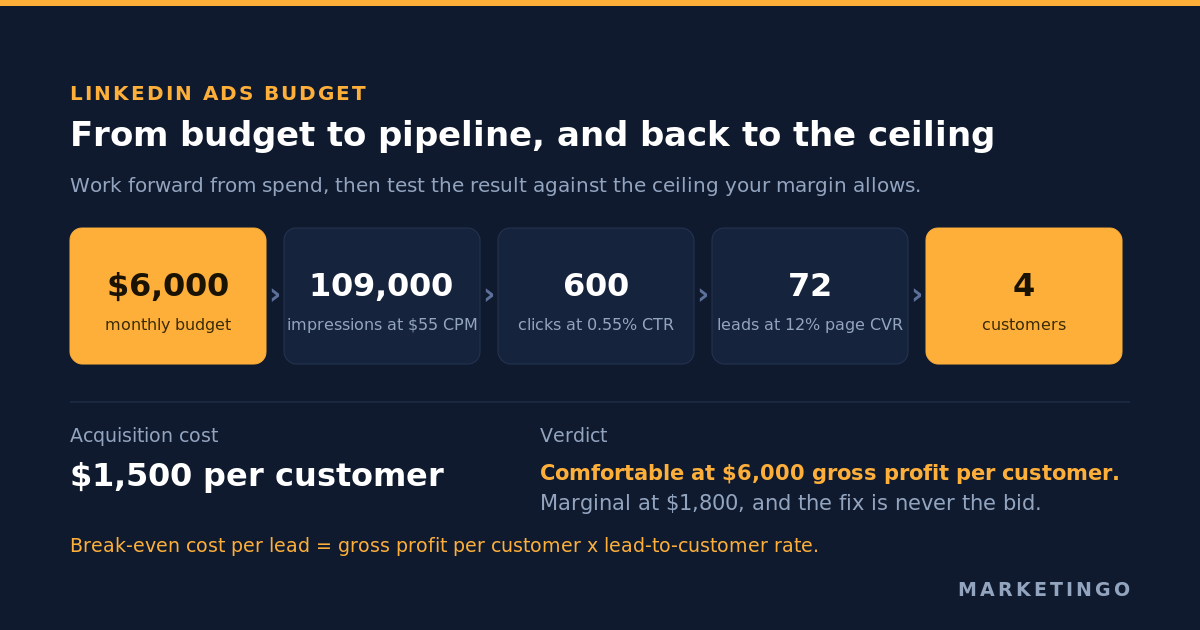
Start with $6,000 a month and a narrow B2B audience clearing at $55 per thousand impressions. That buys roughly 109,000 impressions. At a 0.55% click-through rate, which is a reasonable Sponsored Content result for tight targeting and decent creative, you get about 600 clicks at an effective $10 each. At a 12% landing page conversion rate you get 72 leads, at roughly $83 a lead. If 30% of those become sales-accepted opportunities and a fifth of those close, that is about four customers a month.
Now test it against the ceiling. Four customers from $6,000 is a $1,500 acquisition cost. If your gross profit per customer is $6,000, the channel is working comfortably. If it is $1,800, the channel is marginal and the fix is almost never the bid. It is the conversion rate on the page, the share of leads that qualify, or the audience you chose.
Lead Gen Forms change one term in that chain and not the others. By keeping the form in the feed they typically lift the click-to-lead rate substantially, which lowers cost per lead on the report. They also remove the landing page, which is where most qualification happens, so the share of leads that reach an opportunity usually falls. Whether that trade is worth it is an empirical question for your account, and the only way to answer it is to measure the two paths to opportunities rather than to leads.
Lowering LinkedIn advertising costs without lowering lead quality
Most attempts to cut cost on this platform work by buying a worse audience, which lowers the reported cost per lead and raises the real cost of a customer. These six do not.
Fix the creative before the bid. Relevance is priced into the auction, so an ad earning twice the account's average engagement is effectively discounted on every impression. This is the largest cost lever available to most advertisers and the one that requires no budget approval. LinkedIn does not expose a single public relevance score, but the engagement columns in Campaign Manager tell you the same story if you read them per creative rather than per campaign.
Turn audience expansion off while you are learning. Leave it on and you cannot say what your core audience costs, because the reported figures blend it with the cheaper expanded pool. Establish the clean number first, then decide whether expansion is worth the dilution.
Separate audiences into their own campaigns. A campaign holding enterprise chief financial officers alongside mid-market operations managers will spend most of its budget on whichever clears cheaper, which is rarely the audience you care about. Splitting them costs nothing and gives each a bid you can set deliberately.
Exclude current customers and existing pipeline. On a narrow business-to-business audience, live accounts and open opportunities can be a meaningful share of the impressions you are paying for, and their clicks look like performance while producing nothing.
Measure to opportunities, not to form fills. A campaign optimizing toward leads will find the cheapest people willing to fill in a form, and on LinkedIn those are disproportionately job seekers and consultants. Feeding qualified-opportunity data back into the platform changes what the optimization is chasing, and it is the single biggest driver of lead quality in a business-to-business account.
Rework the page before raising the budget. Cost per click is set by the auction; cost per lead is set by the auction and the page together. Doubling a landing page conversion rate from 6% to 12% halves the cost per lead with no change to what you pay per click, and the page is the half of the equation you fully control.
None of these require you to spend more. Applied together they usually move the effective cost per opportunity further than any bid adjustment, which is why an account review is a better first investment than a budget increase.
Where LinkedIn should sit next to search
LinkedIn is expensive per click because it sells access to a professional audience nothing else can target with the same precision. That premium is worth paying where the deal is large and the buyer is identifiable by role, and it is difficult to justify where the audience is already searching for what you sell. Most B2B accounts that get good results from the platform run it alongside search rather than instead of it: Google and Microsoft capture the demand that already exists, LinkedIn creates and qualifies the demand that does not yet, and both feed one pipeline measurement.
That is how MarketinGO runs it. For an AI compliance SaaS company, a lean Google and LinkedIn pairing grew demo requests 66% from a standing start, with no increase in budget, because the two channels shared audiences and a single conversion definition instead of competing for credit. For a regulatory compliance business, the same approach cut cost per lead from $112 to $40.25, a 64% drop, while producing 557 additional high-value leads on $4,000 less spend over six months.
MarketinGO is a paid media agency and nothing else: LinkedIn Ads, Google Ads, Meta, Microsoft, and the full-funnel strategy that decides how they divide the budget. Most of the accounts we take over in high-ticket B2B and AI and SaaS are not overpaying per click. They are paying a fair price for the wrong audience, measuring leads instead of opportunities, or capping bids below the floor and calling the resulting silence efficiency. If you want that checked against your own account before you raise a budget, the free ad audit is a specific read on where your LinkedIn spend is going and what it is buying. If you would rather compare providers first, the LinkedIn Ads agencies guide covers who does this well and what to ask them.