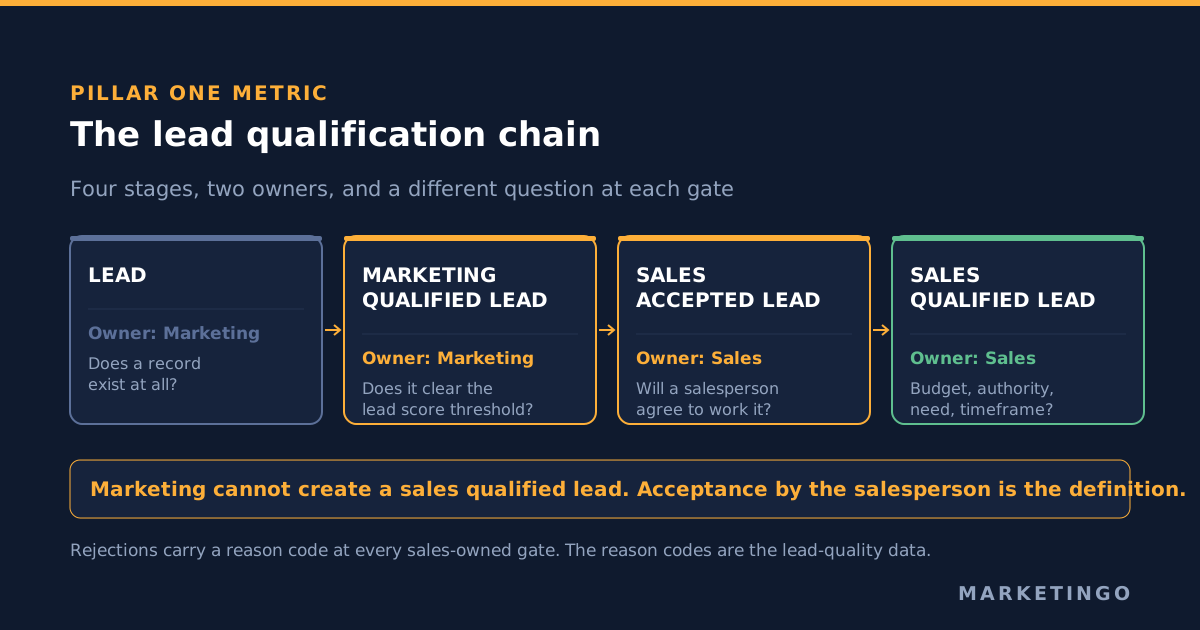
A sales qualified lead, usually shortened to SQL, is a lead that a salesperson has examined and accepted as worth working, measured against qualification criteria agreed before the lead arrived. The marketing team does not get to declare one. Acceptance by the person who has to make the call is the whole definition.
That distinction carries the one piece of arithmetic worth memorising:
MQL to SQL conversion rate = sales qualified leads accepted ÷ marketing qualified leads delivered
Deliver 400 marketing qualified leads in a quarter, have salespeople accept 92 of them as worth a conversation, and the rate is 23%. Nothing else about lead quality is as informative as that single fraction, because it is the only number in the funnel that two teams have to agree on before it can be recorded.
What follows: the definition and the three things it has to specify, what the published definitions actually say and where they disagree, the qualification criteria that survive an audit, a statistic about unqualified leads that is quoted as current and was fielded in 2011, and the part that decides media budgets, which is which qualification stage each advertising platform can receive and optimise on.
What a sales qualified lead is, and the three things the definition has to specify
A usable definition answers three questions. Most definitions in use answer one.
Who decides. If marketing can mark a lead sales qualified, the stage is not a qualification, it is a relabelling. The decision belongs to the salesperson or the sales development representative who will work the lead, and the record has to show who accepted it and when.
Against what criteria. "Looks good" is not a criterion. A criterion is a field a third person can check: the company is inside the ideal customer profile, the contact has authority to spend, a budget exists or has a date, the need is one the product addresses, and there is a timeframe. Written down, those criteria make rejections arguable instead of political.
With what rejection path. A stage with no rejection route silently becomes mandatory. Salespeople who cannot reject a lead stop reading them, which destroys the data the stage exists to produce. Every rejection needs a reason code, and those codes are the most valuable lead-quality data a business can own.
Miss any of the three and the stage produces a number that moves when nothing has changed.
What the published definitions say, and where they disagree
The definitions in circulation are close enough to look settled and different enough to cause arguments in a reporting meeting.
| Source | Its own definition | Dated |
|---|---|---|
| HubSpot | "A sales-qualified lead (SQL) is a prospect who's been vetted and deemed ready for a direct conversation with sales." | Updated 31 July 2026 |
| Published as a sales-terms glossary entry, framed around readiness for direct sales engagement | Undated glossary page | |
| Salesforce | Long-form editorial treatment of the stage and the handoff | Undated at time of writing |
| Forrester, on the SiriusDecisions Demand Waterfall | Does not define the stages. It lists them as questions an organisation must answer for itself: "What is a marketing qualified lead (MQL)? What is a sales accepted lead (SAL)? What constitutes active or qualified demand?" | 17 May 2018 |
The Forrester row is the most useful one, and it is the only one that declines to give an answer. The model that made these stage names standard treats their definitions as something each company sets, which is a strong hint about how much weight an external benchmark can carry.
HubSpot's page also lists what a sales qualified lead usually looks like: leads that "Fit the target persona or ideal customer profile (ICP)", that "Have shown buying signals like inquiring about pricing, asking for clarification of features, or requesting a demo", and that "Have authority, budget, and need". That is a workable starting list, and the first item is doing more work than the other two.
Sales qualified lead, marketing qualified lead and sales accepted lead
Three stages, three different gates, and they are routinely collapsed into two.
A marketing qualified lead has met a threshold marketing set, usually a lead score built from fit and behaviour. The threshold is marketing's to choose, which is both the point of the stage and its weakness. The definition, the scoring criteria and which event to feed back to an advertising platform are covered in full in marketing qualified lead.
A sales accepted lead is the handshake. A salesperson has agreed to work the lead. No judgement about the deal yet, only about whether it is worth an hour.
A sales qualified lead is the verdict after that hour. The salesperson has spoken to the lead and confirmed enough to forecast something.
Compressing sales accepted and sales qualified into one stage is the most common simplification, and it costs a specific thing: the ability to tell a routing problem from a quality problem. Leads that are accepted and then rejected were reaching the right people and failing on substance. Leads never accepted at all were a distribution failure. The two call for opposite fixes, and one combined stage cannot distinguish them.
The handoff agreement, and why it has to be written rather than understood
Every argument about lead quality is really an argument about a document that does not exist. The sales and marketing teams each hold a working definition in their heads, the two differ by about fifteen percent, and the gap only becomes visible in a reporting meeting when the numbers do not reconcile.
The document that fixes it is short. Four stages, each with a clear definition, an owner, and the field in the customer relationship management system that records it.
| Stage | Who owns the decision | What the definition has to state |
|---|---|---|
| Lead | Marketing | The lead source, and the minimum data required for the record to exist at all |
| Marketing qualified lead | Marketing | The lead score threshold and the fit and behaviour criteria behind it |
| Sales accepted lead | Sales | The response time commitment, and the grounds on which a lead may be returned |
| Sales qualified lead | Sales | The qualification criteria, the rejection reason codes, and the sales qualified lead status that the record carries afterwards |
Three details decide whether that agreement survives its first quarter.
The marketing qualified lead criteria and the sales qualified lead criteria have to measure different things. If the marketing threshold already tests budget and authority, the sales qualification process is re-asking questions that were answered upstream, and the MQL to SQL conversion rate will sit near 100% while telling you nothing. The division that works in practice: marketing scores fit and interest, sales tests circumstance.
Acceptance needs a clock. A lead lifecycle with no response commitment degrades quietly, because the conversion rate from marketing qualified lead to sales qualified lead falls with every day of delay, and the fall is attributed to lead quality rather than to the queue. Put a number in the agreement, measure against it, and the distinction between a quality problem and a speed problem stays visible.
The rejection reason codes belong to the agreement, not to whoever built the customer relationship management system. A fixed, short list that both teams signed is what makes the data comparable across quarters. Freeform text is what makes it unusable.
Review the document quarterly against the actual MQL to SQL conversion rate and the actual rejection mix. A definition that has not been revisited in a year is describing a business that no longer exists.
Lead scoring, intent signals, and what actually predicts acceptance
Lead scoring is the mechanism that produces marketing qualified leads, and most lead scoring systems are built backwards. They score how much marketing content a contact consumed, because that is the data the marketing automation platform collects most easily, and consumption of marketing content is a weak predictor of whether a salesperson will accept the lead.
What predicts acceptance, in rough order of strength:
- Firmographic fit. Whether the company matches the ideal customer profile, usually shortened to ICP: the size, the sector, the geography and the technology in place. This is the single strongest signal and it is knowable before the contact does anything at all. It is also the signal paid media can target directly, which is why it belongs at the top of a scoring model rather than buried under behavioural points.
- Role and authority. Whether the contact can authorise a purchase of the product or service, or is close enough to the person who can.
- Intent to buy, expressed through specific actions. A pricing page visit, a question about a feature's limits, a request for a demonstration, a security questionnaire. These are not the same as showing interest in general. A contact who downloads four reports has demonstrated a level of interest in the subject. A contact who asks what the implementation takes is closer to being ready to buy.
- Lead source. Potential leads arriving from a branded search differ systematically from those arriving from a gated asset, and the acceptance rate by source is usually the first thing a rejection analysis reveals.
Score those four and the lead nurturing programme has a clearer job: move contacts who fit the profile but have not yet shown intent, rather than sending more marketing content to everyone who has ever clicked. Contacts who fit the profile and are not ready are the only population for whom nurturing changes the outcome.
Two cautions worth stating. Behaviour scores decay, so a point earned nine months ago should not be carrying a lead over the threshold today. And a scoring model that nobody has tested against what actually got accepted is a set of assumptions with arithmetic attached. Compare the scores of the leads that became sales qualified against the scores of the ones that were rejected, once a quarter, and the model either earns its weights or loses them.
The qualification criteria that survive an audit
BANT is the oldest of these frameworks and the most maligned, usually by people describing a version of it that no original document contains.
The four letters stand for Budget, Authority, Need and Timeframe. Not Timeline. IBM still hosts its own BANT criteria templates in public, and both are titled "Budget Authority Need Timeframe (BANT) Criteria Template": version 3.3 and version 1.1, the second written for Value Advantage Plus for Government Sales. Both use TIMEFRAME as the section heading. HubSpot's own page, updated in July 2026, writes it as "Budget, Authority, Need, and Timeline", and so does most of the material that teaches the framework.
The more interesting thing in those IBM documents is how mechanical the qualification gate was. "A validated opportunity is one where you have made at least one sales call and know the customer's Budget, Authority, Need and Timeframe." Registration was refused outright when the record was thin: "Opportunity records lacking descriptions of a Customer's Budget, Authority, Need and Timeframe (BANT) will be rejected as incomplete." Authority had a test rather than a judgement: at least one customer executive or line-of-business contact on the record, and "Procurement and Purchasing contacts are not valid executive decision makers." Timeframe had to resolve to dates, a minimum of fifteen days out.
Neither document claims IBM invented the framework, which is worth saying plainly, because almost every article on the subject asserts that it did and none of them cites anything. What IBM's own files do demonstrate is something more useful than an origin story: a qualification standard written so that an administrator who had never met the customer could reject a record against it.
That is the bar a sales qualified lead definition has to clear. If two people reading the same record disagree about whether it qualifies, the criteria are not finished.
Where BANT genuinely struggles is a buying group. Gartner puts the typical group for a complex purchase at "six to 10 decision makers, each armed with four or five pieces of information they've gathered independently and must deconflict with the group" (the page carries no date, so treat it as Gartner's standing position rather than a dated finding). Four letters answered by one contact cannot describe that. The repair is not to abandon the criteria but to record which of them a given contact can actually speak to, which is also what makes a second contact on the account a measurable next action rather than a vague one.
MEDDIC, and when a heavier framework earns its overhead
BANT is a qualification gate. MEDDIC is a deal-inspection framework, and the two are often presented as alternatives when they answer different questions at different moments.
MEDDIC asks about metrics, the economic buyer, the decision criteria, the decision process, the identified pain and the champion. Working through six of those with a contact is a sales conversation of real length, which makes it the wrong instrument for deciding whether a lead is worth an hour and the right instrument for deciding whether a deal in the pipeline is real.
The practical split for a business running paid media into a sales team:
- Use a light gate at the sales qualified lead stage. Fit, authority, a need the product addresses, and a timeframe. Four questions a sales representative can answer after one call.
- Use the heavier framework after the opportunity is created, where the extra detail changes the forecast rather than the routing.
Complex enterprise sales with long sales cycles and a buying committee reward the heavier instrument, because the cost of carrying a dead deal for two quarters is high. A product with a thirty-day sales cycle does not: the qualification overhead costs more than the deals it filters out. Match the weight of the framework to the length of the sales cycle, not to the ambition of the sales process.
The statistic everyone quotes about unqualified leads, and when it was collected
One figure dominates writing on this subject: 61% of business-to-business marketers send all their leads straight to sales, and only 27% of those leads are qualified.
It is real. It is also from a survey fielded in June 2011.
The original is a MarketingSherpa post dated 29 September 2011, which states it as "61% send all leads directly to Sales; however, only 27% of those leads will be qualified" and credits its own source line: "©2011 MarketingSherpa B2B Marketing Benchmark Survey; Methodology: Fielded June 2011, N=1,745". Fifteen years later, HubSpot's lead nurturing statistics post, last updated in June 2025, still carries it as item six, credited to "MarketingSherpa" with no link and no date. The figure travels without its vintage, which is why it reads as a current description of lead handling and is quoted as one.
Whether 27% is still roughly right is unknowable from that source, and the honest position is that nobody publishes a current, primary-sourced marketing qualified lead to sales qualified lead benchmark that you can open and check. The widely circulated 13% conversion figure attributed to a Salesforce or Implisit study has the same problem in a worse form: the study cannot be opened at all.
So the benchmark table most articles on this subject would print here does not exist in a citable form, and the practical consequence is specific rather than philosophical. Your own rate, measured over four quarters, is the only version of this number that can tell you anything, and the comparison that matters is against your own previous quarter rather than against an industry figure. The stage-by-stage rates the site does have, measured and dated, are in lead conversion rate.
How to calculate the MQL to SQL conversion rate
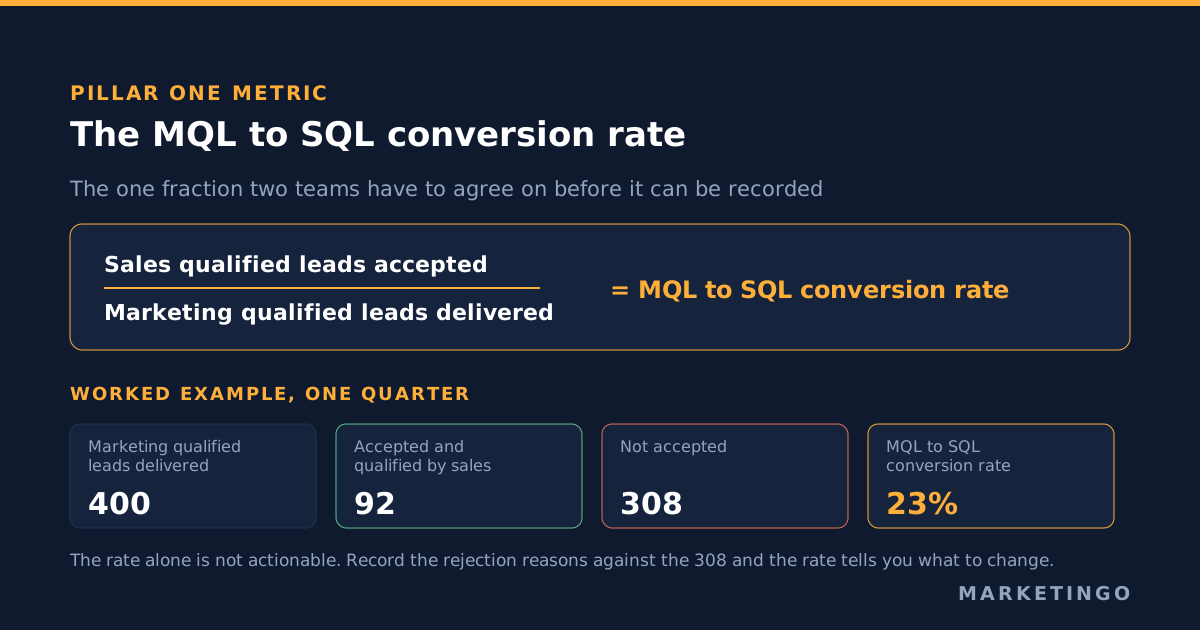
- Fix the period, and fix it long enough to cover your sales cycle. A quarter is the shortest honest window for most business-to-business products.
- Count the marketing qualified leads delivered in that period, not the ones created. A lead sitting in a queue has not been offered to anyone.
- Count the leads a salesperson accepted and then qualified in that period, with the accepting person's name on the record.
- Divide, and record the rejection reasons alongside the rate. A rate of 23% with "wrong company size" on two thirds of the rejections is a targeting instruction. The same rate with "no budget this year" on two thirds of them is a timing instruction, and the two lead to different media decisions.
- Record the elapsed time from marketing qualified to sales qualified as a median, not a mean. The next section explains why that specific number decides what your advertising accounts can do.
Cost belongs beside the rate rather than inside it. Dividing spend by sales qualified leads rather than by form fills is what turns a cost per lead into a number worth steering on, and that arithmetic, with its own benchmarks, is in cost per lead. The lead generation return on investment calculator takes the close rate and the deal value and gives the cost per lead your margin actually allows, which is the ceiling this whole chain is working against.
Which qualification stage each advertising platform can optimise on
Here is the part that changes what you do on Monday morning, and it is the part almost nothing written about sales qualified leads covers.
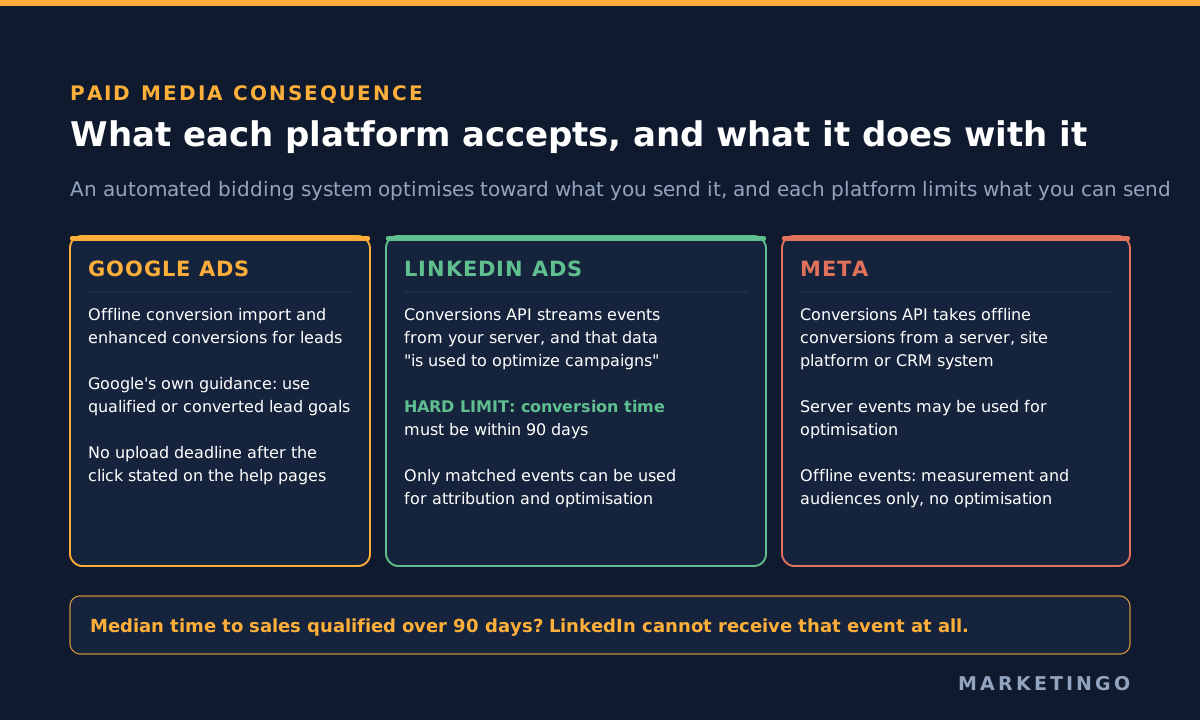
An automated bidding system optimises toward the conversions you send it. Send it form fills and it will find you more form fills, including from the companies your salespeople reject. Send it qualified leads and it optimises toward the thing you actually want. The catch is that each platform limits what you can send and when.
| Platform | What it accepts back | The limit that decides it | Source |
|---|---|---|---|
| Google Ads | Offline conversion import and enhanced conversions for leads: the hashed lead details are uploaded when the lead converts offline, "by signing a contract, for example" | Google's own guidance for lead generation advertisers measuring offline goals is to "use qualified or converted lead goals". No upload deadline after the click is stated on the help pages | Google Ads Help, upgrade guidance |
| LinkedIn Ads | The Conversions API streams conversion events from your server, "regardless of where the conversion occurs", and that data "is used to optimize campaigns" | "Conversion time should be within 90 days." A conversion older than that cannot be matched, and "only matched events can be used for attribution and optimization" | LinkedIn Conversions API, updated 23 September 2026 |
| Meta | The Conversions API connects marketing data including "offline conversions" from a server, website platform or customer relationship management system | Server events "may be used in measurement, reporting, or optimization". Offline events are described only for "attributed offline events measurement, offline custom audience creation or measurement", with no optimisation claim | Meta Conversions API |
Two things in that table deserve to be acted on rather than noted.
The first is LinkedIn's ninety days. If the median time from marketing qualified to sales qualified in your business is longer than ninety days, the sales qualified lead event cannot reach LinkedIn in a usable state at all. That is not a tracking setup problem to be solved with a better integration. It is an arithmetic fact about the window, and the response is to send back the latest stage that reliably happens inside it, usually the sales accepted lead or a mid-stage qualification, and keep the sales qualified lead as a reporting metric rather than a bidding target. Measuring the median first, before building the integration, saves a quarter of work pointed at a conversion the platform will reject.
The second is Meta's wording. The documentation claims optimisation for server events and claims only measurement and audience building for offline events. A plan that assumes Meta will bid toward an uploaded qualified lead the way Google does is assuming something the documentation does not say.
Google's pages carry one more detail worth checking inside your own account rather than taking from an article: all three state that "Starting June 15, 2026, offline conversions import and enhanced conversions for leads uploads will be migrated to the Data Manager API and blocked in the Google Ads API", and add that "Developer tokens that haven't sent a request between January 2026 through June 2026 will not be allowlisted for legacy access". That date has now passed while the help pages still carry the sentence in the future tense, so anyone running uploads through an older integration should confirm which interface their uploads are actually using before assuming the pipeline is intact.
The underlying tracking that has to exist before any of this works, including the conversion actions and the values attached to them, is in Google Ads conversion tracking.
The volume problem nobody mentions
A later-stage conversion is a better optimisation target and a thinner signal, and the second fact can cancel the first.
Automated bidding needs enough conversions per week to learn anything. A business generating 400 marketing qualified leads a quarter and accepting 92 of them is feeding roughly seven qualified leads a week into a bidding system, spread across campaigns. That is often too few, and a campaign optimising toward too few conversions produces unstable delivery rather than better leads.
The usable compromise is to send both. Keep the earlier-stage conversion as the bidding target where volume demands it, send the qualified lead back as a second conversion action with a value attached, and let the value rather than the count carry the quality signal. That is also the only configuration in which the qualified lead influences bidding and reporting at the same time without starving the algorithm.
When the sales qualified lead is the wrong number to steer on
Three cases, all common.
A new account with no history. There is no qualified lead data yet, and waiting a quarter to optimise is worse than optimising on form fills and correcting later. Start on the earlier stage, instrument the later one from day one, and switch when the data exists.
A short, self-serve sales motion. If the product is bought without a conversation, the stage is ceremonial. Optimise on the purchase.
A business where the rejection reasons are all "no budget". That is a pricing or a targeting conversation, not a bidding one, and changing the optimisation target will not touch it.
The metric is a diagnostic. Treating it as a goal in its own right produces the familiar failure where qualification standards quietly loosen until the number recovers.
Where to take this next
The chain described above only pays off when the whole of it is instrumented: the stage definitions written down, the rejection reasons recorded, the median qualification time measured, and the right event wired back into each platform with a value on it. Most accounts have one or two of those four.
If you run paid media for a business-to-business product, the fastest way to find out which of the four is missing is to look at what your campaigns are currently optimising toward. We do that as part of a free ad audit, which reports the conversion actions in use, which of them bidding is actually steering on, and what the handoff between your advertising accounts and your customer relationship management system is passing through.
For an artificial intelligence compliance software company we took from 6 to 10 demo requests a month inside 60 days, a rise of 66%, the thing that made it work was tracking the funnel rather than the form: the account was instrumented to measure pipeline, not just form fills before any budget was scaled. That is the same sequence described above, in the order described above.
How we approach this for high-ticket business-to-business accounts, and how LinkedIn Ads fits alongside search when the buying group has six to ten people in it, are both worth reading next if lead quality rather than lead volume is the constraint you are working against.