A marketing qualified lead, usually shortened to MQL, is a lead the marketing team has judged ready for a sales conversation, measured against agreed criteria covering who the person is and what they have done. The criteria are set inside each company, so the term describes a different thing at every one. A sales qualified lead is the subset sales then accepts.
That first paragraph is the whole definition, and it is also the problem. Every other metric on this site has a formula. Return on ad spend is revenue divided by spend everywhere on earth. A marketing qualified lead has no formula and no external standard, which means a published benchmark for "MQL volume" or "MQL quality" is describing somebody else's threshold, not a measurable quantity.
So this article does two things. It sets out how qualification criteria are built and how the stages differ, because the definitional confusion is real and costly. Then it covers the part that decides where your money goes, and that nobody else writing about this seems to touch: which lead stage the ad platforms can actually receive, and whether your marketing qualified lead volume is large enough and fast enough for an algorithm to learn from.
The definition, and the circularity inside it
HubSpot, whose lifecycle stage field is where most of these labels physically live, defines the stage as "a contact or company that your marketing team has qualified as ready for the sales team" (HubSpot knowledge base). That is honest and completely circular. A lead is qualified when the people doing the qualifying say so.
HubSpot's default ladder runs Subscriber, Lead, Marketing Qualified Lead, Sales Qualified Lead, Opportunity, Customer, Evangelist, and the platform lets you rename the stages or add your own. Two companies using identical software, in the same market, can set thresholds four times apart and both be right by their own books.
This matters more than a terminology quibble. If marketing reports 400 marketing qualified leads a month and sales says it received 60 worth calling, nobody is lying. The two teams are counting against different tests. The fix is not a better industry definition, because there is not one coming. The fix is a shared definition of qualified that both teams sign, reviewed on a schedule, with a disqualifier list attached. Sales and marketing alignment on that one page is worth more than any reporting built on top of two different tests.
MQL vs SQL vs SAL vs PQL, untangled
Four labels get used interchangeably and they mark genuinely different events. Note that "SQL" here is the sales qualified lead, not the database query language that shares the abbreviation.
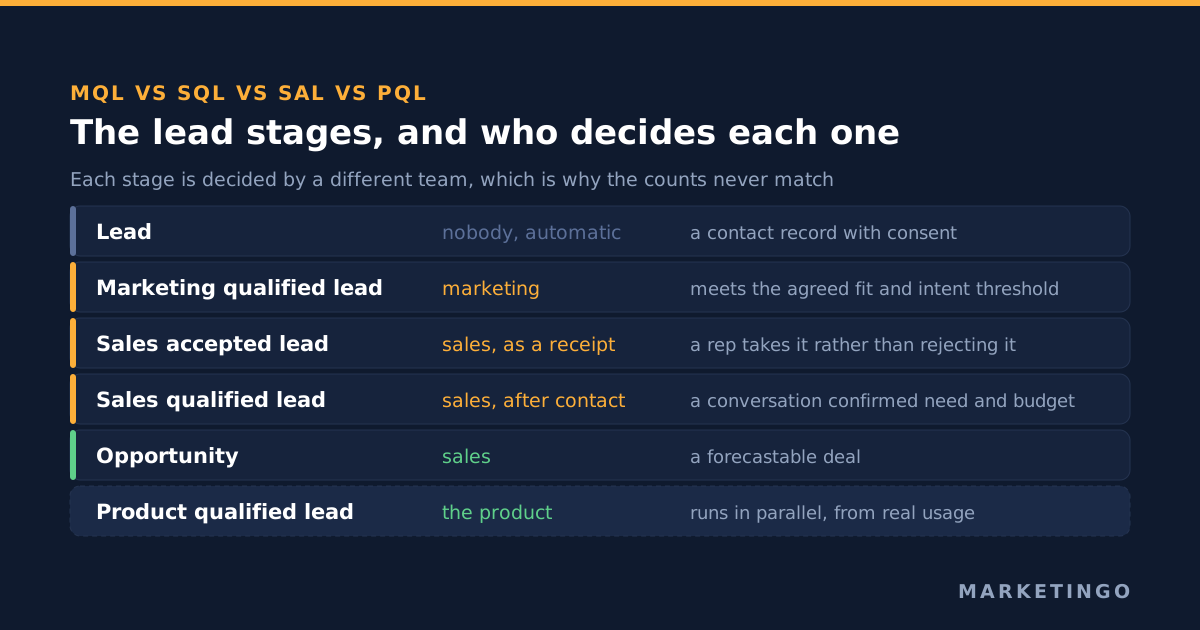
| Stage | Who decides | What it means | Typical trigger |
|---|---|---|---|
| Lead | nobody, it is automatic | a contact record exists with consent to be contacted | any form fill, content download or event registration |
| Marketing qualified lead (MQL) | marketing | meets the agreed fit and intent threshold | lead score crosses a line, or a specific high-intent action |
| Sales accepted lead (SAL) | sales, as a receipt | sales agrees the lead is worth working, before any contact | a rep accepts the record rather than rejecting it |
| Sales qualified lead (SQL) | sales, after contact | a real conversation confirmed need, authority, budget or timing | discovery call completed and qualified in |
| Product qualified lead (PQL) | the product | usage inside a trial or free tier shows the value landed | activation event, seat count, usage threshold |
The sales accepted lead is the stage most teams skip and the one that settles the argument fastest. It is a receipt: sales either takes the record or rejects it with a reason. Rejection reasons collected over one quarter will tell you precisely which part of the marketing qualified lead threshold is wrong, which is more useful than any benchmark. Leads rejected for timing rather than fit go back to nurture rather than into the bin, and the nurture track is where sales readiness gets built for the ones who are not ready to buy yet.
Product qualified leads deserve a flag for anyone running a self-serve trial. If a trial signup activates and invites three colleagues, that is a stronger buying signal than a whitepaper download from a vice president, and it arrives faster. Where a product qualified lead exists, it usually outperforms the marketing qualified lead as both a sales trigger and an optimisation event.
How to qualify leads: building the criteria
Workable qualification criteria have three parts, and most teams build only the first two.
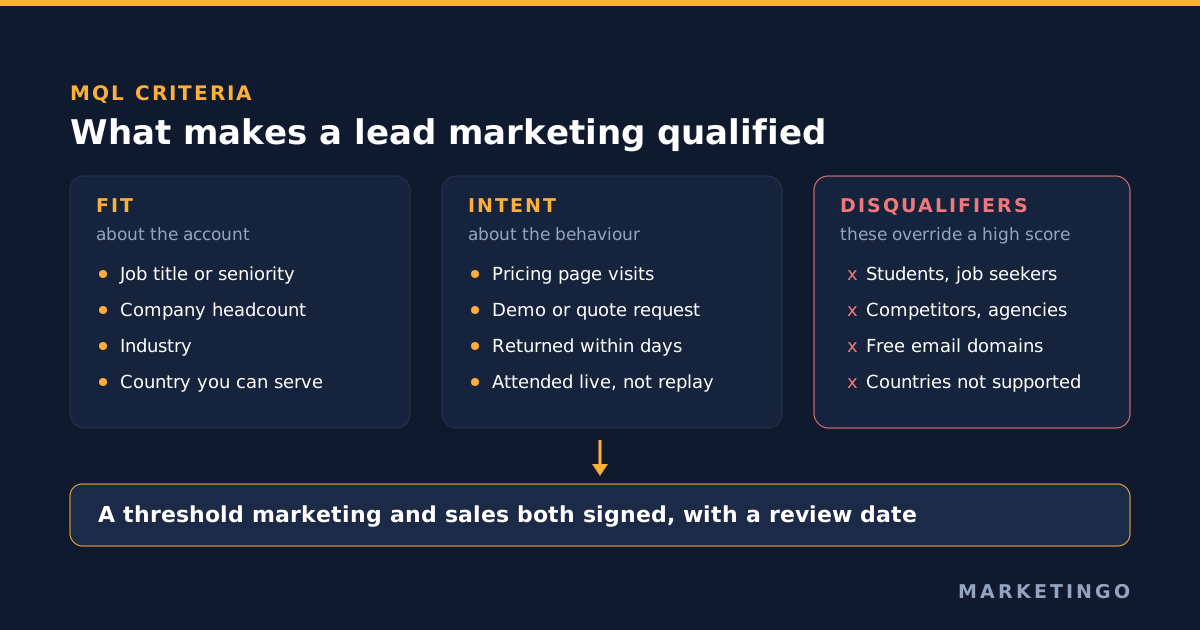
Fit, which is about the account. Job title or seniority, company headcount, industry, country, and whether the company already uses something the product replaces. Fit is knowable at the point of the form fill if you ask for it or enrich it afterwards, and it is the half that protects the sales calendar from leads that could never buy.
Intent, which is about behaviour. Pricing page visits, a demo or quote request, returning within a short window, opening a sequence repeatedly, attending a live webinar rather than downloading the recording. Intent decays. A pricing page visit from three months ago is not the signal a pricing page visit from Tuesday is, so any scoring model without time decay drifts upward until everything qualifies. The decay window should match your sales cycle rather than a default someone set once.
Disqualifiers, which are absolute. Students and job seekers, competitors, consultants and agencies researching on behalf of someone else, free email domains where the product is sold to enterprises, countries you cannot support or invoice. A disqualifier overrides a high score rather than subtracting from it. This is the part teams leave out, and it is why high-scoring junk reaches sales calendars.
Lead scoring is the mechanism, not the standard. Points on fit plus points on intent, a threshold that triggers the stage change, and that threshold reviewed against what sales actually accepted. A lead scoring model is only as good as that review, because scoring rules nobody revisits keep qualifying prospects sales stopped wanting two quarters ago. If you are setting a threshold for the first time, work backwards: take the leads that became customers over the last two quarters, look at what they had in common at the point they entered, and set the bar there. Then watch the sales accepted rate for a month and move it.
The statistic everybody repeats, and where its trail ends
One figure appears in nearly every article on this topic: 61% of business-to-business marketers send all leads directly to sales, while only 27% of those leads will be qualified. It is a good line. It is also, as far as it can be traced, unsourced.
The most-cited home for it is a HubSpot round-up of lead nurturing statistics, where it appears as item six, attributed to "MarketingSherpa" in plain text with no link to any study. Follow it further and the trail runs into conference slide decks and other round-ups citing the round-up. No published report surfaces: no sample size, no sampling method, no survey date, no industry mix. The claim is old enough that even if a study existed, it would describe a market that predates the current advertising platforms entirely.
Treat it the way you would treat any unsourced number in a pitch deck. The underlying idea, that passing everything to sales wastes sales time, is obviously true and does not need a fake statistic propping it up. Our own cost per lead and lead conversion rate articles use datasets that publish their method and their window, which is the standard worth holding here.
The research firm that built the lead waterfall now argues against it
The strongest critique of the marketing qualified lead does not come from a contrarian on LinkedIn. It comes from Forrester, which absorbed SiriusDecisions, the firm whose demand waterfall put lead qualification stages into business-to-business marketing in the first place.
Forrester's own blog series carries the title "The End Of MQLs" and argues that the lead-centric model "has been this way since the late 1990s, and it's fraught with problems." Two of its figures are the heart of the case. Forrester puts the typical conversion rate from inquiry to closed won in a lead-centric process at "less than 1%", and notes that "over 80% of buying decisions are made by a buying group of more than three people."
That second number is the real argument. A marketing qualified lead is a single person. If more than three people decide, scoring one of them and handing that one record to a rep measures the wrong unit. Forrester's replacement framing, in its B2B Revenue Waterfall, is to work from buying groups and opportunities rather than individual leads.
Here is the honest position for anyone buying ads. Forrester is right about the measurement unit and the criticism lands. Most companies running paid media are not in a position to act on it, because buying group detection needs account-level data and a process their revenue team does not have yet. Meanwhile the ad platforms, which is where the budget decision actually gets made, still take individual records with individual identifiers. So the marketing qualified lead survives as a working label even where it is theoretically the wrong one, and the practical question becomes what to do with it.
What the ad platforms can do with a marketing qualified lead
This is the part that decides spend, and it has changed recently enough that most advice on the subject is out of date. All three major platforms now accept lead stages back from a customer relationship management system, and they differ in exactly the ways that matter.
| Google Ads | Meta | ||
|---|---|---|---|
| Route back | enhanced conversions for leads, or offline conversion import through Data Manager | Conversions API, conversion leads integration, lead ads only | Conversions API |
| Stage names | built-in goal types "Qualified lead" and "Converted lead", plus custom stages in Lead Journey Mapping | advertiser-defined; Meta's own documented example funnel uses "Marketing Qualified Lead" | dedicated MARKETING_QUALIFIED_LEAD and SALES_QUALIFIED_LEAD conversion types from API version 202608 |
| How far back events can be sent | Data Manager imports from 90 days ago on each run for file and storage sources, 14 days for data warehouse sources | backfill up to 7 days, and Meta warns against editing timestamps to go further | conversion timestamp must fall within the past 90 days |
| Matching | hashed email, phone or address, plus the click identifier | hashed email or phone, plus a valid lead identifier | hashed email or one of several identifiers; only matched events can be used for optimisation |
| Upload cadence Google and Meta ask for | regularly, ideally daily | at least once a day, real time preferred | not specified; events must be inside the 90 day window |
Sources, all platform documentation, read on 21 October 2026: Google Ads on qualified and converted leads and enhanced conversions for leads, Meta's conversion leads CRM integration, and the LinkedIn Conversions API reference.
Three things in that table are worth stopping on.
Google has promoted the qualified lead to a first-class goal type. Its documentation describes a lead funnel report running "from interactions to leads, qualified leads, and converted leads", so the stage is reportable natively rather than as a custom conversion nobody can find.
LinkedIn went further and named the stages. MARKETING_QUALIFIED_LEAD and SALES_QUALIFIED_LEAD became explicit conversion types from version 202608, which is new enough that most accounts are still sending a single undifferentiated lead event. If you run LinkedIn Ads for a business-to-business company, this is the single highest-value tracking change available to you right now.
Meta is the strictest on time. A seven day backfill limit means a lead qualified on day twelve cannot be sent at all. For any sales process slower than a week, Meta can optimise toward the raw lead and nothing deeper, and no amount of configuration changes that.
The arithmetic that decides which event you optimise on
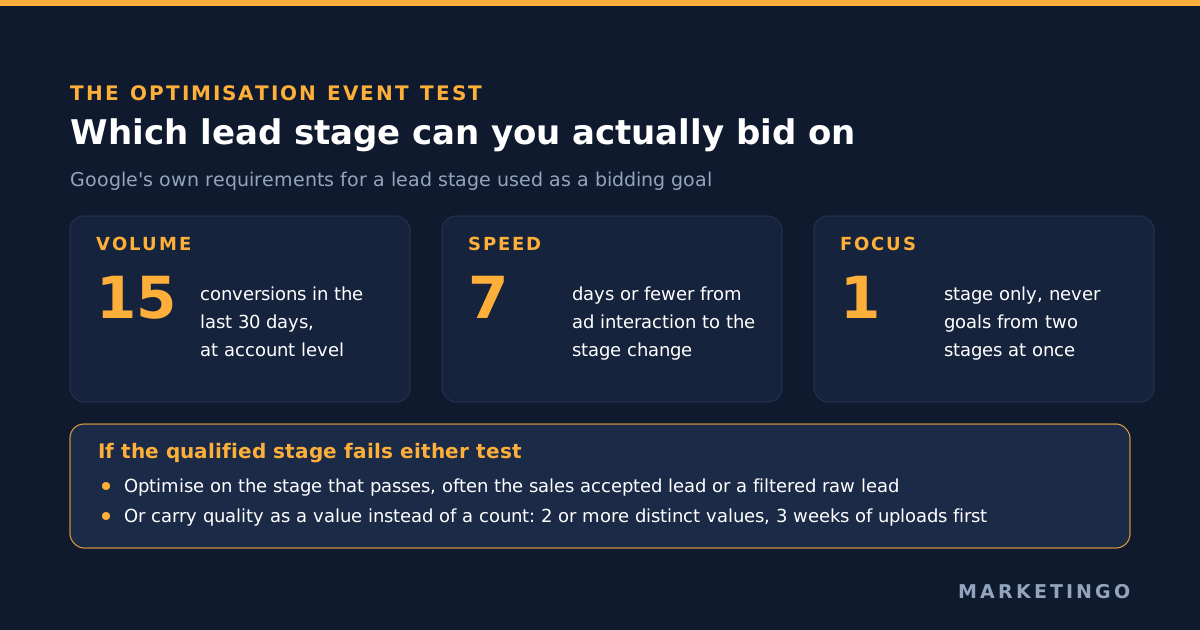
Google's own guidance settles the question most teams argue about, and it is arithmetic rather than opinion. Three rules from its documentation, taken together, form a test.
First, pick one stage. Google's lead generation guidance says to "avoid selecting goals from multiple stages of your Lead Journey Mapping for optimization", and its value-based bidding page repeats it: "choose a single stage in your lead-to-sale journey to use for bid optimization." Feeding the algorithm the raw lead and the qualified lead at once teaches it to count the same person twice.
Second, the stage needs volume. Google asks for "at least 15 conversions in the last 30 days at the account level" for a lead goal, and the same threshold again for Target ROAS at the conversion tracking level, noting that "less conversion volume can make for noisier data when assessing performance."
Third, the stage needs to happen soon. Google advises choosing "a conversion action that happens within 7 days of the ad interaction for timely optimization", and says that where the delay is longer, "consider selecting a goal earlier in the consumer journey, like a qualified lead."
Run your own numbers through that and the answer usually writes itself. A company producing 300 leads a month at a 20% qualification rate has 60 marketing qualified leads, clears 15 comfortably, and can optimise on the qualified stage if the qualification happens inside a week. A company producing 60 leads a month at a 15% rate has 9, misses the threshold, and will get noisier results from the qualified stage than from the raw lead, however much better the qualified stage sounds in a board meeting.
When the stage fails the volume test there are three honest moves, in order of preference. Use the stage that passes, which is often the sales accepted lead or even a filtered raw lead with the disqualifiers already stripped out. Or switch to value-based bidding and carry the quality signal as a value rather than a count, which Google allows with proxy values such as a lead score, requires "two or more different values" to be reported, and asks you to upload for "3 weeks or 1-2 conversion cycles, whichever is longer" before switching the strategy on. Or consolidate campaigns so one bidding strategy sees the whole account's conversion volume instead of splitting 9 events across four campaigns, which is a question of account structure rather than tracking.
What you should not do is optimise toward an event that happens 11 times a quarter and then read the resulting cost per acquisition as a real number.
How to wire it up, in order
- Write the threshold down and get sales to sign it. Fit criteria, intent criteria, disqualifier list, and the point value that triggers the stage. One page.
- Add the sales accepted lead as a receipt stage with mandatory rejection reasons. This is your feedback loop and it costs nothing.
- Fix the tracking foundation first. Stage imports are worthless on top of broken conversion tracking, so if the basics are shaky, start with Google Ads conversion tracking before anything here.
- Count your monthly volume at each stage and the median days from click to stage change. These two numbers choose your optimisation event, using the test above.
- Send every stage back, even the ones you do not optimise on. Meta explicitly requires all stages "including the raw lead" for its integration to work, and reporting a funnel you cannot yet bid on is still how you learn which campaigns produce qualified leads instead of leads.
- Set the upload to run daily, not weekly. Every platform asks for this and it is the most common quiet failure.
- Leave the bidding strategy alone for a full conversion cycle after switching the optimisation event. Changing the target and the event in the same week makes the result unreadable.
When the marketing qualified lead is the wrong thing to steer on
It is the wrong metric when your deal involves a buying group and your data cannot see the group, which is Forrester's point and applies to most enterprise sales. Report it, do not steer on it.
It is the wrong metric when qualification takes longer than the platform's window. Past seven days, Meta cannot receive it. Past 90 days, neither LinkedIn nor Google's file-based import can.
It is the wrong metric when volume is thin, for the arithmetic above.
And it is the wrong metric when the real constraint is downstream. If marketing qualified leads convert to opportunities at a normal rate but opportunities stall, qualification is not your problem and optimising it harder will not help. Compare cost per lead against customer acquisition cost to see which end of the funnel the gap is actually in.
Where to take this next
The qualification threshold is a sales and marketing agreement, and nobody outside your company can write it for you. The paid media half is ours, and it is the half with a checkable answer.
If you want to see what your own numbers do to a qualified lead target, the lead generation return on investment calculator takes your lead volume, qualification rate and close rate and works back to what a lead can cost you. The rest of the metrics that decide profit sit on the resources hub.
For the accounts we run on the business-to-business side, the qualified stage is the one we optimise toward wherever the volume supports it, across Google Ads and LinkedIn together, for high-ticket business-to-business companies and AI and SaaS companies alike. For a regulatory-compliance consultancy, that approach cut cost per lead 64%, from $112 to $40.25, and added 557 extra high-value leads on $4,000 less spend in six months.
If you suspect your campaigns are being optimised toward the wrong event, that is one of the first things a free ad audit checks, along with whether the stages reach the platforms at all.