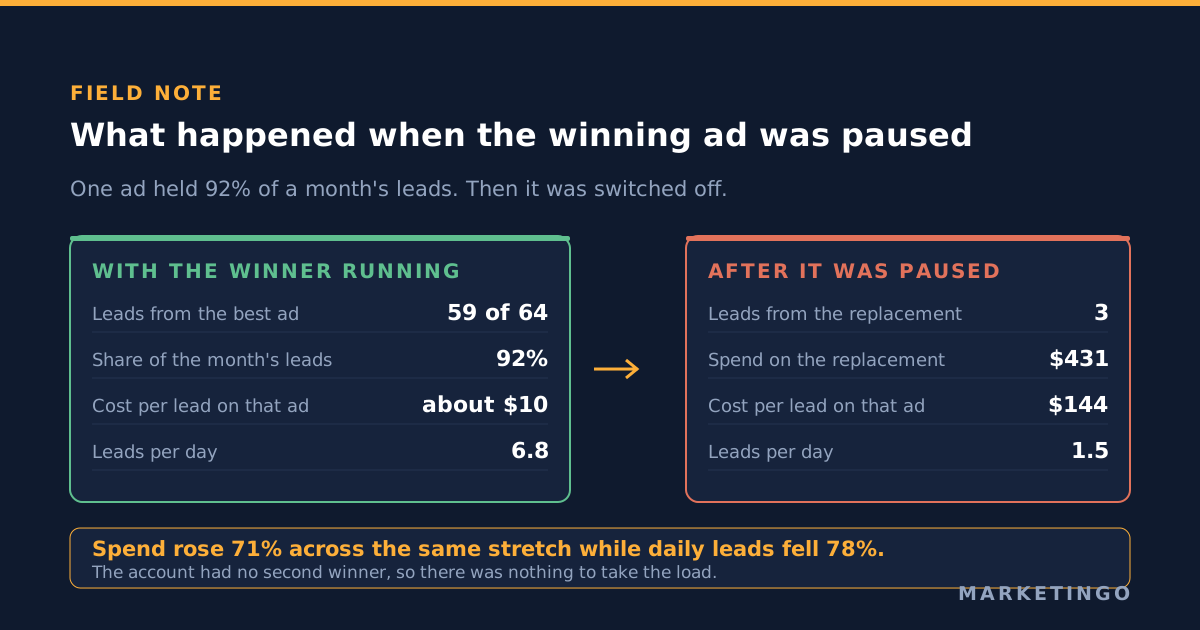
A business-to-business software company we run paid social for went from 6.8 leads a day to 1.5 leads a day inside two weeks, while spend over the same stretch rose 71%. No audience had been exhausted, no tracking had broken, and no policy strike had landed. One ad had been switched off.
That account is the clearest version of a pattern we see in most paid social accounts that arrive describing a fatigue problem. The creative was not the fragile part. The distribution of results across the creative was.
What ad fatigue is, and what it usually is instead
Ad fatigue occurs when the same target audience sees the same ad creative multiple times and stops responding: cost per result climbs, click-through rate falls, and the ad stops earning its delivery. It is the standard explanation for a decline in Facebook ads and in paid social generally. It is real. It is also the wrong diagnosis in most accounts that report it, because the underlying condition is concentration: one creative holds nearly every result, and nothing else in the account can take the load when that creative stops.
The difference matters because the two problems have opposite fixes. Fatigue is solved by new creative. Concentration is solved by building a second winner before you need one, which takes weeks of deliberate testing and cannot be done in the hour after your best ad dies.
The numbers: 59 of 64 leads from a single ad
Here is what the account looked like in the month before the drop.
| Reading | Figure |
|---|---|
| Leads produced by the single best ad | 59 of 64 for the month, about 92% |
| Cost per lead on that ad | About $10 |
| Daily leads before the switch-off | 6.8 |
| Daily leads after the switch-off | 1.5 |
| Spend across the same stretch | Up 71% |
| The replacement ad | $431 spent, 3 leads, $144 each |
Read the last two rows together, because that is where the real cost sits. The replacement was not a bad ad in isolation. It was a revised version of the winner, built on the same angle, and it cost 14 times more per lead. An account carrying one winner does not degrade gracefully when that winner goes. It falls off a step.
The gap also explains why concentration hides so well. While the winner was running, the blended cost per lead looked excellent, and nothing in the monthly summary suggested that 92% of it rested on one creative. Concentration stays invisible until the month it is the only thing that matters, which is why we treat cost per lead as a figure to decompose rather than a figure to report.
Why the replacement never had a chance
The structural reason the account could not recover inside the same month had nothing to do with creative quality.
The conversion event the ad sets were optimising toward sat deep on the site and carried too much friction, so the ad sets never accumulated enough optimisation events per week to leave Meta's learning phase. Meta's own guidance puts that threshold at roughly 50 conversions per ad set per week, and the company recently attached a price to missing it: in a peak season best-practice post, Meta states that in its analysis, "ad sets under that threshold ran about 28% more expensive per purchase", as reported by PPC Land.
An ad set that cannot exit learning is delivering on a thin model of who converts. Swap the creative inside it and you have changed the only variable the reader can see while leaving the one the system actually depends on untouched. That is why the revised ad looked like a creative failure and was really a delivery failure wearing a creative's clothes.
It is also why the fix started with the conversion event rather than with new concepts, the same order we used when we judged a landing page test on purchases rather than on signups. Move the measured event to something the traffic will do at volume, let the ad sets learn, and only then buy creative variety. In the other order you are buying tests the system cannot read.
The two ad fatigue numbers everyone quotes, and where they come from
Two figures carry most of the published advice marketers read on this subject in digital advertising, and both are worth tracing before you plan an ad campaign around them.
The first is a frequency ceiling of four. Jon Loomer reports a 2022 Meta study finding that performance dropped 45% once average frequency reached four, and that number now circulates as a rule. His own conclusion from it is the opposite of a rule: "Do not rely on a specific threshold without considering the bigger picture." Frequency of four measured at the ad set level can mean four different ads seen once each, or one ad seen four times, and the two are not the same account.
The second is the 50-conversion learning threshold above. PPC Land notes that Meta published the 28% figure without a sample size, a time period, a region, a vertical or a campaign type, and without any check for budget as a confounding factor. The threshold is still the best available planning number, because it is the one the delivery system is built around. It is not evidence about your account.
Frequency control itself is real and documented. Reach and frequency buying exposes an explicit frequency cap parameter, and Google Ads reports average impression frequency per user over rolling 7-day and 30-day windows. Both are instruments. Neither tells you which number is too high for your audience and your price point.
The warning signs of ad fatigue, and what each one is actually telling you
Five readings routinely get called ad fatigue. Only two of them point at the ad creative.
A rising cost per result with flat volume. The most common trigger for a creative refresh and the least specific of the warning signs. It moves with auction pressure, seasonality and audience quality as readily as with fatigue.
A falling click-through rate against rising impressions. This is the closest thing to a genuine fatigue signal, because it says the same people are seeing the ad and responding to it less. Read it per ad placement before acting: one placement absorbing the extra impressions will drag the blended figure down on its own.
A rising cost per thousand impressions. Usually an auction story. Your ad delivery is competing against more advertisers for the same audience segment, and new ad creative does not change the price of the inventory.
Frequency climbing while results hold. Not a problem to solve. Meta surfaces its own diagnostics here, with labels such as creative fatigue and creative limited, and the sane reading of them is that the number is context and the performance drop is the signal.
Declining engagement on retargeting specifically. This one is usually real. Retargeting pools are small and finite, so they saturate in a way that broad prospecting does not, and a genuine creative refresh is the right answer.
Only the second and the fifth argue for new creative. The other three argue for looking elsewhere first, which is why the read below comes before any creative work in our own process.
How to measure concentration risk in your own account
Six steps, about 20 minutes in any account with a month of history.
One. Pull the last 30 days at the ad level, sorted by the result you actually buy, not by impressions or clicks. If you buy qualified leads rather than form fills, use the qualified count even if you have to join it to your own records by hand.
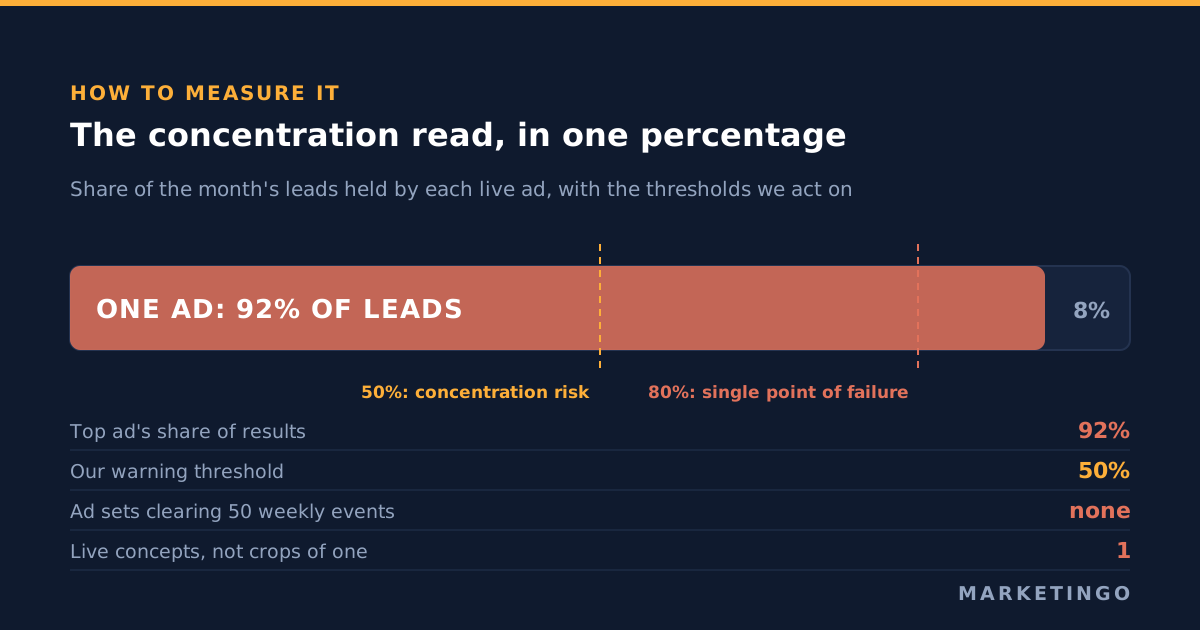
Two. Compute the top ad's share of results. Divide the best ad's results by the account's total for the window. This single percentage is the whole diagnosis.
Three. Set the thresholds before you see the number. Our rule: above 50% in one ad is concentration risk, and above 80% the account is a single point of failure nobody should touch without a replacement already live. The account above sat at 92%.
Four. Count the ad sets clearing the learning threshold. For each ad set, take its weekly count of the event you optimise toward. Ad sets sitting well under 50 a week are delivering blind, and creative tests inside them will not read cleanly whatever you do to the creative.
Five. Check the friction on the optimisation event. If it is a demo request behind a long form, or a purchase at a high price, the volume problem in step four is structural, and the fix is to optimise toward an earlier event that still correlates with revenue. Track that relationship with your own lead conversion rate rather than assuming it holds.
Six. Never switch the winner off first. Run the candidate alongside it, in the same ad set, until it has produced results in its own right. You give up some efficiency during the overlap and you buy the ability to survive the switch, which in the account above was worth about five weeks of lead volume.
A refresh cadence set by the calendar, where every ad is swapped on a schedule whether or not it is working, is the most common answer to all of this and the most expensive. It throws away winners on a timer and keeps the account permanently carrying ad sets that have just re-entered learning. Refresh against the readings above, not against a date.
Price the overlap in step six before you call it expensive. Put your cost per lead and your close rate into the lead generation return on investment calculator and weigh a few weeks of slightly worse efficiency against a month at 1.5 leads a day. The overlap wins every time we have run that comparison.
What actually prevents ad fatigue
Three structural things, and none of them is a schedule.
Audience size relative to ad spend. Fatigue occurs when a target audience is too small for the money pushed through it, so start with the arithmetic. Divide weekly spend by the audience you are actually reaching and compare it with a period when campaign performance was healthy. An account that doubled its budget without widening its targeting has bought a frequency problem, and no amount of new ad copy will undo it.
Several distinct concepts, rather than variations of your ad. Four crops of the same video are one idea in four files, and they tire together. Test a different angle and a different promise, and let the ad format follow the idea rather than the reverse. The point is not freshness. It is that two unrelated ideas rarely decline in the same week.
A permanent second place. The most reliable form of frequency management is an account that always has a challenger running against the incumbent inside the same ad set. It costs a little efficiency each week, it holds acquisition costs steady when the auction moves against you, and it removes the scenario this article describes.
What the recovery actually looked like
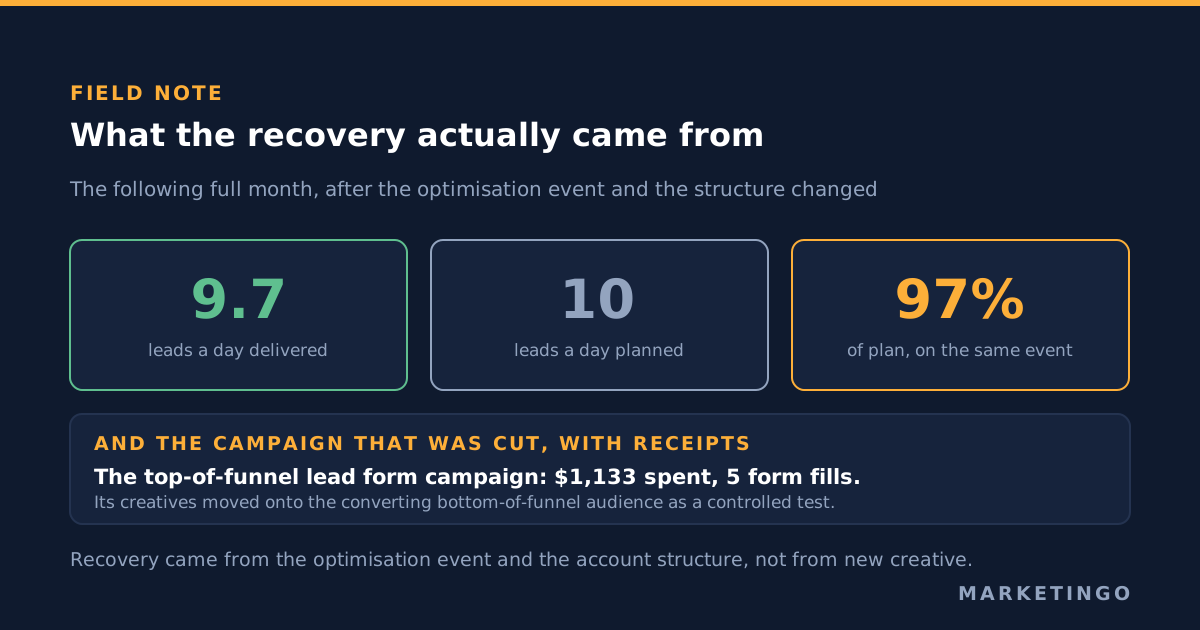
The account came back through restructure rather than a lucky creative. The following full month closed at 9.7 leads a day against a plan of 10, measured on the same event so the two months could be compared at all.
Two decisions did most of that work. The optimisation event moved to something the traffic would complete at volume, which let the ad sets accumulate enough weekly events to deliver on real data. And the account stopped funding what was not working: the top-of-funnel lead form campaign was shut down after $1,133 produced 5 form fills, its creatives moved onto the converting bottom-of-funnel audience as a controlled test rather than deleted. Killing a campaign with the receipts attached is easier to defend than killing it on instinct.
What we did not do is interesting too. We did not add a frequency cap, and we did not rotate creative on a schedule. Neither would have touched the actual failure.
The pattern repeats across the business-to-business software accounts we run, which is why the software and artificial intelligence industry page treats event selection as a structural decision rather than a tracking detail, and why the software case study leads on qualified volume.
When this does not apply
Four situations where the fatigue diagnosis is the right one and this read will mislead you.
A genuinely small audience. An account-based list of 400 companies, a single metro or a named customer file will saturate. Frequency climbs because impressions have nowhere else to go, and new creative is the only lever available.
A long, high-commitment purchase. Repeated exposure to the same message is often doing the work rather than wasting it. Rising frequency with a stable cost per result is not a problem.
Creative with a real expiry date. A seasonal offer or a launch asset stops working because the thing it describes is over. That is neither fatigue nor concentration.
An account with several live winners where one declines. If no ad holds more than a third of your results and one of them tails off, you are watching ordinary rotation. Replace it and move on.
One failure mode mimics both and is neither: delivery problems caused by the account's own plumbing. Before accepting a creative explanation for a drop, rule out the mechanical causes, including the policy and catalogue issues in why Meta keeps rejecting catalogue ads.
Get a second read before you switch the winner off
If one ad is carrying your account, the expensive moment is not today. It is the day somebody pauses it, and by then the options have run out.
We run Meta Ads for business-to-business lead generation and for ecommerce, and the concentration read above is part of the free account review we do before any engagement starts. It covers the optimisation event, the learning status of every ad set and the result share of every live creative, and it comes back as a document you can act on with or without us. Request one through the free ad audit page.