Most Google Ads for SaaS accounts are asked to sell two different things to two different people through one conversion goal. A self-serve trial costs a visitor nothing and takes thirty seconds. An enterprise demo costs them a calendar slot and an internal conversation. Count both as one conversion and Google Ads will buy the cheap one every time, because that is what you told it to do.
This is a field note from a B2B SaaS account we ran for a document redaction and compliance software company. The headline numbers below are published in the matching case study; the account detail around them comes from our own weekly reporting.
The account we inherited
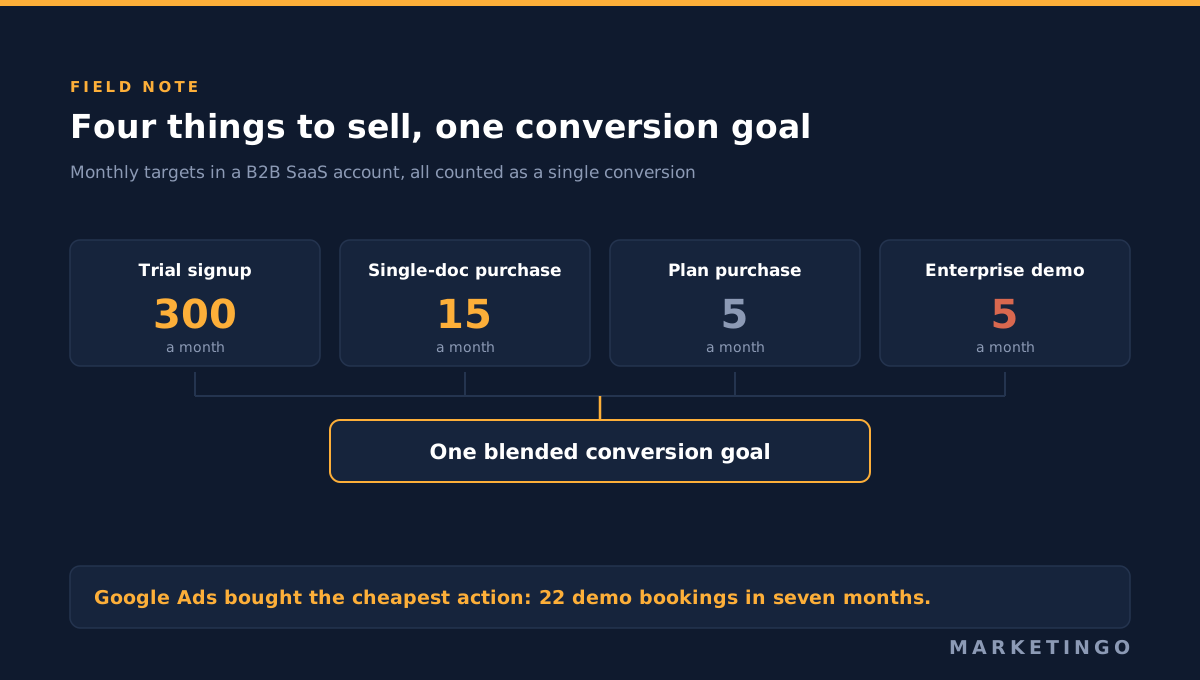
The product sold four ways: a free trial that converted into a subscription, a paid plan upgrade, a one-off single-document purchase, and an enterprise demo that went to a human sales call. The monthly targets at kickoff were 300 trial signups, 5 plan purchases, 15 single-document purchases and 5 demo bookings.
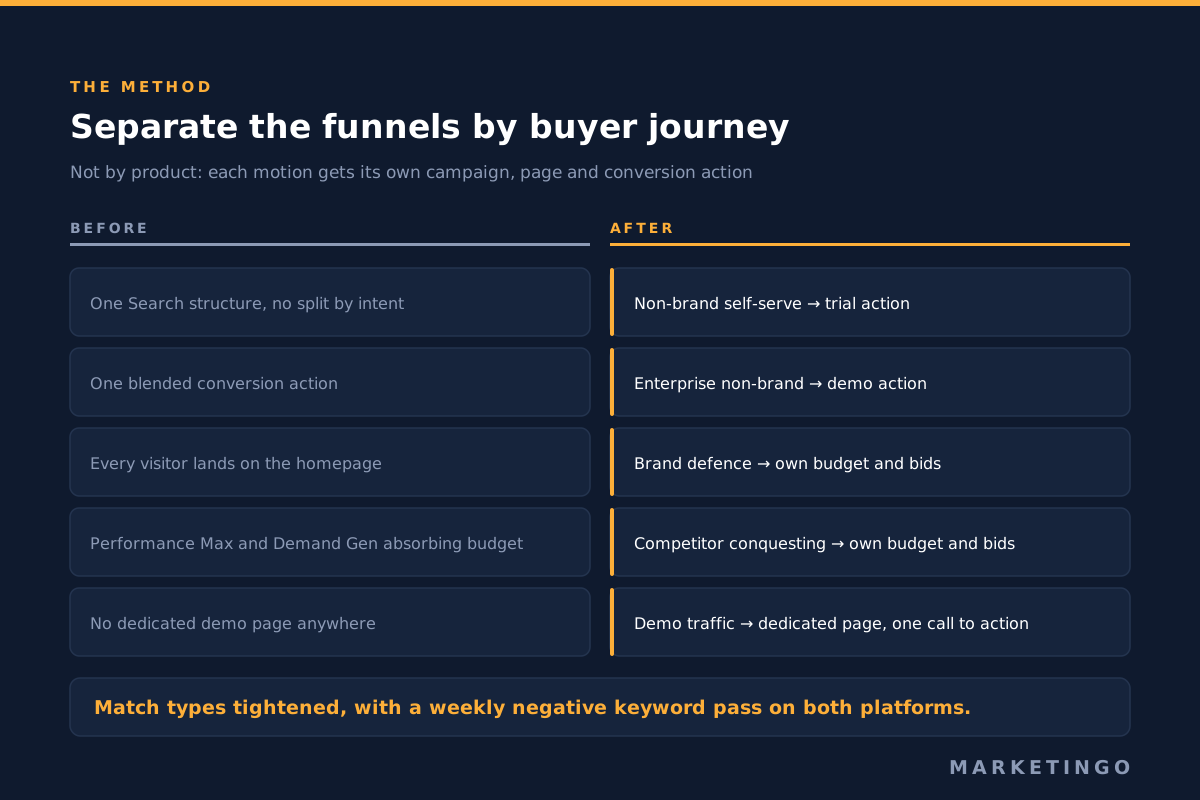
Three structural problems came with it. Every campaign reported into one blended conversion goal, so smart bidding could not tell a thirty-second trial signup from an enterprise demo request. All traffic landed on the same homepage, demo seekers and trial seekers alike, with no dedicated demo page anywhere on the site. And the budget was spread across Performance Max, Demand Gen and YouTube, formats that were not converting for either audience.
The company had previously spent $30,000 to $50,000 a month on a different channel mix with no reliable conversion tracking. By the time we took it on, spend was already cut back to roughly $11,000 a month across Google Ads and Microsoft Ads and conversion costs were still going the wrong way.
What a cold demo campaign actually buys
Before changing the structure we priced the existing demo-capture effort honestly, campaign by campaign, over the seven months of history in the account.
Competitor conquesting built to capture demo requests had spent about $3,300 for 247 clicks and produced almost no demos. On the Microsoft side, the enterprise demo effort took 1,001 clicks to produce 3 conversions. Across the whole period, all the cold demo activity in both accounts together had produced 22 demo bookings.
That is the number worth sitting with. Seven months of expensive demand capture aimed at booking sales calls, and the output was roughly three bookings a month. Cold search traffic will click an ad about enterprise document security. It will not, in the same session, hand a calendar slot to a vendor it met ninety seconds ago.
The obvious conclusion is that demo campaigns do not work for SaaS and the budget belongs in the trial funnel. That conclusion is half right, and the half that is wrong is the expensive half.
Why one conversion goal starves the expensive action
Google Ads optimises toward the conversion you count. When four actions of wildly different value all count as one conversion, the algorithm solves the problem you actually set it: produce the largest number of conversions for the budget. A trial signup at $27 beats a demo booking at several hundred dollars on that maths every single time.
So the account drifted. Budget flowed to the cheapest action, the trial funnel absorbed it, and the demo funnel was left competing for impressions inside campaigns whose bids were set by trial economics. The demo funnel was not failing because enterprise buyers will not convert from paid search. It was failing because nothing in the account was buying enterprise buyers on purpose.
That distinction decides what you do next. If cold traffic simply cannot book demos, you stop trying. If the demo funnel was never given its own budget, its own bid logic and its own page, you have not tested it yet.
The method: two funnels, two conversion goals
What we built is the method the case study names: separate the funnels by buyer journey rather than by product. Six steps, in the order we ran them.
1. Split the conversion actions first. Trial signups, plan purchases, single-document purchases and demo bookings became four distinct conversion actions with four distinct values, not one blended goal. Nothing else on this list works until the account can tell them apart, which is why conversion tracking comes before structure in any Google Ads rebuild.
2. Rebuild Google Search around intent. Four campaign groups, each with its own budget and bidding logic: non-brand self-serve for trial intent, enterprise non-brand for demo intent, brand defence, and competitor conquesting. Match types were tightened in the same pass, exact and phrase for proven converters and broad only where the signals supported it, with a weekly negative keyword pruning habit to stop trial-intent queries bleeding into the enterprise budget. Each group now has one job and one conversion action to answer for.
3. Build the demo funnel a page of its own. The dedicated demo landing page with a single call to action replaced the shared homepage funnel, and the ad copy was rewritten across both platforms at the same time so that the promise in the ad matched the page it opened. Asking enterprise traffic to find the demo form on a page designed to start free trials was costing more than any bid adjustment could recover.
4. Buy the enterprise audience deliberately. Inside Microsoft Search we added LinkedIn profile bid adjustments to bid up on the industries that actually buy compliance software: legal, government, healthcare, and banking and financial services. Microsoft is the platform that exposes that targeting, which is one of several reasons it earns its place in B2B accounts.
5. Stop paying full price for cold traffic twice. Remarketing lists for search ads and Display remarketing on Google, plus Microsoft remarketing and audience bid adjustments, gave the account a way to return to someone who had already read the product page rather than bidding on a stranger again.
6. Cut the formats that were not converting for either funnel. Performance Max targeting was tightened and Demand Gen prospecting was paused, because it was pulling in low-intent traffic that counted as neither a trial nor a demo.
What six months of that looked like
Comparing the first half of 2026 against the second half of 2025, with the budget essentially flat:
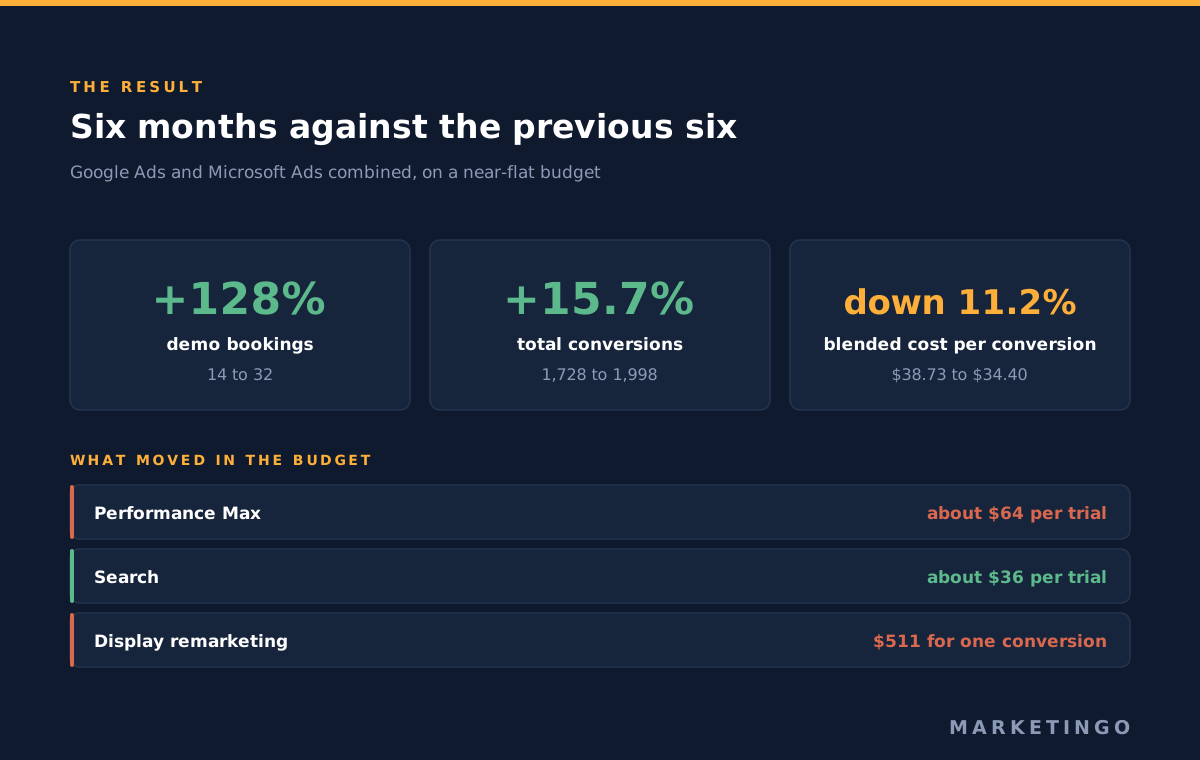
- Demo bookings went from 14 to 32, up 128% across both platforms.
- Total conversions went from 1,728 to 1,998, up 15.7%, on 2.7% more spend.
- Blended cost per conversion fell from $38.73 to $34.40, down 11.2%.
Demo bookings more than doubled in the same six months that we concluded cold demo campaigns were a poor buy. Both things are true. The cold conquesting campaign was a bad way to buy a demo; a dedicated enterprise funnel with its own page and its own conversion action was a good one.
The trial funnel held up alongside it rather than being traded away. In later months the account closed at 304 trial signups against the 300 target, with 5 of 5 demo bookings and 30 single-document plans against a target of 15, then 290 of 300 trials, 4 of 5 demos and 9 plan purchases against a target of 5. One representative week ran $3,652 in spend for 94 trials at $38.86 each, down from $42.09 the week before.
The budget that moved, and where it went
The reallocation is less dramatic than it sounds in a case study, and the detail is the useful part.
Performance Max spent about $255 across a fortnight to produce 4 trials, roughly $64 each, against about $36 per trial on Search in the same period, including one weekend of 6,000 impressions and zero conversions. Display remarketing had spent $511 since the previous month for a single conversion. Neither was a catastrophe alone. Together with Demand Gen prospecting they were absorbing budget the enterprise funnel did not have.
Worth saying plainly: we did not find this by reading the platform's own suggestions. The recommendations we were handed at the time pointed at campaigns that were already at zero spend, and the Performance Max cost per trial was not among them, which is a pattern we have written about when auditing a platform rep's advice.
When splitting the funnels is the wrong call
This method has a floor, and below it the split makes the account worse rather than better.
The first condition is volume. Four conversion actions across four campaign groups means dividing your data four ways, and smart bidding needs enough conversions in each to learn. Most B2B SaaS companies clear that bar on the trial funnel long before they clear it on the enterprise one. An account producing fifteen conversions a month in total should stay consolidated until it is not, whatever its ad spend looks like. The same caution applies to geography and match type: you can only subdivide an account as far as its conversion volume will carry.
Where you read the result matters too. A trial signup can be scored in the ad platform the same day. An enterprise SaaS demo cannot, because the B2B buyer behind it moves on a sales cycle measured in weeks and the outcome lands in the CRM. Feed closed-won data from the CRM back to Google Ads, or wait the cycle out before concluding the enterprise funnel failed.
The second is that the expensive funnel has to be a real funnel. Without a dedicated page, sales capacity to take the calls and someone who follows up the same day, a demo campaign with its own budget produces bookings nobody works.
The third is that this fixes measurement, not demand. If nobody is searching the category, separating conversion goals changes nothing.
One honest limit on the numbers above: they are a six-month before-and-after on a live account, not a controlled experiment. Several things changed at once, by design, because the account needed fixing rather than studying. Where the volume has allowed a single variable to be isolated we have done it, as with the landing page test we refused to call early.
How to check this on your own account
If you are already running Google Ads against both a trial and a sales-led motion, four readings will tell you whether the account is buying both. None of them takes long.
Open your conversion actions and count how many distinct actions report into the goal your bidding uses. If a free signup and a sales call share a goal, you have found the problem and nothing further needs diagnosing.
Then segment your last ninety days by conversion action and divide spend by each one separately. The cost per action for your expensive motion is the number that has been hiding. Compare it against what that motion is worth: our lead generation return calculator gets you there from close rate and deal value, and cost per lead covers how to set the ceiling.
Next, check which keywords sit in each ad group and where that ad group sends its traffic. Enterprise keywords pointing at a homepage built to start free trials are leaking, whatever their click-through rate says.
Last, rank your Google Ads campaigns by cost per conversion for the specific action each is supposed to produce, and look at the formats separately. Performance Max and Demand Gen rarely lose money loudly. They lose it at twice what Search pays for the same action while reporting a healthy total, which is why Performance Max deserves its own line in the review rather than sitting inside a blended average.
Get a second read on your account
If your account is running one conversion goal across a trial and a sales-led motion, the cost of that is measurable in an afternoon, and it is usually larger than it looks from the summary view. We do this read as a free ad audit: the conversion actions, the campaign structure against the funnels you actually sell, and the cost per action for each motion separately.
More on how we build a Google Ads strategy for SaaS companies is on our Google Ads management page and our B2B SaaS and AI page.