Almost every guide to retargeting ends the same way: install the tag, pick a window, write the ads. The window advice is always a round number with no reasoning attached, usually 30 days for an online store and 90 for a business-to-business account.
The number you type into Google Ads or Meta is a ceiling request, not a setting. Three separate limits sit between it and the person who will actually see your ads, and the one most articles discuss is the one that constrains you least.
What retargeting is, and how retargeting works
Retargeting is paid advertising aimed at people who have already been in contact with your business: they visited your website, watched a video, opened a lead form, or sit on a customer list you uploaded. A tag on your site records the visit, the advertising platform adds that person to an audience segment, and your campaigns then show ads to that segment rather than to a cold audience.
The mechanism has four steps, and each one can fail quietly.
- The tag fires. A tracking pixel or tag loads on the page. On Google this is the Google tag, on Meta the Meta Pixel, on LinkedIn the Insight Tag, on Microsoft the Universal Event Tracking tag. All four work the same way: a small piece of JavaScript that writes an identifier the platform can read later.
- The person enters a segment. The platform stores that identifier against a rule you wrote, such as "visited the pricing page in the last 30 days". Google's documentation says visitors are added within seconds of loading a page that carries the tag, that each new visit resets their membership clock, and that a newly created audience list can take 48 to 72 hours to fully populate (Google Ads Help).
- The segment becomes eligible. A segment below the platform's minimum size cannot serve, so nothing happens at all. More on that below, because this is where small accounts lose.
- The ads are served. Your campaigns target the segment across the places that platform sells: the Google Display Network and YouTube, Facebook and Instagram, the LinkedIn feed, the Microsoft search results.
Retargeting focuses the spend on people who already know you, which makes it a distribution decision rather than a creative one. It changes who sees your ads, and leaves the question of what those ads should say entirely open. That question gets its own section, because a returning visitor shown the same ad that failed the first time is a wasted impression with a higher cost attached.
The benefits of retargeting, and which benefit is a measurement artefact
The case for retargeting is simple arithmetic about attention. Most people who arrive on a website leave without making a purchase or filling in a form, and in online advertising that first visit is the expensive part. Retargeting is the cheapest way to get a second conversation with people who already showed interest in your business and then left your website, which is why it sits in almost every digital marketing strategy that has a budget attached.
The benefits of retargeting that hold up under examination:
- It reaches people with known intent. A cold display campaign guesses who the potential customers are, and most of that guess is wrong. A retargeting list does not have to guess, because the people on it visited your website and told you which pages they cared about.
- It costs less per conversion than acquisition. Not because the clicks are cheaper, but because the audience converts at a higher rate, so the same spend buys more outcomes.
- It lets you show specific ads instead of generic ones. A visitor who looked at one product can be shown that product. A visitor who read a pricing page can be shown proof. Display ads, Facebook ads and ads across the other social media platforms all support this, and catalogue formats automate it.
- It keeps your brand in front of a slow decision. For anything with a considered purchase, the business that is still visible in week three has an advantage over the one that spent everything on week one. Traditional advertising bought this with reach. Retargeting buys it with precision, at a fraction of the budget.
- It separates two jobs that need different ads. These are two types of campaigns with two different marketing goals. Awareness campaigns introduce you to strangers. Conversion campaigns close people who already know you. Running one creative across both wastes the budget twice, which is the most common structural mistake we see in accounts that have never split them.
Now the benefit that is mostly an artefact, and it matters because it drives real budget decisions. Retargeting campaigns almost always report the best cost per conversion and the best return in the account, and part of that is true while part of it is just credit assignment. The audience was already leaning towards a purchase, so a share of those conversions would have arrived with no retargeting ad served at all. The platform counts them anyway, because the ad was the last thing the person saw.
That does not make retargeting a bad use of money. It makes the reported figure the wrong number to budget from, and it is why the measurement section near the end of this article matters more than any tactical change you could make to the ads.
The two types of retargeting, and why they decay differently
There are two types of retargeting, and the difference between them is not the targeting. It is the shelf life of the data.
Pixel-based retargeting builds the audience from browser activity. Someone lands on your site, the retargeting pixels write an identifier to their browser, and that identifier is what your campaign targets. It needs no personal information from the visitor and it starts working the moment the tag goes live. It also depends entirely on storage that the browser controls and can erase.
List-based retargeting builds the audience from data you already hold: email addresses from your customer records, uploaded to the platform and matched against its own accounts. Google calls this Customer Match, Meta calls it a customer list custom audience. It survives any browser change, because nothing is stored in the browser at all, and it can reach people who never visited your website recently. It also needs a real list and a legal basis for uploading it.
Most accounts should run both. The honest division of labour: pixel-based retargeting catches current intent and loses it fast, while list-based retargeting holds a smaller, more valuable audience indefinitely. If your retargeting campaigns are entirely pixel-based, the audience you spent a year building is mostly gone, and the next section is the reason.
An example of retargeting, start to finish
The mechanics are easier to hold on to as one person's path through them.
A buyer searching for a product or service lands on a product page from a paid search click. She reads the specification, checks the delivery terms, and then leaves your website without making a purchase. Nothing unusual has happened: this is what the large majority of first visits look like, on every account we have ever opened.
As the page loaded, the tracking pixels on your site wrote an identifier into her browser and told the advertising platform which page she had seen. She is now on a retargeting list, specifically the one whose rule says "viewed a product page, did not purchase, last 14 days".
Your campaigns are already running against that list, so the platform begins to serve ads to past visitors like her: on platforms like Facebook and Instagram, inside the Google Display Network, on YouTube before a video, and as a bid adjustment the next time she searches a relevant term. Because the list is segmented by page, she sees your ads for the product she actually looked at rather than a generic brand message. Retargeting lets you make that distinction; a cold campaign cannot.
Eleven days later she clicks one of those display campaigns, returns to the product page with the delivery question already answered by the ad copy, and buys. Her purchase is attributed to the retargeting campaign, because that was the last ad she touched.
That last sentence is the one to sit with. It is a true description of the data and a misleading description of what happened, since the original paid search click did most of the work and the retargeting ad finished a job that was already most of the way done. Both things are true at once, which is exactly why retargeting looks so good in reports and why its reported return should never be the number you budget from.
The three numbers that set your retargeting window
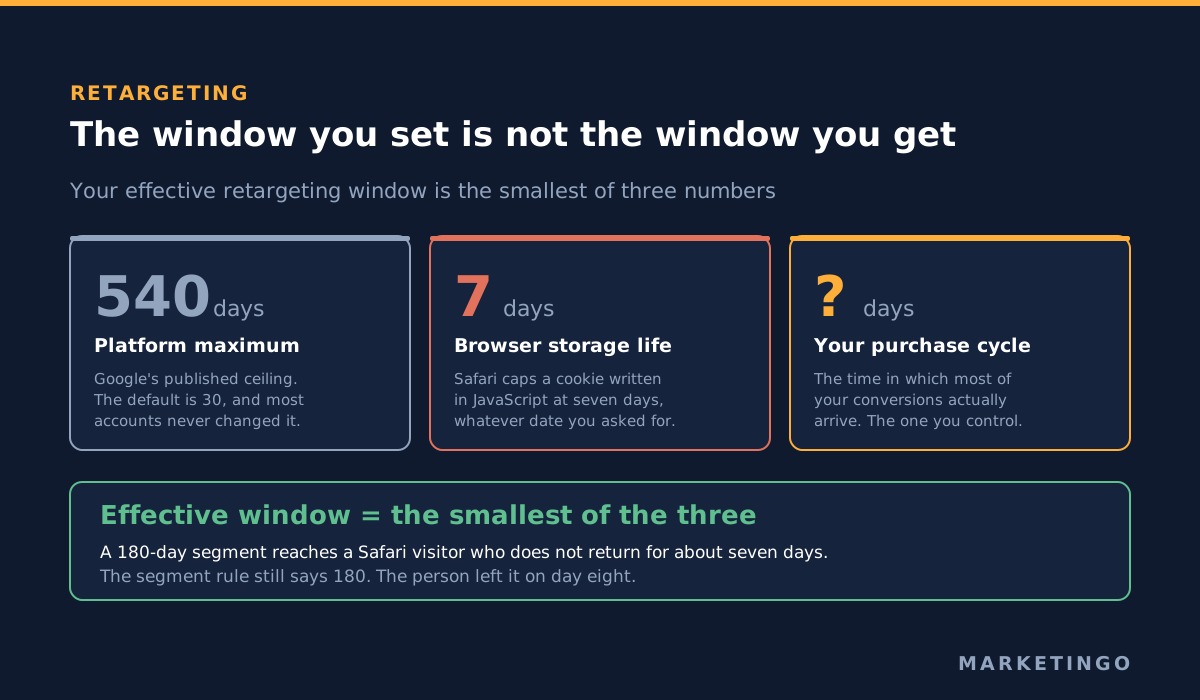
Your effective window is the smallest of three numbers.
The platform maximum: Google remarketing lists run to 540 days
Google Ads publishes its own limits. For both the Display Network and Google search, a data segment has a default membership duration of 30 days and a maximum of 540, and Google states plainly that if you set a duration longer than the maximum, "the visitor or user will be removed from the data segment at the maximum duration" (Google Ads Help). The same page notes that an open segment left unused in targeting for 540 days is closed automatically, and that for Google's own audience segments a user inactive for more than 18 months is removed.
Two practical consequences. First, the default is the number most accounts are running, because nobody changed it. Second, 540 days is far longer than any sane retargeting plan, so the platform maximum is almost never your real constraint. Meta, LinkedIn and Microsoft each publish their own maximums and each has moved them before, so read the current figure in that platform's help centre rather than trusting a number from an article, including this one.
The browser's storage life: seven days on Safari
This is the limit that quietly rewrites your plan, and it comes from Apple rather than from any advertising platform.
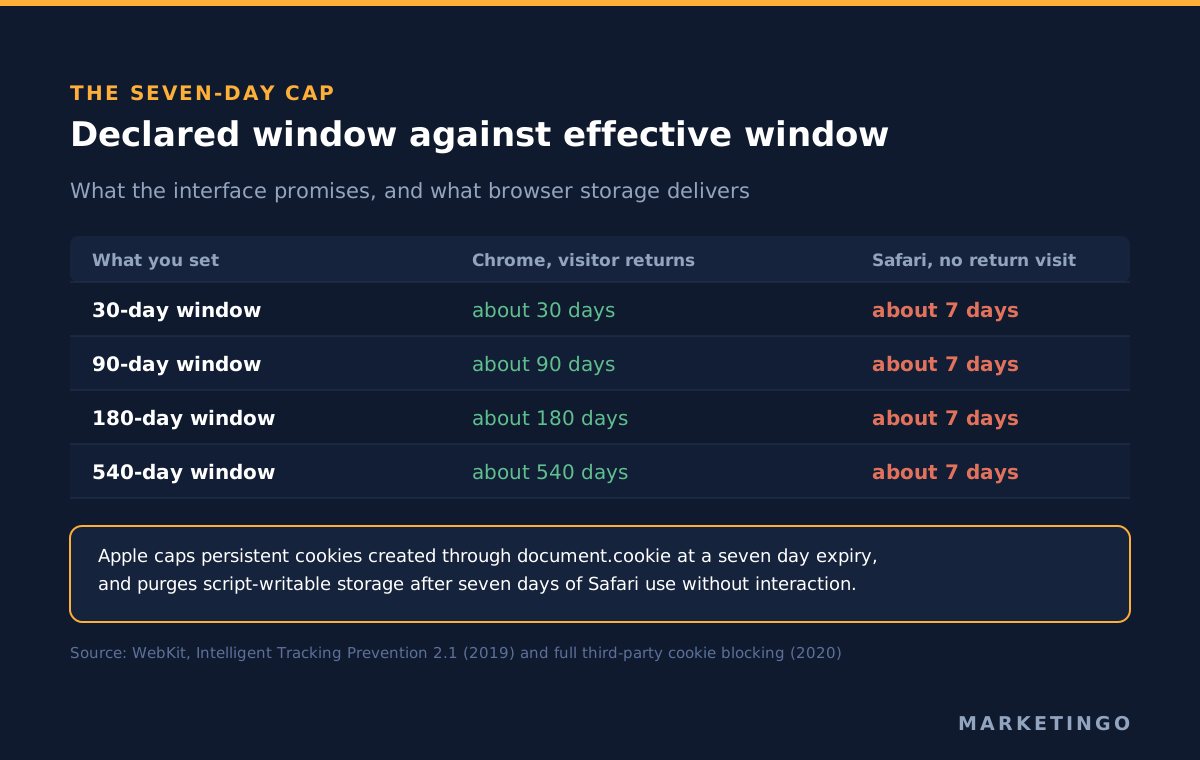
In February 2019, WebKit shipped Intelligent Tracking Prevention 2.1 with a section headed "Client-Side Cookies Capped to 7 Days of Storage". The wording is unambiguous: "all persistent client-side cookies, i.e. persistent cookies created through document.cookie, are capped to a seven day expiry" (WebKit). Cookies with a shorter expiry keep it. Session cookies are unaffected.
In March 2020, WebKit went further. Alongside blocking cookies for cross-site resources by default, it introduced a "7-Day Cap on All Script-Writeable Storage", deleting a site's script-writable storage after seven days of Safari use without user interaction on that site. The list of affected storage includes localStorage, sessionStorage, IndexedDB and service worker registrations (WebKit).
Read that against your 180-day retargeting window. For a visitor on Safari who does not come back, the identifier your tag wrote is gone in a week. The segment rule still says 180 days. The person stopped being in it on day eight.
| What you set | Chrome, visitor returns | Safari, visitor does not return |
|---|---|---|
| 30-day window | about 30 days | about 7 days |
| 90-day window | about 90 days | about 7 days |
| 180-day window | about 180 days | about 7 days |
| 540-day window | about 540 days | about 7 days |
Server-side tagging and the conversions interfaces each platform now publishes change part of this picture, because an identifier written in an HTTP response rather than in JavaScript is not the client-side cookie that cap applies to. That is a different piece of work with its own article: see the Meta Conversions API playbook for how the server-side path is actually built, and Google Ads conversion tracking for the measurement half.
The point for this article is narrower. If a meaningful share of your traffic arrives on Safari, and for consumer brands in the United States that share is substantial, then your long retargeting window is doing far less than the figure in the interface suggests, and you should stop planning around the figure.
The purchase cycle: the only one you control
The third number is the one nobody can set for you: how long it actually takes your buyers to decide.
For an online store selling a CA$40 consumable, that is days. For high-ticket business-to-business services with a procurement step, it is months. A window shorter than the purchase cycle drops people before they decide. A window longer than it fills the segment with people who already bought elsewhere, and you pay to show your ads to them.
The usable rule is to set the window to roughly the time in which most of your conversions arrive after the first visit, then tier inside it rather than treating everyone in the window the same way. Your analytics will give you that distribution, and it is almost never the round number in the guides. If you have never looked, that measurement is worth more than any change to the ads.
The 100-visitor floor, and the sites that never clear it
Before any of the window arithmetic matters, a retargeting list has to be big enough to serve at all, and this is the limit that stops small accounts cold.
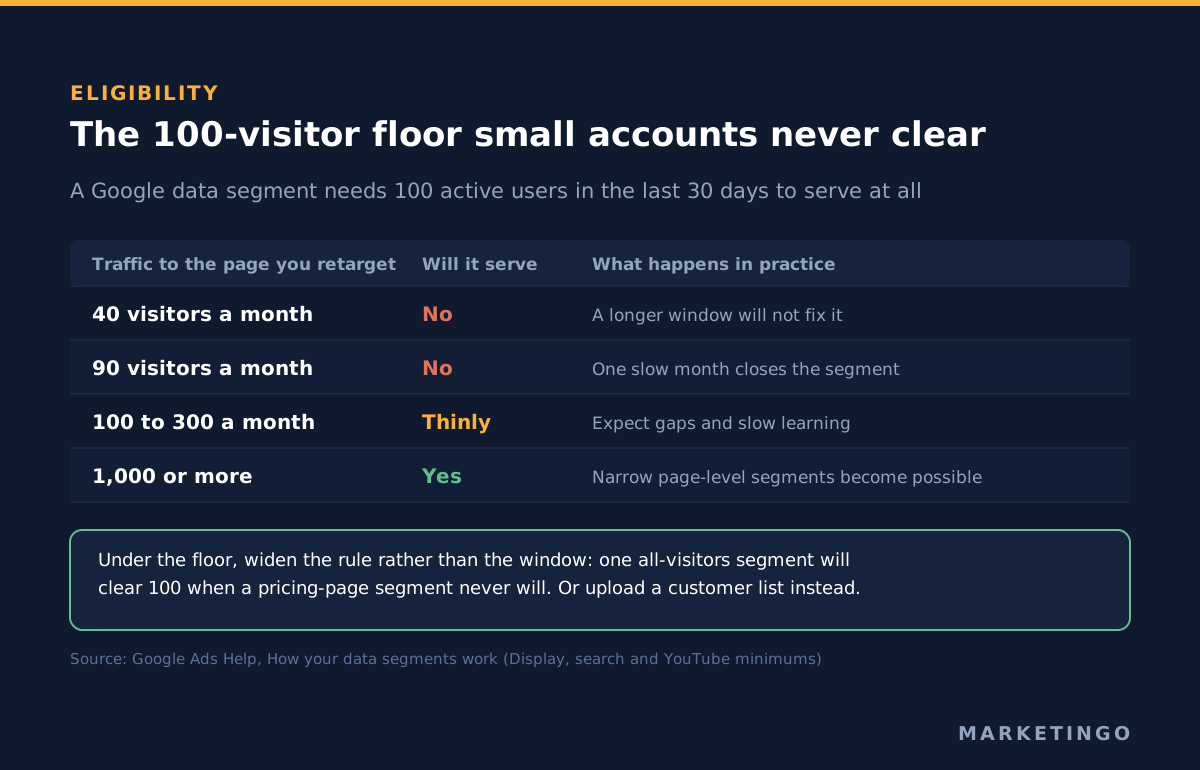
Google states the minimum for each network: a segment "must have a minimum of 100 active visitors or users within the last 30 days" to serve on the Display Network, and the same 100-user minimum applies on the Google search network and on YouTube. For uploaded customer lists the same 100-user requirement applies, but only to lists uploaded or refreshed after 1 February 2024; older lists must still clear the previous minimum of 1,000 matched users (Google Ads Help).
Note what the figure is counted against. It is 100 active users in the last 30 days, not 100 people inside your window. Stretching the window from 30 days to 180 does not help a page that gets 40 visitors a month clear the floor.
| Monthly visitors to the page you want to retarget | Will the segment serve |
|---|---|
| 40 | No, and a longer window will not fix it |
| 90 | No, not reliably: one slow month closes it |
| 100 to 300 | Yes, thinly: expect gaps and slow learning |
| 1,000 or more | Yes, and narrow segments become possible |
The practical answers when you are under the floor, in the order worth trying:
- Widen the rule, not the window. One segment for all site visitors will clear 100 when a pricing-page segment never will. Narrow segmentation is a luxury of traffic volume.
- Move to list-based retargeting. An uploaded customer list reaches people the pixel never held, and a business with 400 customers can target them even when its website traffic cannot fill a segment.
- Spend on the top of the funnel first. Retargeting works best on demand that already exists, and it cannot create demand it has no record of. If the site has 40 visitors a month, the problem is not the retargeting campaign, and a free ad audit will usually say so in the first ten minutes.
How to segment a retargeting list so the retargeting ads are relevant
Once the list is eligible, the work is segmentation. A single "all visitors, 30 days" segment is where most accounts stop and where most of the waste sits, because it treats a person who bounced off the homepage and a person who abandoned a full cart as the same potential customer.
Three cuts do most of the work.
By recency. Split the window into tiers: roughly days 0 to 3, days 4 to 14, and the remainder. Recent visitors are close to ready to buy and justify the highest bids and the most direct offer. Older visitors need a reason to return rather than a nudge to finish. Running one bid across a 90-day window overpays for the tail and underpays for the people who are about to convert.
By page depth. A visitor who reached the pricing page, the cart, or a product detail page showed interest in your business in a way that a blog reader did not. Build the deepest segments first, bid them highest, and let the shallow segments run cheaply or not at all.
By exclusion. This is the cut most often missing. Exclude people who already converted, unless you have a genuine repeat-purchase or upsell offer for them. Exclude existing customers from acquisition campaigns unless the offer is genuinely for them. Cap frequency so the same person does not see your ads twenty times in a week, which stops working and starts annoying: the mechanics are in ad fatigue and how to spot it.
What each segment should be shown follows from the cut. This is also where you create retargeting ads worth running. The cart abandoner needs the specific product and whatever removed the friction, usually delivery cost or a guarantee, and the arithmetic of how much that is worth is in cart abandonment rate. The pricing-page visitor in a long sales cycle needs proof, not a discount. The repeat buyer needs the next thing in the catalogue. Dynamic and catalogue formats do this product-by-product automatically, which is why they tend to outperform a single static creative on an online store with real inventory.
One honest limit on personalization: you can personalize by behaviour, not by identity. The platforms will not tell you who the person is, and attempting to look as though you know is the fastest way to make retargeting ads feel invasive rather than useful.
How to retarget on Google Ads, Meta, LinkedIn and Microsoft
The concept is common to every platform. The implementation, the naming and the inventory are not.
Google Ads. Audience segments built from the Google tag can be targeted across the Google Display Network, YouTube, Gmail, Discovery and, as a bid adjustment, on paid search. Search retargeting is the underrated one: showing a returning visitor a different ad, or bidding more for them, when they search a relevant term again. Google has also renamed this area, from remarketing lists to "your data" segments, in the same spirit as the rename of the platform itself, formerly Google AdWords, so an older guide and the current interface will not use the same words. Our own view of how the Google side should be built sits in Google Ads management.
Meta. Website custom audiences built from the Meta Pixel, plus customer lists, video viewers and form openers. Catalogue campaigns turn the audience into product-level retargeting ads automatically, which is the format that returns the most for the least work on an online store. Facebook retargeting and Instagram placements come from the same audience, so treat them as one decision about Meta advertising rather than two.
LinkedIn Ads. Website retargeting from the Insight Tag, plus retargeting by engagement with a previous ad, a lead form or a company page. LinkedIn's minimum audience sizes are higher than Google's in practice and its traffic volumes are lower, so a business-to-business account usually needs a site-wide segment rather than a page-level one. Details of how we use it are on LinkedIn Ads.
Microsoft Ads. Remarketing lists from the Universal Event Tracking tag, usable as bid adjustments on Microsoft search and across its audience network. The audience is smaller and the cost per click is usually lower, which makes it one of the better places to run a retargeting campaign cheaply: see Microsoft Ads.
A note on scope, because the terms get mixed. Email retargeting, personalized emails triggered by browsing behaviour, and the marketing automation that fires them are a different discipline with a different tool set, and they are not paid media. They work well alongside retargeting campaigns and they are not a substitute for them. MarketinGO runs the paid side only, across those four advertising platforms, usually as part of a full-funnel strategy rather than as one of a dozen isolated marketing tactics. Social media retargeting and search retargeting are two halves of the same audience, not two separate plans.
On a roughly 40,000-product dental supplies catalogue we manage, the Meta programme was built on catalogue campaigns with dynamic prospecting seeded from the products Google Ads had already proven, plus several remarketing audiences targeting people at different stages who had not yet bought. Return on ad spend on that channel moved from 1.72 to 9.53 while monthly spend rose from about CA$1,500 to about CA$8,300, and purchases went from 23 to 433 (case study). The retargeting audiences were a component of that, not the whole of it, which is the honest way to describe any retargeting result.
The cookie deprecation that did not happen, and the replacement that was retired
Any article on retargeting written between 2020 and 2024 told you that third-party cookies were about to disappear from Chrome and that retargeting as practised would end with them. A great many still say it. Two official announcements have made that wrong, and both are worth knowing because they change what you should be building.
In April 2025, Google said it had "made the decision to maintain our current approach to offering users third-party cookie choice in Chrome" and that it would not roll out a new standalone prompt for third-party cookies (Privacy Sandbox). Third-party cookies are not being removed from Chrome.
In October 2025, Google went further and announced it had "decided to retire the following Privacy Sandbox technologies", a list that includes Protected Audience, Topics, the Attribution Reporting API, Private Aggregation, Protected App Signals and Related Website Sets (Privacy Sandbox). Protected Audience was the retargeting-specific replacement. It is being retired before it ever carried meaningful spend.
So the deadline moved and the replacement went away. What did not change is the Safari cap, which has been in force since 2019 and never depended on Chrome at all. The lesson for a marketer planning a retargeting strategy is to stop waiting for a cookie deadline and start reducing the dependency on browser storage: first-party data you actually own, uploaded customer lists, server-side event delivery, and a window set from your real purchase cycle rather than from a guess.
When retargeting is the wrong place for the money
Retargeting has the best-looking numbers in most accounts and that is partly an artefact. A few situations where more of it is the wrong call.
- Traffic below the floor. Covered above. Under roughly 100 relevant visitors a month, the segment barely serves and the spend belongs at the top of the funnel.
- Very long buying cycles with few buyers. If 2% of a business-to-business audience will ever buy, a broad retargeting list is 98% people you are paying to reach for no reason. Narrow by page depth and by firm, or move the budget to list-based retargeting against accounts you have chosen deliberately.
- Branded search overlap. Retargeting a visitor who was going to type your name into Google anyway buys a click you already had. This is the same measurement trap as bidding on your own brand term.
- Thin inventory or one product. Without a catalogue there is little to personalize, and a single creative shown repeatedly hits fatigue quickly.
- Nothing wrong with the first visit. If the landing page converts at a fifth of what it should, retargeting pays twice for the same broken page. Fix the page first: landing page A/B testing is the cheaper experiment.
How to measure a retargeting campaign without flattering it
Last-click reporting makes retargeting look extraordinary, because by construction the audience was already interested. The platform happily takes credit for conversions that were going to happen.
Three habits keep the number honest.
Hold out a share of the audience. The cleanest test available to most accounts: exclude a random portion of the retargeting segment, run for long enough to accumulate conversions, and compare. If the holdout converts at nearly the same rate, you were paying for conversions you already had. The method is in incrementality testing for paid media.
Know which attribution model you are reading. Credit assignment changes the apparent return on investment of a retargeting campaign more than any bid change will, and the models available have narrowed: Google Ads attribution models covers what remains and what was removed.
Judge it against the business, not the platform. Measure the account against break-even, not against the retargeting campaign's own return on ad spend. For an online store that means break-even return on ad spend and the ecommerce return on ad spend calculator. For lead generation it means cost per qualified lead and the lead generation return on investment calculator. A retargeting campaign reporting 12 times return while the blended account sits under break-even is not a success, it is a reporting artefact.
Where to go next with your own account
If you run paid media for an online store, the fastest wins are usually catalogue-based retargeting ads segmented by recency and page depth, with converters excluded, measured against break-even rather than against platform-reported return. That is the pattern behind most of the work on our ecommerce and direct-to-consumer accounts.
If you sell high-ticket services with a long cycle, the wins come from list-based retargeting against chosen accounts, a window matched to the real sales cycle, and proof rather than discounts in the creative. That is how we run high-ticket business-to-business programmes.
Either way, the first thing worth checking is the one at the top of this article: what your current window is set to, whether anyone chose it, and whether the segments are actually serving. A free ad audit covers that, plus the exclusions and the measurement, and it tells you which of the two problems you have before you spend anything on fixing the wrong one.